
Children of Silentown rewards patience, sharp observation, and careful listening more than speed. The best way to survive your first playthrough is to inspect every hotspot, keep track of who knows what, craft songs as soon as new ideas appear, and avoid spending rare items until the game clearly asks for them. Lucy’s journey is a hand-drawn point-and-click adventure, not a combat game, so progress comes from connecting clues, reading character behavior, and making choices you can live with.
These 10 essential Children of Silentown tips and tricks for new players focus on the mechanics that quietly decide whether a puzzle feels clever or completely opaque. They also help you protect your save, understand Roach’s role, and reach the later chapters without missing the details that make Silentown such an effective horror story.
If you enjoy methodical adventure games, Steamoz’s guides to making every run count and planning ahead in slower games cover similar habits, but Silentown demands an even closer eye.
1. Inspect every hotspot before leaving an area
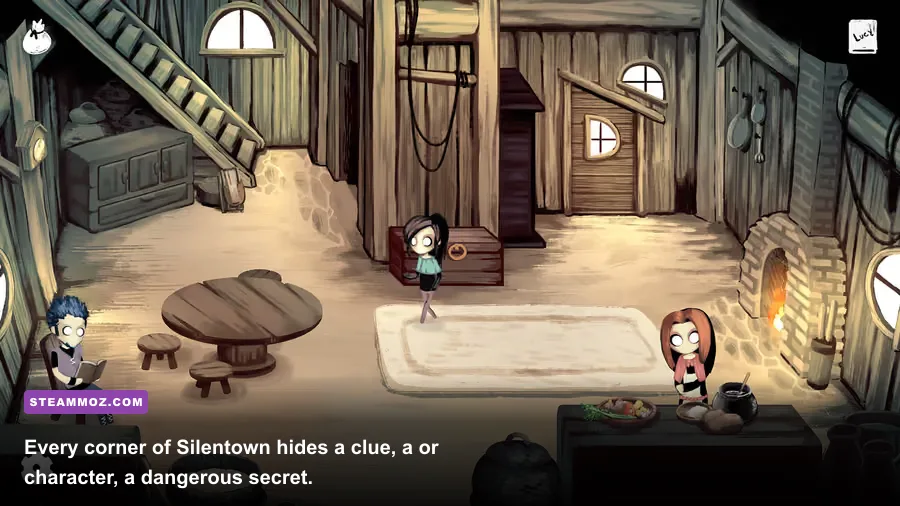
Silentown is built around small environmental observations. A door, pile of junk, tree, window, animal, or background object may look decorative, but many of these hotspots contribute to Lucy’s understanding of a location. Click on everything you can reach before moving to the next screen. The game often separates an item you can collect from a detail you merely observe, and both can matter later.
Pay particular attention to repeated visual motifs: scratches, unusual stains, locked entrances, missing tools, and anything that looks out of place against the otherwise muted scenery. Lucy’s comments are not filler. If she reacts to an object, read the line carefully and remember its wording. The game frequently turns an early observation into a later puzzle clue without placing a bright quest marker on it.
Use a simple mental rule: don’t leave an area until you have checked the foreground, the background, and every character twice. Some interactions become available only after a conversation, a story event, or a newly learned song.

🎮 Children of Silentown
Looking to experience this game? Grab your digital key directly on our store for $5.99.
View on Steammoz Store →2. Talk to everyone, then revisit them after major events

Dialogue is one of your main investigation tools. Speak to every available resident, even when their first conversation appears unrelated to Lucy’s immediate problem. Silentown’s characters often reveal information indirectly through evasive answers, nervous reactions, or oddly specific memories. Their tone can be as valuable as the literal clue.
When a chapter changes the situation, return to the town and check familiar characters again. A person who had nothing useful to say before may now offer a new line, item, or interaction. This is especially important when someone has mentioned the forest, a disappearance, a forbidden subject, or a personal fear. The town’s silence is not just atmosphere; it is a social system that Lucy has to decode.
Don’t skip dialogue because you think you already understand a character. The game uses small changes in wording to signal new information. If you’re unsure whether a conversation has advanced, walk away, inspect another object, and come back. That short reset often refreshes the available interaction.
3. Treat songs as tools, not collectibles
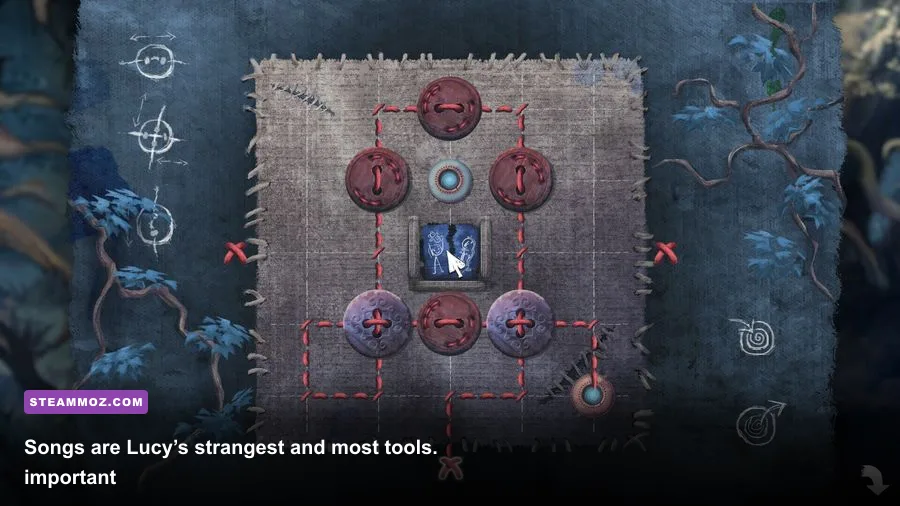
Lucy’s songs are among the most distinctive mechanics in Children of Silentown. They are not merely story rewards or optional collectibles. Songs can expose memories, influence characters, reveal hidden thoughts, and open routes through puzzles that ordinary item combinations cannot solve.
Whenever Lucy learns a new song or gains a new piece of musical knowledge, test it in the places where the subject matter seems relevant. A song connected to fear, memory, or a particular person may work on a character or object that previously gave you no useful response. The game expects thematic reasoning rather than a traditional inventory recipe.
Keep your song options in mind while exploring. If a character is clearly hiding something, a song may be more useful than another round of questioning. If an object seems connected to a past event, think about which song could draw out its story. This is why reading every line matters: the game gives you the vocabulary needed to decide when a song fits.
Do not randomly test every song on every hotspot. That creates noise and makes the logic harder to follow. Start with the strongest narrative connection, then broaden your search if nothing changes.
4. Use Roach whenever a puzzle involves reach or distraction

Roach, Lucy’s cat, is not just a charming sidekick. His presence changes how you approach several environmental puzzles. Whenever an object is too high, too distant, hidden behind a barrier, or difficult for Lucy to reach safely, check whether Roach can interact with the space.
Roach can also function as a distraction or a way to draw attention away from Lucy. If a scene seems to require perfect timing around a person, animal, or threat, look for a way to use the cat before trying to force Lucy through it. The game usually communicates this possibility through the environment: a narrow opening, a reachable ledge, a tempting object, or a character who reacts strongly to animals.
Here is a useful decision table for the game’s major puzzle tools:
| Tool | Best First Use | What It Usually Signals | Common Mistake |
|---|---|---|---|
| Lucy’s observation | Unusual objects and environmental details | A clue, memory, or future interaction | Leaving before exhausting hotspots |
| Dialogue | Residents with changing behavior | Social clues and story progression | Assuming one conversation is final |
| Songs | Fear, memory, or emotionally charged scenes | Hidden thoughts or story information | Using them randomly without a theme |
| Roach | High, narrow, distant, or guarded areas | A route or distraction puzzle | Ignoring environmental access points |
| Inventory items | Blocked paths and physical obstacles | A multi-step combination puzzle | Combining everything blindly |
5. Don’t combine items randomly
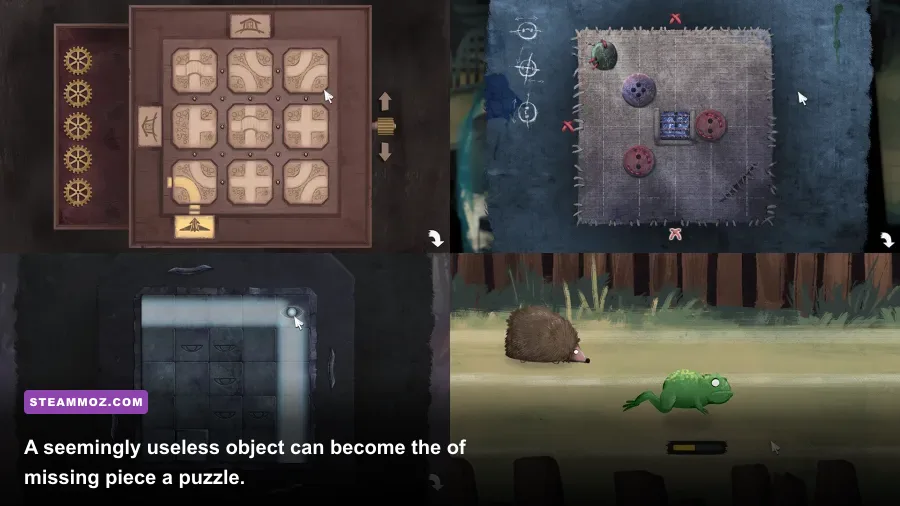
Inventory puzzles are designed around context. If you collect two objects that look vaguely compatible, that doesn’t mean the game expects you to combine them immediately. Before experimenting, ask what practical problem each item solves. A tool may repair something, create access, distract a character, or alter an object’s condition rather than directly opening a door.
Read Lucy’s descriptions and examine items more than once. The wording often tells you whether an object is flexible, fragile, sharp, noisy, or connected to a specific person. Those adjectives are functional hints. If an item has a clear owner or location, try returning it to that context before attempting unusual combinations.
When a combination fails, don’t assume you missed the recipe. Sometimes the correct solution is to use one item on the environment first, triggering a change that makes the second item useful. Adventure games love this two-step structure, and Silentown often hides it behind a tiny visual change.
For comparison, Silentown’s item logic is closer to a classic mystery adventure than a loot-driven RPG. Steamoz’s guide to testing tools without wasting attempts uses a different genre, but the same principle applies: experiment with a reason, not out of panic.
6. Save before choices, risky exploration, and chapter transitions

Make manual saves regularly, especially before major conversations and moments when Lucy enters a new area. The game’s decisions can affect scenes, character relationships, and the way you interpret the story. A second save lets you explore an alternative response without replaying an entire chapter.
Create separate slots rather than overwriting one file. A practical rotation is a general progress save, a pre-choice save, and a recent-area save. Keep the pre-choice file until you are certain you’re happy with the result. Horror adventures are much more enjoyable when you can investigate consequences instead of worrying that one click permanently erased your preferred route.
Save before entering locations that feel noticeably more threatening. The visual language is clear once you learn it: tighter framing, heavier shadows, unsettling sound design, or a sudden lack of ambient activity usually means the game is preparing a tense sequence. These moments are not built around traditional combat stats, so your safety comes from awareness and the ability to retry an interaction.
7. Read the environment as a puzzle language
Children of Silentown rarely gives you a big objective arrow. Instead, it establishes visual relationships. A locked door near a missing key, a damaged object beside a repairable tool, or a character staring at one specific landmark is the game quietly presenting a problem.
Train yourself to compare objects within the same screen. Ask what has been placed together and why. The art direction uses contrast deliberately: a bright item against a dark background, a clean mark in a dirty room, or a new object in an otherwise familiar location deserves attention.
Sound matters, too. Strange noises can point toward an interaction, while silence can indicate that a character is withholding information. Play with headphones if possible, but don’t treat audio as a reaction test. It is primarily an investigation clue and a way to identify when the atmosphere has shifted.
8. Approach nightmare sequences slowly
When the game moves from ordinary village exploration into its more disturbing sequences, rushing is usually the worst response. Watch the screen before clicking. Look for safe routes, repeating movement patterns, and objects that can interrupt the danger. These scenes are about reading telegraphs and understanding the space, not winning a conventional fight.
If Lucy appears trapped, search for an interaction that changes the scene rather than repeatedly clicking the exit. The correct answer may be a song, a nearby environmental object, or Roach. Keep the cursor moving methodically across the scene, but don’t spam every hotspot at once; doing so can bury the important response under repeated flavor text.
Use the following progression priorities when a chapter opens a new area:
| Priority | Action | Why It Matters | Best Habit |
|---|---|---|---|
| 1 | Inspect the entire screen | Reveals clues and available routes | Check foreground and background objects |
| 2 | Talk to every accessible character | Updates social and story information | Return after major discoveries |
| 3 | Review songs and inventory | Identifies newly usable solutions | Match tools to narrative themes |
| 4 | Test Roach’s possible routes | Finds access and distraction options | Look for ledges, gaps, and objects |
| 5 | Save before committing | Protects choices and progress | Use multiple manual save slots |
9. Keep a clue notebook outside the game
Silentown’s mysteries stretch across locations and chapters, so a small real-world notebook can save you from repeated backtracking. Record names, suspicious statements, locked locations, song themes, and objects that Lucy describes as belonging to someone else.
Write down relationships rather than only item names. “Mack avoids the forest” is more useful than “Mack mentioned forest.” “This symbol appeared near the disappearance” gives you a connection to test later. The game’s strongest puzzles are often solved by remembering why a detail felt strange, not by finding a single obvious key.
Don’t worry about documenting every line. Focus on contradictions, repeated phrases, and anything a character refuses to explain. Those are the clues most likely to become important later.
10. Let the first playthrough stay imperfect
The temptation to reload every uncomfortable decision is understandable, but it can flatten the tension that makes Children of Silentown work. Lucy is navigating a town built on fear and denial; uncertainty is part of the experience. If a choice feels morally complicated, allow yourself to see what follows before immediately chasing a perfect result.
That doesn’t mean you should accept technical frustration or lose hours of progress. Save sensibly, protect important decision points, and reload when you genuinely made an accidental click. But don’t treat the game like a checklist where every dialogue option must be optimized on the first attempt.
For a second run, use your notes to pursue missed interactions, alternate choices, and details you overlooked. The story lands harder when you already understand the town’s rules, because you can spot the moments when characters break them.
A smart first-playthrough routine
Children of Silentown becomes far less frustrating when you follow a repeatable loop: enter an area, inspect every hotspot, speak with every character, review your songs, test Roach’s access, and only then use inventory items. Save before a major decision or unsettling transition. If you hit a wall, don’t mash through the scene; revisit the dialogue and look for a thematic connection between the clue and the tool you’re trying to use.
The official Children of Silentown Steam page is the best place to check current platform information, while the developer’s official game page offers more background on Lucy’s world. You can also browse Daedalic Entertainment’s Steam catalog if you want another atmospheric adventure after the credits.
Most importantly, pay attention to what Silentown refuses to say out loud. Its puzzles, characters, songs, and ominous forest all point toward the same lesson: the town’s secrets are solved by connecting details, not by finding one magic item. Stay observant, keep your saves clean, and your first journey with Lucy will feel tense, coherent, and genuinely memorable.