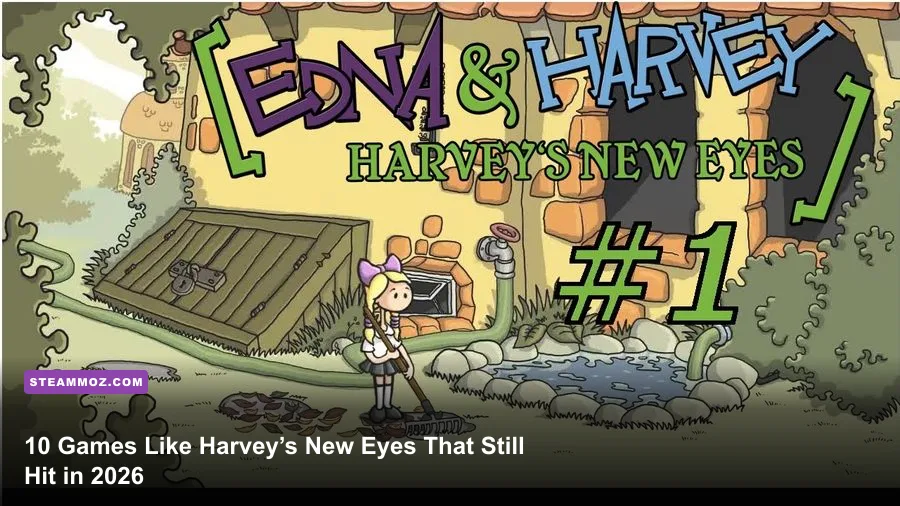
If you’re hunting for the best games like Edna & Harvey: Harvey’s New Eyes in 2026, start with Deponia, Fran Bow, The Whispered World, Machinarium, and Kathy Rain. They all understand the magic of Daedalic’s cult classic: hand-drawn worlds, cruelly funny writing, strange inventory puzzles, and protagonists trapped inside stories that are much darker than their art style suggests.
Harvey’s New Eyes is unusually difficult to replace because its appeal isn’t just “point at objects until the puzzle works.” Lilli’s forced obedience, the boarding school’s escalating absurdity, and the game’s wonderfully nasty narrator create a very specific flavor of adventure comedy. The recommendations below are ranked by how closely they reproduce that combination of surreal humor, visual personality, puzzle logic, and emotional unease. Some are funnier, some are scarier, and a few are better designed, but all are excellent follow-ups for anyone who finished Lilli’s story and still wants something gloriously odd.
S-Tier games for Harvey’s New Eyes fans

These are the closest matches, whether you want Daedalic’s signature comedy, the same hand-painted European adventure aesthetic, or a protagonist pushed through an increasingly ridiculous nightmare. If you only have time for two games, pick Deponia for comedy and Fran Bow for the unsettling side of Lilli’s journey.
| Game | Tier | Closest Match | Best For |
|---|---|---|---|
| Deponia | S | Daedalic humor and puzzle structure | Players who want jokes every few minutes |
| Fran Bow | S | Child protagonist, trauma, surreal horror | Players comfortable with disturbing imagery |
| The Whispered World | S | Hand-painted melancholy and classic puzzles | Players who want a sadder, slower adventure |
| Little Misfortune | S | Dark comedy through a child’s perspective | Players who prefer a short, narrative-led experience |
1. Deponia
Deponia is the obvious first stop because it comes from Daedalic Entertainment and uses the same fundamental adventure-game language. You collect absurd objects, combine them in deliberately questionable ways, and move between tightly themed locations while Rufus causes problems that could have been avoided by simply listening to another human being.
Rufus is almost the inverse of Lilli. She is quiet, conditioned, and slowly pushed toward rebellion; he is loud, selfish, mechanically gifted, and convinced that every terrible plan is genius. That contrast changes the comedy, but the underlying rhythm feels familiar. A puzzle may ask you to manipulate a crane, distract a guard, repair a machine, or create an elaborate chain reaction from junkyard materials. The payoff is usually a punchline rather than a combat encounter.
Start with the original Deponia, then continue into Chaos on Deponia, Goodbye Deponia, and Deponia Doomsday if Rufus’s brand of self-inflicted disaster works for you. The first game establishes the world of the trash planet and introduces Goal, whose arrival turns Rufus’s escape fantasy into a much bigger story. The sequel is generally more confident with locations and character comedy, while Goodbye Deponia leans harder into consequences.
One warning: Deponia’s puzzle logic can be just as mischievous as Harvey’s New Eyes. The game often expects you to follow a joke’s internal logic instead of real-world logic. Search every hotspot, exhaust dialogue options, and keep a mental list of objects that seem useless. Rufus’s toolbox is less about efficient problem-solving and more about weaponizing nonsense.
See the official Deponia Steam page for the current PC release.
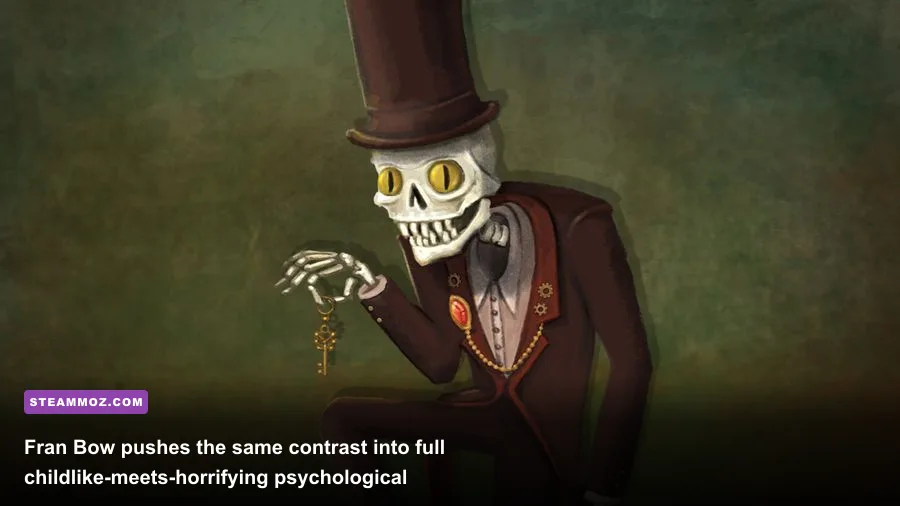
2. Fran Bow
Fran Bow is the strongest recommendation if what you loved was the uncomfortable gap between a child’s innocent perspective and a world full of cruelty. Fran is trying to find her missing cat, Mr. Midnight, after witnessing a horrifying family tragedy. She is placed in the Oswald Asylum, where the game’s reality keeps bending into something grotesque.
The defining mechanic is Fran’s use of Duotine, red pills that let her see an alternate version of the world. A harmless hospital room can become a blood-soaked nightmare; a blocked route in one reality may be open in another. This isn’t a cosmetic filter. You’ll switch between realities to locate objects, read clues, identify hidden routes, and understand what is actually happening to Fran.
Fran Bow is more direct than Harvey’s New Eyes about abuse, death, mental illness, and body horror. Its grotesque creatures include the antlered Twins, the spider-like Remor, and a range of enemies that make even ordinary rooms feel unsafe. It remains a point-and-click adventure rather than an action game, though. There are no weapon stats, dodge rolls, or reflex tests; the challenge comes from interpreting visual clues and knowing when the red-pill perspective reveals a solution.
The puzzle curve is uneven. Chapter 2 introduces the alternate-reality system effectively, while later chapters sometimes hide the required interaction behind busy screens. Use Fran’s observation dialogue aggressively, and don’t assume the most horrifying object is automatically the important one. Fran’s notebook and conversations frequently provide more practical guidance than the scenery.
For a darker companion piece, Steamoz’s breakdown of Children of Silentown is worth reading. It shares Fran Bow’s interest in children, memory, and horror without turning the experience into conventional survival combat.
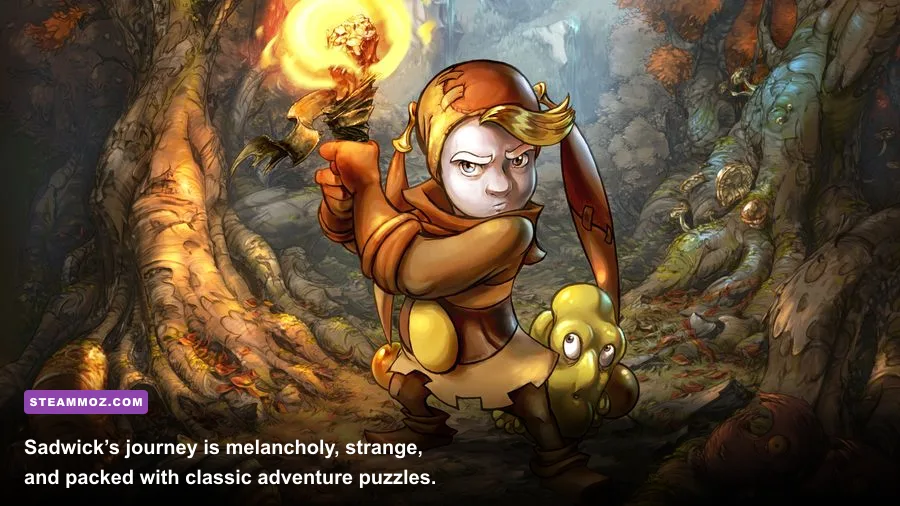
3. The Whispered World
The Whispered World follows Sadwick, a melancholy young clown who travels through a dying fantasy realm after a prophetic dream. He has a round face, a mournful personality, and a pet caterpillar named Spot who can change forms to solve environmental problems. That sounds whimsical, but the game is much closer to a fairy tale about depression and inevitability than a cheerful cartoon adventure.
Spot is the mechanical highlight. Depending on the situation, he can become a fireball, a heavy ball, a flattened shape, or a gas-like form. Each transformation opens different puzzle possibilities. You may use one version to cross a gap, another to activate a mechanism, and another to interact with a hazardous surface. The game teaches these abilities through experimentation instead of dumping a long tutorial on you.
The major locations, including Sadwick’s circus, the gloomy forest, and the kingdom threatened by the Endless Night, are filled with hand-painted details that reward slow exploration. Compared with Harvey’s New Eyes, the humor is gentler and the pacing is more deliberate. The game wants you to sit with its sadness. That makes it an excellent choice after the manic absurdity of Deponia.
There are a few classic adventure-game frustrations. Some solutions depend on combining an item with a hotspot that doesn’t initially look important, and Spot’s forms can be easy to forget when you revisit an earlier screen. Write down every transformation and inspect the cursor carefully. The game’s visual style is rich enough to hide functional objects in plain sight.
The original release and the later Special Edition tell the same core story, but the Special Edition is the sensible 2026 choice for most players because it includes presentation improvements and a more convenient modern release. Don’t expect a fast playthrough; this is a slow-burn adventure built around atmosphere.
4. Little Misfortune
Little Misfortune takes the “disturbing story seen through a child’s eyes” idea and makes it more compact, interactive, and openly satirical. Misfortune Ramirez Hernandez is an optimistic eight-year-old who leaves home with the mysterious narrator, Mr. Voice, to find the “Eternal Happiness” promised as a prize for her mother.
Like Lilli, Misfortune is constantly surrounded by adults who fail her. The difference is that Misfortune responds to danger with cheerful curiosity, stickers, glitter, and an almost heroic willingness to touch things she absolutely should not touch. The game’s dark comedy lands because she doesn’t understand the full implications of what she sees, while the player usually does.
This is not as puzzle-heavy as Harvey’s New Eyes. Most interactions are environmental choices, object inspections, small fetch tasks, and branching moments that affect scenes rather than radically changing the plot. You can throw glitter, pet animals, collect objects, and make decisions that reveal Misfortune’s personality. The estimated runtime is roughly four to five hours, making it ideal for a weekend rather than a long campaign.
Its strongest trick is tonal control. A cute forest, a talking fox, or a family outing can turn sour without a dramatic musical sting. The game trusts the contrast. If you want the emotional unease of Harvey’s New Eyes but don’t want another 12-hour inventory marathon, Little Misfortune is almost perfectly calibrated.
🎮 Edna & Harvey: Harvey's New Eyes
Looking to experience this game? Grab your digital key directly on our store for $1.99.
View on Steammoz Store →A-Tier adventures with sharper puzzles
The next group doesn’t copy Harvey’s New Eyes beat for beat, but each game excels at a part of the formula: clever inventory design, surreal world-building, dry humor, or characters who feel trapped by the stories around them.
| Game | Puzzle Style | Tone | Approximate Length |
|---|---|---|---|
| Machinarium | Visual logic and object manipulation | Warm, wordless, wistful | 6–8 hours |
| Kathy Rain | Evidence gathering and dialogue deduction | Dark mystery | 8–10 hours |
| Thimbleweed Park | Multi-character inventory puzzles | Absurd detective comedy | 10–15 hours |
| The Darkside Detective | Short clue-based cases | Paranormal sitcom | 6–8 hours |
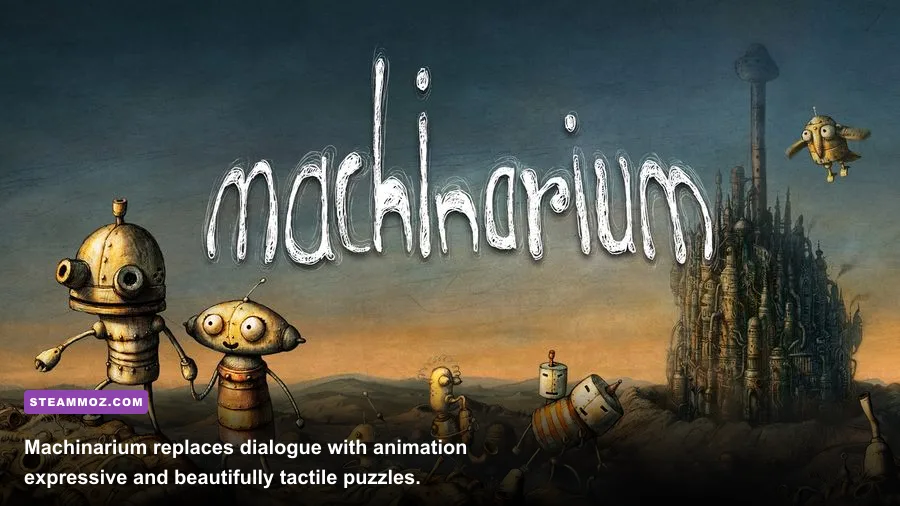
5. Machinarium
Machinarium stars Josef, a small robot dumped in a scrap heap outside a city of machines. He must reassemble himself, rescue his kidnapped girlfriend, stop a bombing plot, and outwit the Black Cap Brotherhood. There is no spoken dialogue, but icons, animations, sound effects, and Josef’s thought bubbles communicate almost everything.
The game’s puzzle design is more coherent than Harvey’s New Eyes. Josef can stretch his body, shrink himself, and use a hint system that requires playing a small mini-game before revealing a solution. That hint system is useful because Machinarium’s puzzles are based on physical relationships: plug the right cable into the right socket, distract the guard, decode the musical machine, or use the environment to move a heavy object.
It’s also the best-looking game here for players who love illustrated worlds but want something less verbally dense. Every pipe, rust stain, and flickering lamp tells you what kind of place this is. The absence of dialogue gives the adventure a gentle pace, though it also means you won’t get the savage narration that makes Lilli’s story so memorable.
Play with sound enabled. The musical cues are not just decoration, and several puzzle solutions are easier to understand when you hear what machines are doing. Machinarium is available through the official Steam listing.
6. Kathy Rain
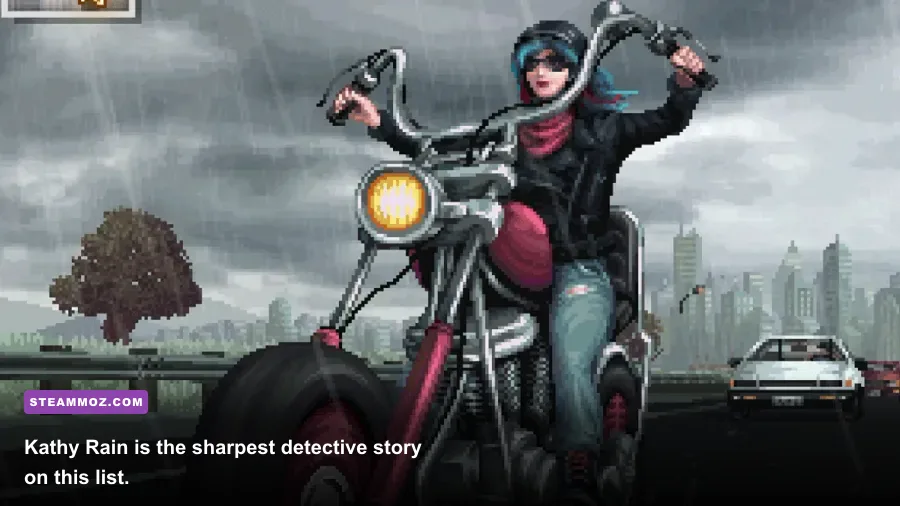
Kathy Rain shifts from surreal school horror to a small-town murder mystery. Kathy returns to Conwell Springs on a motorcycle after learning that her grandfather, Joseph Rain, died under suspicious circumstances. She wears a denim jacket, carries a notebook, and approaches the town’s secrets with the exact amount of sarcasm you’d want from a point-and-click detective.
The game’s best puzzles revolve around information. You collect evidence, compare statements, revisit locations after new discoveries, and use Kathy’s notebook to connect details. The notebook doesn’t solve the mystery for you, but it makes the investigation feel organized rather than like random pixel hunting. Key locations include the Rain family home, the hospital, the police station, and the abandoned church, each revealing another layer of Conwell Springs’ history.
Unlike Harvey’s New Eyes, Kathy Rain is not built around surreal punchlines. Its tone is more restrained and its 16-bit presentation deliberately evokes 1990s adventure games. Still, the protagonists share a stubborn refusal to accept the explanations handed to them. Kathy’s investigation becomes increasingly strange without abandoning its detective structure.
Choose the original Kathy Rain if you want the classic pixel-art version. Kathy Rain: Director’s Cut adds new areas, expanded dialogue, extra puzzles, and quality-of-life improvements, making it the better purchase in 2026. It’s a strong pick for players who want their next adventure to have an actual investigative spine.
7. Thimbleweed Park
Thimbleweed Park is a love letter to classic LucasArts adventures, but it’s not merely nostalgia in pixel-art clothing. You control five playable characters: federal agents Angela Ray, Antonio Reyes, eccentric game developer Delores, clown Ransome, and washed-up actor Franklin. Their separate inventories and personalities create a deliberately tangled puzzle structure.
The central murder investigation begins beside a river and expands into a bizarre town filled with a hotel, a pillow factory, a radio station, a carnival, and a government conspiracy. Switching characters is essential. One character may find a clue that another can use, while a seemingly useless object becomes important several chapters later.
Thimbleweed Park offers Casual and Hard difficulty modes. Casual removes some of the more elaborate steps, while Hard expects the kind of multi-stage solutions that old-school adventure fans enjoy. Pick Casual if you’re primarily here for the story; choose Hard if you want to map out inventory chains and revisit every suspicious hotspot.
The comedy is broader and more referential than Harvey’s New Eyes, but it shares the same willingness to make the player perform an elaborate, ridiculous action for a payoff that is mostly a joke. That’s not a flaw here. The joke is the reward.
B-Tier picks when you want something different
These games are still worth playing, but they match only part of the Harvey formula. Consider them excellent side routes rather than direct replacements.
8. The Darkside Detective
The Darkside Detective follows Detective McQueen and his permanently exasperated partner, Officer Dooley, as they investigate paranormal cases in Twin Lakes. Each episode is a compact case, usually spread across a handful of screens. You’ll investigate haunted apartments, strange cults, cursed objects, and supernatural disturbances that the ordinary police department would rather ignore.
The structure makes it easy to play in short sessions. Cases usually take between 20 and 45 minutes, and the puzzles focus on combining clues rather than building a huge inventory. McQueen’s dialogue is dry, Dooley’s reactions are reliably ridiculous, and the pixel art turns every occult threat into something charmingly low-budget.
It lacks Harvey’s New Eyes’ emotional intensity, but its comedy is consistently sharp. The sequel, The Darkside Detective: A Fumble in the Dark, expands the formula with larger cases and more elaborate locations. Play the first game before the sequel because the relationship between McQueen and Dooley is the real progression system.
9. Silence
Silence is the sequel to The Whispered World and follows Noah and his younger sister Renie through a magical realm threatened by war. Its environments are more cinematic, its character animation is more polished, and its puzzles are generally more accessible than Sadwick’s original journey.
The game’s strongest section involves moving between different parts of Silence while helping a small group of rebels. Noah and Renie approach the world differently, and their sibling relationship gives the story more emotional weight than a simple fantasy quest. The production values are high, but the campaign is shorter and less puzzle-dense than the classic point-and-click adventures that inspired it.
Play Silence if you want beautiful backgrounds, a sad fairy-tale atmosphere, and a more modern presentation. Don’t choose it expecting the same amount of inventory experimentation as Harvey’s New Eyes.
10. Edna & Harvey: The Breakout
If you somehow played Harvey’s New Eyes before Edna & Harvey: The Breakout, go backward. The original game introduces Edna, Harvey, and the strange asylum that defines their relationship. Edna has no memory of why she is locked away, and her conversation with Harvey gradually turns escape into a chaotic mission against the institution holding her.
The Breakout is rougher around the edges. Its puzzle logic is more old-school, its interface less friendly, and its tone sometimes wanders before finding the precise cruelty that makes Harvey’s New Eyes so effective. But it contains the essential DNA: talking objects, unreliable memories, cartoon violence, and a story that keeps asking whether the protagonist’s version of events can be trusted.
The game is best approached as a historical companion rather than a modernized sequel. Save often, combine aggressively, and expect several solutions to feel intentionally absurd. The official Edna & Harvey: The Breakout Steam page is the right starting point.
Which game should you play first?
The right choice depends on which part of Harvey’s New Eyes stuck with you. If it was Lilli’s tragicomic journey, choose Fran Bow. If it was the inventory comedy, choose Deponia. If it was the hand-painted European art, choose The Whispered World. If it was the feeling that a cheerful child is wandering through a deeply broken world, choose Little Misfortune.
| If You Loved... | Play This First | Why It Fits | Main Difference |
|---|---|---|---|
| Lilli’s bleak innocence | Fran Bow | Child protagonist and disturbing surrealism | Much more explicit horror |
| Daedalic’s jokes | Deponia | Same studio and puzzle-comedy rhythm | Rufus is louder and more selfish |
| The painted backgrounds | The Whispered World | Hand-crafted fantasy environments | Slower and more melancholy |
| The unsettling child viewpoint | Little Misfortune | Dark comedy built around innocence | Shorter and less puzzle-heavy |
| Object-based puzzles | Machinarium | Excellent environmental problem-solving | Almost no dialogue |
For a two-game weekend, pair Deponia with Fran Bow. The first gives you the closest comedic replacement; the second explores the emotional darkness that Deponia largely leaves behind. For a quieter, more atmospheric run, play The Whispered World followed by Machinarium. Both reward patience, careful observation, and a willingness to inspect every suspiciously painted object.
Players who prefer mysteries should start with Kathy Rain: Director’s Cut. Its evidence-driven progression feels more deliberate than the classic “use everything on everything” approach, and its lead character has enough attitude to carry the slower investigation. If you only have an hour at a time, The Darkside Detective is the most practical option because every case has a clear beginning and ending.
How to enjoy these adventures without spoiling the puzzles
Point-and-click adventures are at their best when you solve the problem yourself, but older games can punish players for missing one tiny interaction. The trick is to use a disciplined approach instead of immediately opening a walkthrough.
1. Exhaust dialogue before combining items
Characters often unlock a new line after you inspect an object or show them a related item. In Kathy Rain, conversations also establish which statements are suspicious. In Deponia, dialogue frequently telegraphs the joke behind the next puzzle. Talk to everyone twice before assuming a location is finished.
2. Separate real clues from comedy props
Harvey’s New Eyes trains you to distrust everything, but not every strange object has a purpose. Keep a short note of items that have clear mechanical potential: keys, containers, tools, broken devices, and anything that changes after dialogue. This stops you from repeatedly testing a rubber chicken or decorative sign against every hotspot in the room.
3. Revisit screens after major story beats
Adventure games often update older locations silently. A locked door may open after you learn a password; a character may move after you solve an unrelated task; a previously decorative machine may become interactive. The Whispered World and Thimbleweed Park both reward this habit, especially when multiple characters are involved.
4. Use hints before a full solution
Machinarium’s hint system is a model because it gives assistance without immediately destroying the puzzle. If a game has a built-in clue system, use the smallest nudge first. External walkthroughs are best reserved for genuine dead ends, not the first time an item combination fails.
5. Save before irreversible choices
Modern adventure games are usually forgiving, but older releases may contain missed-item situations or choices that alter dialogue. Keep three rotating saves: the start of a chapter, the newest manual save, and a backup before entering a new major location. That small habit prevents a frustrating restart several hours later.
For more point-and-click survival advice, Steamoz’s new-player tips for Brothers: A Tale of Two Sons Remake cover the same useful fundamentals: observe the environment, test character abilities, and don’t rush past visual storytelling.
Final ranking for 2026
Harvey’s New Eyes remains unique, but that doesn’t mean it stands alone. The games below offer different routes into its appeal, from Daedalic’s cynical comedy to Fran Bow’s nightmarish psychology and Machinarium’s nearly wordless mechanical poetry.
| Rank | Game | Best Match For | Verdict |
|---|---|---|---|
| 1 | Deponia | Comedy, puzzles, Daedalic style | The safest recommendation for almost every fan |
| 2 | Fran Bow | Dark child-centered surrealism | The boldest and most disturbing follow-up |
| 3 | The Whispered World | Art, melancholy, classic adventure design | A slower but beautifully crafted journey |
| 4 | Little Misfortune | Short dark comedy | Perfect for a focused weekend playthrough |
| 5 | Machinarium | Visual puzzles and atmosphere | The cleanest puzzle design on the list |
| 6 | Kathy Rain | Detective storytelling | Best choice for evidence-driven mystery fans |
| 7 | Thimbleweed Park | Multi-character classic adventure puzzles | Long, funny, and unapologetically old-school |
| 8 | The Darkside Detective | Short paranormal cases | Fast, funny, and easy to play in bursts |
| 9 | Silence | Cinematic fantasy presentation | Beautiful, but lighter on traditional puzzles |
| 10 | The Breakout | Edna and Harvey’s origins | Essential context despite its rougher design |
My personal order is Deponia, Fran Bow, and The Whispered World. Together, they cover the three qualities that make Harvey’s New Eyes endure: outrageous puzzle comedy, unsettling emotional stakes, and a world that looks playful right up until it reveals something awful. Start there, keep a few save files, and resist the walkthrough until you’ve genuinely run out of ideas. The best moment in any of these games is still the second when an utterly ridiculous solution suddenly makes perfect sense.
For official release information, you can also check Daedalic Entertainment, the Fran Bow Steam page, and the Deponia Doomsday listing.