These 10 Brothers: A Tale of Two Sons Remake tips will save you the most frustration: learn both control schemes immediately, keep the brothers positioned together, search every quiet side path, use the camera before moving, and treat every puzzle as a two-character timing problem. The remake is forgiving, but its deliberately old-school controls and wordless environmental puzzles can still catch new players off guard.

🎮 Get Brothers: A Tale of Two Sons Remake
Ready to dive in? Grab your copy today for just $7.99.
Check Offer1. Learn which brother does what before solving puzzles
Naia is the older brother, and Naiee is the younger one. The game consistently uses that relationship as its core puzzle language. Naia has the strength to turn heavy mechanisms, pull large levers, and perform actions that require force. Naiee is smaller and can reach narrow spaces, slip through openings, or handle routes his older brother cannot.
On a standard controller, the left stick controls Naia and the right stick controls Naiee. Their interaction buttons are separate as well, so your hands are effectively piloting two characters at once. That sounds awkward for the first 10 minutes, but it becomes natural surprisingly quickly. Don't mash both interaction buttons randomly. Watch the prompt over each brother and press only when the correct character is in position.
A useful rule is simple: if a mechanism looks heavy, try Naia first. If a gap looks too small for an adult, move Naiee toward it. The game rarely asks you to guess without visual clues.
🎮 Brothers: A Tale of Two Sons Remake
Looking to experience this game? Grab your digital key directly on our store for $7.99.
View on Steammoz Store →2. Stop fighting the camera and use it deliberately
The remake's camera is cinematic rather than perfectly tactical. It often frames a beautiful vista instead of showing every usable object. Before committing to a jump, climb, or pull, rotate the camera and check the landing area. This matters especially near cliffs, rotating platforms, and narrow ledges where one brother can drift off-screen.
Keep the brothers within a short walking distance whenever possible. If one character is hidden behind scenery, stop the other instead of continuing blindly. The game usually recenters after an interaction, but that doesn't mean the next route is immediately obvious. Look for ropes, pale climbing surfaces, movable platforms, and unusually bright environmental details.
If you are playing on PC, a controller is strongly recommended. Keyboard movement can work, but simultaneous twin-stick movement and separate interaction inputs feel much less comfortable on a keyboard. You can find the game's current PC information on the official Steam page.
3. Think in paired actions, not separate objectives
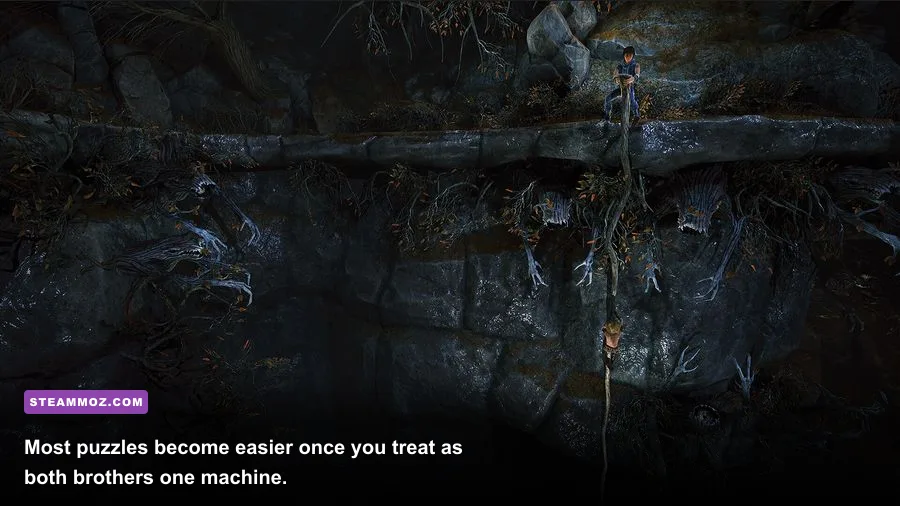
Most puzzles aren't asking Naia and Naiee to complete two unrelated jobs. They're asking you to create a sequence. One brother holds a platform in place while the other crosses. One pulls a lever while the other uses the opening. One distracts an obstacle while the other moves into the newly available space.
When you find two interactable objects, don't immediately activate both. First, identify what changes in the environment. Watch gates, lifts, bridges, and water wheels for a full cycle. Then decide which brother needs to move first. A common mistake is putting both characters on separate switches, only to discover that one must leave its switch to reach the next section.
Use short, controlled movements around interactive objects. The brothers can bump into each other, and a poorly angled approach can make the wrong character grab a handle. If that happens, back away, separate their positions, and try again. Resetting your stance is faster than wrestling with the camera.
4. Use this progression checklist for every chapter
Brothers: A Tale of Two Sons Remake is linear, but each area contains optional interactions and environmental moments. There is no conventional skill tree, weapon inventory, level system, or combat build to optimize. Your progression is measured by story chapters, puzzle knowledge, and optional discoveries.
Before leaving a location, pause for a quick sweep. Look behind structures, around the back of bridges, beside waterfalls, and along paths that seem to lead nowhere. Optional scenes are often activated by approaching a person, animal, or object and pressing the relevant interaction button. They are not always marked with a collectible icon.
| Area Type | What to Check | Why It Matters | Best Habit |
|---|---|---|---|
| Village paths | Homes, docks, side alleys | Optional character moments | Walk behind buildings before advancing |
| Outdoor routes | Waterfalls, ledges, animal pens | Environmental interactions | Rotate the camera at every junction |
| Puzzle rooms | Both switches and alternate exits | Prevents missed routes | Observe one complete mechanism cycle |
| Story arenas | Edges of the playable space | Extra scenes can sit away from objectives | Explore before triggering the next prompt |
There is no penalty for exploring before progressing. In fact, the quiet pauses are where the remake's strongest character writing often appears. If completion matters to you, take screenshots or note unusual side paths rather than assuming you can return later.
5. Master climbing, swimming, and narrow passages
Movement sections look simple, but they punish rushing. When climbing, keep both brothers aligned with the route instead of sprinting ahead with one character. If Naia reaches a ledge first, wait until Naiee is safely attached before changing direction. The camera may swing during transitions, and sudden inputs can send the trailing brother toward the wrong edge.
Swimming sections are built around keeping the pair together. Move smoothly and avoid sharp directional changes near rocks or banks. If one brother gets stuck against geometry, release movement for a moment and let the camera settle. Then steer both characters toward open water. The game generally provides generous space, so panic-correcting usually causes more trouble than the obstacle itself.
Narrow passages are a visual signal to test Naiee. Don't waste time trying to force Naia through an opening that clearly favors the younger brother. Once Naiee reaches the far side, inspect the environment for the interaction that lets Naia follow or changes the route for both characters.
6. Treat hostile encounters as movement puzzles
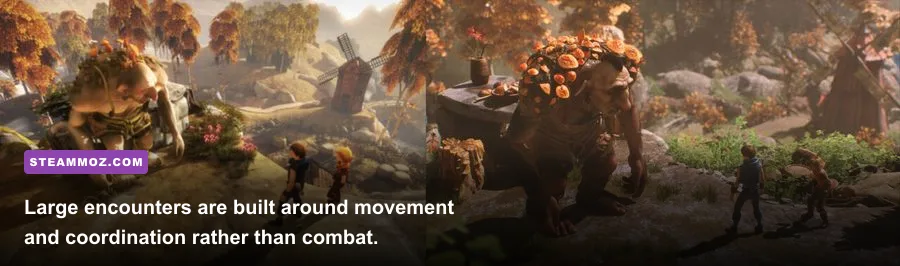
Combat is not the point of Brothers, and neither brother has a traditional weapon, health build, or attack combo. Hostile encounters are about hiding, timing, climbing, and escaping. If an enemy appears, look for the route rather than searching for a damage prompt.
Watch the enemy's animation before moving. Large creatures telegraph lunges with a pause, a turn, or a sudden change in posture. Use that window to cross open ground, reach cover, or activate the next environmental object. Staying near the center of an arena is usually safer than hugging an edge, because you have more room to sidestep a charge.
When the brothers split up, resist the urge to move both at full speed. Advance the character in danger first, then reposition the other. The active camera can make the second brother vulnerable off-screen, especially during chase sequences.
7. Adjust graphics settings for smooth camera movement
The remake's upgraded lighting and character models make it considerably heavier than the original, but this isn't a twitch game. A stable 60 frames per second is more valuable than maxed shadows because camera readability directly affects platforming and puzzle positioning.
| Setting | Recommended Value | Performance Impact | Visual Trade-Off |
|---|---|---|---|
| Resolution | Native monitor resolution | High | Lower first if frame rate is unstable |
| Frame limit | 60 FPS | None | Provides consistent camera response |
| Shadows | High or Medium | Medium to high | Medium saves frames with modest loss |
| Post-processing | Medium | Medium | Reduces blur and visual softness |
| Texture quality | High if VRAM allows | Low to medium | Keep high for character detail |
| V-sync | Use if tearing appears | Low | May add input latency on some systems |
Don't assume the highest preset is automatically correct. If traversal feels uneven, lower shadows and post-processing before textures. For more PC troubleshooting ideas, Steamoz's PC crash and low-FPS fixes cover the same basic diagnostic steps: update drivers, verify files, and test fullscreen modes.
8. Don't skip the small interactions
Some of the remake's most memorable moments come from doing something that has no obvious mechanical reward. Talk to villagers. Investigate animals. Try harmless objects in a quiet corner. The brothers' relationship is communicated through gestures and reactions as much as dialogue, so these scenes add context that the main route doesn't always explain.
Use the lack of a quest log as a reason to slow down, not as a reason to sprint. If an area gives you time before the next major objective, it is probably inviting you to look around. The publisher's official game page highlights the remake's rebuilt visuals, but the emotional pacing still depends on the player's willingness to notice these small details.
9. Play co-op only after learning the solo rhythm
The remake supports local co-op, with each player taking control of one brother. That mode can be fun, but it changes the experience dramatically. Solo play teaches you to coordinate both characters as a single thought; co-op adds communication, hesitation, and occasionally two people reaching for the same timing window.
If you're playing with a friend, agree on a few rules. The player controlling the character closest to danger calls the timing. Neither player moves during a puzzle explanation or camera transition. When a section fails, reset both characters instead of blaming the last input. These tiny habits prevent most co-op arguments.
For a first playthrough, solo is still the clearest way to understand Naia and Naiee's relationship. Co-op works best as a second run, especially if your partner enjoys exploring rather than optimizing every movement.
10. Prepare for the ending without spoiling it for yourself
The final stretch deliberately tests everything the game has taught you: separate movement, environmental timing, climbing, swimming, and the emotional connection between the brothers. Don't treat the late game like a standard action climax. If a sequence feels difficult, identify which character is currently safe and which one needs your attention.
Keep the camera wide whenever possible, follow visual prompts instead of button-mashing, and remember the central rule: both brothers may be controlled separately, but the solution is usually shared. The remake's final chapters are more satisfying when you understand the mechanics rather than rushing through them.
Also, save time for the credits and the scenes immediately around them. Brothers: A Tale of Two Sons is a short adventure, but its conclusion depends on emotional pacing. If you want technical comparisons with other older PC releases, Steamoz's Brothers in Arms PC performance guide is a useful reminder that “older” does not always mean “effortless” on modern hardware.
The quick version
Control Naia and Naiee independently, use their physical differences as clues, inspect every side path, and never rush a camera transition. There are no stats, weapons, or skill trees to master; the real progression is learning how to read the environment and coordinate two characters without losing track of either one. Once that clicks, the remake's puzzles stop feeling fiddly and start feeling wonderfully precise.