
Deponia has no XP, character levels, equipment stats, or gold economy. If you’re searching for a fast leveling and gold farming route, the real solution is to stop grinding and optimize puzzle progression instead. Rufus advances by combining inventory items, exhausting dialogue options, revisiting screens, and triggering the next story flag. There’s no enemy loop to farm and no merchant balance to exploit; every minute spent hunting imaginary coins is a minute lost to the actual solution.
That distinction matters because Deponia looks like an RPG at first glance. It has a named protagonist, a sprawling world, collectible objects, and plenty of locks, machines, and suspiciously important bits of rubbish. But Daedalic Entertainment built it as a traditional point-and-click adventure. The closest thing to “progression” is your mental map of the puzzle chain. Once you understand that, the game becomes much faster—and a lot less frustrating.
This guide covers the first Deponia Steam release, with practical advice that also applies to the Deponia Collection. It focuses on spoiler-light routing, inventory logic, optional rewards, and the common traps that make players believe they’ve missed a level or a gold source.
First, Delete the RPG Rules From Your Head
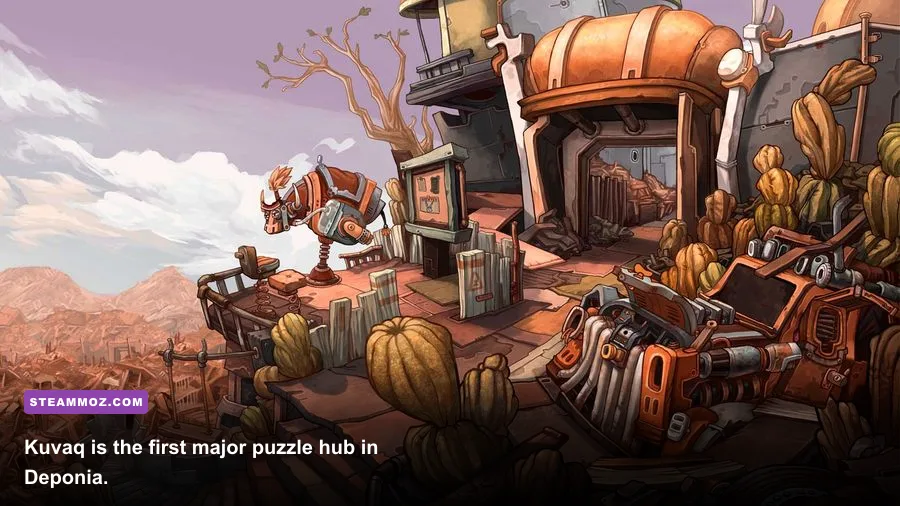
There are no experience points in Deponia. Rufus never gains a level, no weapon increases his damage, and no attribute screen changes his ability to interact with the world. The game’s progression is flag-based: a conversation, item combination, or completed puzzle changes the state of a location and unlocks the next interaction.
There also isn’t a conventional gold currency. You won’t find a repeatable enemy, chest route, mining node, or vendor loop that produces money. Some scenes involve tokens, tickets, payments, or objects that function like currency inside a single puzzle. Those items are key items, not a wallet you can accumulate. If a character asks Rufus for something valuable, the intended answer is usually another puzzle chain—not a farming session.
| RPG Feature | Does Deponia Have It? | What Replaces It |
|---|---|---|
| XP and character levels | No | Story flags and completed puzzle chains |
| Gold or repeatable currency | No | One-off tokens, tickets, and quest objects |
| Weapons and armor | No | Context-sensitive item interactions |
| Skill tree | No | Player knowledge and dialogue choices |
| Grinding route | No | Screen-by-screen investigation |
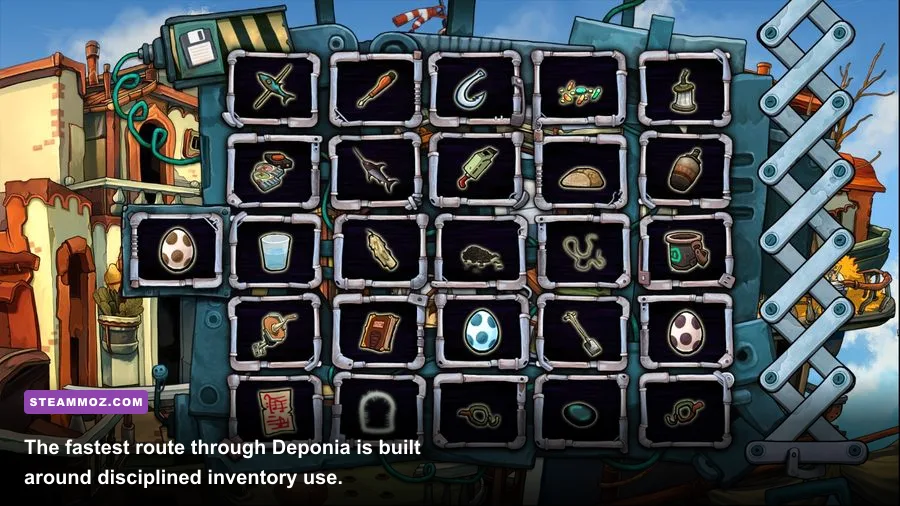
That means the best “build” is a clean inventory. Keep every unusual object until the game clearly proves it has no further use. Deponia likes visual jokes, but its comedy is often attached to a real solution. A scrap component that looks like a gag prop may become part of a machine, while a perfectly ordinary household item can solve a completely absurd problem.
For a quick refresher on the game’s structure, Steamoz’s related breakdown, Deponia has no leveling—here’s how to progress fast, reaches the same core conclusion. The useful mindset is not “Where can I earn more?” but “Which world state am I missing?”

🎮 Deponia
Looking to experience this game? Grab your digital key directly on our store for $0.99.
View on Steammoz Store →The Fastest Progression Loop for Every Chapter
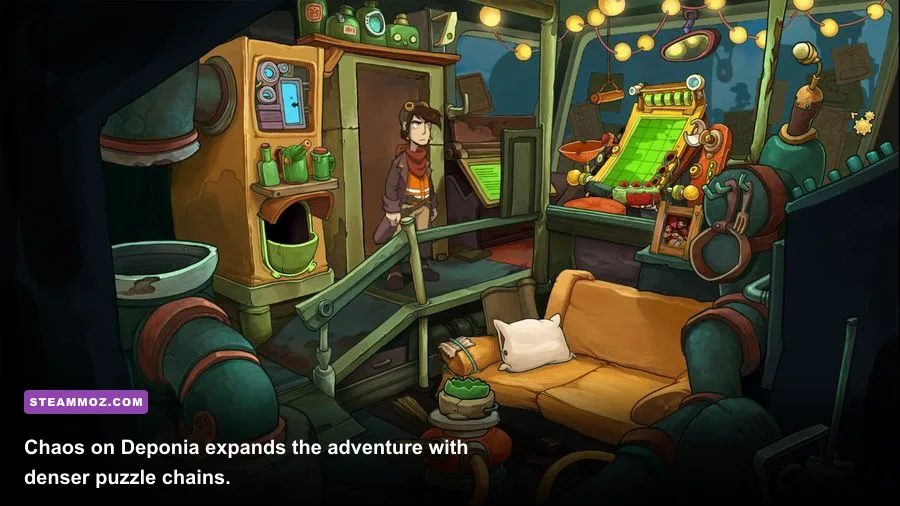
Deponia rewards a repeatable investigation routine. Use it whenever you enter a new screen, especially after a major conversation or cutscene. This routine is quicker than random clicking because it separates information gathering from experimentation.
1. Sweep the screen before touching anything
Move the cursor over every interactive hotspot. Look at doors, switches, machines, containers, animals, signs, cables, and background objects that seem too decorative to matter. Rufus’s comments are not always jokes; they often tell you whether an object is currently useful, blocked, or linked to another puzzle.
2. Talk to every available character twice
Exhaust every dialogue branch before combining items. A conversation can add a new hotspot or change the response attached to an old one. Speak to Goal, Cletus, Bozo, Barry, Toni, and the various Organon characters whenever they become available. Deponia’s puzzle flags are frequently gated behind a specific line rather than a visible button.
3. Inspect every inventory object
Click each item and read Rufus’s description. Then test it against the environment only when you have a plausible connection. The game’s logic is eccentric, but it is usually internally consistent at the category level: something that cuts may interact with rope or tape; something that carries liquid may interact with a machine; something that makes noise may distract a character or animal.
4. Combine objects aggressively—but logically
Try combinations when two items share a clear purpose. Avoid dumping every item onto every hotspot. That creates noise, wastes time, and makes it harder to remember what you’ve already tested. When a combination fails, note the failure and move on. Deponia usually gives you a humorous response, but the joke is not a hint that the same action will work later.
5. Revisit old screens after a major success
New dialogue, new exits, and changed objects often appear after a puzzle completes. If you repair a machine, distract a guard, acquire Goal, or alter a transport route, revisit the previous two or three screens. This is the closest thing the game has to a progression reset.
The practical time-saving rule is simple: never reload a save just because an interaction produced a sarcastic comment. Deponia is designed around experimentation. Manual saves are still valuable before a large puzzle chain, but the game generally does not punish wrong clicks with permanent character death or lost gold because neither system exists.
Where Players Mistake Puzzle Items for Gold
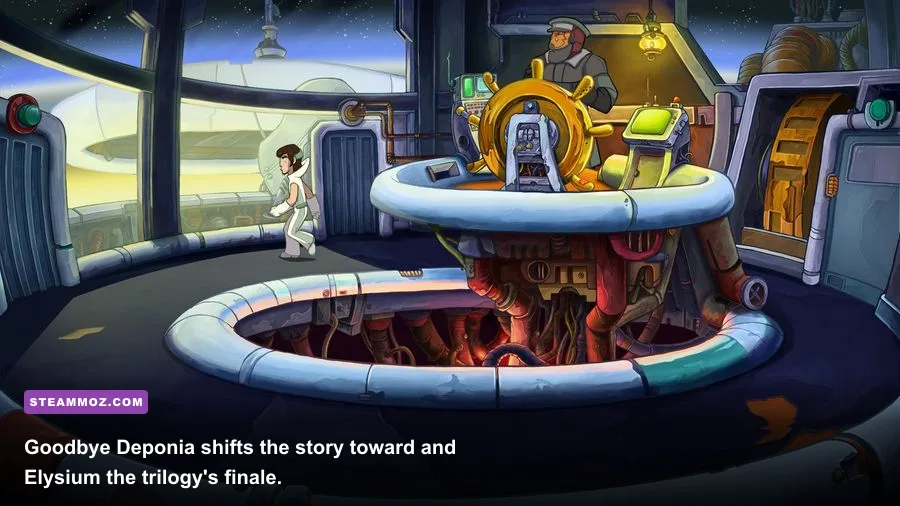
The junkyard setting makes every object feel like potential loot. Lowerias, the Ascension Station, and the surrounding scrap zones are packed with things that look collectible, but Deponia’s objects fall into functional categories rather than an economy. Some are permanent inventory pieces, some vanish after use, and some exist only to deliver a joke or establish the setting.
| Object Type | Typical Role | Best Handling Rule | Common Mistake |
|---|---|---|---|
| Machine component | Repairs or activates a device | Keep it until the connected machine works | Discarding it because it looks like scrap |
| Token, ticket, or pass | Unlocks one local interaction | Use it where the dialogue points | Searching for a repeatable currency value |
| Food or drink | Distracts a character or animal | Test it near living obstacles | Trying to consume it with Rufus |
| Cutting or fastening tool | Changes ropes, wires, tape, or containers | Match tool and material first | Using it randomly on every hotspot |
| Comedy prop | Delivers flavor or a short gag | Read the description before ignoring it | Assuming every funny object is worthless |
There is no safe “sell everything” strategy. Deponia does not provide a reliable merchant interface where surplus items convert into progress. If you’re carrying something, assume it may be relevant until you finish the local chain. The game’s inventory is intentionally compact, so it isn’t asking you to manage hundreds of junk items like an RPG would.
For players coming from loot-heavy games, this is the biggest adjustment. In an RPG, a weak sword becomes gold. In Deponia, a weak-looking object becomes a clue. Treat every pickup as a verb: cut, distract, connect, open, lubricate, redirect, disguise, or trigger. Once you think in verbs, the apparent clutter becomes a readable toolkit.
Chapter Routing Without Random-Clicking
The quickest route through Deponia comes from controlling the order of your information. Don’t rush toward the most visually obvious machine. First identify the blocked objective, then list the obstacles between Rufus and that objective. Most chapter puzzles are nested in a predictable sequence: obtain information, acquire a tool, alter the environment, then use the newly available route.
Lowerias and the opening junkyard
The opening sections teach the central loop. Rufus’s escape plan is not solved by finding one magical item; it is assembled through several small interactions involving the junkyard, the elevator or transport infrastructure, and nearby characters. Speak to everyone before committing to a solution, inspect the surrounding scrap, and treat every broken mechanism as a multi-step puzzle.
When a route seems impossible, look for the missing state rather than a missing statistic. The usual causes are an untriggered conversation, an item that has not been combined, or a screen that needs to be revisited after a machine changes. If the cursor shows no useful hotspot, walk to another screen and return after progressing a nearby interaction.
The cable car and transport puzzles
Transport sequences are classic Deponia bottlenecks because they connect several screens and characters. Map the cable, platform, control, and destination relationships before experimenting. If Rufus says a control is inaccessible, that’s generally a positional problem or a prerequisite interaction—not a sign that you need a level or a stronger tool.
Goal, Cletus, and dialogue-gated progress
Goal’s storyline introduces more character-driven puzzle states. Keep talking after the first obvious answer, particularly when Cletus or an Organon representative changes the situation. Deponia often makes the first conversation establish the problem and the second interaction reveal the workaround.
For a chapter-by-chapter pace check, compare your route with the companion progression guide for Decay: The Mare. It’s a different game, but the same anti-grind principle applies: identify gated objectives instead of farming nonexistent resources.
| Progress Block | What Usually Causes It | Fastest Check | What Not to Do |
|---|---|---|---|
| Locked door or hatch | Missing key item or dialogue flag | Inspect nearby objects and exhaust conversations | Reloading repeatedly for a random outcome |
| Broken machine | Uncombined component or missing power source | Read Rufus’s comments on each machine part | Searching for XP or a better tool |
| NPC refuses to help | Another character or item must change first | Visit adjacent screens and return | Clicking the same dialogue line endlessly |
| New area appears empty | Hotspot is hidden in scenery or requires inspection | Sweep the cursor across background edges | Assuming the area is decorative |
Save Management, Achievements, and Real Rewards
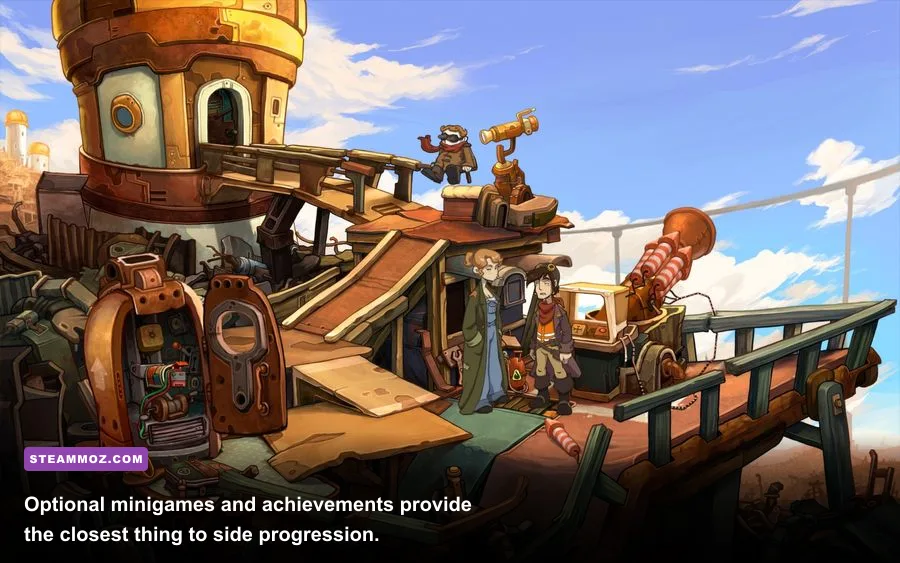
Since there’s no gold to farm, the only meaningful optional rewards are achievements, discovery, and the satisfaction of solving Deponia’s nastier chains without a walkthrough. That makes save management more important than resource management.
Create a manual save at the start of each chapter and another before a long multi-stage puzzle. Use separate slots instead of overwriting one file. This protects you from missing an achievement opportunity and lets you experiment without retracing an hour of dialogue. Deponia’s autosave behavior can vary by edition, so don’t assume the latest checkpoint preserves every useful state.
For achievements, avoid blindly following a guide on your first run if you care about the comedy and pacing. Many optional interactions are funny precisely because they are inefficient. On a second run, use a checklist and combine it with your chapter saves. That is the closest Deponia gets to a completionist farming route: replaying targeted scenes to clean up missed interactions, not collecting currency.
Also check the edition you own. The official Daedalic Deponia page provides the clearest publisher-level reference for the series, while the official Steam listing confirms the original game’s point-and-click adventure identity. If you’re playing the trilogy or Doomsday, don’t assume every later puzzle uses the exact same item logic.
The Definitive Fast-Progress Checklist
Use this checklist whenever you feel stuck:
- Talk to every visible character until the dialogue repeats.
- Inspect every inventory item and read Rufus’s description.
- Sweep the current screen for hotspots, including background objects.
- Identify the immediate blocked objective: door, machine, person, vehicle, or route.
- List the obstacle’s required verb—open, cut, connect, distract, power, or redirect.
- Search nearby screens for an item that matches that verb.
- Combine only items with a plausible functional relationship.
- After a successful interaction, revisit adjacent screens.
- Save before starting a long chain or attempting an achievement.
- Use a walkthrough only after you’ve identified the exact missing flag.
The final answer to the Deponia fast leveling and gold farming question is therefore blunt: there is nothing to level and nothing to farm. Rufus gets stronger only because you understand the puzzle language better. Keep the inventory intact, exhaust conversations, revisit changed locations, and track the verbs each obstacle demands. That approach turns Deponia’s junkyard chaos into a surprisingly efficient route through one of Daedalic’s funniest adventure games.
If you want another Steamoz guide built around avoiding wasted progression, see our Dungeon Siege classic RPG coverage or the practical advice in Din’s Curse town-saving tips. Those games actually do have leveling systems—but Deponia is the reminder that sometimes the best grind is no grind at all.