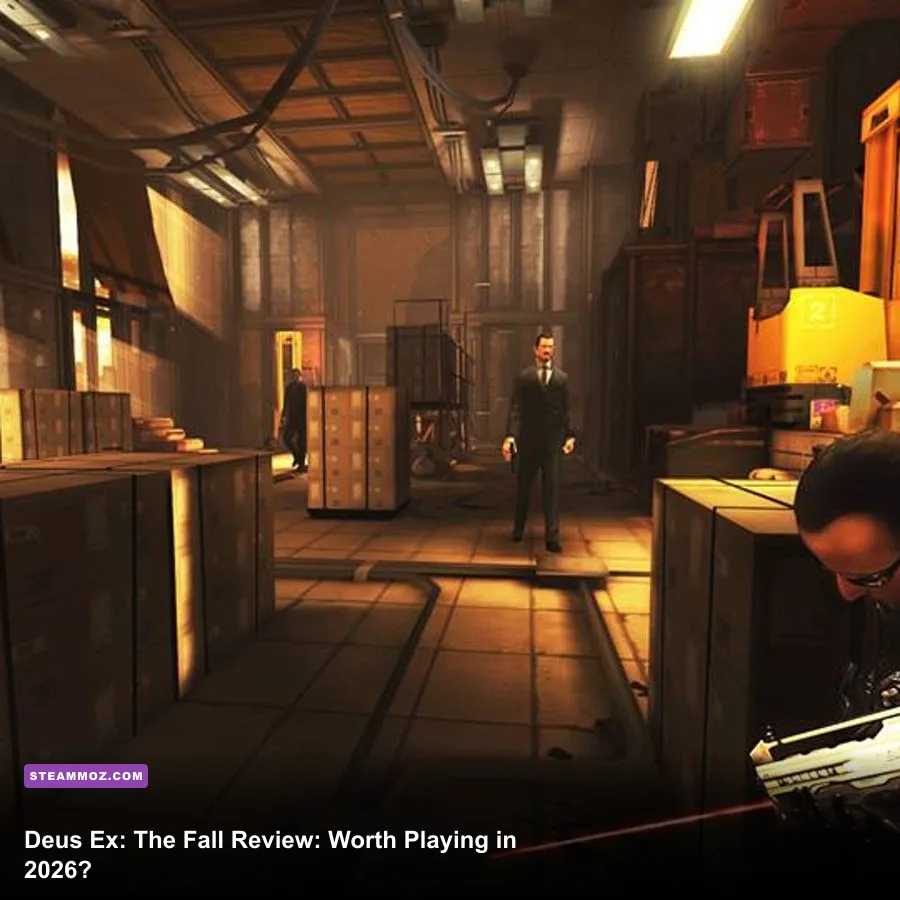
Yes, Deus Ex: The Fall is worth playing in 2026—but only if you treat it as a compact, compromised Deus Ex side story rather than a lost sequel. Its stealth systems, hacking, weapon customization, and cyberpunk mood still work, especially when you can grab the PC version cheaply. The problem is scope: the campaign is short, the writing rarely reaches Human Revolution, and the original mobile design leaves awkward fingerprints all over the Steam release. My verdict is a cautious 6/10: recommend it to Deus Ex fans, completionists, and immersive-sim tourists, but not as your first game in the series.
The setting remains a strong hook. You play Ben Saxon, a former British SAS operative and augmented mercenary whose loyalty to the Tyrants has collapsed. After escaping that group, Saxon and Anna Kelso become entangled in a conspiracy involving Neuropozyne, corporate power, and the widening social divide between augmented and unaugmented people. It is familiar Deus Ex material, but the game understands the assignment: every back alley, corporate lobby, and security checkpoint should feel like a problem with several possible answers.
What The Fall Gets Right in 2026
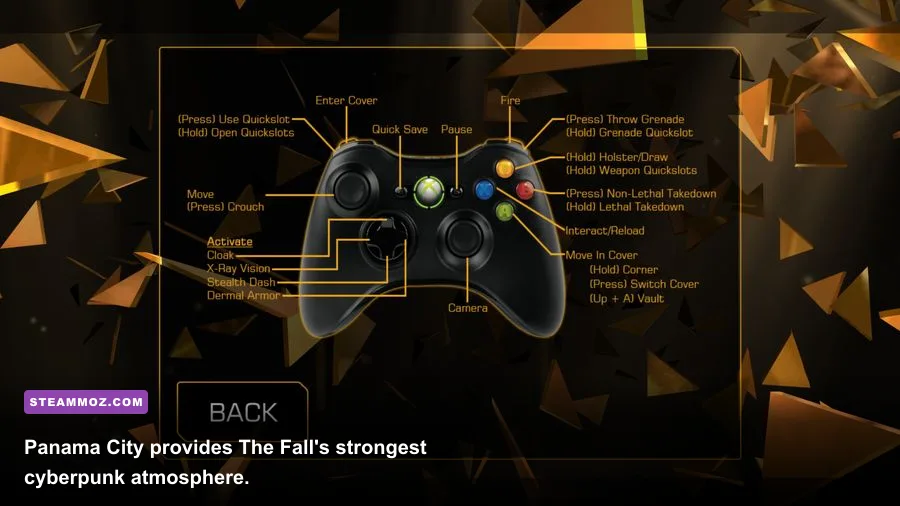
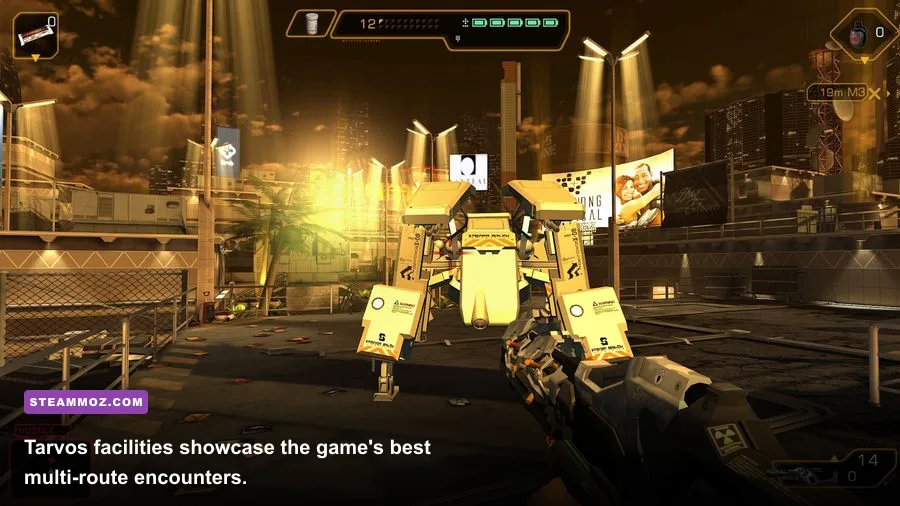
The best reason to play The Fall today is density. Its environments are much smaller than those in Deus Ex: Human Revolution, yet they still reward nosiness. A locked door may lead to a computer terminal, an alternate route, a stash of ammunition, or a conversation that changes how you read the next objective. You can explore Panama City, follow mission markers, or ignore the obvious route and hunt for vents, rooftops, maintenance passages, and hackable security systems.
That flexibility is the game's authentic Deus Ex spark. Hacking is not a decorative minigame; it can remove cameras, open doors, expose passwords, and create quieter approaches. Social encounters also matter. The dialogue is not as sharp as the original game's philosophical confrontations, but speaking to civilians, contacts, and faction members makes the locations feel less like shooting galleries.
The interface is the biggest survivor from the mobile version. Menus are simple, objectives are clear, and the game rarely buries basic information behind layers of inventory management. On a handheld, that restraint made sense. On PC, it can feel underdeveloped, particularly when you expect the richer systemic detail of Human Revolution or Deus Ex: Mankind Divided.
| Area | 2026 Strength | 2026 Weakness |
|---|---|---|
| Exploration | Compact spaces contain vents, terminals, passwords, and alternate routes | Levels are small and rarely evolve after objectives begin |
| Stealth | Hacking, cover, takedowns, and cloak-style augments support quiet play | Enemy AI can lose track of you too easily |
| Combat | Weapons feel readable and upgrades give encounters some build identity | Shooting is blunt compared with modern immersive sims |
| Story | Strong Deus Ex themes and a useful look at Ben Saxon | Short runtime leaves major arcs underdeveloped |
If you enjoy games that turn locked doors into questions, The Fall remains more interesting than its reputation suggests. Steam's official Steam page is the sensible starting point, particularly during a sale. Just don't expect a hidden 40-hour RPG.

🎮 Deus Ex: The Fall
Looking to experience this game? Grab your digital key directly on our store for $1.99.
View on Steammoz Store →How the RPG and Augmentation Systems Feel
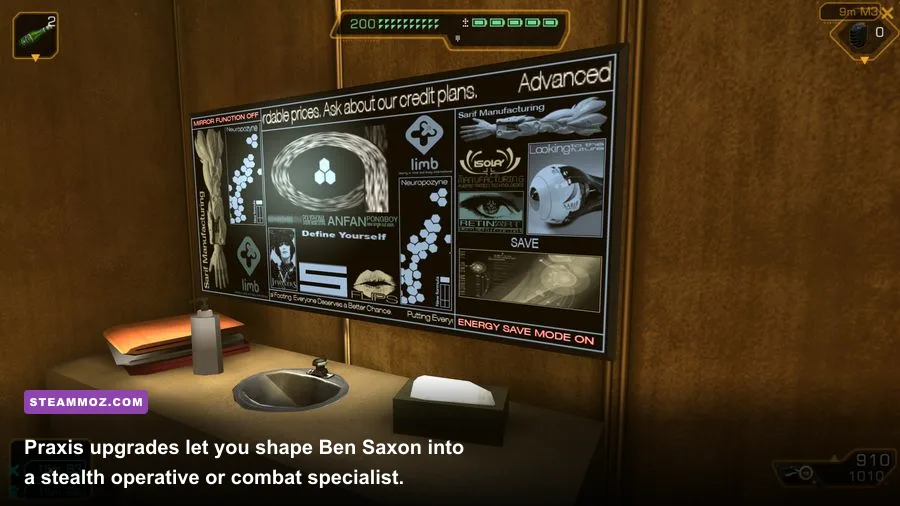
Ben Saxon's progression is built around Praxis Points and augmentations rather than a traditional class system. You earn experience from completing objectives, discovering information, hacking, and dealing with enemies. Praxis Points then unlock abilities that shape your approach. The most useful early choices are not flashy damage boosts; they're the upgrades that expand access to the world.
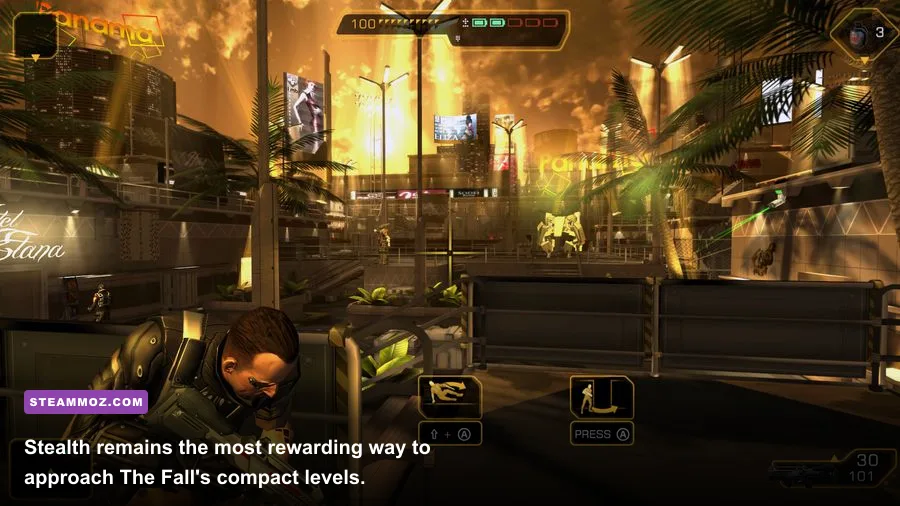
Hacking is the obvious priority for a first run. Better hacking access turns computers, doors, and security devices into resources instead of hard stops. Cloaking-style stealth tools are also valuable because The Fall's compact arenas often place guards close together. A quiet escape can be more efficient than trying to defeat every soldier in a corridor.
Combat-focused players can invest in weapon handling, recoil control, and durability-oriented augmentations, but a pure guns-blazing build exposes the game's weakest side. Ammunition is limited in several early situations, enemy reactions are inconsistent, and firefights lack the punchy feedback found in dedicated shooters. The most effective build is a hybrid: hacking for access, stealth for positioning, and one reliable firearm for when plans collapse.
| Build Direction | First Priorities | Best Tools | Weak Point |
|---|---|---|---|
| Infiltrator | Hacking access, stealth movement, cloak utility | Suppressed pistol, tranquilizer options, terminals | Bad if surrounded in an open room |
| Combat Operative | Weapon handling, armor support, ammunition efficiency | Combat rifle, shotgun, grenades | Consumes resources quickly |
| Hybrid Agent | Basic hacking plus one stealth and one combat branch | Pistol, rifle, environmental routes | Never reaches maximum specialization |
| Explorer | Hacking, inventory utility, movement access | Computers, vents, alternate entrances | Longer setup before direct encounters |
There is no need to chase every upgrade on the first playthrough. Pick a playstyle and commit for several missions. Resetting your priorities mentally is more useful than trying to build an imaginary perfect character. For broader immersive-sim comparisons, Steamoz's ELEX performance guide is also worth a look, although ELEX is dramatically larger and more demanding.
Weapons, Stealth, and the Cost of Going Loud
The Fall gives you a familiar Deus Ex arsenal: the 10mm pistol, combat rifle, shotgun, crossbow-style stealth options, grenades, and heavier weapons for emergencies. Weapon upgrades improve the practical feel of these tools, but they do not transform them into radically different guns. The 10mm pistol is the dependable workhorse. It is accurate, economical, and ideal for finishing isolated targets after a stealth approach fails.
The combat rifle is more useful when you deliberately choose aggression. It handles groups better than the pistol, but its ammunition disappears quickly and its recoil makes careless bursts inefficient. The shotgun is powerful at close range but encourages the exact kind of noisy confrontation that The Fall's AI handles least convincingly. Stealth ammunition and non-lethal options are therefore more valuable than their damage numbers suggest: they preserve resources and keep the level's alternate paths available.
Enemy telegraphs are simple. Guards investigate suspicious sounds, react to bodies, and patrol around cameras, but they can also become strangely passive once you break line of sight. Use that behavior rather than fighting it. Save before crossing a guarded threshold, disable cameras through terminals when possible, drag or avoid downed enemies, and keep one escape route behind you. The game's most satisfying encounters happen when you manipulate patrols instead of trading bullets.
A practical combat rhythm looks like this: scout with your available vision tools, identify the nearest camera and alarm source, hack or disable surveillance, isolate one guard, use a takedown or quiet weapon, then relocate before the remaining patrols converge. If the alarm triggers, don't automatically reload. The chaos can create a new route, and fleeing to a vent or adjacent room often costs less ammunition than a full reset.
The Story Is Intriguing, but Clearly Incomplete
Ben Saxon is a promising protagonist because his background creates immediate tension. He knows how mercenaries think, understands augmentation culture from the inside, and has personal reasons to distrust the people who once employed him. Anna Kelso provides an important human counterweight, while the Neuropozyne crisis gives the plot a recognizable social pressure point.
What hurts is not the premise but the compression. The Fall often introduces a faction, location, or moral question just as you begin to care about it. Conversations can sound like abridged versions of scenes that should have had another draft. The game gestures toward the political paranoia of Deus Ex, but it rarely has enough time to let those ideas collide in a satisfying way.
The original release was episodic in spirit, and that context matters. The Steam version delivers the available campaign rather than a fully expanded sequel. Some players will interpret the abrupt ending as a cliffhanger; others will see it as a hard stop. Either way, it limits the value of replaying for story alone.
That said, the narrative is still valuable for series fans. It expands the world around the Human Revolution era, shows another perspective on augmentation conflict, and gives Ben Saxon a more personal stake than the game initially reveals. Read every email and listen to optional conversations if the lore is your reason for playing. Rushing objectives makes the script feel thinner than it is.
PC Performance and Steam-Port Problems
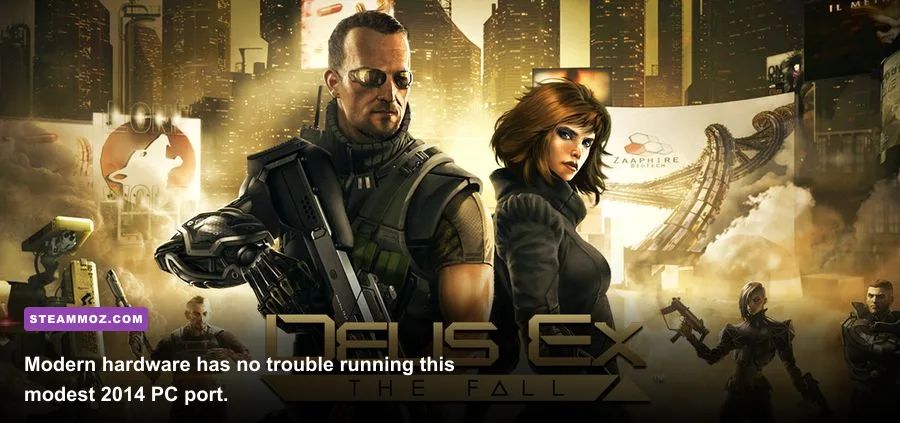
Modern PCs can run Deus Ex: The Fall without breaking a sweat. The Steam listing asks for a Windows 7-era machine with a 2 GHz dual-core processor, 2 GB of memory, a DirectX 9-compatible graphics card, and roughly 4 GB of storage. Those requirements are trivial in 2026. The real issue isn't horsepower; it's compatibility, controller behavior, resolution scaling, and the generally modest quality of the port.
| Setting or Hardware | Minimum Listed Target | Recommended 2026 Profile | Practical Note |
|---|---|---|---|
| Operating system | Windows 7-era support | Current 64-bit Windows with compatibility updates | Run the game as a legacy title if overlays misbehave |
| Processor | 2 GHz dual core | Any modern four-core CPU | CPU performance is rarely the bottleneck |
| Memory | 2 GB RAM | 8 GB or more system RAM | Extra RAM helps multitasking, not game frame rate |
| Graphics | DirectX 9-compatible GPU | Integrated graphics or any modern discrete GPU | Prioritize stable resolution and correct scaling |
| Storage | About 4 GB | SSD installation | Loading is already short; an SSD mainly improves consistency |
Expect high frame rates on contemporary hardware, but don't mistake that for a polished PC experience. Some users report awkward mouse sensitivity, occasional crashes, display-scaling quirks, or controller prompts that feel inherited from mobile design. Disable unnecessary overlays first, try borderless mode if exclusive fullscreen acts strangely, and verify the game's files through Steam before hunting for third-party fixes. Keep expectations realistic: you can make The Fall run smoothly, but you can't patch in the missing level design.
The game is far less troublesome than the notorious PC ports covered in Steamoz's Far Cry 2 PC coverage, yet it still benefits from a little patience. If your display has an unusual ultrawide resolution, test 16:9 first. The Fall was not built for modern aspect ratios, and stretching can make the already dated presentation look worse.
Who Should Play It in 2026?
Play Deus Ex: The Fall if you want a short, playable cyberpunk RPG with hacking, stealth, optional exploration, and a direct connection to the Human Revolution era. It works particularly well as a weekend game. A focused run can be completed in roughly six to eight hours, while searching every area and reading the available lore pushes that higher. Its compact size also makes it a good palette cleanser after a massive open-world RPG.
Skip it if you're looking for the best entry point into the franchise, a deep immersive sim, or a complete story with a clean emotional payoff. Start with the original Deus Ex, Human Revolution, or Mankind Divided instead. The Fall's ideas are easier to appreciate after you understand what a fully realized Deus Ex game can do.
| Player Type | Recommendation | Why |
|---|---|---|
| Deus Ex completionist | Buy on sale | Ben Saxon's story and the setting add useful series context |
| Immersive-sim newcomer | Maybe | Good introduction to hacking and route choice, but not the strongest example |
| Action shooter fan | Skip unless discounted heavily | Combat is functional, not deep or especially satisfying |
| Cyberpunk atmosphere hunter | Recommended | Panama City's neon streets and corporate spaces carry real mood |
| Story-first RPG player | Wait for a sale | Interesting themes are held back by the short, unfinished-feeling campaign |
My final recommendation is simple: Deus Ex: The Fall is worth playing in 2026 at a low price, not at premium expectations. Approach it as an archived side chapter, lean into hacking and stealth, explore before following objectives, and accept that its final act cannot match its opening promise. It isn't the forgotten masterpiece some fans hope to discover, but neither is it disposable mobile shovelware. Under the rough port and abrupt structure is a small, surprisingly authentic Deus Ex experience.
For more compact RPG and strategy recommendations, browse Steamoz's Everspace weapon guide and Far Cry 3: Blood Dragon weapons ranking. For official background, compare the game's listing with the official Deus Ex website and Eidos-Montréal's official site before deciding where The Fall fits in your backlog.