
The fastest way to level up in Bus Simulator 18 with the Official Map Extension is to build short, dense routes through the two added districts, repeat them in Career mode, and protect your score with clean driving. There is no traditional gold currency to hoard: the useful “gold” is the gold medal rating awarded for strong mission and route performance. Farm that rating alongside experience by connecting nearby stops, keeping schedules realistic, and avoiding penalties rather than taking long scenic lines.
This approach works because Bus Simulator 18 rewards consistency more than distance. A huge route can look profitable, but every extra junction adds traffic lights, collisions, missed stops, passenger complaints, and timetable pressure. The map extension is at its best when treated as a compact training circuit. You can learn the roads, memorize braking points, and turn the same reliable route into a repeatable XP and gold-medal run.
What the Official Map Extension Actually Adds
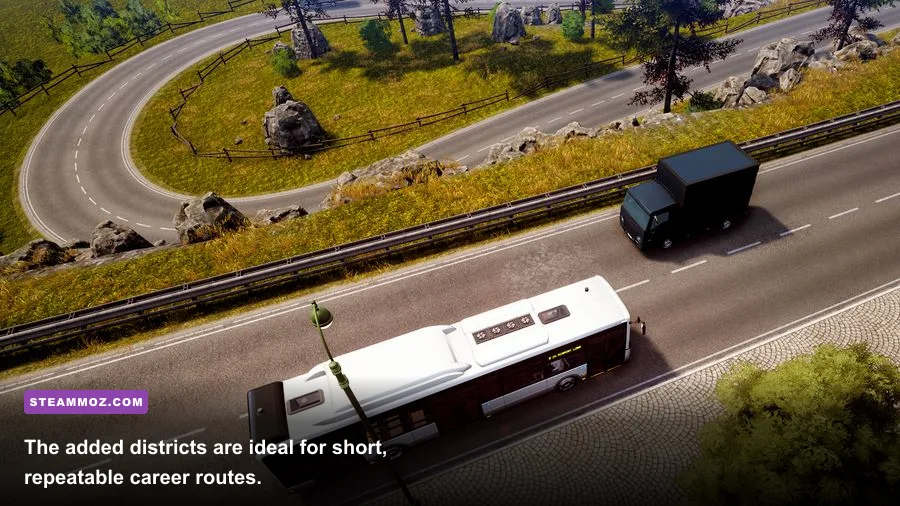
The Official Map Extension on Steam expands Seaside Valley with two additional districts. It is not a separate game mode or a magic XP multiplier. Its value comes from fresh roads, new stop combinations, and more room to create efficient lines after the original campaign routes become familiar.
Before farming, unlock the extension's districts through the normal career progression. If a district or mission is unavailable, driving around it in Free Ride will not bypass the campaign requirement. Career unlocks, route creation, and company progression still matter. Once the areas are open, scout them without passengers first. Look for clusters of stops, wide turning spaces, traffic-light density, hills, and junctions where an articulated bus is likely to clip a curb.
| Route Feature | Farming Value | Why It Matters |
|---|---|---|
| Three to five nearby stops | High | Creates short cycles with frequent scoring events |
| Long straight approach roads | High | Makes speed control and braking easier |
| Dense traffic-light junctions | Medium | More delay and violation risk |
| Tight corners and narrow lanes | Low for beginners | Raises collision and curb-hit risk |
| Mixed residential and commercial stops | High | Provides varied passenger activity without excessive distance |
For official details on patches, licensed content, and the current version, check the TML-Studios website. The game also supports workshop content, but custom maps and mods should be separated from a clean progression run if you want dependable results.
🎮 Bus Simulator 18 - Official map extension
Looking to experience this game? Grab your digital key directly on our store for $4.79.
View on Steammoz Store →Build a Short Route That Pays Repeatedly
Start with a loop of four or five stops, not a line that crosses the entire map. Put the first stop close to the depot or a safe turnaround, then connect the most compact cluster in the new district. A good farming loop should take roughly ten to fifteen minutes once you know it. That gives you repeated boarding events, manageable timetable pressure, and a quick reset if one run goes bad.
When creating the line, avoid stacking every available stop into one route. The route planner can tempt you into building a monster circuit, but added stops only help when they sit naturally along the road. A stop that forces a U-turn or detour is usually a net loss. Remove it, test the line, and compare the score instead of judging the route by its total length.
Use the first run as a calibration lap. Record where the timetable becomes tight, where passengers accumulate, and where the bus needs a wider turning path. Then edit the line. The best repeat route normally has one clear direction, minimal backtracking, and a final stop that returns you close to the beginning. If your loop ends far away, the empty repositioning drive wastes time and creates another chance for damage.
| Route Type | Recommended Stops | XP and Gold Potential | Best Use |
|---|---|---|---|
| Compact district loop | 4–5 | Very high | Repeat farming and medal attempts |
| Balanced commuter line | 6–8 | High | Learning the extension and building demand |
| Cross-map line | 9+ | Inconsistent | Exploration, not efficient farming |
| Single-stop shuttle | 2 | Low | Bus testing and parking practice |
As with the route advice in our 4th & Inches tips guide, repeatability beats flashy plays. In Bus Simulator 18, that means a line you can drive almost perfectly while half-focused is more valuable than a theoretically larger route you frequently fail.
How to Protect Gold-Medal Scores
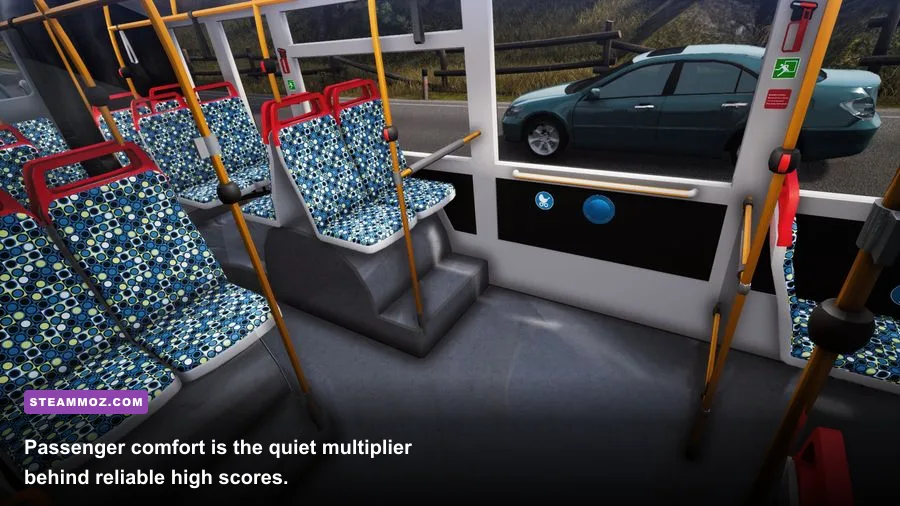
Gold medals are won through a clean collection of small decisions. Stop accuracy, passenger comfort, punctuality, and traffic discipline all matter. You do not need to drive aggressively to make the timetable; you need to leave the stop smoothly, anticipate lights, and brake early enough that passengers are not thrown around the cabin.
At every stop, position the bus parallel to the curb and open the doors only when fully settled. A crooked approach can leave passengers waiting or make the boarding area awkward. Watch the stop marker rather than the front bumper. The rear of an articulated bus can swing wider than expected, so enter the stop slowly and straighten before opening the doors.
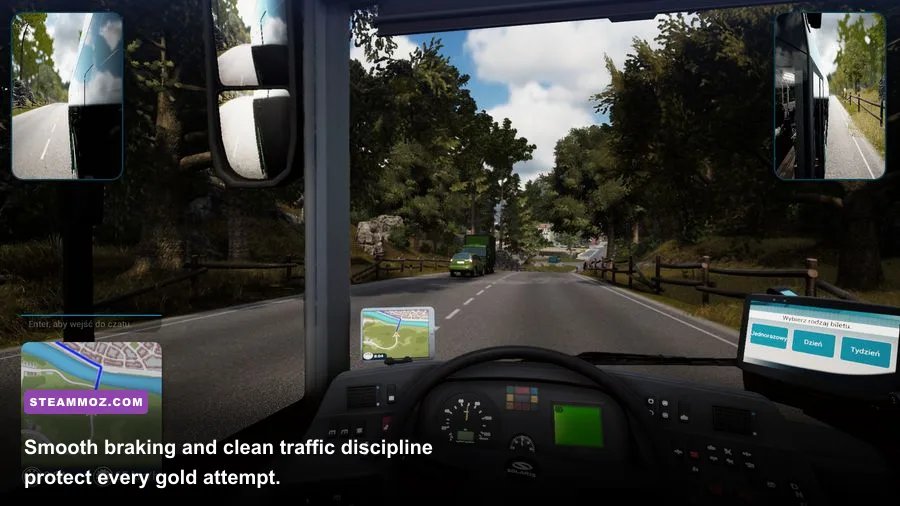
Before pulling away, check the mirrors and wait for the boarding animation to finish. Then indicate, release the parking brake, and accelerate gently. Sudden throttle inputs are especially costly in a packed bus. The same applies to braking: start earlier than you would in a car. A controlled stop at the line is worth more than arriving quickly and producing a passenger complaint.
| Score Threat | Common Trigger | Reliable Counter | Medal Impact |
|---|---|---|---|
| Passenger discomfort | Hard acceleration or braking | Use gradual throttle and early braking | High |
| Traffic violation | Running a red light or speeding | Lift off early and obey signals | High |
| Late arrival | Overlong route or traffic delay | Cut detours and leave buffer time | High |
| Collision damage | Clipping traffic, curbs, or signs | Slow before turns and use mirrors | Very high |
| Missed boarding | Stopping too far from the marker | Center the bus and open doors when aligned | Medium |
Do not restart after every tiny mistake. A minor curb touch may still leave the run salvageable, while a serious collision or repeated violation is usually a better reset. Keep separate saves or avoid overwriting a clean career state until you know the route is stable.
Choose the Right Bus for Fast Progression
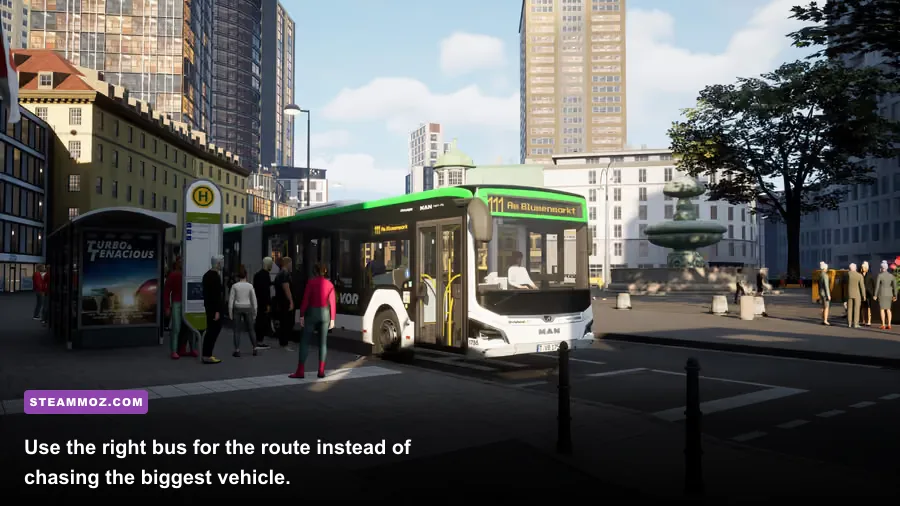
Use the smallest suitable bus while learning the extension. A shorter city bus is easier to place at stops, turns more cleanly, and gives you more room to recover when traffic blocks a junction. Move to a longer or articulated vehicle only after the route has wide corners and predictable demand. Bigger capacity is useful when passengers are left behind, but it does not automatically improve XP per minute.
Licensed vehicles such as the MAN Lion’s City range feel different on the road, especially when you switch between shorter and articulated layouts. Treat each bus as a handling change, not a cosmetic upgrade. Practice the same loop in Free Ride, then run it in Career mode once you can clear the difficult corners without touching the curb.
Company progression should guide purchases. Buy a bus that unlocks a useful route requirement or handles your busiest line; do not spend early funds simply because a larger model is available. A reliable bus on a gold route earns more practical progress than an expensive vehicle driven on an inefficient line.
| Bus Choice | Strength | Weakness | Farming Recommendation |
|---|---|---|---|
| Short rigid bus | Easy turning and stop alignment | Lower passenger capacity | Best for learning and tight districts |
| Standard city bus | Balanced capacity and handling | Less forgiving than a short bus | Best all-round repeat farmer |
| Articulated bus | Moves more passengers per run | Wide turns and rear-swing risk | Use after mastering the route |
If you enjoy optimization-heavy games, our Barotrauma settings guide covers the same kind of practical performance thinking: remove friction first, then chase higher output.
The Fastest Daily Farming Routine
Begin each session by checking the active campaign objective and your current company unlocks. If the task awards a medal, run that mission first while your attention is fresh. Afterward, switch to the compact Official Map Extension loop and repeat it until the route stops feeling clean. This combines one-time progression with repeatable driving practice instead of wasting a session on random exploration.
Step 1: Scout without pressure
Drive the proposed line in Free Ride. Learn the traffic lights, stop approaches, and the one corner most likely to cause trouble. Test both directions; the reverse loop may have better visibility or fewer left turns.
Step 2: Edit for safety
Remove awkward detours, isolated stops, and any segment that consistently creates late arrivals. A slightly shorter route with zero collisions will outperform a longer line with more passenger events.
Step 3: Run a clean career attempt
Use indicators, obey signals, and drive below the limit whenever the road narrows. Keep the camera angle that gives you the best mirror and stop-marker visibility. If a traffic jam forms, do not force a risky overtake; wait, because a collision can erase the value of the entire run.
Step 4: Repeat and adjust one variable
After each run, change only one thing: bus choice, stop order, route length, or driving pace. This makes it obvious what actually improved the score. Once you have a gold result, leave the route alone and farm it rather than endlessly rebuilding it.
For broader progression habits, compare this method with Steamoz's beginner progression guide and PC fixes guide. The lesson carries over: remove avoidable losses before chasing advanced optimizations.
Settings That Keep Driving Consistent
Stable performance matters because stutter can make braking, mirror checks, and stop alignment feel inconsistent. Bus Simulator 18 is an older PC game, so lowering expensive visual options is usually more useful than sacrificing input responsiveness. Keep the resolution native if possible, then reduce shadows and reflections before turning down texture quality.
| Setting | Recommended Value | Performance Impact | Visual Trade-Off |
|---|---|---|---|
| Resolution | Native monitor resolution | High | Preserves dashboard readability |
| Shadows | Medium | Medium to high | Less detailed road shading |
| Reflections | Low or medium | Medium | Fewer convincing bus and window reflections |
| Texture quality | High if VRAM allows | Low to medium | Keeps signs and scenery sharp |
| View distance | High | Medium | Improves junction visibility |
| Motion blur | Off | Small | Clearer braking and turning view |
Finally, disable distractions that make a perfect run harder: unnecessary overlays, excessive camera shake, and audio levels that hide indicator or warning cues. The official Bus Simulator 18 Steam page lists the supported PC specifications, while the official Steam community discussions remain useful for version-specific troubleshooting.
The winning formula is deliberately unglamorous: compact extension route, safe bus, clean stops, and repeated gold attempts. Once the roads become familiar, the Official Map Extension stops being extra scenery and becomes your most dependable progression circuit.