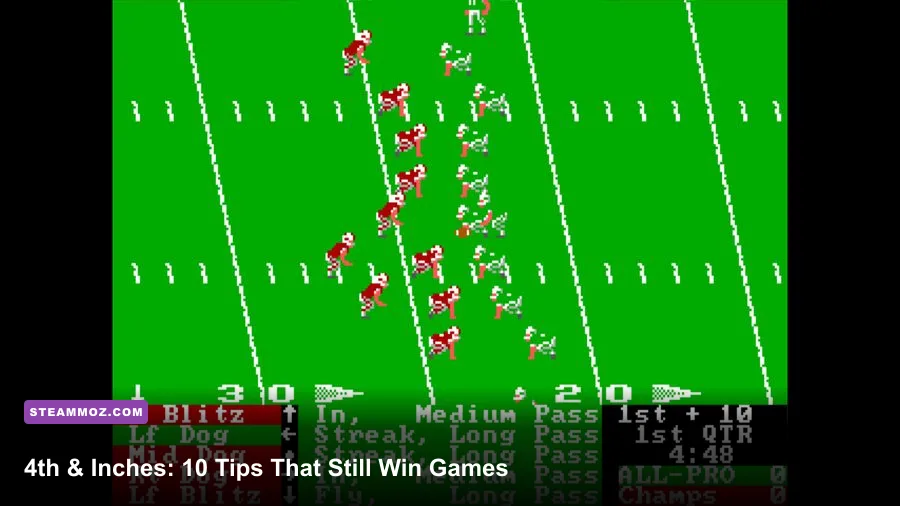
4th & Inches rewards patience, field position, and simple play-calling more than frantic joystick movement. For new players, the winning formula is straightforward: learn the four-down rhythm, identify what the defense is giving away, run behind blockers instead of away from them, and treat every possession as a field-position battle. Accolade’s 1987 football game looks primitive beside modern simulations, but its small playbook makes every decision visible—and brutally punishable.
This is not a game where you can hide behind ratings screens, audible into ten exotic formations, or rely on a generous comeback system. The core loop is old-school football: pick a play, read the developing blocks, control the ball carrier or quarterback, and make the next yard count. The advice below applies to the original computer versions and emulated play, although keyboard layouts and controller mappings can vary by release. If you’re running it today, the official DOSBox site is the safest place to start for a compatible environment.
Start With the Four-Down Math
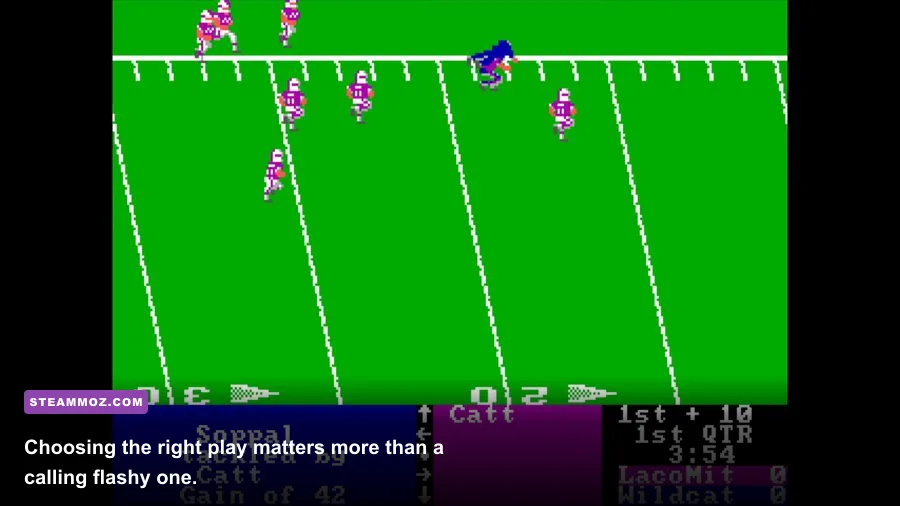
The most important rule in 4th & Inches is also the easiest to ignore: you have four downs to gain 10 yards. That sounds obvious, but beginners often treat every snap like an isolated action. They throw deep on first down, lose yardage, panic on second, and then discover that third down has become a must-pass situation.
Think in three-play sequences. On first down, aim for a modest gain that keeps the playbook open. A run of four or five yards is excellent because it leaves manageable options on second down. On second down, use the defense’s alignment to decide whether to continue attacking the ground or take a controlled pass. Save your most reliable play for third down, not your most entertaining one.
Fourth down is not automatically a failure. If you are near midfield and only need a yard, a conversion attempt can be correct. If you are backed up inside your own territory, a turnover on downs gives the opponent a short field. The game’s title encourages aggression, but good aggression is situational. Count the distance, count the field position, and only then decide whether to punt or go for it.
| Down Situation | Best Beginner Goal | Why It Works | Main Mistake |
|---|---|---|---|
| 1st and 10 | Gain 3–6 yards | Keeps runs and passes available | Forcing a deep throw |
| 2nd and short | Attack the edge or take a safe pass | Creates a manageable third down | Ignoring defensive alignment |
| 3rd and medium | Use your highest-confidence play | Protects the drive | Calling a low-percentage bomb |
| 4th and short | Convert only with field position in mind | A yard can be worth more than possession risk | Going for it automatically |

🎮 4th & Inches
Looking to experience this game? Grab your digital key directly on our store for $2.44.
View on Steammoz Store →Ten Essential Tips for New Players
1. Learn the controls before chasing wins
Spend a few possessions learning how movement, switching players, passing, and tackling feel. Classic 4th & Inches does not offer the input forgiveness modern football games provide. A tiny directional mistake can send a runner into a blocker or make a defender take the wrong pursuit angle. If you’re using DOSBox, map the original joystick or keyboard controls to a modern controller and test every button in a low-stakes exhibition game.
2. Run where the blockers are going
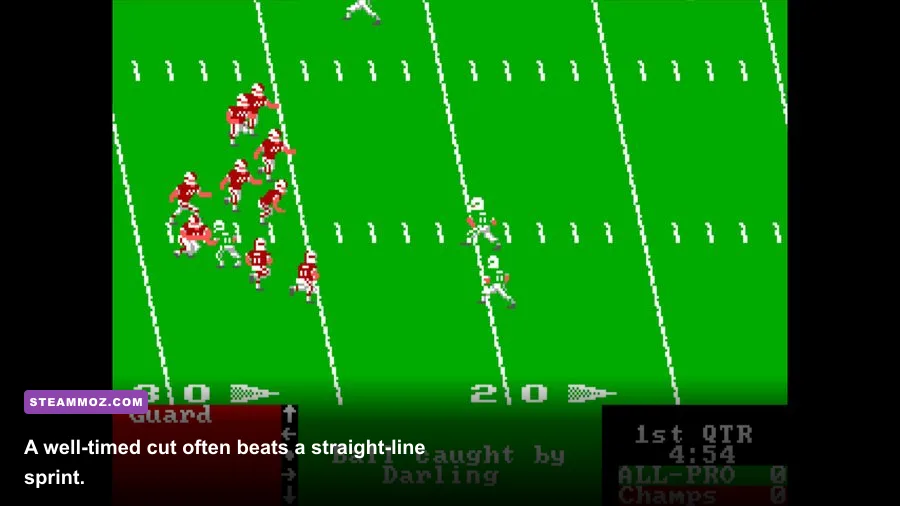
The best running line is rarely the most direct line to the end zone. Watch the lead blockers and follow the gap they create. If the interior is congested, bounce outside only when the edge defender is already engaged. New players tend to hold forward and hope the collision resolves in their favor. It usually doesn’t. Ease off the direction briefly, let the block develop, then cut through the opening.
3. Stop sprinting into the line
Speed feels powerful, but maximum movement makes corrections harder. Use short directional adjustments near the line of scrimmage. A runner who arrives slightly late can slip through a gap; a runner who arrives too early gets swallowed by the first defender. This is especially important on short-yardage plays, where one clean cut is often worth more than a long straight run.
4. Treat short passes as your safety valve
Passing is not just a touchdown tool. A short throw can turn second-and-long into a playable third down and punish defenders who sell out against the run. Aim for open space rather than the receiver’s exact body position. Because the game’s visuals and timing are limited compared with modern Madden-style systems, simple completions are more dependable than trying to thread a spectacular throw between multiple defenders.
5. Throw before the receiver looks completely open
Waiting until a receiver is visibly clear is a common beginner trap. By then, the defender may already be closing. Read the route’s direction, identify the nearest defender, and release the ball into the space the receiver is moving toward. Do not throw across the field just because a target is technically uncovered; the travel time gives pursuit defenders a chance to recover.
6. Use the snap to read defensive spacing
Before committing to a play, look at where defenders are packed. A crowded middle suggests that an inside run is asking for trouble. A thin edge can invite a sweep or outside run. Conversely, a defense spread wide may be conceding interior yards. The game does not bombard you with tactical overlays, so the alignment itself is your information. Make the defense prove it can stop the area you intend to attack.
7. On defense, pursue the angle—not the ball icon
Chasing directly from behind is usually too slow. Move diagonally toward where the ball carrier will be, especially when the runner is heading toward a sideline. The sideline acts as an extra defender, so your job is to cut off the inside escape route. If you control a player who is already out of position, switching early can be better than forcing that player to make a desperate turn.
8. Protect the middle first
New defenders often sprint toward the first visible runner and open a larger lane behind them. Hold the central area until the play declares itself. If the runner goes outside, pursue from inside-out. If the play stays between the tackles, you’re already in position to make the stop. This conservative approach feels slower, but it prevents the huge gains that swing old-school football games.
9. Punt when the field says punt
Possession matters, but field position matters just as much. A failed fourth-down attempt near your own goal line is effectively a short touchdown opportunity for the opponent. Punting from deep can flip the field and make the next defensive stop more valuable. Go for fourth down when the distance is short, the reward is meaningful, and the likely consequence of failure is acceptable—not simply because you dislike giving the ball back.
10. Practice one dependable drive script
Don’t try to master every play immediately. Build a small script: one interior run, one outside run, one short pass, and one third-down call. Repeat it until you understand how the defense reacts. Then add variations. This approach teaches the game’s timing faster than randomly selecting plays. It also gives you a fallback when a match becomes tense and your decision-making starts to collapse.
Build a Small Playbook You Actually Trust
4th & Inches is at its best when you think in complementary calls. An inside run establishes that the middle must be respected. An outside run punishes defenders who pinch inward. A short pass attacks the space created when linebackers step toward the ball. These aren’t modern formation-specific audibles; they’re simple strategic relationships that make the limited play selection feel deeper than it first appears.
For a first campaign or exhibition series, choose plays based on situation rather than personal preference. Use your safest run on first down, your outside option when the defense crowds the center, and your short passing call when the opponent is consistently overcommitting. Keep one aggressive pass available for obvious passing downs, but don’t build your entire offense around it.
| Play Type | Best Situation | Key Read | Risk |
|---|---|---|---|
| Interior run | 1st and 10 or 2nd and short | Gap between the interior blockers | Can stall against a packed front |
| Outside run | Defense compressed inside | Edge defender and sideline | Loss of yardage if the edge closes |
| Short pass | 2nd and medium or 3rd and manageable | Open space ahead of the receiver | Defender can jump the lane |
| Deep pass | Long-yardage situations | Defender position and throw timing | Low margin for error |
| Quarterback sneak or short plunge | 4th and inches | Immediate gap at the line | Minimal room for correction |
Keep a mental note of what the opponent has stopped. If your inside run has failed three times into the same alignment, don’t stubbornly call it again because the play worked in the previous quarter. Classic football games amplify repeated habits: the opponent’s formation becomes a clue, and your play-calling becomes a pattern it can punish.
How to Win the Run Game Without Wasting Downs
Running in 4th & Inches is a timing exercise. The line of scrimmage is crowded, the camera gives you limited information, and collisions happen quickly. Your first objective is not a touchdown; it’s identifying the first defender who can actually stop the play. If that defender is blocked, keep the original path. If the blocker loses leverage, make a small cut rather than attempting a dramatic reversal.
Do not bounce outside by default. The edge looks inviting because it has more screen space, but outside runs take longer to develop and give defenders time to converge. Use them when the middle is clearly sealed or when the defense is overloading the interior. On a short-yardage conversion, trust the designed lane and accept a modest gain.
When controlling the runner, avoid constant directional flicking. Rapid corrections can make your movement look unpredictable to you but actually reduce forward progress. A measured approach—forward movement, brief adjustment, then acceleration—lets you exploit the game’s collision timing. It’s an old technique, but it remains the difference between a two-yard pileup and a first down.
Defensive Tactics That Stop Big Plays
Defense starts before the tackle. Your first job is to keep the offense from turning a normal gain into a breakaway. Maintain inside leverage, force outside movement toward the sideline, and switch defenders when your current player can no longer reach the play. A tackle made five yards downfield is better than a missed tackle that leaves the entire backfield behind you.
Against a run, prioritize the ball carrier’s escape path. Don’t follow the blocker’s movement so closely that you lose sight of the runner. Against a pass, avoid abandoning the middle too early. The offense wants you to chase the first target you see; the safe response is to protect the most dangerous space until the throw is committed.
There’s also value in accepting incomplete information. You won’t always know whether the play is a run or pass immediately. Rather than guessing wildly, take a balanced position for the first moment of the snap. Once the backfield movement reveals the play, accelerate toward the correct lane. This patience is particularly useful for players coming from modern football games, where defensive pre-snap tools can make every read feel explicit.
| Defensive Problem | Likely Cause | Counter Strategy | What to Avoid |
|---|---|---|---|
| Repeated inside runs | Middle defenders are late | Hold the interior and attack the gap | Chasing the edge immediately |
| Outside runs breaking free | Edge is undefended | Pursue inside-out and use the sideline | Taking a direct rear angle |
| Short passes converting | Linebackers overcommit | Keep a defender in the passing lane | Vacating the middle on the snap |
| Deep passes landing open | Late reaction or poor switching | Change control early and protect the route space | Following the quarterback only |
Make the Old PC Presentation Work for You
4th & Inches was designed for an era of low-resolution displays, simple audio, and limited input hardware. Don’t judge its responsiveness through a poorly configured emulator. Lock the emulation speed, avoid unnecessary visual filters that blur player positions, and use a controller mapping with a clear directional input. If the game runs too quickly, the timing window for cuts and tackles becomes much harder to read; if it runs inconsistently, you’ll mistake technical stutter for bad execution.
For preservation background, the MobyGames database is useful for checking release information and platform variations, while the Internet Archive DOS software library provides historical context for the period. Always use legally obtained game files and verify the control scheme for your specific release. If you enjoy this kind of hands-on retro advice, our guides to Hacknet’s first-breach tips and Freedom Wars beginner strategies follow the same principle: learn the game’s actual rules before chasing advanced tricks.
Modern display settings can also affect readability. Keep the original aspect ratio if possible, use a sharp nearest-neighbor scale rather than a soft blur, and avoid input latency from excessive post-processing. You don’t need a powerful PC for this game; you need stable timing and controls that feel immediate. That’s the entire performance “build” here.
Your First Five Games Should Be Practice
Use the first game to learn movement, the second to test a conservative run-first offense, and the third to focus on defensive angles. In the fourth, track how often you convert third down. In the fifth, play the full field-position game: punt intelligently, protect short leads, and stop giving away possessions with desperate throws.
Keep the scoreboard secondary while you learn. A loss where you discover that outside runs are being overused is more valuable than a lucky win built on repeated deep passes. 4th & Inches has fewer systems than modern sports games, but that simplicity exposes your decisions. Once you understand down-and-distance, blocking lanes, pursuit angles, and risk management, the game becomes surprisingly tense.
For more retro PC troubleshooting, Steamoz’s guides to Huntdown’s performance settings and Genesis Noir’s frame-focused setup offer useful general advice for getting older-style games running cleanly. But the biggest upgrade for 4th & Inches isn’t graphical. It’s learning to see a three-yard gain as a win, a punt as a weapon, and one defensive mistake as something you can manufacture rather than merely hope to exploit.