
If Fly Corp’s worldwide route juggling has you hooked, start with Transport Fever 2 for the deepest overall replacement, OpenTTD for unmatched network complexity, and Mini Metro for fast, elegant route optimization. Mini Motorways, Airport CEO, and Sky Haven round out the best games like Fly Corp in 2026, each targeting a different part of its addictive formula: expansion, bottleneck control, airport management, or pure logistics.
Fly Corp is unusually good at turning a simple rule into pressure. You connect cities, unlock countries, watch demand climb, and then discover that one overloaded hub can ruin an entire continent. The best alternatives preserve that cause-and-effect relationship instead of merely putting airplanes on a map. I ranked these games by how strongly they reward planning, how clearly they expose network problems, and how much satisfying decision-making survives after the early-game novelty disappears.
The best games like Fly Corp at a glance
The right choice depends on what you enjoy most about Fly Corp. If you love seeing a network evolve across decades, Transport Fever 2 is the obvious S-Tier recommendation. If you care more about the beautiful panic of repairing a failing network, Mini Metro delivers that feeling in under ten minutes. OpenTTD is less polished and far less welcoming, but its route economics are deeper than almost anything else here.
| Game | Tier | Best for | Biggest difference from Fly Corp |
|---|---|---|---|
| Transport Fever 2 | S-Tier | Long-term transport empires | Detailed 3D cities, cargo chains, and vehicles |
| OpenTTD | S-Tier | Deep route economics | Classic presentation with enormous system depth |
| Mini Metro | A-Tier | Fast network puzzles | Abstract subway lines and escalating passenger demand |
| Mini Motorways | A-Tier | Traffic bottlenecks | Road design replaces aircraft and airports |
| Airport CEO | A-Tier | Building an airport business | Terminal layouts, staff, security, and runway operations |
| Sky Haven | B-Tier | Airline and airport history | Era-based airport construction and airline management |
For a useful point of comparison, Steamoz’s list of games like First Strike: Final Hour covers a more military style of global map strategy. Fly Corp’s closest relatives are gentler in presentation, but they can be just as ruthless about capacity and timing.

🎮 Fly Corp
Looking to experience this game? Grab your digital key directly on our store for $10.49.
View on Steammoz Store →Transport Fever 2 is the strongest all-round alternative
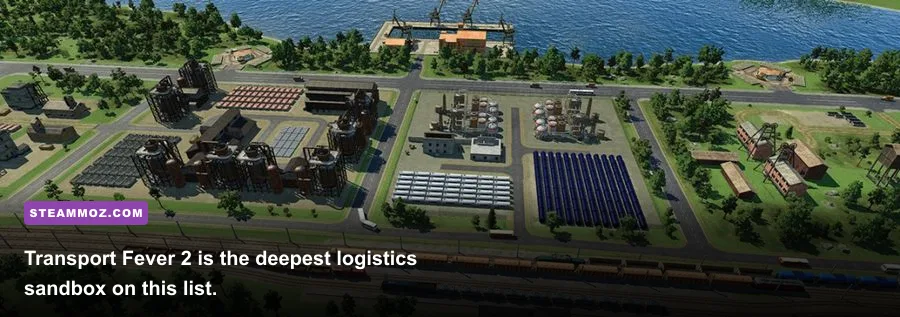
Transport Fever 2 is the game to buy if Fly Corp’s world map makes you wish you could zoom in and actually build the infrastructure. Its campaign and free-play modes let you create road, rail, sea, and air networks across three historical periods, with 200-plus vehicles and production chains that turn every route into a connected business decision.
Why it ranks S-Tier
The key difference is that Transport Fever 2 makes demand physical. A city does not simply need a new connection because a number on the map changed. Passengers need stations, cargo needs the correct production chain, and vehicles need enough frequency to prevent goods from sitting at a terminal. A passenger line from a rural town to a major city can be profitable, but only if its station is placed near enough population and the route is not clogged by slow freight traffic.
Airlines are especially satisfying once your road and rail backbone is ready. Use buses to collect passengers, trains to move them between major urban areas, and aircraft for long-distance connections. A strong setup often looks like a hub-and-spoke system, but Transport Fever 2 gives you more options than Fly Corp: point-to-point flights can work when city populations are large enough, while feeder routes keep smaller towns relevant.
| Transport Fever 2 system | Fly Corp equivalent | Best practical move | Common mistake |
|---|---|---|---|
| Airports and aircraft | City air routes | Use aircraft for long-distance demand | Flying short routes that buses can handle |
| Bus and tram lines | Regional connections | Feed passengers into major hubs | Running too many overlapping lines |
| Rail stations | High-capacity hubs | Separate freight and passenger traffic | Allowing slow cargo trains to block express routes |
| Production chains | Country unlock economy | Trace every resource to its final buyer | Building factories before demand exists |
It is also the prettiest option here. On a mid-range PC, start with high textures, medium shadows, and reduced vegetation if large cities cause stutter. The simulation can become CPU-heavy once you have hundreds of vehicles, so lowering resolution will not always solve late-game slowdowns. Cap the frame rate at 60 and avoid spawning fleets you cannot keep profitable.
OpenTTD rewards the player who loves perfect routes
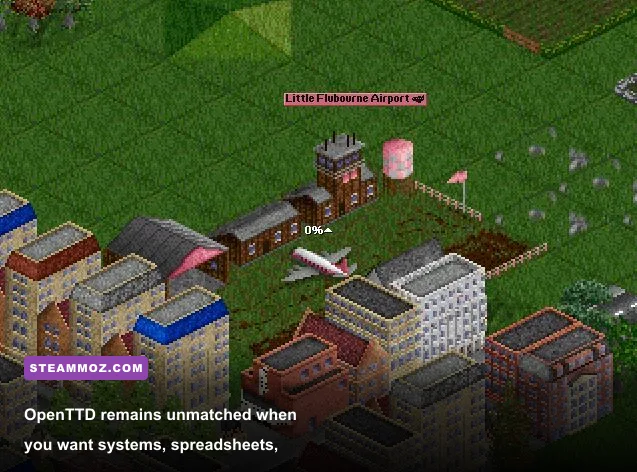
OpenTTD is free, tiny, and visually old-fashioned. It is also one of the most demanding logistics games ever made. You begin with a small amount of money and create transport companies using buses, trucks, trains, ships, and aircraft. The objective sounds familiar, but the detail is on another level: station ratings, cargo waiting times, line capacity, vehicle acceleration, servicing, signals, and terrain all shape your profits.
The network lesson Fly Corp players will appreciate
OpenTTD teaches you to treat every route as a pipeline. A profitable aircraft route can still fail if the airport is too small, the feeder buses arrive in bursts, or passengers wait so long that the station rating collapses. The game’s aircraft are useful for distance, but rail often becomes the economic spine of a mature company. Build your network around cargo flow rather than visual symmetry.
For a reliable first company, connect two nearby towns with buses before touching aircraft. Add a truck route between a nearby industry and its accepting factory, then reinvest in a train only when the cargo volume justifies the track. When you do build rail, use path signals for complex junctions and keep platforms long enough for the train consists you actually intend to run. A short platform creates a capacity problem that money alone cannot fix.
Aircraft become attractive when airports are far apart and passenger demand is high. Avoid placing multiple airports inside the same catchment area unless you have a specific feeder plan. OpenTTD’s economy can punish redundant routes, especially when running costs rise and planes spend too much time circling congested airports. The game is less immediately readable than Fly Corp, but every failure has a traceable cause.
New players should use the official OpenTTD Wiki for signal behavior and cargo rules. It is not hand-holding; it is a reference manual for a game whose best tricks were discovered by people who enjoy counting tiles and checking vehicle timetables.
Mini Metro turns Fly Corp’s pressure into a perfect puzzle
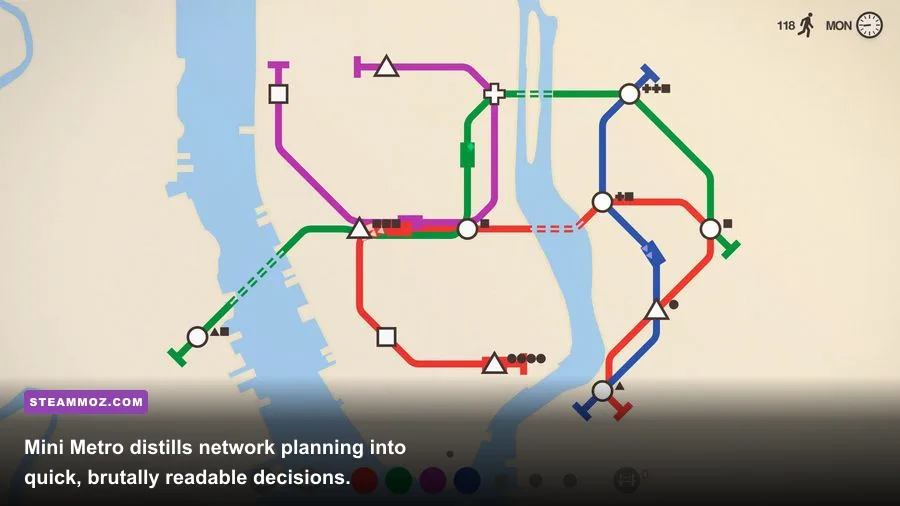
Mini Metro strips the airline fantasy down to colored lines, stations, trains, and passengers. That sounds simple until a triangle appears on the wrong side of the river and your circular line suddenly has three overloaded stations. Each city gives you a different layout, while weekly upgrades force you to choose between more locomotives, extra carriages, tunnels, line extensions, or interchange stations.
Why it feels so close to Fly Corp
Both games are about controlled expansion. You do not lose because one route is technically impossible; you lose because a small inefficiency compounds. A station that receives too many passengers creates a queue, that queue slows your trains, and the delay spreads across every station on the line. The same thing happens in Fly Corp when a major hub absorbs more traffic than its routes can process.
The strongest Mini Metro habit is to build for recovery, not just immediate coverage. Keep one line relatively short so it can serve as a pressure-release valve. Use an interchange at a central station, but do not turn every busy stop into one; passengers transferring through a giant hub can make the entire map fragile. When a special station appears, connect it early enough to prevent a queue, then redesign the surrounding line before the upgrade timer forces another expansion.
| Problem | Warning sign | Best response | Bad response |
|---|---|---|---|
| Overloaded station | Passengers stack faster than trains arrive | Add a carriage or a second line | Extending the same line everywhere |
| Slow transfers | Multiple colors pile up at one interchange | Split the interchange and shorten routes | Adding more circles to the network |
| River bottleneck | Stations wait beside one bridge or tunnel | Reserve tunnels for high-value crossings | Using every crossing immediately |
| Late-game collapse | Several stations turn critical together | Pause and rebuild the worst line first | Adding random extensions while unpaused |
Mini Metro is the best pick for short sessions. A run can be a ten-minute commute or a full evening of chasing a higher score. It lacks Fly Corp’s countries, budgets, and unlock progression, but its interface is so clean that you can see the exact moment your strategy starts to crack.
Mini Motorways is the best road-based substitute
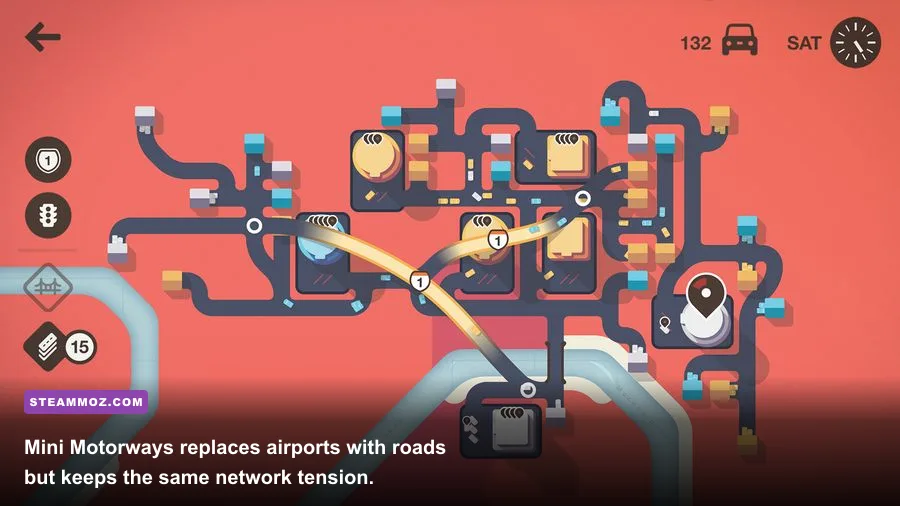
Mini Motorways swaps airports for homes, workplaces, roads, bridges, and motorways. It is not an airline simulation, but it captures Fly Corp’s core pleasure: connect demand efficiently, watch traffic grow, and redesign before one chokepoint takes down the whole system.
Every destination has a color, and matching homes must reach that color. Early roads are easy. Later, houses appear on opposite sides of rivers, destinations expand, and a single road can carry more cars than it was designed to handle. The game never gives you a traditional balance sheet, so your feedback comes from traffic speed and growing queues rather than profit and loss.
The strategy that prevents traffic death spirals
Do not connect every new house to the nearest destination. That instinct creates tangled local roads and forces unrelated traffic through the same intersection. Instead, preserve long, direct routes for high-demand neighborhoods and use motorways to bypass the worst geography. Keep roads short near destinations, where excessive intersections create turning delays.
Bridges and motorways are strategic resources, not convenience buttons. Spend a bridge when the alternative route would create a permanent detour. Save a motorway for a destination that has no clean road solution, especially when the city map generates a river or mountain that divides your network. Like Fly Corp’s busiest hubs, one central intersection can look fine for several minutes before demand suddenly overwhelms it.
Mini Motorways is more tactile than Mini Metro and less economic than Transport Fever 2. Pick it if you want a game that explains its problems instantly. For another route-planning recommendation, check Steamoz’s breakdown of games like Attack on Hex Island; it scratches a more turn-based, territorial side of strategic expansion.
Airport CEO and Sky Haven go deeper into aviation
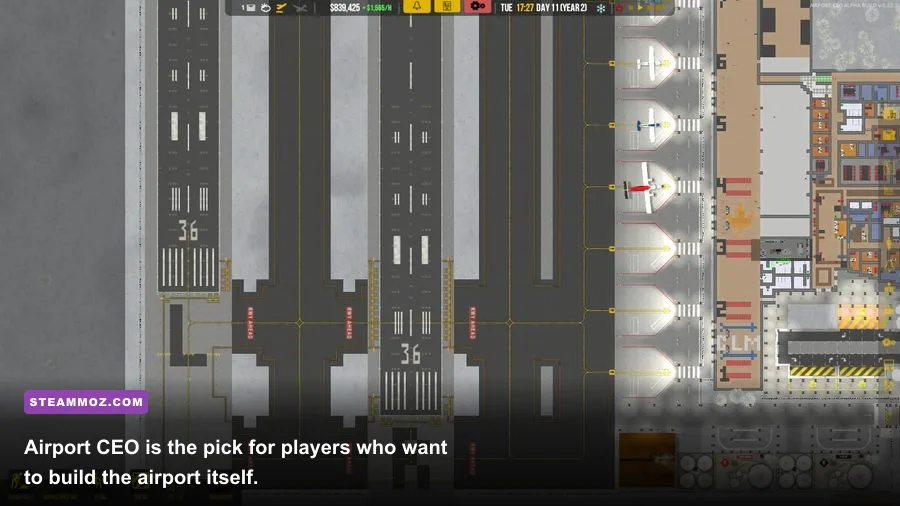
Airport CEO is the closest choice if what you really want is to operate the airport behind Fly Corp’s routes. You design terminals, place security checkpoints, hire staff, build baggage systems, assign gates, manage runways, and negotiate airline contracts. It has more operational detail and less elegant global-map simplicity, so expect a slower start and more time spent fixing queues inside the terminal.
The early-game trap is building too much terminal before you have enough passenger volume. Start with a compact check-in area, one security zone, a few gates, and short walking distances. Passenger happiness drops when paths are confusing or facilities are too far apart, while airline profitability depends on the airport processing flights quickly enough. A beautiful terminal that cannot turn aircraft around on time is just an expensive traffic jam.
Airport CEO is also more sensitive to layout than Fly Corp. Put baggage handling near the relevant gates, separate arriving and departing flows where possible, and leave expansion space around security. When the airport grows, a second security checkpoint can be more valuable than another gate because queues there delay every passenger regardless of airline.
Sky Haven takes a more historical approach. You build airports from the 1930s onward, research new facilities, operate aircraft, and move through aviation eras with changing technology. It is less sandbox-flexible than Transport Fever 2 and not as immediately readable as Fly Corp, but it delivers a satisfying sense of progression. Expanding from a modest early airport into a jet-age hub gives every construction decision more context.
| Game | Airport detail | Economic depth | Best player profile |
|---|---|---|---|
| Airport CEO | Terminal, security, baggage, staff, runways | High | Players who enjoy operational management |
| Sky Haven | Historical facilities and airport expansion | Medium | Players who want aviation progression |
| Fly Corp | Global routes and country unlocks | Medium | Players who prefer map-level decisions |
| Transport Fever 2 | Airports plus complete multimodal infrastructure | Very high | Players building giant transport systems |
Neither game is a direct replacement for Fly Corp’s quick global puzzle. Airport CEO asks you to care about baggage belts and staff zones, while Sky Haven asks you to follow an evolving aviation industry. That added friction is exactly why they work for players who want to stay with an airport project for dozens of hours.
Which Fly Corp alternative should you play first?
Choose Transport Fever 2 if you want the most complete and modern transport sandbox. It offers aircraft, but also lets you solve the first-mile and last-mile problems that Fly Corp abstracts away. Choose OpenTTD if route economics, timetables, station ratings, and train signaling sound exciting rather than exhausting. It is the deepest game here, though the interface takes patience.
Pick Mini Metro for the purest version of Fly Corp’s network pressure. It is easy to learn, hard to master, and excellent on a laptop or handheld. Mini Motorways is better if you enjoy visual redesign and traffic flow. Its roads are instantly understandable, and every collapse teaches you something about redundancy and capacity.
Finally, choose Airport CEO if airports themselves are the fantasy, or Sky Haven if you want an aviation career arc across multiple eras. They are not as clean or immediate as Fly Corp, but they provide the most satisfying detail once your interest moves from “Which cities should connect?” to “How can this airport process twice as many flights?”
My personal order for 2026 is Transport Fever 2 first, Mini Metro second, OpenTTD third, Airport CEO fourth, Mini Motorways fifth, and Sky Haven sixth. That ranking is not about graphics or review scores. It is about how consistently each game turns a growing network into meaningful decisions. If you want more strategy recommendations after this list, Steamoz’s guide to games like Cultures: Northland is a good next stop, while the Barotrauma settings guide is useful when your PC needs help keeping demanding simulations smooth.
Fly Corp’s magic comes from watching a simple connection become an interdependent machine. These six games understand that feeling from different angles. Start with the one that matches your favorite kind of problem, then resist the temptation to overbuild early. The best networks are not the ones with the most lines; they are the ones that still function when demand suddenly doubles.