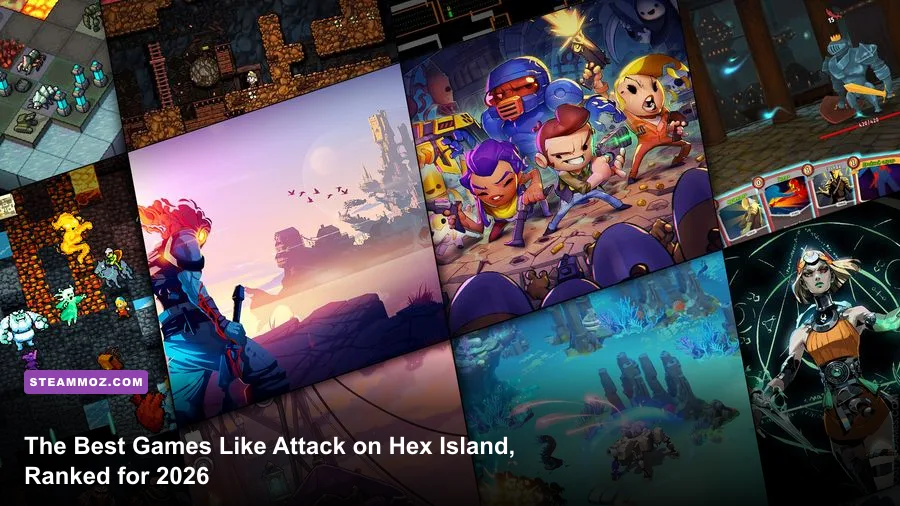
If Attack on Hex Island has you hooked on compact maps, escalating attacks, and the satisfying math of making one tile do several jobs, start with Into the Breach. It is the closest match in 2026, while Hexarchy is the better pick for territorial expansion, The Last Spell for long-form defense, and Cobalt Core for a deckbuilding spin on readable tactical combat. These aren't interchangeable clones, but each preserves the decision-making that makes a hex-island run so difficult to put down.
That distinction matters. Attack on Hex Island works best as a bite-sized strategy game: you read the board, anticipate the next assault, spend limited resources, and accept that a perfect run can collapse because one defensive tile was placed one space too far away. The recommendations below are ranked around those priorities rather than broad genre labels. If you want a relaxed city builder, this isn't the list. If you want every turn to feel like a small emergency, keep reading.
For a useful point of comparison, Steamoz's AI War 2 review looks at a strategy game built around pressure and counterplay, while the Biped 2 weapon tier list shows how much a strong recommendation depends on specific mechanics rather than a game's store-page genre.
The 2026 ranking at a glance
The ranking uses four tests: how clearly the game communicates danger, how meaningful each tile or action feels, whether a run supports different solutions, and how well the difficulty curve rewards learning instead of simply adding hit points. S-Tier games capture the core appeal immediately. A-Tier picks are excellent but change one major ingredient. B-Tier choices are worth playing when you want the same strategic itch with a different rhythm.
| Game | Tier | Closest match | Best for |
|---|---|---|---|
| Into the Breach | S-Tier | Predictable attacks and compact tactical puzzles | Short, brutally replayable runs |
| Hexarchy | S-Tier | Hex maps and fast territorial decisions | Players who want expansion and deckbuilding |
| The Last Spell | A-Tier | Wave defense and scarce upgrades | Longer campaigns with RPG progression |
| Cobalt Core | A-Tier | Turn planning and build experimentation | Deckbuilders who like visible enemy intent |
| Bad North | B-Tier | Island defense and positional control | Clean, accessible real-time tactics |
Why these games beat generic strategy recommendations
Many turn-based games give you a large map and hundreds of units, then bury the interesting choice under administration. The games here do the opposite. Their battlefields are small enough to understand at a glance, but every occupied space has a price. A blocked route can save a village. A greedy capture can expose your flank. A cheap card can be stronger than a legendary upgrade if it lets you preserve tempo.
They also respect information. In the strongest alternatives, you can usually see an enemy's target, movement range, or attack lane before committing. That doesn't make them easy; it makes failure educational. After a lost run, you can identify the exact decision that broke the defense rather than blaming an invisible dice roll.

🎮 Attack on Hex Island
Looking to experience this game? Grab your digital key directly on our store for $9.99.
View on Steammoz Store →S-Tier alternatives that nail the hex-grid tension
1. Into the Breach
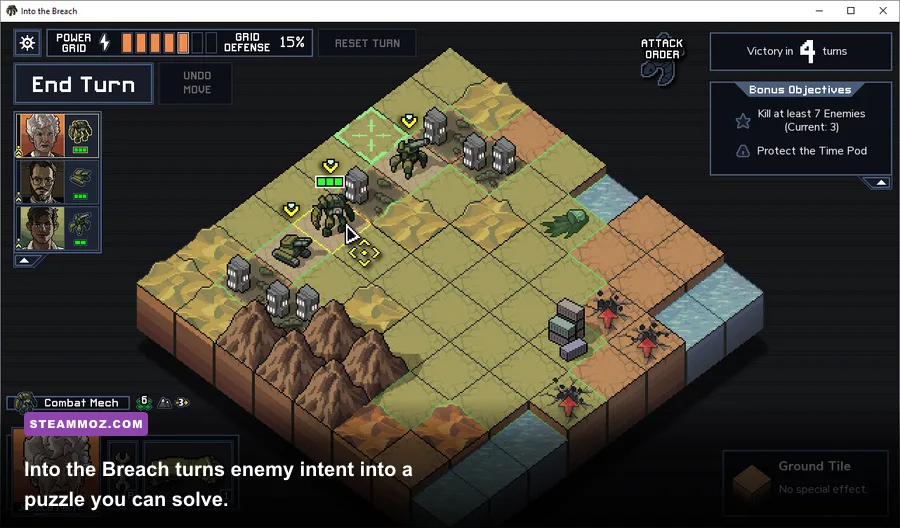
Into the Breach is the obvious recommendation, and obvious doesn't mean overrated. Each battle takes place on an 8-by-8 grid. You control a squad of three mechs, and the Vek announce their attacks before you act. The real objective isn't to kill everything. It's to push, block, freeze, smoke, or otherwise redirect threats so civilians survive and the Grid Power meter doesn't collapse.
The Rusting Hulks squad makes a particularly good transition from Attack on Hex Island because its Jet Mech, Rocket Mech, and Pulse Mech teach three essential habits: repositioning, delayed damage, and displacement. The Rocket Mech's artillery shot can hit a target at range while leaving fire behind; the Pulse Mech can push adjacent enemies and protect buildings without dealing damage. That last detail is the point. Damage is only one answer.
The game has 5 grid power units at the start of a standard run, and losing a protected building costs one power unless you can repair the damage later. A perfect island often comes down to a one-damage environmental trick: shoot a mountain to create smoke, move a Vek onto a spawn tile, or push an attacker into another enemy. The official Into the Breach Steam page remains the best place to check current edition details.
2. Hexarchy
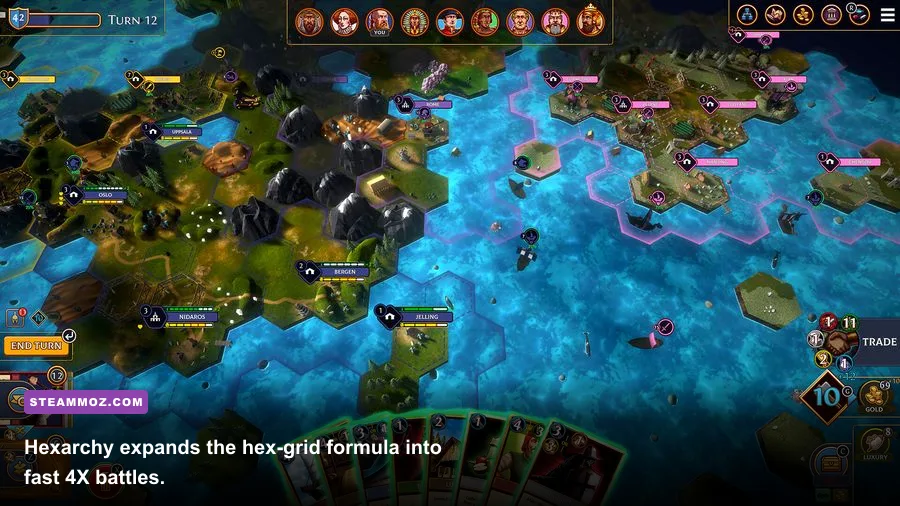
Hexarchy is the pick if the part you love most is claiming an island, connecting resources, and turning a small lead into a dangerous snowball. It mixes 4X systems with deckbuilding, so your faction's economy and military identity are shaped by the cards you draft. A typical match is much broader than a single Attack on Hex Island encounter, but turns stay fast because every action is focused on expansion, research, production, or combat.
Its best strategic lesson is adjacency. A settlement that touches useful terrain can become a production engine, while an isolated outpost may be strategically worthless even if it expands your border. Don't throw every card into the first attack. Early research and resource cards improve the quality of your future draws, and that compounding advantage is usually stronger than taking a low-value neutral tile.
Hexarchy is especially good for players who want an answer to the question, “What happens after I survive the wave?” Instead of resetting to a menu, you develop the map, unlock technologies, and make the next conflict harder or easier through earlier choices. Visit the official Hexarchy listing for its current multiplayer and content information.
| Game | Map scale | Core resource pressure | How you win |
|---|---|---|---|
| Into the Breach | 8-by-8 battle grid | Grid Power and civilian survival | Complete objectives and evacuate intact |
| Hexarchy | Expanding hex territory | Production, research, and card quality | Outscore or defeat rival factions |
| Attack on Hex Island | Compact island encounters | Defensive placement and run resources | Survive escalating attacks |
A-Tier picks for deeper runs and bigger build choices
3. The Last Spell
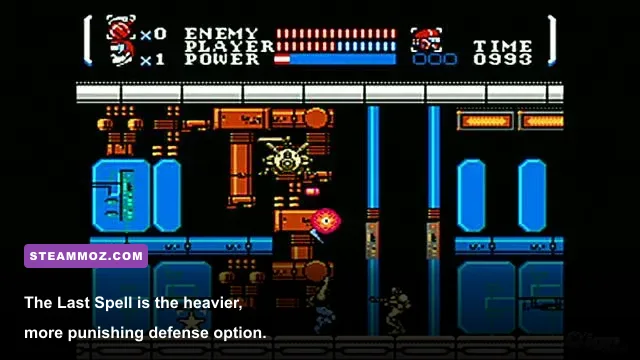
The Last Spell takes island-defense anxiety and stretches it across a full campaign. Every night, hordes of mutants attack Haven, while every day lets you rebuild defenses, recruit or improve heroes, and choose which part of the ruined city to reclaim. The combat grid is larger and more chaotic than Attack on Hex Island, but the principle is familiar: an action that saves one building may expose another.
Your heroes can move, attack, and use skills in the same turn, with action points and mana creating a constant trade-off. A strong early pattern is to use a cheap area attack to soften a cluster, then spend the remaining action points on a high-damage finisher. Don't waste a hero's entire turn chasing one enemy at the edge of the map. The night ends when the threat is controlled, not when every monster is dead, and positioning for tomorrow is often worth more than one extra kill.
The most important progression decision is range versus reliability. A weapon with huge damage but poor accuracy can be excellent against a dense group and terrible when a single runner is one tile from a house. Mix dependable single-target attacks with area damage, and prioritize perks that improve action economy rather than merely inflating a damage number. The official The Last Spell Steam page has the latest information on its campaign and updates.
4. Cobalt Core
Cobalt Core isn't a hex-grid game, but it understands the same pleasure of solving a visible tactical problem. Combat takes place across three lanes, enemy attacks are telegraphed, and your crew's cards let you shift the ship, redirect danger, or set up a devastating turn. The result feels like a compact puzzle wrapped in a roguelike deckbuilder.
Position is the hidden currency. A card that moves your ship can be defensive, offensive, or both depending on the incoming attack pattern. The Scrap resource also rewards careful planning: spending everything to produce a spectacular turn can leave you unable to react when the next enemy intent changes. Build a deck with enough cheap cards to preserve options, then add expensive finishers once your draw and energy economy are stable.
The three playable characters have different card pools and combat identities, so a run changes dramatically depending on who joins the crew. Cobalt Core is a better fit than The Last Spell if you prefer 30-minute runs, repeated drafting, and learning through card interactions. It is less suitable if the satisfying part of Attack on Hex Island is physically surrounding an enemy on a map.
5. Bad North
Bad North is the cleanest recommendation for island defense. Small islands become battlefields, boats reveal incoming Viking units, and you place infantry, pikemen, archers, or shield units where they can survive the landing. It is real-time rather than turn-based, but its maps are compact, readable, and brutally sensitive to positioning.
The key mistake is treating every island like a kill box. Your units need time to recover, and a formation that wins one landing may be exhausted when the second boat arrives. Keep a reserve near the village, use high ground for ranged units, and avoid placing archers where a shielded squad can reach them immediately. The game feels simple for the first few islands, then starts testing whether you can manage multiple landings without panicking.
Bad North is also a good choice for players who want less spreadsheet work. There are no sprawling technology trees or giant inventories. You read the terrain, watch the boats, and make a fast call. For more settings-focused strategy coverage, Steamoz's Dungeons 3 specs and settings guide is a useful companion when your PC struggles with larger simulation-heavy games.
Which game should you play first?
Choose based on the specific part of Attack on Hex Island you don't want to lose. If that is enemy telegraphs and clever tile manipulation, play Into the Breach. If it is building an island economy and expanding toward danger, play Hexarchy. If you want a campaign where every defense changes the next one, pick The Last Spell. Cobalt Core is the strongest choice for deckbuilding, while Bad North is the fastest route to pure island-defense pressure.
| If you want... | Play this | Why | Main warning |
|---|---|---|---|
| Perfect-information tactical puzzles | Into the Breach | Every enemy attack is previewed | It can feel harsh until you stop chasing kills |
| Hex expansion and 4X systems | Hexarchy | Cards shape territory, economy, and warfare | Its strategic layer is broader than island defense |
| RPG progression and huge waves | The Last Spell | Heroes, equipment, and city upgrades create long runs | Late-night battles are substantially more demanding |
| Fast deckbuilding decisions | Cobalt Core | Three lanes and visible intents keep combat readable | There is no physical hex map |
| Accessible real-time defense | Bad North | Small islands make positioning immediately understandable | Reaction speed matters more than in turn-based games |
A practical play order for 2026
Start with Into the Breach and force yourself to complete a run without resetting after every mistake. That teaches the most transferable skill: solving the board you have rather than waiting for an ideal board. Move to Hexarchy once you want longer-term consequences. Then try The Last Spell when you are ready for a campaign that punishes poor economy as much as poor combat.
Use Cobalt Core between heavier sessions. Its runs are short enough for experimentation, and its three-lane combat sharpens your ability to value movement as highly as damage. Bad North works best when you want something immediate and tactile, especially on a controller.
One final warning: don't judge these games by their first hour alone. Into the Breach opens up through squads and pilots, Hexarchy becomes more interesting once card quality starts shaping your faction, and The Last Spell only reveals its real economy after the early safety net disappears. The best Attack on Hex Island alternatives are not games that copy its art or camera angle. They're games that make every small piece of ground feel expensive.
For more focused recommendations, check Steamoz's Alien: Isolation 2026 survival guide, the Dino Crisis 2 weapon rankings, and the Dungeon Tycoon performance guide. But if you only install one game from this list tonight, make it Into the Breach. Nothing else turns a tiny battlefield into such a sharp, replayable argument with yourself.