
After Us is worth playing in 2026 if you want a short, atmospheric platformer with a sincere ecological message, but it is not an essential buy for players chasing precise movement or deep combat. Piccolo Studio's adventure still looks striking, and Gaia's simple toolkit creates a handful of genuinely memorable traversal puzzles. The catch is that its open zones can feel padded, its combat rarely develops beyond basic avoidance, and its environmental storytelling is often more interesting than the actual moment-to-moment play.
That makes this a recommendation with conditions rather than a blanket thumbs-up. Play it for the lonely landscapes, the extinct-animal theme, the quiet audio design, and the pleasure of watching dead spaces bloom again. Buy it on sale if you are sensitive to repetitive encounters, loose platforming, or games that explain their metaphors with a very heavy hand.
What After Us Actually Does Well
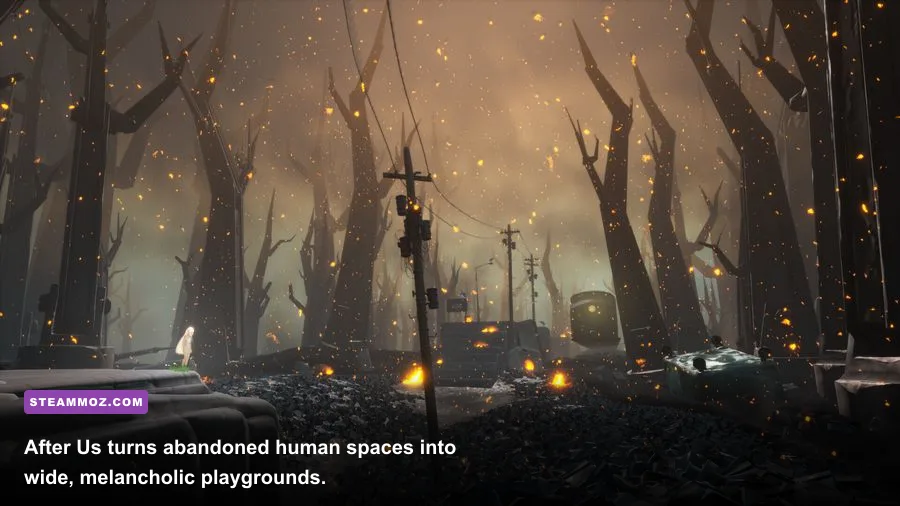
You play as Gaia, a luminous spirit tasked with recovering the souls of Earth's last animals after humanity has destroyed the natural world. The setup is delivered through a stylized myth rather than a conventional science-fiction plot: a maternal creator figure sends Gaia into a collection of devastated regions, where each rescued creature becomes part of the world's gradual recovery.
That premise gives the game a clear emotional target. Gaia is not hunting loot, building a character sheet, or trying to become stronger than a villain. She is repairing a broken ecosystem one animal at a time. The most effective scenes are the quiet ones: a whale spirit moving through an emptied ocean, a wolf returning to a reclaimed habitat, or a dead industrial space filling with color after Gaia restores its life force.
The visual contrast is excellent. Human structures appear as skeletal remnants, oil fields glow with hostile orange and black, and abandoned roads cut through landscapes that are trying to grow around them. Later areas introduce more saturated vegetation and water, but the game never completely forgets the scars left behind. This is a world built around before-and-after imagery, and its best transformations land because the contrast is so strong.
The game also benefits from restraint in its presentation. There is no conventional inventory, no equipment screen, and no weapon system to distract from the central journey. Gaia's abilities are tied to movement and life restoration rather than numerical progression. If you are expecting upgrades with damage values, armor ratings, or skill trees, After Us deliberately goes in the opposite direction.
That simplicity is refreshing for a few hours. It also exposes the game's limitations later. Without a build system or meaningful progression choices, the quality of the individual environments has to carry the entire campaign. When a traversal section is clever, that works beautifully. When it is a long sequence of similar jumps around visual clutter, there is very little else to keep you engaged.
| Element | What You Get | 2026 Verdict |
|---|---|---|
| Story | Gaia restores animal souls in a ruined world | Earnest and visually clear, though sometimes blunt |
| Movement | Jumping, gliding, dashing, wall traversal, and air control | Good when spaces are curated; inconsistent in open areas |
| Combat | Life-energy attacks and evasive encounters | Functional, but not a reason to buy the game |
| Progression | Ability expansion tied to exploration and story progress | Easy to understand, light on long-term depth |
| Collectibles | Animal souls, memories, and optional discoveries | Worth pursuing for completionists, less compelling for everyone else |

🎮 After Us
Looking to experience this game? Grab your digital key directly on our store for $5.99.
View on Steammoz Store →Gaia's Movement Is Better Than Its Combat

Gaia's core movement kit is the reason to keep playing. She can jump across gaps, glide to extend an arc, dash through dangerous spaces, and use wall-running or wall-traversal sequences to climb sections of the environment. The individual actions are not especially complex, but they combine into a readable rhythm: jump, redirect in the air, glide, land, then dash before the next hazard closes in.
The movement feels most satisfying when the level design gives you a clean line through the environment. A good sequence lets you see the next platform, identify the corruption blocking it, and decide whether to take a safer route or commit to a longer airborne chain. There is a pleasing sense of flow when Gaia's abilities connect properly, especially after new movement options open previously inaccessible routes.
Precision is another story. This is not Celeste, and it does not pretend to be. Gaia's jumps can feel floaty, while the camera occasionally makes depth difficult to judge near industrial structures and broken architecture. Some ledges are generous, but others seem to demand a particular approach without clearly communicating it. Missed jumps are rarely catastrophic, yet repeated recoveries can make an otherwise simple route feel clumsy.
Combat uses Gaia's life-based powers rather than traditional weapons. Corrupted creatures and hostile environmental forms patrol several areas, and Gaia can attack, avoid, or move around them depending on the encounter. The visual language is clear enough: threats are generally loud, brightly marked, or animated with a noticeable wind-up. The problem is that the encounters do not evolve enough. Once you understand the timing of Gaia's attack and evasive movement, many fights become brief interruptions between platforming sections.
There is no weapon roster to compare and no stat scaling to optimize. That matters because the game's combat can look more substantial in screenshots than it feels during play. If you want a richer action loop, our Clone Drone survival tips cover a game where timing, attack choice, and enemy reading are much more central. After Us is closer to an exploration platformer that happens to contain hostile encounters.
How to approach the movement system
Use the camera before you use the jump button. Stop at the edge of a platform, rotate until the landing surface is visible, and only then commit to a glide or dash. Gaia's air control is forgiving enough to correct a poor initial angle, but it is not generous enough to rescue every blind leap.
During hostile sections, avoid treating every enemy as a mandatory duel. The quickest route is often to read the arena, activate the nearby life source, and move on. Save your dash for crossing a corruption patch or escaping a telegraphed attack rather than spending it casually on a short gap. That single habit makes the game's rougher encounters much less irritating.
Exploration, Collectibles, and the Four-Part Journey
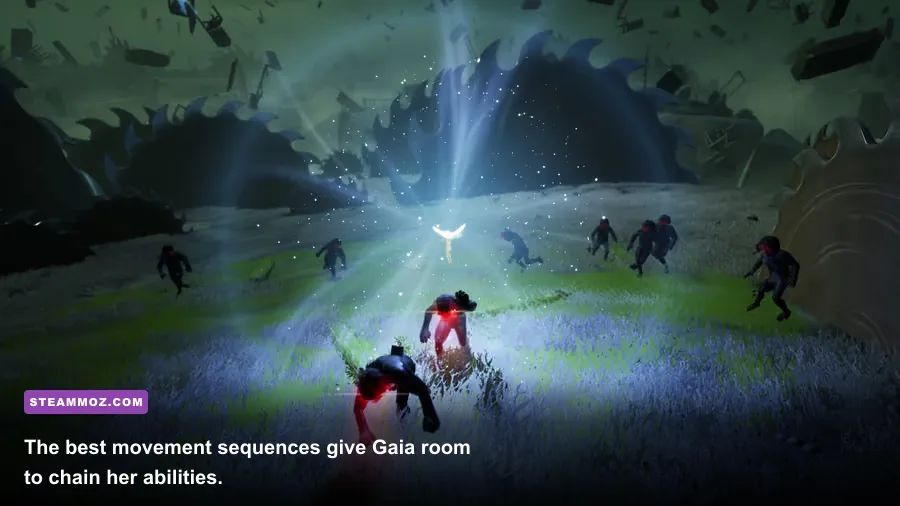
After Us is structured around a series of broad regions rather than one seamless open world. The settings shift between ruined human settlements, barren industrial zones, drowned spaces, forests, and other devastated habitats. Each area mixes a critical route with optional branches containing animal souls, memory fragments, and environmental details that flesh out what happened to the planet.
The animal souls are the strongest collectibles because they reinforce the story's purpose. Finding one does not simply add another icon to a menu; it completes a small piece of Gaia's mission. The game repeatedly asks you to look beyond the obvious route, climb a side structure, or cross a hazardous patch to reach a creature that the main path does not require.
Still, exploration can become noisy. The zones are visually dense, and the game often uses the same kinds of broken roads, concrete shells, pipes, wreckage, and vegetation to communicate scale. Without a strong mental map, you can spend time circling a landmark that looked like a route but was only background dressing. The absence of a robust navigational system makes optional cleanup more frustrating than it needs to be.
The campaign's progression curve is uneven. Early areas are good at teaching the visual grammar of the world: life sources indicate restoration, corruption signals danger, and unusual geometry usually points toward a side path. Later regions are larger and more dramatic, but they do not always deliver a matching increase in mechanical complexity. You often get more space rather than more interesting decisions.
| Progression Stage | Primary Focus | What to Watch For | Completion Advice |
|---|---|---|---|
| Opening regions | Learn Gaia's movement and life-restoration loop | Shortcuts and obvious environmental markers | Explore freely; the game is teaching its visual language |
| Mid-game regions | Longer traversal chains and more corruption hazards | Side routes above or below the critical path | Mark memorable landmarks mentally before backtracking |
| Late regions | Large spaces, heavier atmosphere, and demanding routes | Blind jumps and repeated enemy arenas | Prioritize story progress unless you enjoy collectible cleanup |
| Post-campaign cleanup | Return for missed animal souls and memories | Unclear routes in visually similar areas | Use a written checklist rather than relying on memory |
If you enjoy methodical cleanup, the experience is closer to a compact collectible platformer than a sprawling adventure. Players who liked the observational puzzles in Children of Silentown may appreciate the way After Us hides meaning in its spaces, though After Us replaces dialogue-heavy investigation with traversal and visual discovery.
Performance and Best PC Settings in 2026

On PC, After Us remains a demanding-looking game for its scale. The foliage, volumetric effects, reflective surfaces, and large ruined environments can push the GPU harder than the relatively simple character model suggests. The official Steam listing gives a useful baseline: the minimum specification is a 64-bit Windows 10 system with an Intel Core i5-8400 or AMD Ryzen 5 2600, 8GB of RAM, and a GeForce GTX 1060 6GB or Radeon RX 580 8GB. The recommended tier moves to an Intel Core i7-9700 or Ryzen 7 3700X, 16GB of RAM, and a GeForce RTX 2070 or Radeon RX 5700 XT, with roughly 30GB of storage.
Those figures are best treated as targets for the game's intended presentation, not a guarantee of a locked frame rate. A modern midrange card should handle 1080p comfortably with sensible settings, while 1440p benefits from reducing volumetric quality and screen-space effects before dropping texture quality. Textures usually provide more visual value than expensive fog and reflection options.
| Setting | Recommended Value | Performance Impact | Visual Trade-Off |
|---|---|---|---|
| Resolution | Native 1080p or 1440p | Very high | Use resolution scaling only after lowering heavy effects |
| Textures | High if VRAM allows | Low to medium | Preserves environmental detail and surface clarity |
| Shadows | Medium to High | Medium to high | Medium is a good compromise in busy ruins |
| Volumetric effects | Medium | High | Reduces fog density and some atmospheric depth |
| Reflections | Medium | Medium to high | Water and glossy surfaces lose some subtle detail |
| Anti-aliasing | High or the game's default | Low to medium | Helps foliage and broken architecture shimmer less |
| Motion blur | Off for clarity | Minimal | Cleaner camera movement during jumps and dashes |
For a stable 60fps profile, begin at 1080p, keep textures High, set shadows and volumetrics to Medium, and disable motion blur. If traversal still stutters, lower reflections before textures. Those changes preserve Gaia's bright colors and the game's most important environmental silhouettes. For more general PC optimization context, our Filament settings guide explains the same useful principle: protect clarity first, then trim expensive atmosphere effects.
Console players get a simpler choice between visual quality and responsiveness, depending on platform and display. The faster mode is the better fit for After Us because camera control and landing judgment matter more than small increases in foliage or shadow quality. This is not a slow cinematic game where a lower frame rate adds weight; movement benefits directly from consistency.
Who Should Play After Us in 2026?
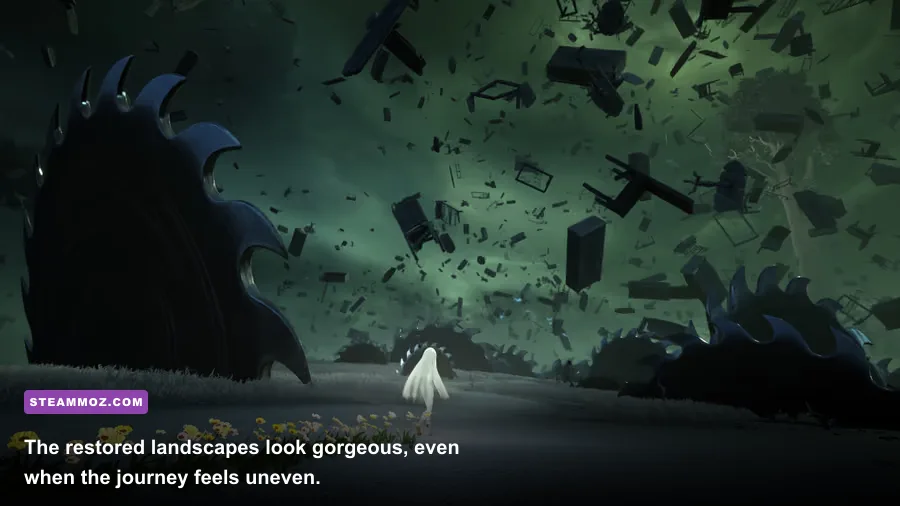
After Us is a strong recommendation for players who like games such as Spirit of the North, RiME, Journey, or Gris and want another reflective adventure built around atmosphere rather than combat depth. It is especially appealing if you enjoy environmental storytelling and do not need every plot point delivered through dialogue. Gaia's journey is easy to follow even when the symbolism gets obvious, and the restored habitats provide a steady visual reward.
It is a weaker recommendation for hardcore platforming fans. The game has satisfying movement, but it lacks the exactness, failure-driven learning, and tightly tuned challenge found in the best precision platformers. It is also a poor match for players expecting a Metroidvania with a large map, layered ability gates, or a meaningful upgrade economy. Gaia gains tools, but the game is not asking you to invent a build or solve a combat puzzle.
The environmental message will divide people. After Us is not subtle about pollution, extinction, and humanity's destructive habits. Oil, abandoned machinery, dead animals, and ruined cities are repeated visual motifs, and the final impression is unmistakably a plea for stewardship. Some players will find that sincerity moving; others may feel the game underestimates them by restating the same idea too often.
That bluntness is balanced by a genuinely lovely sense of place. Piccolo Studio understands how to make a ruined landscape feel mournful without making every screen gray. Bright plants, glowing animal spirits, and Gaia's luminous silhouette give the world a fairytale quality, while the industrial debris keeps the fantasy grounded. The art direction carries scenes that the writing occasionally overexplains.
Check the official Steam page for current PC pricing and specifications, and see Private Division's official game page for platform information. Piccolo Studio's developer page for After Us is also useful if you want more background on the game's visual design and ecological premise.
The final verdict
After Us is worth playing in 2026, but preferably at a discount and with the right expectations. Its world is more compelling than its combat, its atmosphere is stronger than its platforming precision, and its ecological story lands hardest when the game stops explaining and lets a restored landscape speak for itself. The campaign is compact enough that the repetition never completely overwhelms the good ideas, but uneven enough that a full-price recommendation feels generous.
Give it a weekend if you want a colorful, melancholy single-player adventure with no grinding and no live-service clutter. Skip it if you need deep systems, immaculate jumps, or combat that keeps escalating. After Us is not the definitive environmental game, but it remains an earnest and occasionally beautiful reminder that even a damaged world can still be worth saving.
For another perspective on judging performance before you buy, browse our PC requirements coverage and our Eiyuden Chronicle hardware guide. The conclusion is the same here: know what kind of experience you want first, then let the game's gorgeous, damaged world make the final argument.