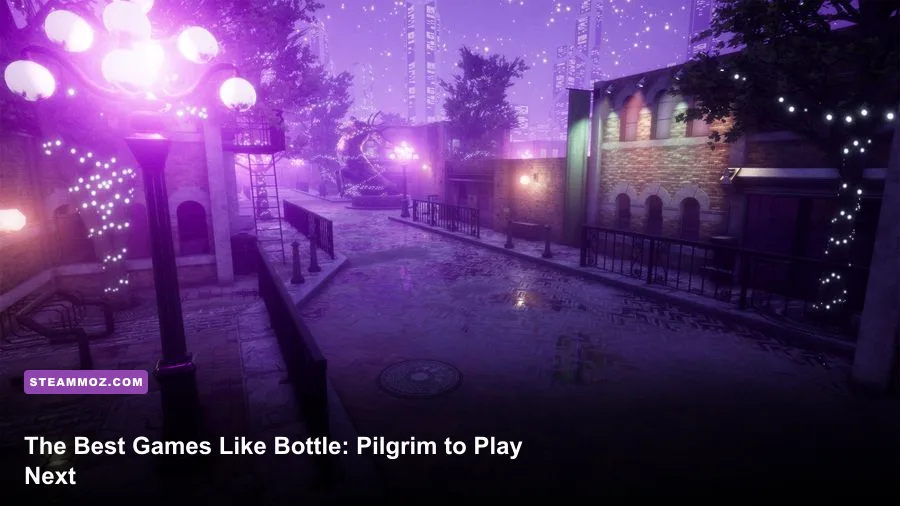
If Bottle: Pilgrim hooked you with its slow-burn journey, tactile discovery, and refusal to bury every quiet moment under combat, start with Eastshade, Season: A Letter to the Future, and Sable. They capture the same feeling of moving through a world at your own pace, but each pushes the formula in a different direction: painting, documenting a culture, or crossing a huge desert on a hoverbike.
That distinction matters. Bottle: Pilgrim belongs to a particularly appealing corner of adventure games where the reward is not a legendary sword or a giant damage number. You are there to notice things. A distant landmark, a half-forgotten story, a strange architectural detail, or a conversation that lands differently after you understand the setting. The six games below are the strongest follow-ups for that kind of player, ranked by how closely they preserve the same meditative exploration loop.
The best Bottle: Pilgrim alternatives ranked
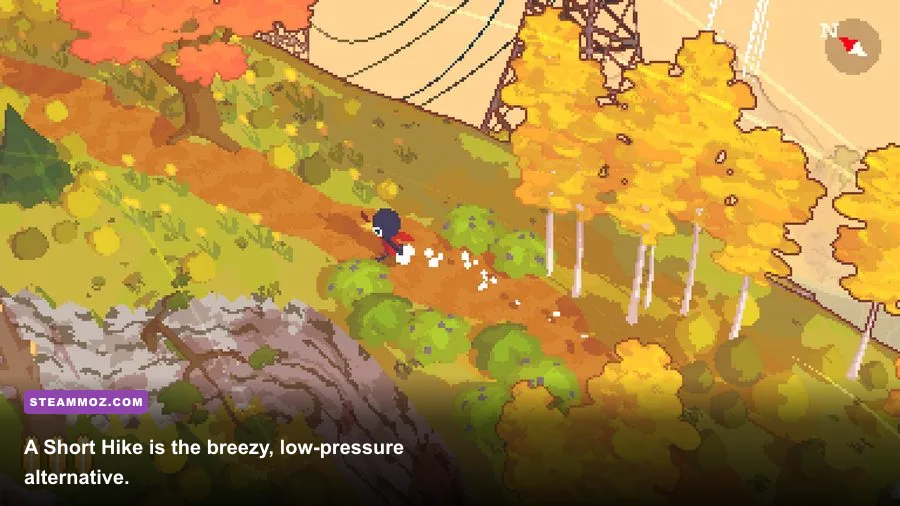
My S-Tier picks are Eastshade and Season: A Letter to the Future. Both make observation an active mechanic rather than decorative scenery. Sable sits just behind them because its open world is more game-like and less intimate, although its travel system is superb. A Short Hike is the best short-form option, while Dordogne is the strongest choice if you want a tightly authored story with almost no wandering overhead.
| Game | Tier | Core activity | Typical length | Best for |
|---|---|---|---|---|
| Eastshade | S-Tier | Painting landscapes and helping residents | 8–12 hours | Players who want peaceful worldbuilding |
| Season: A Letter to the Future | S-Tier | Recording places, voices, and memories | 8–10 hours | Players who value atmosphere and documentation |
| Sable | A-Tier | Exploring ruins and completing mask quests | 12–20 hours | Players who want a larger world |
| A Short Hike | A-Tier | Climbing Hawk Peak and helping hikers | 2–4 hours | Players wanting a compact feel-good adventure |
| Dordogne | B-Tier | Solving memory-driven puzzles | 4–6 hours | Players who prefer linear storytelling |

🎮 Bottle: Pilgrim
Looking to experience this game? Grab your digital key directly on our store for $1.99.
View on Steammoz Store →1. Eastshade is the closest overall match

Eastshade on Steam is the easy recommendation if the appeal of Bottle: Pilgrim is its gentle rhythm. You play a traveling painter on the island of Eastshade, and your canvas is effectively your weapon, quest item, and conversation starter. There is no combat system to interrupt the mood. Instead, you explore four major settlements and the surrounding wilderness, accept requests from locals, and create paintings by finding the right composition and pressing the painting prompt.
The clever part is that painting is not just a photo mode. Residents request specific subjects, and completing those paintings unlocks dialogue, items, or access to new areas. A blocked route may require a particular quest chain rather than a stronger character. That gives Eastshade a satisfying progression curve without traditional levels or gear scores.
Its weaknesses are worth knowing. Movement can feel floaty, and some fetch quests stretch a little too long. The game also has a handful of awkward collision moments around slopes and ladders. Still, its environmental storytelling is unusually confident. Look for benches, docks, cave entrances, and elevated viewpoints before chasing quest markers; the best paintings often come from ignoring the obvious route.
If you like games that turn scenery into evidence, Steamoz's A Monster's Expedition recommendations are another strong stop after Eastshade.
2. Season: A Letter to the Future makes memory playable
Season: A Letter to the Future is more structured than Bottle: Pilgrim, but its central idea is nearly perfect for the same audience. You cycle through a rural valley shortly before a mysterious change called the end of a season. Your tools are a camera, an audio recorder, a journal, and your bicycle. Every location becomes an opportunity to collect fragments before the world moves on.
The camera has real utility. You can photograph landmarks, objects, and people, then arrange those discoveries inside your journal. Sound recordings add another layer: wind, machinery, wildlife, and conversations create a richer record than a screenshot alone. The result is a scrapbook that reflects what you chose to notice, not merely a checklist of mandatory collectibles.
Season is best played slowly. Stop at the roadside shrines. Read the notes in abandoned buildings. Rotate your camera around a scene instead of snapping the first obvious subject. The game occasionally nudges you toward a puzzle solution through visual framing, so rushing from objective to objective removes a lot of its texture.
The trade-off is pacing. Its final act becomes more dialogue-heavy and less open than the early cycling sections. If you want unrestricted wandering for twenty hours, Sable is a better fit. If you want an emotional travel diary with a clear beginning and ending, Season is the sharper recommendation.
3. Sable is the open-world upgrade

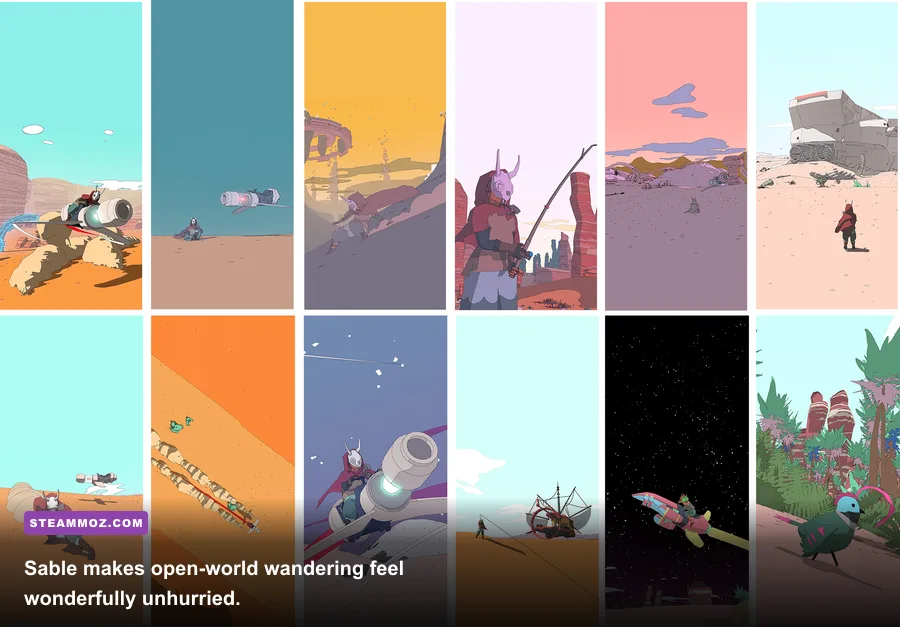
Sable takes the quiet pilgrimage idea and expands it across a desert world filled with crashed ships, ancient ruins, nomadic camps, and enormous skeletal machines. Its defining feature is the hoverbike. Once you have it, traversal becomes a smooth loop of climbing a ridge, spotting a landmark, and racing across the sand toward it.
There is no conventional combat, experience level, or enemy health bar. Progress comes from masks, badges, currency, and completing activities for different communities. The Ibexii quest begins your coming-of-age journey, while mask quests let you specialize your identity through exploration, climbing, machinery, or commerce. The game trusts you to decide which thread matters.
That freedom can also make Sable feel under-directed. Several quests provide vague instructions, and the world occasionally asks you to identify a landmark from a description rather than a map marker. Keep a manual note of unusual locations. When a character mentions a ship lodged in a canyon or a shrine near a massive bridge, that clue often matters hours later.
On PC, Sable benefits from a stable frame rate more than ultra-quality shadows. Its cel-shaded presentation already does most of the visual work, while distant foliage and volumetric effects can create noticeable dips in wide desert views. A locked 60 fps profile feels better than unstable ultra settings, especially while steering the hoverbike.
| Setting | Recommended value | Performance impact | Visual trade-off |
|---|---|---|---|
| Resolution | Native 1080p or 1440p | High | Use resolution scaling before lowering textures |
| Texture quality | High | Low to medium | Preserves the illustrated look |
| Shadow quality | Medium | Medium | Small loss in ruin depth, useful FPS gain |
| Volumetric effects | Medium | Medium to high | Less atmospheric haze at distance |
| Motion blur | Off | Minimal | Cleaner hoverbike steering |
4. A Short Hike is the perfect weekend pilgrimage
A Short Hike is smaller, brighter, and more playful than Bottle: Pilgrim, but it understands the same basic truth: a journey feels meaningful when the game gives you room to wander. Claire wants to reach Hawk Peak to find cell reception. That simple objective opens into a compact mountain full of hikers, fishers, treasure hunters, and side paths.
The feather system gives exploration a gentle mechanical backbone. Golden feathers increase your climbing and gliding capacity, letting you reach higher ledges and cross wider gaps. You never become overpowered; you simply gain enough mobility to revisit places that were previously just out of reach. It is a remarkably clean progression loop, and the mountain is designed so that curiosity usually pays off.
Do not sprint straight to the summit. Talk to every character near the beach, collect shells, try the fishing spots, and check the water around the island. The optional activities are not filler. They provide the emotional punctuation that makes the final climb land. A Short Hike can be finished in roughly two hours, but a relaxed completionist run usually takes closer to four.
For another game built around clever routes and patient discovery, see Steamoz's hidden locations guide. The scale is different, but the same advice applies: the obvious path is rarely the whole reward.
5. Dordogne delivers the most focused story
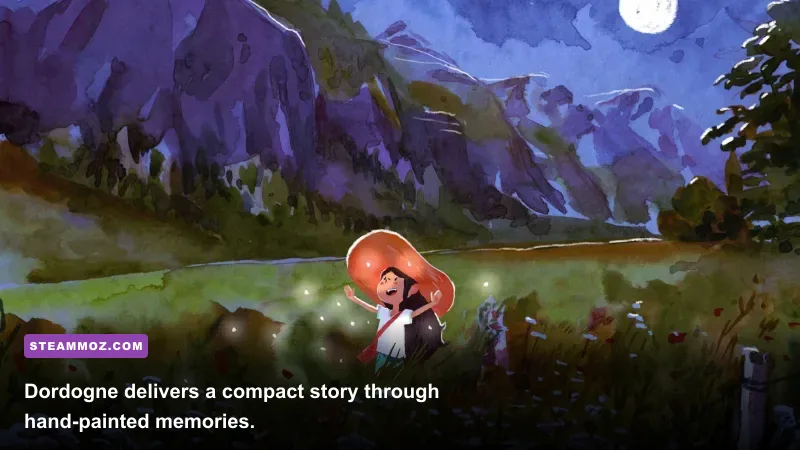
Dordogne is the pick for players who want the visual warmth of a pilgrimage without a large open world. Its watercolor presentation follows Mimi as she revisits memories of childhood in the Dordogne region. You explore riverside homes, forests, and family spaces while gathering photographs, sounds, words, and objects for a memory book.
The key difference is structure. Dordogne uses short chapters, environmental puzzles, and scrapbook activities rather than broad free-roaming zones. You might arrange stickers on a page, record a frog, photograph a landscape, or find an object that unlocks a memory. These actions are simple, but they reinforce the story's focus on how people preserve places after they have changed.
It is less mechanically ambitious than Eastshade and less open than Season, yet that restraint helps its four-to-six-hour runtime. There is very little dead air. If Bottle: Pilgrim's strongest moments were its intimate encounters and handmade atmosphere, Dordogne gets to those moments faster.
Which Bottle: Pilgrim-like game should you play first?
Choose Eastshade if you want the closest overall replacement: peaceful exploration, NPC requests, and a world where observation drives progress. Pick Season if recording a disappearing culture sounds more appealing than completing conventional quests. Go with Sable when you want the pilgrimage expanded into a large, non-combat open world with excellent traversal.
A Short Hike is the safest recommendation for a single evening, while Dordogne is the better choice for a focused, emotional narrative. None of these games copies Bottle: Pilgrim, and that is exactly why they work as follow-ups. Each preserves the quiet essentials—movement, attention, place, and personal discovery—then builds its own memorable system around them.
Players who prefer a more tactical journey after these gentler adventures can switch gears with Steamoz's Blackguards beginner build guide or browse the Banners of Ruin progression tips. But if what you really want is another game that lets silence do some of the storytelling, start with Eastshade tonight.