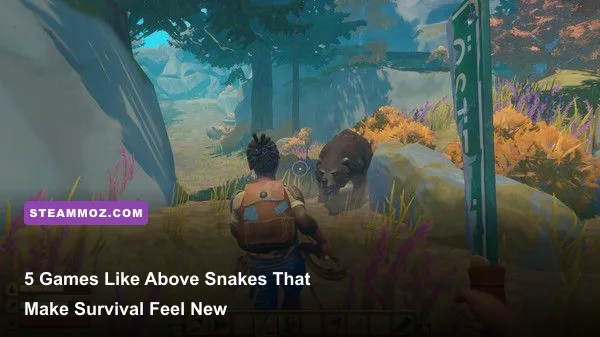
If Above Snakes hooked you with its bite-sized islands, top-down exploration, Western survival setting, and constant urge to improve your camp, start with Len's Island for the closest overall match. Raft is the best choice for co-op, Grounded delivers the strongest combat, The Planet Crafter offers the most relaxing progression, and Sunkenland is the pick for players who want guns, boats, and more dangerous raids.
Above Snakes is unusually good at making survival feel manageable. You gather wood, stone, fiber, and food without being buried under a dozen opaque systems, then spend those materials on a growing settlement and the next piece of the world. Its floating-island structure also creates a satisfying rhythm: explore a compact zone, solve its immediate problems, unlock new recipes, and move on.
That combination is harder to find than the label “survival crafting” suggests. Some games are mostly base builders, some are combat sandboxes, and others are resource spreadsheets with a hunger bar attached. The five games below earn their place because they preserve at least one crucial Above Snakes quality: clear exploration goals, tangible crafting upgrades, a strong sense of place, or a world that keeps opening in manageable steps.
The best games like Above Snakes ranked
The ranking below weighs more than surface similarities. I’m looking at progression clarity, solo play, co-op quality, combat pressure, exploration variety, and how often the game gives you a useful reason to leave home. Exact pricing and platform availability can change, so check the current Above Snakes Steam page and each game’s official listing before buying.
| Game | Tier | Closest Above Snakes Strength | Best For |
|---|---|---|---|
| Len's Island | S-Tier | Compact exploration, crafting, farming, and action combat | Solo players wanting the nearest overall fit |
| Raft | S-Tier | Simple gathering loop and constantly expanding home | Two-to-four-player co-op crews |
| Grounded | A-Tier | Readable survival progression and rewarding exploration | Players who want deeper combat |
| The Planet Crafter | A-Tier | Clear upgrades and a world that visibly changes | Relaxed solo builders |
| Sunkenland | B-Tier | Island-to-island scavenging and base improvement | Players who prefer firearms and raids |
There isn’t a single “best” replacement. Len’s Island has the closest moment-to-moment feel, but Raft is much better if the appeal was building a home that travels with you. Grounded is more demanding and combat-heavy than Above Snakes, while The Planet Crafter removes most direct combat altogether. Sunkenland sits furthest from the cozy side of the comparison, yet its flooded-world scavenging makes every expedition feel consequential.

🎮 Above Snakes
Looking to experience this game? Grab your digital key directly on our store for $6.24.
View on Steammoz Store →Len's Island is the closest overall match
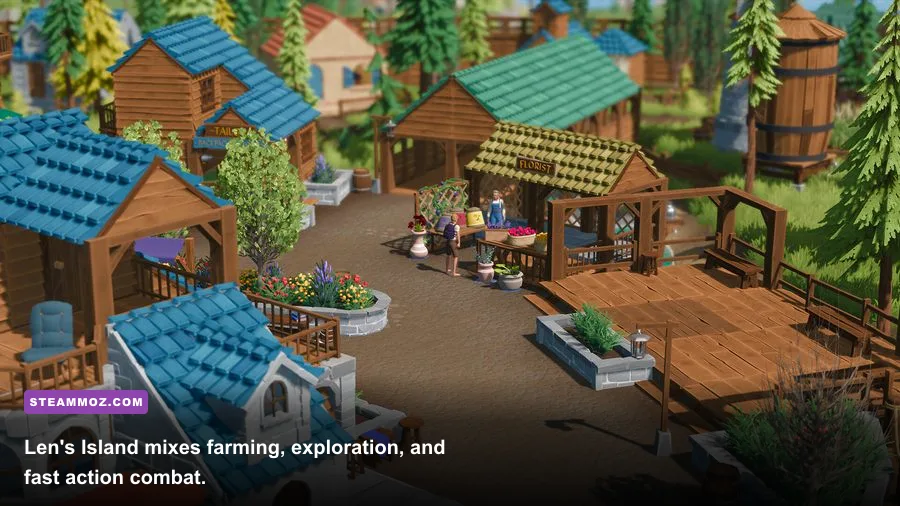
Len’s Island is the first game I’d hand to an Above Snakes fan. Its loop is immediately legible: collect resources, expand a home, grow crops, craft equipment, and enter dangerous areas for better materials. The major difference is perspective and tempo. Len’s Island uses a third-person action-RPG camera, and combat revolves around movement, dodge timing, weapon reach, and stamina rather than Above Snakes’ simpler top-down encounters.
The early settlement at Bridgewater gives you a practical base while you learn the economy. Wheat, potato, and other crops turn farming into a reliable food source, but farming isn’t just decorative. A larger island homestead can support production chains, storage, and crafting stations, which means you spend less time running back to vendors or searching for basic ingredients.
The best progression route is to avoid rushing into dungeon content with starter equipment. Upgrade your basic tools first, build storage near your crafting stations, then invest in a weapon that matches your preferred range. Swords are forgiving in close quarters, while ranged options let you punish enemies before they surround you. Bring food that restores both health and stamina; running out of stamina during a dodge-heavy fight is the fastest way to turn a routine cave trip into a corpse run.
Why it works for Above Snakes players
Both games understand the value of compact objectives. You’re rarely asked to cross an enormous empty map just to collect one ingredient. Len’s Island also gives exploration a strong risk-reward shape: dungeons contain better loot and materials, but enemy groups punish careless button mashing. The result is a more physical version of the same “one more island” urge.
Its weakness is that the survival systems aren’t as tightly tied to a narrative journey as Above Snakes’ chapter-like island progression. Len’s Island can also feel grindier once you’re optimizing production and equipment. Still, if you want the same blend of homestead building and forward momentum, this is the obvious starting point. The official Len’s Island Steam page is the best place to check its current features and co-op support.
Raft makes co-op survival feel effortless
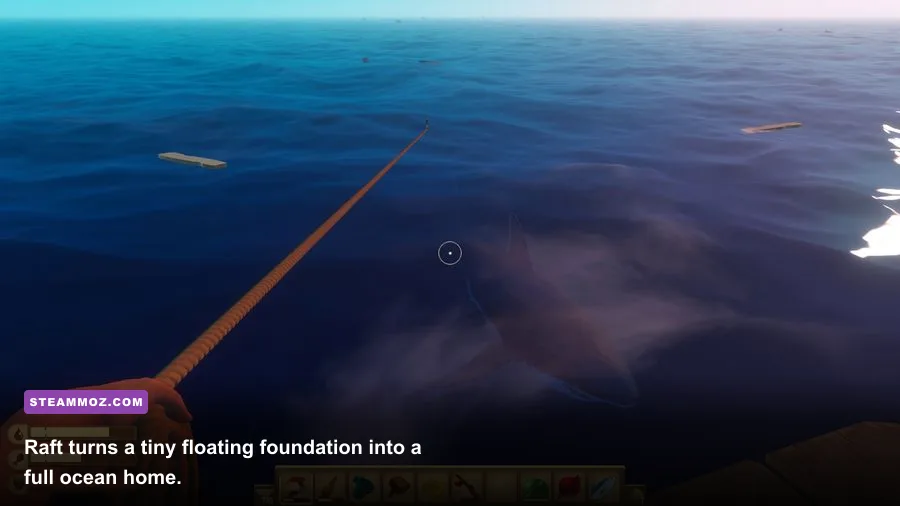
Raft is the strongest recommendation for friends. You begin on a tiny four-foundation raft with a hook, a cup, and a lot of ocean between you and the next scrap of plastic. That modest opening is brilliantly tuned. Every plank and barrel matters, but the game quickly turns those random pickups into a research-driven technology ladder.
Your first priorities should be a Simple Purifier, a Simple Grill, and the Research Table. Water and food are the early pressure points, and solving them lets the whole crew focus on expansion. The receiver then changes the direction of play by pointing you toward story locations. Unlike Above Snakes’ self-contained islands, Raft’s world is an ocean route: steer toward landmarks, stop to harvest, and decide whether the next abandoned structure is worth the time and durability cost.
The shark, Bruce, is more than a standard enemy. It attacks the raft’s foundations, so a careless crew can lose the platform supporting its storage, grill, and crafting stations. Reinforced foundations eventually reduce that pressure, but don’t treat them as an excuse to ignore repairs. Design your raft with critical systems toward the center, leave walkable lanes around them, and keep spare planks in a central chest.
| Raft Upgrade | Priority | What It Solves | Practical Advice |
|---|---|---|---|
| Simple Purifier | Immediate | Fresh drinking water | Place it beside your grill to simplify early routines |
| Research Table | Immediate | Recipe and technology unlocks | Research duplicate resources rather than hoarding them |
| Receiver | High | Story navigation | Build antennas with clear space around the device |
| Reinforced Foundation | Medium | Bruce’s structural attacks | Protect storage and essential crafting stations first |
| Engine and Steering Wheel | High | Reliable movement against wind | Wait until your raft is large enough to justify fuel upkeep |
Raft is less combat-focused than Grounded and its early resource collection can feel repetitive when playing alone. In a group, though, that repetition becomes teamwork: one player fishes, another purifies water, a third handles the sail, and someone else dives for metal. Check the official Raft website for current development information.
Grounded is the combat-heavy upgrade
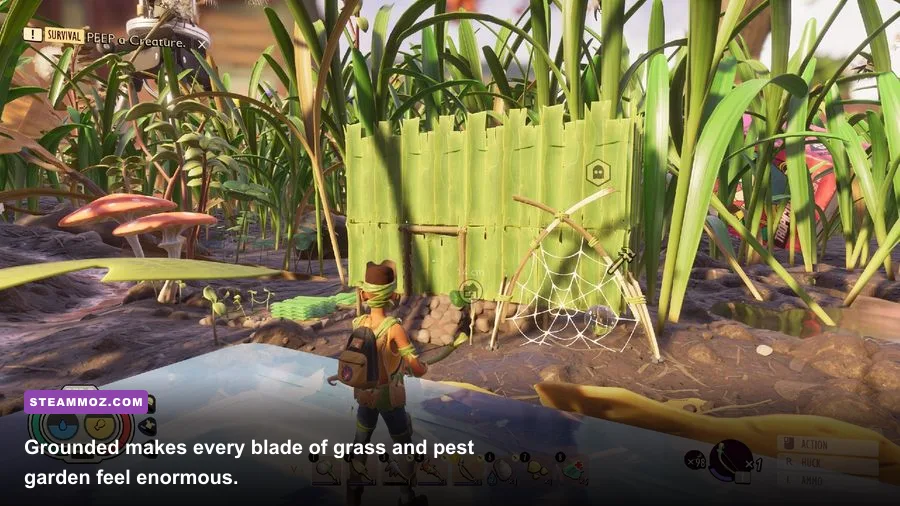
Grounded takes the approachable survival structure Above Snakes uses and drops it into a backyard where a single lawn mite can ruin your afternoon. The premise is memorable, but the real reason it belongs here is its progression design. Every new biome teaches you a different survival rule, and every tier of gear changes which enemies and locations you can challenge.
The Oak Tree is an early landmark and a reliable warning that the game is about to become more dangerous. The Hedge introduces vertical exploration and tougher insect encounters, while the Haze changes the environment with poisonous gas until you address its source. The Black Anthill and Sandbox then raise the combat and environmental stakes again. These areas don’t just provide bigger resource piles; they demand new preparation.
Combat rewards learning enemy tells. Ants telegraph lunges, ladybirds pressure you with direct charges, and spiders force you to respect spacing and attack timing. Perfect blocks are particularly important because they preserve stamina and can trigger powerful counter opportunities. If blocking feels inconsistent, practice against a single red soldier ant rather than learning in the middle of a wolf spider fight.
Gear progression is organized around materials such as Berry Leather, Lint Rope, Mint Shards, and Black Ox Parts. Don’t upgrade every weapon immediately. Choose a primary damage type and a backup tool, then spend upgrade materials on equipment you actually use. Mutation choices also matter: a movement or stamina-focused setup is safer during exploration, while damage and defense options become more attractive when you’re farming a specific enemy.
Grounded is a stronger pick than Above Snakes if you want deliberate melee combat, armor bonuses, and boss-style encounters. It’s a weaker pick if your favorite part was the calm act of placing buildings on a new island. The backyard has a lot more verticality and threat density, so expect a sharper learning curve. The official Grounded site has current game information, while Steamoz’s Dins’s Curse survival tips are useful if you enjoy protecting a settlement under pressure.
The Planet Crafter is the best peaceful alternative
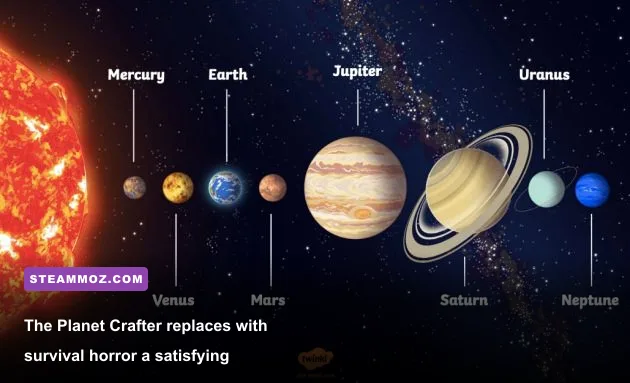
The Planet Crafter is the answer for players who liked Above Snakes’ gathering and construction more than its enemies. You’re stranded on an inhospitable planet and must transform it into a habitable world. There are no conventional hostile creatures to fight, so the tension comes from oxygen, water, temperature, shelter, and whether you have enough supplies to make it back from an ambitious expedition.
The progression system is unusually satisfying because the planet visibly responds to your work. Your terraformation score advances through several linked metrics, including Heat, Pressure, Oxygen, and later Biomass. A base full of machines isn’t just an efficient factory; it becomes proof that the barren landscape is changing. Lakes, vegetation, and eventually a living ecosystem give your construction decisions a direct visual payoff.
Start with oxygen equipment and a dependable shelter network before chasing ambitious blueprints. Place your first base near accessible crates and basic mineral nodes, then build storage so you can return from wrecks without discarding useful materials. The Osmium and Iridium supply chains become important for higher-tier machines, but there’s no benefit in stockpiling late-game materials before your oxygen and water infrastructure can support longer trips.
| System | Early Goal | Midgame Upgrade | Why It Matters |
|---|---|---|---|
| Oxygen | Oxygen Tank and shelter beacons | Higher-capacity tank and breathable zones | Extends exploration range |
| Water | Water Filter | Reliable food and water production | Removes constant return trips |
| Heat | Heater units | Advanced heaters using rare metals | Pushes terraformation forward |
| Pressure | Drill machines | Higher-tier drills | Unlocks new terraformation milestones |
| Biomass | Vegetation spreaders | Tree spreaders and lake systems | Creates the planet’s visible transformation |
The lack of combat can feel like a missing ingredient if you want Above Snakes’ danger and story tension. But as a decompression game, Planet Crafter is excellent. It lets you chase the next machine, blueprint, or unexplored wreck without punishing every detour with an enemy ambush. The official Steam listing covers its current solo and multiplayer details.
Sunkenland is the harsher island-hopping choice
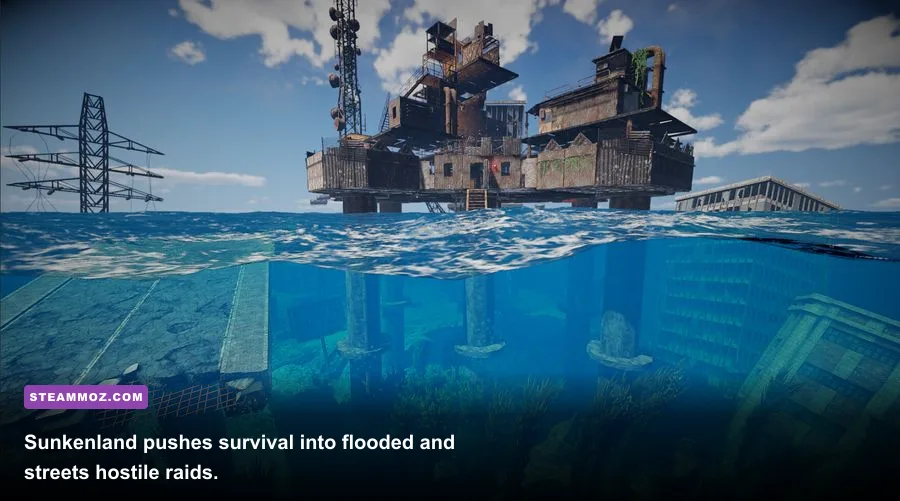
Sunkenland takes the island-to-island scavenging idea and makes it considerably more hostile. The setting is a flooded future, so valuable materials sit inside submerged buildings, wrecks, and partially drowned settlements. You build a base above or below the water, use boats to reach new sites, and defend your supplies from hostile survivors.
The game’s strongest similarity to Above Snakes is its expedition rhythm. You leave a safe base, gather a specific list of materials, return before your inventory and health become liabilities, then craft an upgrade that expands your options. The difference is that Sunkenland gives you firearms, ammunition management, underwater oxygen limits, and human enemies who can raid your base. That turns every resource run into a tactical decision rather than a relaxed collection lap.
Build your first defensible base close to shallow water and a dependable source of wood, but don’t place every valuable station on the outer edge of the structure. Use walls, doors, and elevated firing positions to create layers between intruders and your storage. Keep a reserve of ammunition and healing items inside the core of the base, not in a chest beside the entrance.
Underwater trips need their own checklist. Bring an oxygen solution, a melee weapon for emergencies, and enough inventory space to justify the dive. Mark entrances to submerged buildings because returning to the surface can be disorienting, especially when multiple structures look similar. Boats are useful for hauling resources, but they also attract attention and can become a liability if you leave them exposed.
Sunkenland ranks below the others because its survival pressure and combat can overwhelm the relaxed construction appeal that draws many players to Above Snakes. If you want a grittier version with guns, raiding, and a flooded-world atmosphere, though, it has a clear identity. It’s also a good companion to a more tactical Steamoz read such as the Desperados III stealth review, especially if planning your approach matters as much to you as crafting.
Which Above Snakes alternative should you play first?
Choose Len’s Island if you want the closest overall structure: farming, settlement growth, dungeons, and active combat in a readable world. Pick Raft if your priority is co-op and you like the idea of turning a fragile platform into a moving fortress. Grounded is the best upgrade for players who want enemy patterns, armor builds, mutations, and tougher biome-based progression.
Go with The Planet Crafter if you want to build without constant combat and enjoy watching your work reshape the environment. Choose Sunkenland if the fantasy of scavenging flooded cities with a boat and a loaded weapon sounds better than farming and fishing.
My personal order for an Above Snakes fan in 2026 is Len’s Island first, Raft second, Grounded third, The Planet Crafter fourth, and Sunkenland fifth. That isn’t a quality ranking so much as a distance-from-the-original ranking. Each game pulls one strand of Above Snakes into sharper focus, whether that’s compact exploration, meaningful base growth, survival co-op, or the satisfaction of turning a hostile world into somewhere you can finally call home.
Before buying, check whether your group wants shared progression, whether you prefer first-person or third-person play, and how much combat you actually want. Those three choices matter more than the marketing label. For more survival-focused recommendations, Steamoz’s Dragonkin performance guide and Dungeon Siege retrospective are worth bookmarking too. The right alternative isn’t merely another crafting game; it’s the one that preserves the exact part of Above Snakes you keep thinking about after you quit.