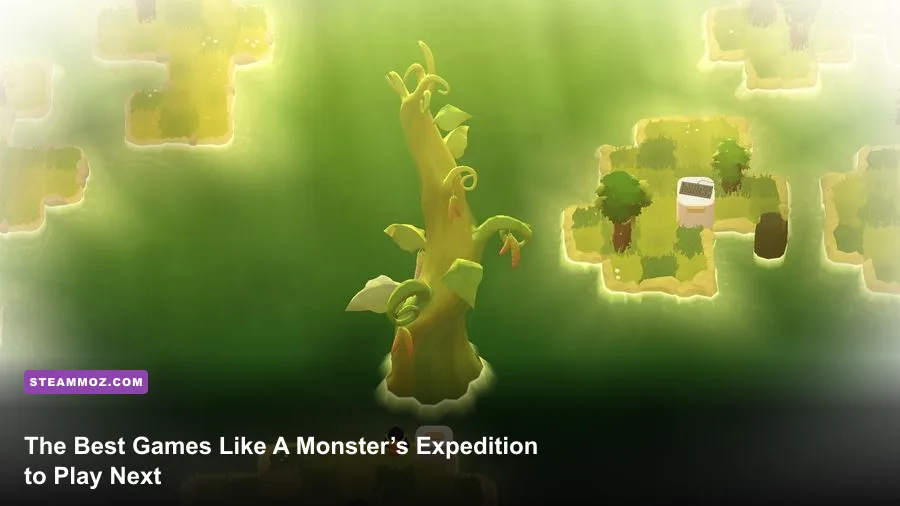
If you loved A Monster’s Expedition for its clever tree physics, relaxed island-hopping, and puzzles that teach themselves without text dumps, start with Isles of Sea and Sky, Bonfire Peaks, and Patrick’s Parabox. They capture the same satisfying loop of observation, experimentation, and sudden understanding, while Baba Is You and The Witness push the formula into much stranger territory.
Draknek & Friends’ expedition remains unusually hard to replace. You play an adorably determined monster exploring a chain of islands, harvesting trees, rolling logs across water, and using the environment itself as your instruction manual. There’s no stamina meter, combat system, or gear treadmill to interrupt the thinking. The best alternatives below respect that purity, but each attacks it from a different angle.
This ranking focuses on four things: how naturally each game teaches its mechanics, how much it rewards experimentation, whether exploration feels meaningful, and how sharply its difficulty rises. For a wider look at compact PC games, our guides to Freshly Frosted settings and Fibbage XL PC requirements are useful detours too.
The best games like A Monster’s Expedition ranked
| Game | Tier | Core hook | Best for |
|---|---|---|---|
| Isles of Sea and Sky | S-Tier | Open-world Sokoban exploration | Players who want the closest overall match |
| Patrick’s Parabox | S-Tier | Recursive boxes and spatial loops | Players chasing breakthrough moments |
| Bonfire Peaks | A-Tier | Crate pushing with optional collectibles | Players who prefer focused challenges |
| Baba Is You | A-Tier | Editable rules made from words | Systems thinkers and experimenters |
| The Witness | A-Tier | Environmental line puzzles | Explorers who enjoy visual deduction |
| A Good Snowman Is Hard To Build | B-Tier | Snowball construction puzzles | Short, charming puzzle sessions |
S-Tier means the game most convincingly recreates the expedition’s mix of movement, discovery, and elegant puzzle logic. A-Tier games are essential recommendations, but they trade away one major ingredient: Bonfire Peaks is more linear, Baba Is You is more abstract, and The Witness is less mechanically tactile. B-Tier is still worth playing, especially if you want a smaller palate cleanser rather than another 20-hour brain workout.

🎮 A Monster's Expedition
Looking to experience this game? Grab your digital key directly on our store for $5.99.
View on Steammoz Store →Isles of Sea and Sky is the closest follow-up

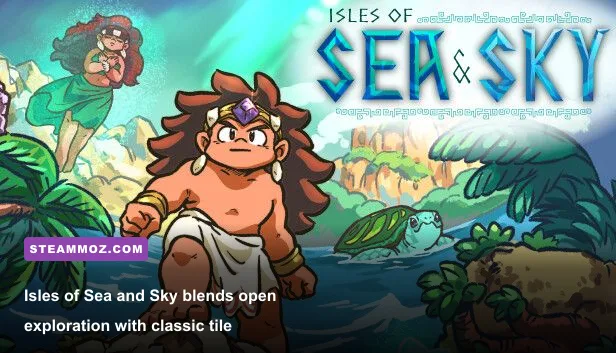
Isles of Sea and Sky is the obvious first stop because it understands what made A Monster’s Expedition feel so inviting. Its world is a connected collection of colorful islands, and progression comes from solving tile-based environmental puzzles rather than collecting combat upgrades. You push blocks, manipulate obstacles, open routes, and return to earlier areas with a better understanding of what the terrain is asking.
The crucial difference is structure. A Monster’s Expedition uses trees and logs as its signature physical language; Isles of Sea and Sky leans into a more traditional grid. That makes its puzzles easier to read at a glance but no less devious once several objects interact. The game also gives exploration more overt importance, with hidden paths and secrets rewarding players who inspect corners instead of marching directly toward the next objective.
Its difficulty curve is particularly friendly. Early rooms establish one rule at a time, then later islands combine those rules without burying you under irrelevant mechanics. If you ever enjoyed the satisfaction of spotting that a seemingly decorative tree in A Monster’s Expedition is actually the key to an entire island, you’ll recognize the same design instinct here.
Play it when you want the closest emotional substitute: bright scenery, low pressure, no combat, and puzzles that ask you to think before they ask you to execute. The official Isles of Sea and Sky Steam page is the best place to check current platform details.
Patrick’s Parabox turns space into a logic trap
Patrick’s Parabox takes the familiar Sokoban idea—push boxes onto goals—and folds it through itself. Boxes can contain other boxes, rooms can exist inside boxes, and moving one container can alter the space you’re standing in. It sounds like a novelty. In practice, it creates some of the cleanest “wait, that’s allowed?” moments in modern puzzle design.
The important skill is not fast movement; it’s understanding containment. A box may be an obstacle in one layer and a destination in another. You can push a smaller box into a larger one, enter the smaller space, and use the resulting arrangement to escape a position that looked permanently dead. The game’s recursive rules are consistent, so every solution feels earned rather than magical.
That consistency also makes failure useful. When a room collapses into an unsolvable state, you can usually identify the exact mistake: a box was pushed from the wrong side, a container was entered too early, or a needed exit was sealed. The reset button is generous, and the game never punishes experimentation with resource loss.
It’s less peaceful than A Monster’s Expedition—not because of enemies, but because the abstraction level is higher. You’re no longer asking where a log can float. You’re asking whether the room you’re in can contain the room containing you. The official Steam listing for Patrick’s Parabox shows the recursive concept clearly, but screenshots barely prepare you for how quickly it escalates.
Bonfire Peaks is the sharpest crate-pushing challenge
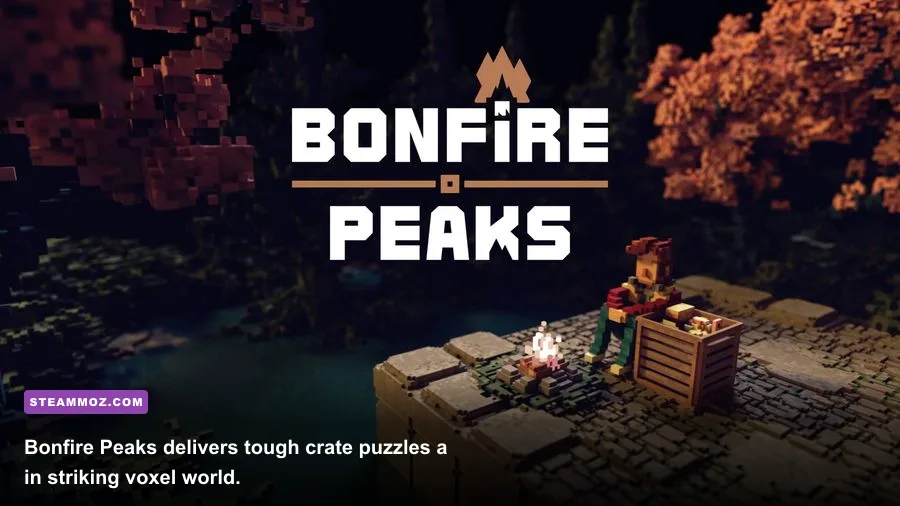
Bonfire Peaks strips away A Monster’s Expedition’s leisurely sightseeing and concentrates on one goal: burn every box. You guide a tiny voxel character across a compact mountain, pushing crates toward bonfires while learning how slopes, platforms, bridges, and one-way situations interact. Each solved stage opens more of the island, creating a steady rhythm of challenge, reward, and visual progress.
The “burn everything” objective changes how you read a room. A crate isn’t merely something to move onto a marked square; it can become a bridge, a temporary wall, or the only object capable of blocking another crate’s route. Many puzzles are lost several moves before the mistake becomes visible. That’s classic Sokoban cruelty, but Bonfire Peaks softens it with quick resets and levels designed around one central idea.
Optional collectibles add a second layer for completionists. You can finish the main route without solving every side challenge, which is important because the harder bonus puzzles are deliberately more demanding. They often require planning the order of crate disposal rather than simply finding a route from point A to point B.
Choose Bonfire Peaks if you want the tactile push-and-positioning side of A Monster’s Expedition without its broader expedition structure. It’s also a great fit after reading our Door Kickers beginner tips—not because the games play alike, but because both reward planning several moves ahead instead of improvising under pressure.
Baba Is You and The Witness challenge different muscles

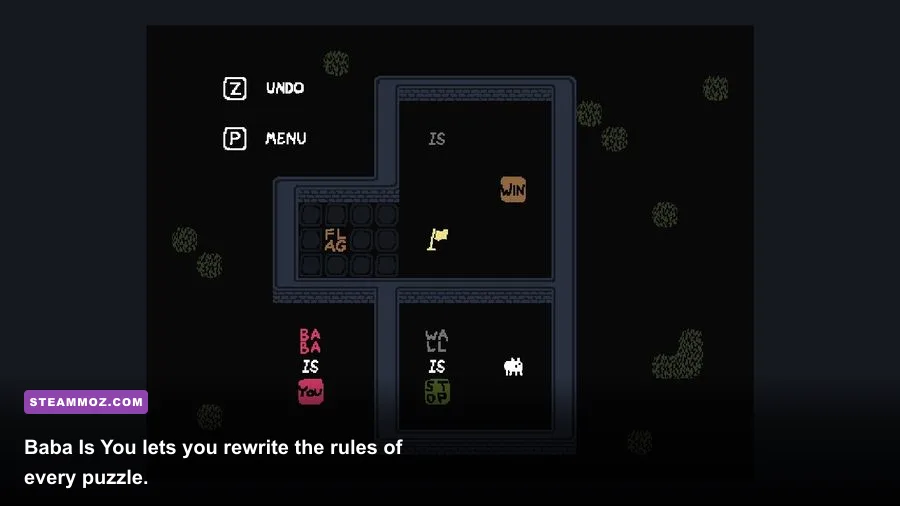
Baba Is You is the most radical recommendation here. Its rules are physical objects: BABA IS YOU, ROCK IS PUSH, and FLAG IS WIN can be rearranged to change what the level means. Turn a wall into a controllable object, make a key intangible, or transform the goal itself. The game’s brilliance comes from making programming-style logic feel like a toy box.
Start by identifying which rule is doing the most work, then test whether moving one word breaks or repurposes it. A common beginner mistake is to focus on reaching the flag. In Baba Is You, the real objective is often changing the definition of “you” so the route becomes possible. The official Baba Is You Steam page gives away the premise, but not the delightful cruelty of its later world maps.
The Witness takes the opposite approach. It gives you no inventory, text tutorial, or explicit rulebook. Instead, the island teaches line puzzles through repetition and context. A panel may introduce symmetry, colored regions, sun icons, or sound-based clues, then quietly expect you to carry that knowledge elsewhere.
The Witness is ideal if your favorite A Monster’s Expedition moments involve noticing something in the scenery that suddenly changes how you interpret a puzzle. Its island is not just a backdrop; the trees, shadows, architecture, and perspective can all become part of the solution. Check the official The Witness page before buying if you prefer guided progression, because its refusal to explain can feel thrilling or maddening depending on your mood.
Two smaller picks deserve your time in 2026
A Good Snowman Is Hard To Build is a compact, charming puzzle game built around making snowmen from three snowballs: a large base, a medium middle, and a small head. The catch is that snowballs grow as you roll them through snow, so every movement changes the available space. It turns a cute premise into a surprisingly exact positioning problem.
Storyteller is less physically systemic but excellent for players who enjoy discovering rules through experimentation. You arrange characters, settings, and objects into comic-book panels to satisfy a specific narrative condition. It’s shorter and more bite-sized than A Monster’s Expedition, making it a good choice for a few relaxed sessions rather than a long expedition.
| Game | Typical session | Difficulty profile | Why play it |
|---|---|---|---|
| A Good Snowman Is Hard To Build | 10–25 minutes | Gentle start, precise later rooms | Physical puzzles with huge charm |
| Storyteller | 5–15 minutes | Accessible and highly readable | Fast experimentation and funny outcomes |
| A Monster’s Expedition | 20–60 minutes | Gradual, exploration-led escalation | Best blend of world and mechanics |
Neither is a direct mechanical replacement, but both understand the value of a small ruleset that produces many outcomes. For more unusual PC recommendations, Steamoz’s Groove Coaster review and Dungeons 3 hardware guide are worth browsing after you finish your puzzle queue.
How to choose your next puzzle adventure
Pick Isles of Sea and Sky if you want the nearest overall experience: colorful exploration, environmental obstacles, and a world that rewards wandering. Choose Patrick’s Parabox if you want the biggest conceptual leap and don’t mind spending ten minutes staring at one room. Go with Bonfire Peaks for pure crate logic, Baba Is You for rule manipulation, and The Witness for a slower, more mysterious investigation of visual language.
The smartest way to approach all five is the same: stop moving when a puzzle feels impossible. Walk around it mentally. Identify the irreversible actions, look for objects that can serve two purposes, and test the smallest possible change. These games rarely demand reflexes. They demand that you notice the rule you’ve been treating as scenery.
That’s why they remain such strong picks for 2026. They don’t need season passes, giant maps filled with icons, or combat ladders to hold your attention. A tree, a box, a word, or a line is enough—provided the designer knows exactly when to reveal what it can do.