If you're searching for a Death Note Killer Within weapon tier list and best equipment ranking, here's the crucial answer: the game has no equipable weapons, loot tiers, armor, or stat-based equipment. Its real arsenal is made up of role abilities, information tools, objectives, and meeting pressure. Ranked properly, the Death Note sits in S-Tier for Kira, investigative actions and L's deductions occupy S-Tier for the Task Force, and ordinary objectives are powerful but completely dependent on timing.
That distinction matters. Treating this like a traditional action game will send you looking for damage numbers that simply aren't there. The official Steam page describes a social-deduction game built around hidden roles, secret communication, tasks, meetings, and votes. Your best "equipment" is whatever lets your team control information before the other side does.
The real weapon tier list in Death Note Killer Within
The rankings below score tools by four practical factors: how much control they create, how reliably they produce information, how hard they are to counter, and how much they help your win condition. The list isn't pretending that a button has a damage stat. Instead, it answers the question players actually mean: which mechanics deserve priority when a round gets tense?
| Rank | Weapon or tool | Side | Why it ranks here | Best use |
|---|---|---|---|---|
| S-Tier | Death Note | Kira | Directly removes a player when Kira has the required identity information | Delete confirmed threats without exposing a pattern |
| S-Tier | L's investigation | Task Force | Creates the strongest route from suspicion to an actionable accusation | Build a case before a meeting, not during panic |
| S-Tier | Meeting vote | Both teams | Converts social pressure into a permanent role removal | Force a decision after information has been cross-checked |
| A-Tier | Task Force objectives | Task Force | Generates progress and movement patterns that can expose Kira's side | Split safe routes and watch who avoids useful work |
| A-Tier | Kira's information tools | Kira | Turn uncertainty into a legal target for the Death Note | Confirm names while appearing to pursue tasks |
| B-Tier | Public suspicion | Both teams | Useful pressure, but easy to manufacture and easy to reverse | Push a player into contradictions, not an instant vote |
| B-Tier | Routine task progress | Task Force | Advances the match but offers little value if nobody reads behavior | Complete it while tracking routes and meeting claims |
The key takeaway is that the Death Note isn't automatically S-Tier because Kira owns it. It becomes S-Tier only when Kira has a clean name, enough privacy to act, and a believable explanation for the target disappearing. A blind or rushed kill is closer to a self-inflicted debuff.

🎮 DEATH NOTE Killer Within
Looking to experience this game? Grab your digital key directly on our store for $4.99.
View on Steammoz Store →S-Tier tools and why they decide matches
The Death Note
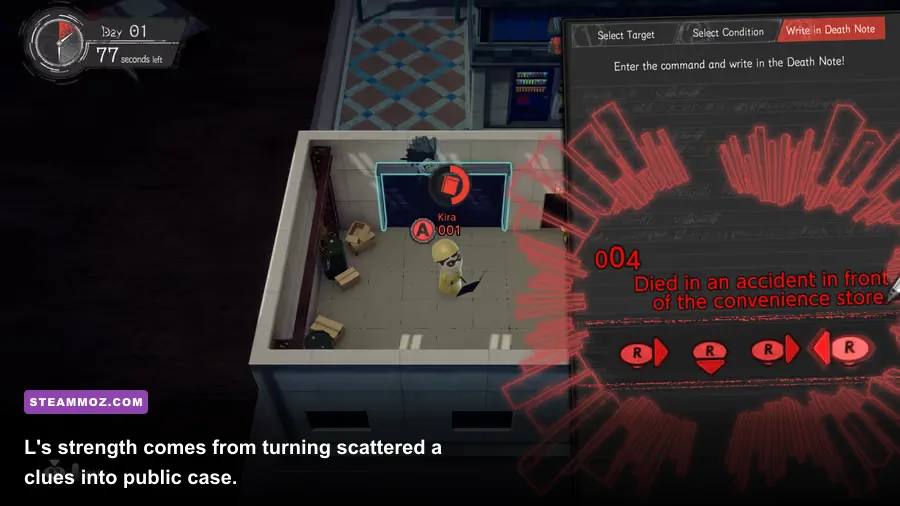
The Death Note is the closest thing the game has to a weapon. Kira's win condition revolves around using it to remove the right players while protecting the identity of Kira and any Kira-side ally. The strongest use isn't necessarily killing the most vocal Investigator. It's removing the player whose information would connect two separate clues.
Look for three target types. First, eliminate a player whose testimony can verify L's investigation. Second, remove a quiet player who has correctly tracked movement but hasn't attracted public attention. Third, kill someone whose role is likely to be confirmed at the next meeting. Kira should avoid repeating a visible targeting pattern, especially when the same room, route, or accusation precedes every death.
There is no damage value, cooldown chart, critical-hit chance, or equipment upgrade to optimize. The practical resource is certainty. A name gathered from a weak claim is low-quality ammunition; a name confirmed through role behavior, timing, and a credible investigation is a guaranteed pressure point.
L's investigation
L is the Task Force's information engine. An investigation is valuable only if the result changes what the team does next. If you discover something and keep it private until the final seconds of a meeting, you've spent the best tool in the game without converting it into a vote or a protective plan.
L should establish a chain of evidence: who was seen where, which task they claimed, who can confirm that route, and whether the suspect's behavior fits Kira-side incentives. Don't announce a conclusion before checking the easy alternative. Kira thrives when L turns a partial clue into an overconfident public accusation.
For players learning the role structure, Steamoz's Death Note Killer Within tips for new players is a useful companion. The same principle applies here: information has value only when your team can act on it.
A-Tier equipment substitutes for each role
Because there are no selectable weapons, the best equipment ranking changes with your role. Kira wants identity certainty and controlled timing. L wants verifiable information. Investigators and the Task Force want safe task progress plus behavioral evidence. The same meeting can therefore be an S-Tier resource for one side and a trap for the other.
| Role or side | Priority tool | Tier | What to do with it | Common mistake |
|---|---|---|---|---|
| Kira | Death Note target selection | S-Tier | Remove confirmed information threats and preserve a believable public story | Killing the loudest player without checking who benefits |
| Kira-side ally | Social cover | A-Tier | Support plausible accusations and keep attention away from Kira's route | Defending Kira too directly |
| L | Investigation result | S-Tier | Cross-check the result, then present a short, testable accusation | Revealing every clue without a vote plan |
| Investigator | Route and task evidence | A-Tier | Track who can verify movement and who avoids contested areas | Calling every unusual movement proof of guilt |
| Task Force | Objective completion | A-Tier | Keep progress moving while creating predictable observation points | Running alone with no witness for every claim |
| Any role | Meeting vote | S-Tier | Vote only when evidence survives a direct counterclaim | Following confidence instead of corroboration |
Why objectives aren't just filler
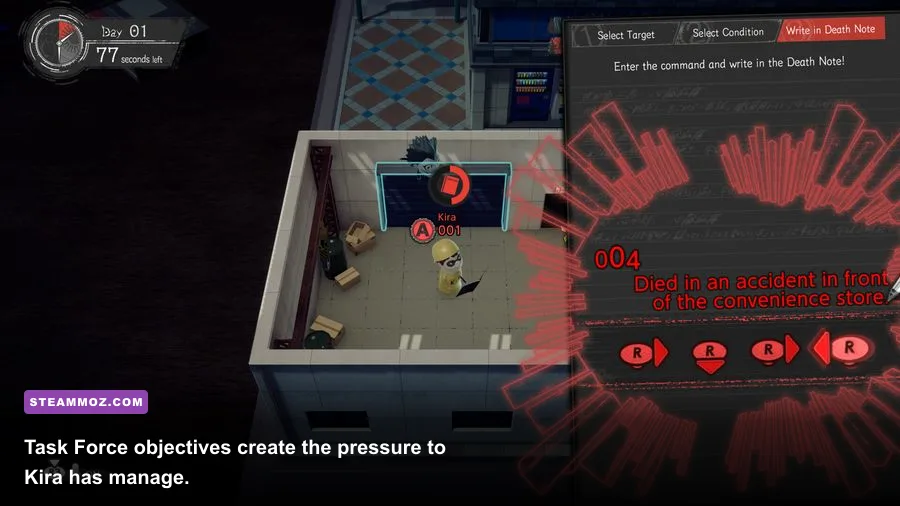
Task Force objectives are often underrated because they don't produce an instant knockout. Their real value is structure. A task forces players to travel, pause, select an interaction, and later explain where they were. Those moments create a timeline. A clean timeline can expose a lie more effectively than a dramatic accusation.
Use objectives as controlled experiments. Have two players take a route together, ask one player to verify a location, or deliberately choose a task that makes movement easy to observe. If someone constantly avoids witnessable work, that's not proof by itself, but it is a meaningful B-to-A-Tier clue when it lines up with a suspicious meeting claim.
Meeting votes are the highest-risk weapon
Meetings are where every tool gets converted into a win or wasted. A vote has enormous impact, but its reliability depends on the quality of the evidence entering the discussion. That's why the meeting vote ranks S-Tier in theory and B-Tier in inexperienced hands.
Use a simple three-step structure. Start with facts: location, task claim, timing, and confirmed witnesses. Move to contradictions: what changed between the first statement and the follow-up question? Finish with the decision: which player should be removed, and what specific evidence supports that choice?
Don't let the conversation become a popularity contest. Kira-side players can weaponize certainty by repeating the same accusation until it sounds established. Task Force players should ask short questions that force precise answers: Which task? Which room? Who saw you leave? What happened immediately before the meeting? The goal isn't to sound clever. It's to create a record that a liar can't keep consistent.
Kira should treat meetings as another kind of attack. A failed vote can still be valuable if it divides the Task Force, but an overconfident push can reveal the Kira-side alliance. If your accusation is too clean, deliberately leave room for uncertainty. A persuasive Kira isn't always the player with the best lie; it's the player who sounds most willing to test every possibility.
This is also where experience from other stealth-heavy games helps. Steamoz's Desperados III stealth review covers a similar lesson: information, positioning, and timing beat flashy action. Death Note Killer Within simply moves that contest into conversation.
Best role loadouts for winning consistently
Think of a loadout as a repeatable priority order rather than a bag of items. The best setups reduce impulsive decisions and tell you what to protect when the round becomes chaotic.
Kira loadout: certainty, cover, removal
Your first priority is identity confirmation. Your second is an ordinary-looking movement story. Your third is choosing a target whose removal weakens the Task Force more than it increases suspicion. Never rush the Death Note simply because a player is annoying. Track who is asking useful questions, who can confirm L's claims, and who is quietly building a route map.
After a kill, prepare a reason for your position before the next meeting. A good Kira story explains the route, the objective, and why another player could have behaved suspiciously. A great story also accepts one small uncertainty instead of trying to control every sentence.
L loadout: verify, compress, direct
L should gather enough evidence to create a narrow choice. You don't need a theatrical monologue; you need a claim that another player can verify. Share the useful portion of an investigation early enough for the Task Force to protect the information and challenge the suspect.
Keep a mental ranking of evidence. Direct role information is stronger than a movement hunch. Two independent witnesses beat one confident speaker. A contradiction becomes powerful only when the original claim was specific. These distinctions stop L from burning a meeting on noise.
Investigator and Task Force loadout: witness, route, vote
Investigators should prioritize paired movement and confirmable tasks. If you always work alone, your completed objectives may be real but your testimony remains easy to dismiss. The Task Force should avoid dogpiling one suspect without checking the wider timeline. Kira wants the team to tunnel vision because every wasted vote buys more room to operate.
For a broader progression mindset, Steamoz's Dins's Curse survival tips makes a surprisingly relevant point: protecting the objective and reading danger early are often more important than chasing the most obvious threat. In Death Note Killer Within, that means keeping task progress alive while still treating every route as evidence.
| Round situation | Best tool priority | Kira's response | Task Force response |
|---|---|---|---|
| Early round, little evidence | Objectives and movement tracking | Build cover and avoid a predictable kill pattern | Use witnesses and record specific claims |
| One strong suspect | Investigation and cross-checking | Create a second plausible suspect without overplaying it | Ask focused questions before voting |
| Confirmed identity information | Death Note or decisive vote | Remove the information threat at a low-suspicion moment | Protect the source and convert it into a team decision |
| Split meeting | Social pressure and consistency checks | Stay calm and let allies create disagreement indirectly | Compare claims against routes, witnesses, and timing |
| Late game | Win-condition discipline | Prioritize the final obstacle, not revenge | Stop solo plays and coordinate every vote |
Custom rules can change the value of these tools, so check the lobby settings before applying a fixed ranking. Bandai Namco's official game page and the official Death Note Killer Within website are the safest places to check current role and mode information rather than relying on outdated player-made charts.
What to upgrade first: your decision-making
There is no weapon upgrade path in Death Note Killer Within. The meaningful progression is learning to separate information from interpretation. New players often rank a loud accusation above a quiet confirmed route because the accusation feels more dramatic. Experienced players do the reverse.
Before every vote, ask three questions: what is directly known, who can independently verify it, and which side benefits if this player stays alive? Before every Death Note action, ask two more: do I know the target's identity for a reason that survives scrutiny, and can I explain my own position afterward?
That is the final ranking. The Death Note is S-Tier, but only with certainty. L's investigation is S-Tier, but only with communication. Objectives are A-Tier, but only when they create witnessable behavior. Meetings are S-Tier, but only when the lobby resists panic. There are no guns, swords, armor sets, or numerical builds to hide behind here. The best equipment is a clean timeline, a believable story, and the discipline to wait one more question before pulling the trigger.