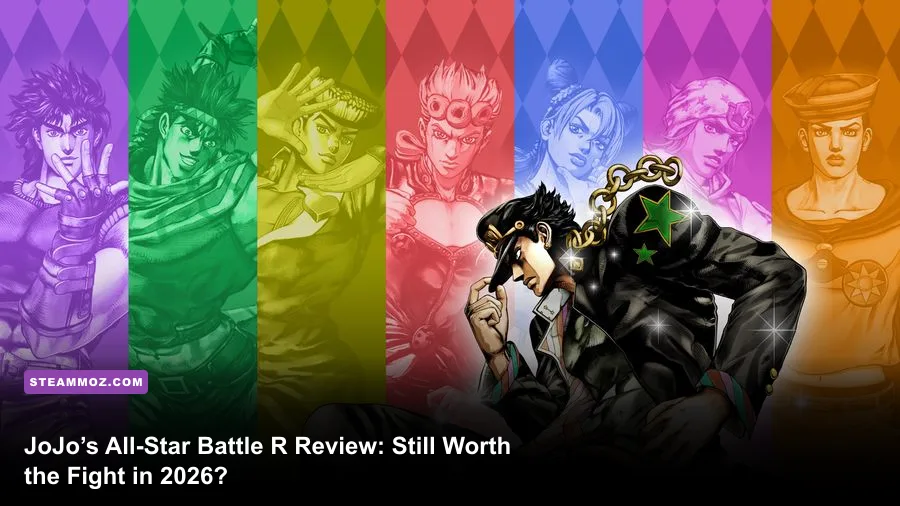
Yes—JoJo’s Bizarre Adventure: All-Star Battle R is still worth playing in 2026, especially if you want a stylish, content-heavy anime fighter with rollback netcode and a roster packed with personality. It isn’t the deepest competitive fighter on the market, and its online population is naturally smaller than Street Fighter 6 or Tekken 8, but the excellent fan service, generous character variety, and satisfying 60 FPS combat make it an easy recommendation at a discount. The catch is simple: buy it for JoJo’s eccentric matchups and expressive mechanics, not for a huge always-busy ranked ladder.
CyberConnect2 rebuilt the original 2012 game rather than merely upscaling it. All-Star Battle R adds new voice performances, balance changes, additional fighters, assists, stages, and a free-roaming presentation that feels much closer to the manga’s theatrical energy. The result is a fighter that can be welcoming for newcomers while still hiding serious system depth behind its extravagant poses and one-liners.
🎮 Get JoJo's Bizarre Adventure: All-Star Battle R
Ready to dive in? Grab your copy today for just $9.99.
Check OfferWhat makes All-Star Battle R worth playing?
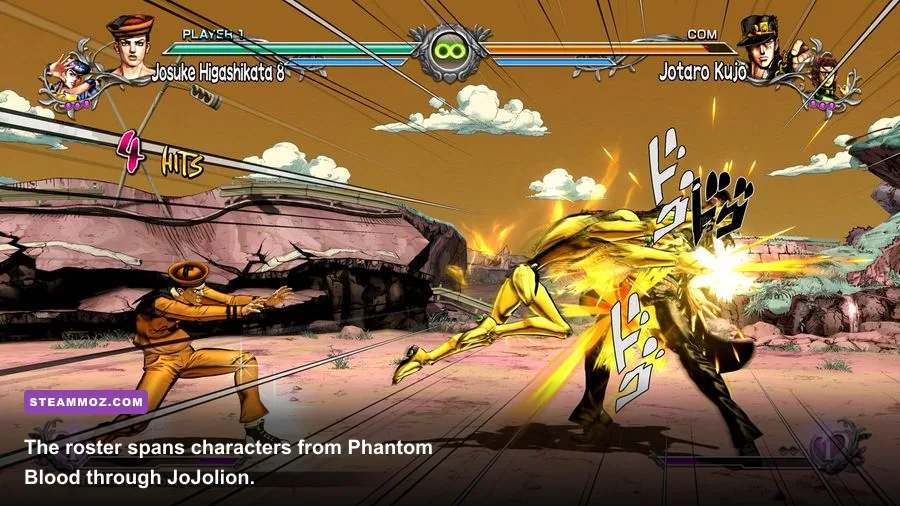
The biggest strength is the roster. The base game brings together fighters from Parts 1 through 8, including Jonathan Joestar, Joseph Joestar, Jotaro Kujo, Josuke Higashikata, Giorno Giovanna, Jolyne Cujoh, Johnny Joestar, and Josuke from JoJolion. Villains such as Dio Brando, DIO, Yoshikage Kira, Diavolo, Enrico Pucci, Funny Valentine, and Tooru give the cast genuine matchup variety instead of serving as cosmetic alternates.
There are 50 playable characters in the expanded All-Star Battle R package, with additional DLC fighters sold separately or included in relevant season passes. That number matters because the cast does not play like 50 lightly reskinned martial artists. Guido Mista controls the screen with Sex Pistols and ammunition management, Johnny builds offensive pressure around Tusk ACT 2 and ACT 3, Gyro uses Spin projectiles and mounted options, while Foo Fighters turns healing and body control into a central resource.
The presentation is pure JoJo. Characters call out attacks, portraits slam onto the screen during clashes, and stages can trigger dramatic stage hazards. You can disable some of the flashier interruptions if you want cleaner matches, but leaving them on captures the game’s comic-book rhythm. It’s one of the few anime fighters where a match can feel like a manga panel becoming interactive.
| Feature | What you get | 2026 verdict |
|---|---|---|
| Roster | 50 playable characters across Parts 1–8, plus DLC options | Excellent for JoJo fans |
| Modes | All-Star Battle, Arcade, Versus, Practice, Mission, and online play | Strong solo package |
| Combat | Style actions, Stands, assists, Heart Heat Gauge, Great Heat Attacks | Accessible but surprisingly deep |
| Online | Ranked and player matches with rollback netcode | Playable, population-dependent |
For a broader look at how Steam fighters hold up after launch, our 2026 recommendations guide is useful context, although All-Star Battle R is far more character-driven than most of the games on that list.

🎮 JoJo's Bizarre Adventure: All-Star Battle R
Looking to experience this game? Grab your digital key directly on our store for $9.99.
View on Steammoz Store →How deep is the combat system?
All-Star Battle R uses four primary attack buttons—Light, Medium, Heavy, and Stand—or Style, depending on the character. The Style button activates a fighter’s defining ability: Jotaro and DIO call out their Stands, Joseph uses Hamon, Johnny accesses his nail bullets, and characters without Stands rely on specialized techniques. Holding the Style input can change the move, making the system more expressive than a basic four-button layout suggests.
Normal attacks chain through light, medium, and heavy strength, while command normals and character-specific special moves create the real matchup texture. A successful Stylish Dodge slows time briefly and lets you punish an opponent, but the timing window is strict enough that you can’t spam it safely. The game also includes Flash Cancel, which spends one Heart Heat Gauge stock to cancel recovery and extend pressure or save a risky normal. That single mechanic gives experienced players a way to convert awkward hits into real combos.
The Heart Heat Gauge holds two stocks. A Heart Heat Attack generally costs one stock, while a Great Heat Attack consumes two and delivers the game’s most extravagant cinematic finishers. Guarding, taking damage, and landing attacks build the meter. You also need to watch the guard gauge: blocking too much eventually causes Guard Crush, leaving you open. This creates a useful push-and-pull between safely defending and taking a calculated risk to regain momentum.
Beginner-friendly characters
Jotaro is the obvious starting point because Star Platinum gives him strong normals, clear pressure, and a time-stop Great Heat Attack once the required conditions are met. Bruno Bucciarati is another good teacher: Sticky Fingers offers straightforward confirms, mobility, and threatening close-range pressure. Polnareff’s Silver Chariot rewards aggressive players without forcing them to manage an overly complicated resource system.
More unusual picks become rewarding once you understand the basics. Hol Horse controls lanes with Emperor and uses J. Geil’s Hanged Man assist-style setups to make movement uncomfortable. Narancia turns Aerosmith into a zoning tool, but his limited fuel and screen-control decisions punish careless play. Giorno is powerful in the right hands, yet Gold Experience’s setplay and Requiem transformation demand more matchup knowledge.
| Character | Learning curve | Core strength | Best for |
|---|---|---|---|
| Jotaro Kujo | Low to medium | Strong fundamentals and Star Platinum pressure | First-time players |
| Bruno Bucciarati | Low to medium | Reliable close-range strings and mobility | Aggressive beginners |
| Joseph Joestar | Medium | Hamon setups, traps, and prediction tools | Players who enjoy mind games |
| Johnny Joestar | High | Tusk nail bullets and stance-based conversions | Technical specialists |
| Funny Valentine | High | Love Train defense and dimensional movement | Advanced matchup players |
Easy Beat is available if you repeatedly press the light attack button, automatically producing a basic combo and sometimes a Heart Heat Attack. It’s useful for learning a character’s rhythm, but turn it off quickly if you want to understand manual confirms, Flash Cancels, and meter management.
Which modes and progression actually deliver?
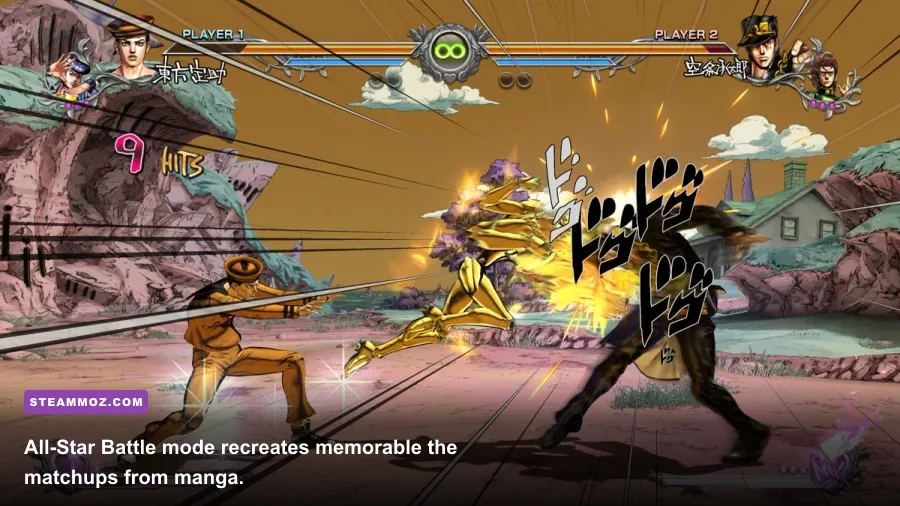
All-Star Battle Mode is the main solo attraction. It presents themed battles based on manga relationships and events, often adding mission conditions that alter how you approach a fight. You’ll face combinations such as protagonist-versus-rival matchups, then earn unlockables including costumes, taunts, and artwork. It isn’t a traditional story campaign with fully animated narrative scenes, but it’s an entertaining museum of JoJo confrontations.
Arcade mode is more traditional: choose a fighter, clear a sequence of opponents, and finish with a character-specific result. Versus and Practice are where the game becomes most useful as a fighting sandbox. Practice lets you set the opponent’s guard behavior, record actions, and test assist timing. Spend time checking how far your character’s normals reach before jumping into ranked matches; several fighters look similar on screen but have radically different effective ranges.
Mission Mode is less glamorous but valuable for learning. It teaches practical commands and lets you earn customization material. You’ll unlock alternate colors, sound effects, taunts, and character commentary, giving the solo loop a reason to continue after the novelty of the roster wears off.
There’s no RPG-style stat grind, and that’s a major positive. Every fighter is available without leveling them, so your progress is about knowledge rather than inflated numbers. The weaker point is that some unlockables feel designed to stretch the package rather than deepen it. If you only want ranked battles, you’ll see much of the content once and move on. If you love JoJo trivia and visual callbacks, the extras are considerably more rewarding.
Players who enjoy unlocking systems and experimenting with specialized builds may also appreciate our weapon-tier analysis, though All-Star Battle R replaces loot chasing with matchup mastery.
How good is the PC performance in 2026?
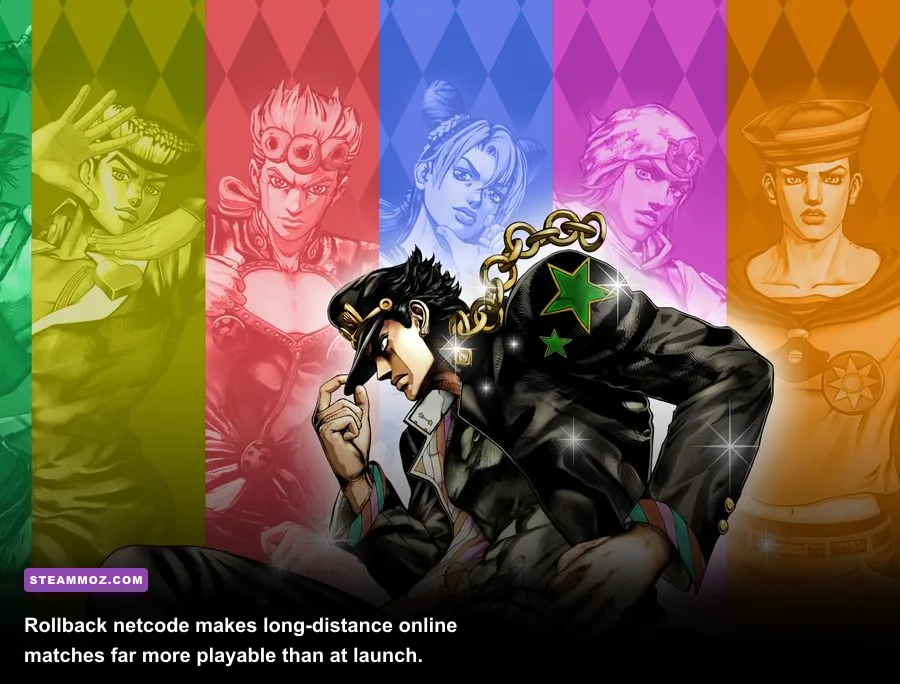
On PC, the target should be a locked 60 FPS. Fighting-game timing feels immediately worse when frame delivery fluctuates, even if the average frame rate looks high. The game’s cel-shaded art is not especially demanding by modern standards, so most gaming PCs released in the last several years can run it comfortably at 1080p. The more important variables are shader compilation stutter, background applications, and whether your display is running at its intended refresh rate.
The official Steam requirements remain modest: the minimum specification lists an Intel Core i5-2300 or AMD FX-8120, 8 GB of RAM, and a GeForce GTX 770 or Radeon HD 7950-class GPU. The recommended specification moves to an Intel Core i5-3470 or AMD FX-8350, 16 GB of RAM, and a GeForce GTX 1060 or Radeon RX 480-class card. You’ll also need roughly 60 GB of available storage.
| Setting | Recommended value | FPS impact | Visual note |
|---|---|---|---|
| Resolution | Native 1080p or 1440p | Medium at 1440p | Keep native resolution for crisp manga outlines |
| Texture quality | High | Low on modern GPUs | Preserves costume and stage detail |
| Shadow quality | Medium to High | Low to medium | Lower this first on older graphics cards |
| Anti-aliasing | High or default | Low | Reduces jagged character silhouettes |
| V-Sync | Off with a VRR display | Can add latency when enabled | Use a frame cap if tearing appears |
| Frame rate | Locked 60 FPS | Essential target | Prioritize consistency over ultra settings |
For troubleshooting, our smooth-FPS settings advice applies well to the usual PC culprits. Also check your controller layout before playing online: analog movement is fine, but a reliable D-pad makes quarter-circle inputs and instant Stylish Dodges much more consistent.
Is the online community still active enough?
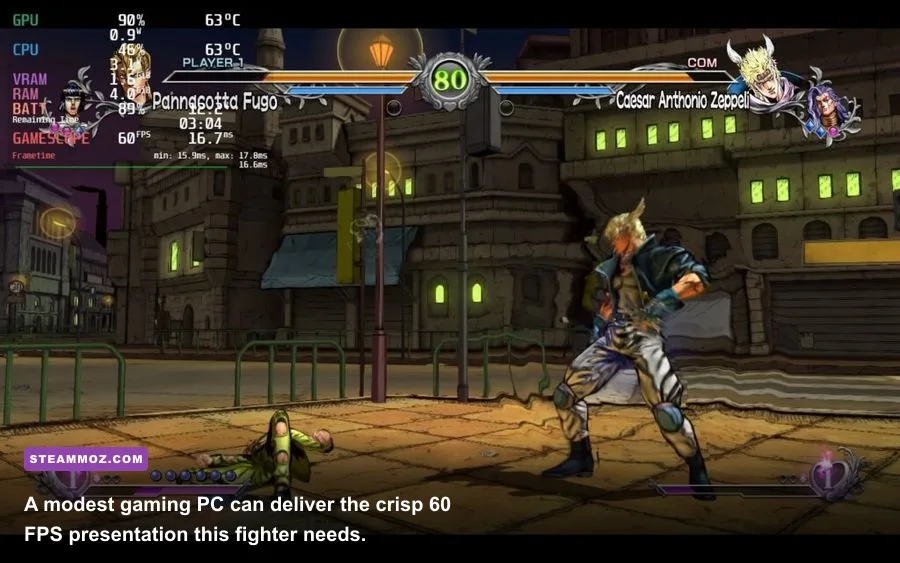
Rollback netcode is the reason online play remains worth discussing in 2026. It cannot manufacture opponents where there are none, but it makes the connection quality far more forgiving when you do find someone nearby or when matchmaking reaches a distant player. Ranked Battle gives you a straightforward competitive ladder, while Player Matches are better for private rooms, long sets, and testing unfamiliar characters.
The practical warning is population. Peak hours and sale periods are your best chance of finding ranked opponents quickly. Outside those windows, matchmaking can take longer, and you may encounter the same names repeatedly. That isn’t a deal-breaker for a JoJo fan, but it should shape your purchase decision. Buy on PC during a discount, and look for community Discords or friend groups if online competition is your main reason for playing.
Balance is also worth keeping in perspective. The roster is broad and entertaining, but it isn’t tuned with the same competitive precision as the newest genre leaders. Some characters have more reliable neutral tools, stronger assists, or easier conversions than others. That imbalance is part of the game’s personality, yet tournament-minded players may eventually want a more rigidly competitive environment.
For connection and performance issues in other Steam games, Steamoz’s PC optimization coverage offers useful general fixes. For official details, check the JoJo’s All-Star Battle R Steam page, the publisher’s official game page, and CyberConnect2’s official site.
Final verdict: buy it for the characters, stay for the system
JoJo’s Bizarre Adventure: All-Star Battle R is worth playing in 2026 if you want a fan-service-heavy fighter that still has real mechanical bite. Its 50-character roster, expressive Style system, two-stock Heart Heat Gauge, Flash Cancels, and rollback netcode give it more substance than a disposable anime tie-in. The solo modes are substantial enough to justify learning several characters, and the PC requirements are low enough that performance shouldn’t be a major barrier.
It’s less convincing as a full-price purchase for someone who only wants a thriving ranked ecosystem or the cleanest competitive balance. The online population is smaller, some matchups are uneven, and the presentation occasionally interrupts the action with spectacle. But those same dramatic flourishes are exactly why JoJo fans will forgive it. At a sale price, All-Star Battle R is an easy recommendation; at full price, buy it only if the roster and manga callbacks already have you grinning.
Steamoz verdict: 8/10. Flashy, generous, and more technical than it first appears, All-Star Battle R remains the best interactive JoJo celebration on PC—even if its online future depends on finding the right opponents at the right time.