
If BALL x PIT’s bouncing projectiles, wave-clearing chaos, and between-run base upgrades have you hooked, start with Vampire Survivors, Brotato, and Halls of Torment. They deliver the closest mix of escalating enemy swarms, addictive permanent progression, and build decisions that can turn a doomed run into a screen-clearing monster. For more active aiming, 20 Minutes Till Dawn is the better choice; for deeper loot and blessing combinations, pick Death Must Die.
BALL x PIT occupies an unusual space. It looks like a brick breaker, but its real loop is a survivor-like roguelite: choose a ball, stack modifiers, survive increasingly dense waves, collect resources, return to a persistent settlement, and unlock stronger options for the next attempt. The appeal isn't simply watching numbers climb. It's the moment a modest projectile package becomes a carefully engineered machine that clears an entire lane, ricochets through a target cluster, or combines into a new threat.
This list ranks games by how well they reproduce that feeling rather than by surface appearance alone. I’m weighing five things: run-to-run variety, the quality of build synergies, how meaningful permanent upgrades feel, whether movement and targeting demand skill, and how quickly each game gets to the good stuff. If you want a second opinion on the broader survivor genre, Steamoz’s best combo guide covers a different kind of score-chasing loop, while this list focuses on proper roguelite progression.

The Best BALL x PIT Alternatives Ranked
The ranking below separates direct mechanical matches from games that capture one especially strong part of BALL x PIT. Vampire Survivors is still the easiest recommendation because its pacing and meta-progression are almost impossible to misunderstand. Brotato is more tactical and more demanding per minute, while Halls of Torment is the closest match for deliberate positioning and dense enemy formations.
| Game | Tier | Closest BALL x PIT Feature | Best For |
|---|---|---|---|
| Vampire Survivors | S-Tier | Automatic attacks, wave escalation, permanent upgrades | Players wanting the purest survivor loop |
| Brotato | S-Tier | Stacking weapons, rapid builds, short runs | Fast optimization and high replay value |
| Halls of Torment | A-Tier | Positioning, enemy lanes, character-specific upgrades | Players who want more movement discipline |
| Death Must Die | A-Tier | Roguelite combinations, persistent power, boss encounters | Loot-focused action RPG fans |
| 20 Minutes Till Dawn | A-Tier | Projectile growth and overwhelming enemy waves | Manual aiming and active combat |
| Deep Rock Galactic: Survivor | B-Tier | Resource gathering, upgrade choices, wave survival | Mining, objectives, and class-based progression |
That final distinction matters. BALL x PIT’s charm comes from how its ball system makes a projectile feel physical and readable. Vampire Survivors and Brotato don't reproduce the bouncing behavior, but they match the addictive build mathematics. 20 Minutes Till Dawn comes closest to the feeling of actively shaping projectile behavior, while Deep Rock Galactic: Survivor adds a stronger objective layer at the cost of some of BALL x PIT’s immediate simplicity.
🎮 BALL x PIT
Looking to experience this game? Grab your digital key directly on our store for $11.99.
View on Steammoz Store →1. Vampire Survivors Is the Essential Starting Point
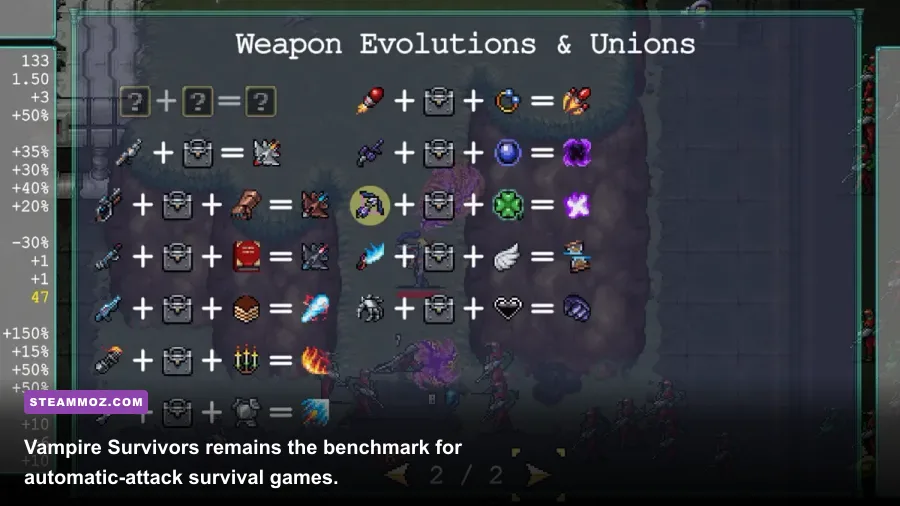
Vampire Survivors on Steam is the obvious recommendation, but obvious doesn't mean outdated. Poncle’s game remains the genre’s cleanest lesson in why upgrade choices work. Your character attacks automatically, movement is your main defensive tool, and every level-up offers a small set of weapons or passive items. That limitation creates the same satisfying rhythm as choosing which ball effects to prioritize in BALL x PIT.
The early benchmark build is Garlic plus Pummarola. Garlic creates a damaging circular zone, while Pummarola increases recovery; evolve the weapon into Soul Eater once you have the required weapon level and passive. For a more projectile-heavy run, take King Bible and Spellbinder toward Unholy Vespers. The Bible rotates around your character, and its knockback lets you stand your ground while the screen fills.
Vampire Survivors is less mechanically busy than BALL x PIT, but that is part of its strength. You can understand a build instantly: weapons deal damage, passives modify them, and evolved weapons arrive through a clear pairing. The weakness is that experienced players may find the first ten minutes too passive. Stick with it until you unlock the Arcana system and weapon evolutions; that is where the game stops being a simple survival toy and becomes a serious build laboratory.
Use the official Vampire Survivors site for current platform and DLC information. If you enjoy tracking upgrade priorities, Steamoz’s weapon tier-list approach is also useful for thinking about damage, utility, and situational value rather than chasing raw rarity.
2. Brotato Rewards Better Decisions Per Minute
Brotato is the best alternative if your favorite BALL x PIT moments involve making three excellent choices in quick succession. Runs are built around six weapon slots, waves usually last 20 seconds, and the shop appears between waves. That structure makes every purchase matter far more than it does in a traditional 30-minute survivor.
The baseline strategy is simple: don't collect six unrelated weapons just because they are available. Focus on a tag or damage identity. A ranged build might combine SMGs with attack speed, ranged damage, and lifesteal. A melee setup using Choppers wants attack speed, melee damage, and enough armor or harvesting to survive contact. The Wrench is especially interesting because Engineering converts your investment into deployable turrets, giving you a second damage engine while you kite.
| Build Direction | Core Weapons | Priority Stats | Main Risk |
|---|---|---|---|
| Ranged burst | SMG, Revolver | Attack Speed, Ranged Damage, Lifesteal | Low armor and poor close-range recovery |
| Engineering | Wrench, Screwdriver | Engineering, Armor, Harvesting | Weak personal damage early |
| Melee sustain | Chopper, Lightning Shiv | Melee Damage, Attack Speed, HP Regeneration | Getting trapped by elites |
| Elemental control | Wand, Shredder | Elemental Damage, Burning, Area | Damage can lag against armored targets |
The critical difference from BALL x PIT is that Brotato asks you to respect the economy. Harvesting is not a glamorous stat, but gaining more materials early compounds across the entire run. Don't reroll the shop repeatedly for one perfect weapon if it leaves you unable to buy survivability. The final waves punish greedy damage builds with elite enemies, projectiles, and cramped movement lanes.
For players who want to understand upgrade sequencing, Brotato is arguably the strongest game here. It doesn't hand you a long runway. It asks whether you can identify a winning plan by wave three and still adapt when the shop refuses to cooperate.
3. Halls of Torment Makes Positioning Matter
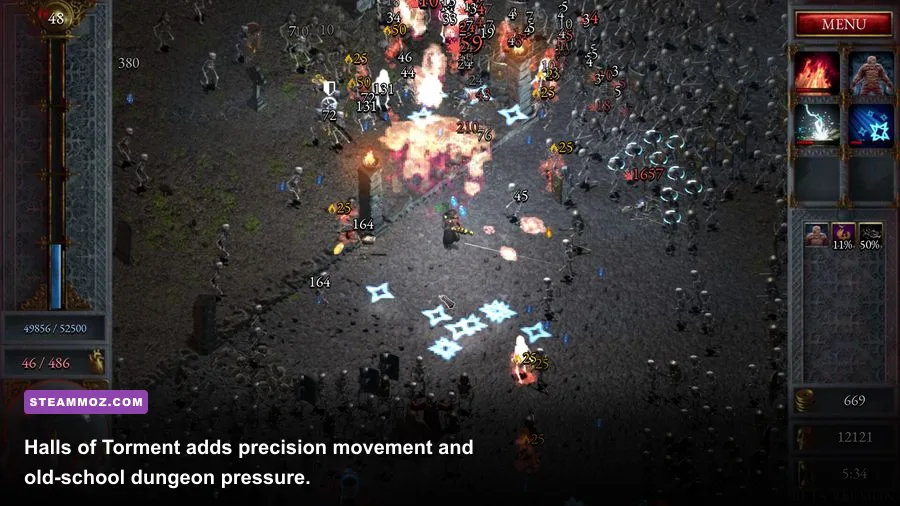
Halls of Torment is the pick for anyone who likes BALL x PIT’s visual clarity but wants movement to carry more weight. Its isometric arenas are packed with skeletons, demons, ghosts, and elite threats, yet enemy attacks are readable enough to dodge when you pay attention. You aren't merely orbiting a horde; you're managing lanes, choke points, and escape routes.
The game’s characters change the shape of a run. The Archer rewards critical-hit investment and careful spacing, while the Exterminator creates a sustained fire lane that becomes excellent when enemies funnel toward you. The Cleric splits damage across nearby targets, making crowd density a resource rather than just a danger. Each hero also has quest-based unlocks, so permanent progression feels tied to actual play instead of a generic currency dump.
Build around a damage type before the middle of a run. If you take a piercing projectile, look for upgrades that improve projectile count, range, or attack speed rather than scattering points across unrelated elemental effects. The best runs use the arena geometry: pull enemies into a broad arc, keep one side open, and only cross the horde when a telegraphed attack forces you to move.
Halls of Torment has a more deliberate tempo than Vampire Survivors. That can feel slower for the first few minutes, but it pays off once elite waves begin testing your route planning. It’s also a good option for players who prefer a dark fantasy presentation over BALL x PIT’s bright arcade look.
4. Death Must Die Is the Best Loot-Driven Alternative
Death Must Die adds a layer BALL x PIT players may appreciate immediately: loot. You control heroes entering the underworld, gain blessings from gods during a run, and return with equipment that changes future attempts. The result feels like a compact action RPG crossed with a survivor game rather than a pure arena endurance test.
Its blessing system encourages combination hunting. Winter can slow or freeze threats, Justice improves direct offensive pressure, and Time manipulates cooldown-oriented play. The exact god mix matters less than building around a clear plan. A freeze-heavy setup wants repeated hits and area coverage so enemies remain controlled; a critical-focused character wants attack speed and effects that turn each successful hit into a bigger payoff.
The gear system is powerful, but don't mistake higher item level for an automatic upgrade. A lower-level item with movement speed, cooldown reduction, or a useful resistance can outperform a raw damage piece when a run is failing because you can't reposition. That is one reason Death Must Die feels more RPG-like than many competitors: survival is often a stat-check problem caused by a bad loadout, not merely a missed dodge.
Its main drawback is uneven pacing. Some combinations snowball dramatically, while others take too long to become functional. If you want immediate feedback, choose Brotato. If you enjoy chasing a perfect blessing-and-equipment package across multiple attempts, Death Must Die is the richer long-term project.
5. 20 Minutes Till Dawn Gives You Manual Control
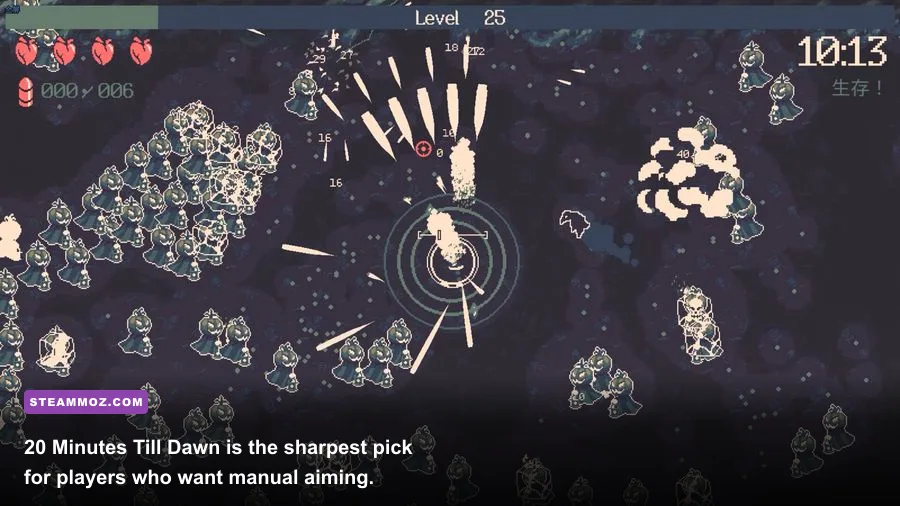
20 Minutes Till Dawn is the strongest choice when the thing you love about BALL x PIT is projectile behavior rather than automatic combat. You aim with the mouse or right stick, fire manually, and choose upgrades that can transform a basic weapon into an absurdly efficient killing engine. It feels more like a twin-stick shooter than a passive survivor game.
Hina is a particularly strong starting character because her Shadow Clone creates an additional damage source and rewards aggressive movement. Pair her with Magic Spear or Dual SMGs depending on whether you want piercing control or rapid single-target pressure. Shana is more flexible, especially when you can exploit her ability to improve the next level-up choice, but she demands better decisions because her early damage is less forgiving.
Choose a weapon first, then commit to its upgrade family. A reload-focused gun needs reload speed and bullet count; a magic build benefits more from elemental effects and projectile size. Don't automatically take every summon. Summons are excellent when they cover your blind side, but they can dilute a build if your character already has a strong direct-fire plan.
Compared with BALL x PIT, 20 Minutes Till Dawn has fewer base-building distractions and a much higher demand for active aiming. You must keep firing while steering through gaps, and bosses punish tunnel vision with large telegraphed attacks. It is the best recommendation for players who think BALL x PIT is almost perfect but wish they had a trigger to pull.
Which Game Should You Play First?
Start with Vampire Survivors if you want the most accessible version of the formula. Pick Brotato if you prefer short runs and shop-based optimization. Halls of Torment is better for careful movement, Death Must Die for loot and RPG progression, and 20 Minutes Till Dawn for manual aiming. Deep Rock Galactic: Survivor deserves a look if mining objectives and class identity sound more appealing than a pure arena loop.
| If You Want... | Play This | Why | Difficulty Feel |
|---|---|---|---|
| The closest overall genre match | Vampire Survivors | Clear weapons, evolutions, and permanent upgrades | Easy to learn, deep to master |
| Fast tactical runs | Brotato | Six weapon slots and 20-second waves | Demanding from the opening minutes |
| Precision movement | Halls of Torment | Readable threats and character-specific quests | Measured but punishing |
| Loot and build chasing | Death Must Die | Equipment, blessings, and hero progression | Swingy but rewarding |
| Manual projectile combat | 20 Minutes Till Dawn | Aiming and weapon-focused upgrade trees | Action-heavy and reactive |
My personal order for a BALL x PIT fan is Brotato first, 20 Minutes Till Dawn second, and Vampire Survivors third. Brotato best matches the feeling of making a small decision that changes an entire run. 20 Minutes Till Dawn gives projectile lovers more control, while Vampire Survivors remains the genre’s essential foundation.
Don't ignore performance when you start stacking hundreds of projectiles and enemies. These games are usually lightweight, but late-run particle effects can still create frame-time spikes. On PC, use a stable 60 fps target, lower screen shake before reducing resolution, and disable unnecessary damage-number clutter if the game offers that option. A smooth frame pace makes dodging telegraphs easier than a higher average frame rate with constant stutter.
For more performance-focused advice, Steamoz has a useful graphics settings guide, and its Star Wars Outlaws optimization breakdown explains the same basic principle: protect frame-time consistency before chasing extra visual detail.
BALL x PIT may be the game that brought you to this corner of the roguelite genre, but it shouldn't be the last stop. Vampire Survivors supplies the foundation, Brotato sharpens your decision-making, Halls of Torment tests your feet, Death Must Die feeds the loot hunter, and 20 Minutes Till Dawn puts your aim under pressure. Any one of them can consume a weekend. Together, they show just how much room remains between a simple survival loop and a genuinely great build-crafting game.