IXION has no conventional weapon arsenal or combat damage tier list. The best “equipment” is the operational fleet that keeps the Tiqqun alive: the Science Ship is the S-tier priority, followed by the Mining Ship, Cargo Ship, and finally extra probe capacity. If you came looking for laser cannons, missile launchers, or damage builds, the important correction is that IXION is a survival colony sim, not a space combat game. Your strongest setup wins through research, resource timing, hull stability, and smart expedition routing.
That distinction changes how you should rank every vehicle and system. A Science Ship can unlock enormous story rewards and critical technology. A Mining Ship can prevent an iron or carbon shortage from collapsing an entire sector. A Cargo Ship can keep food, alloys, electronics, and waste moving between sectors. None fires a weapon, yet losing one at the wrong moment can be more devastating than losing a battle in a traditional 4X game.
This ranking focuses on the equipment that actually determines an IXION run: what to build first, where each ship sits in the progression curve, which upgrades deserve research, and why some apparently useful investments are traps. For a broader look at performance tuning in demanding PC games, Steamoz’s Deep Rock Galactic performance guide covers the same kind of practical frame-rate troubleshooting, while this article stays focused on IXION’s systems and strategy.
IXION equipment tier list at a glance

The table below ranks equipment by strategic impact rather than imaginary DPS. S-tier tools either unlock progression or protect the station from the resource spirals that cause most defeats. A-tier equipment is extremely valuable but depends on the situation. B-tier choices are useful support systems, while C-tier investments are usually premature unless a specific scenario demands them.
| Equipment or system | Tier | Why it ranks here | Best timing |
|---|---|---|---|
| Science Ship | S-Tier | Drives expeditions, story progression, research rewards, and key discoveries | Build as soon as the Space Dock and resources allow |
| Mining Ship | S-Tier | Turns nearby asteroid resources into a reliable supply of iron, carbon, silicon, and ice | Early game, especially before stockpiles become comfortable |
| Cargo Ship | A-Tier | Moves resources between sectors and prevents local production bottlenecks | When multiple sectors or specialized production chains open |
| Probe Launcher | A-Tier | Reveals points of interest, resource locations, and expedition opportunities | Use continuously once power and probe materials are stable |
| Science Ship upgrade paths | A-Tier | Improves the value and safety of exploration without adding direct combat | After basic survival technologies are secured |
| Extra low-priority ships | B-Tier | Increase throughput but can drain electronics, alloys, and workforce attention | Midgame, after the economy has proven it can support them |
| Unplanned duplicate fleet | C-Tier | Looks powerful on paper but often creates maintenance and logistics stress | Only when a clear resource or expedition bottleneck exists |
Why “weapon ranking” is the wrong IXION question
There is no player-controlled combat layer where you equip the Tiqqun with a gun and compare damage per second. Hostile events, dangerous locations, and narrative threats are handled through decisions, ship assignments, technology, and station preparation. The real loss condition is usually indirect: an expedition takes too long, food stops moving, hull integrity falls, or a production chain consumes the last electronics needed to repair critical buildings.
That is why an S-tier ship is not necessarily the fastest or most glamorous one. It is the tool that creates the biggest improvement in your survival margin. A Science Ship can be idle for a few minutes and still be more valuable than a second Cargo Ship sitting beside an empty stockpile.

🎮 IXION
Looking to experience this game? Grab your digital key directly on our store for $12.24.
View on Steammoz Store →S-Tier: Science Ship and Mining Ship
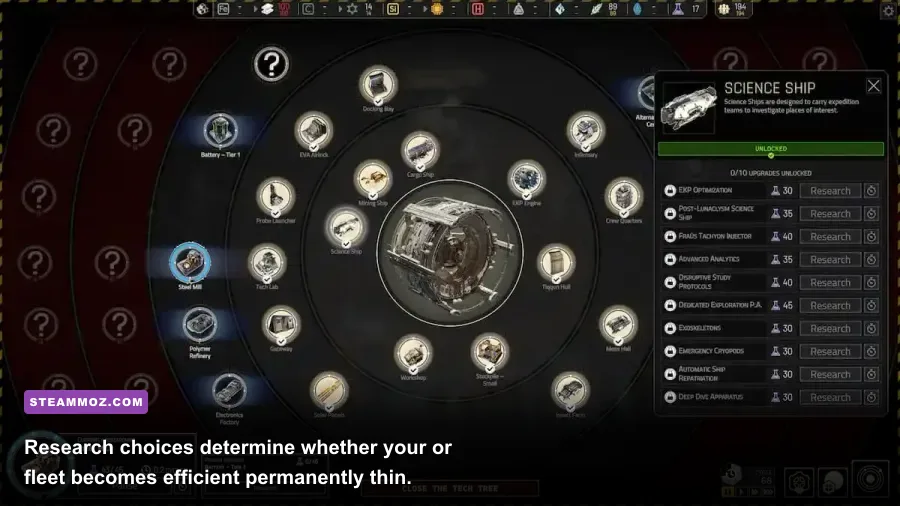
Science Ship is the best first specialist
The Science Ship deserves the top ranking because IXION’s progression is tightly tied to exploration. It investigates locations, advances expedition chains, returns research opportunities, and frequently uncovers resources or narrative information that cannot be obtained by simply building another factory. Its value compounds: early discoveries improve later decisions, while delayed exploration can leave you under-researched when the station’s demands accelerate.
Send it to locations that are close enough to fit your current logistics plan rather than blindly chasing every distant marker. A ship away from the Tiqqun is not just unavailable; it also represents time during which you cannot react to a new event with that asset. Before launching, check the station’s food, hull integrity, power production, and available storage. The ideal expedition is one that returns before a predicted shortage becomes an emergency.
Research should support the Science Ship’s role instead of competing with basic infrastructure. Prioritize technologies that improve exploration reliability, unlock better production chains, or reduce the time and material cost of keeping the station running. Researching a flashy late-game option while your food or alloy economy is unstable is the IXION equivalent of buying a graphics card while your power supply is failing.
Mining Ship turns nearby space into stability
The Mining Ship sits beside the Science Ship in S-tier because raw materials are the foundation of every station decision. Iron becomes alloys, carbon supports construction and industry, silicon feeds electronics, and ice helps sustain the water and food economy. The exact resource you need changes by chapter and sector, but the principle never does: a stockpile is only useful if you can replenish it before the next building queue drains it.
Mining is strongest when you plan routes around consumption. If the sector is about to spend its iron on housing, roads, and industrial buildings, send the Mining Ship toward an iron-rich location before the shortage appears. Do not wait until the stockpile reaches zero. Production buildings may stop, cargo routes may sit empty, and the workforce can begin spiraling into low morale while you scramble to recover.
Mining Ships are also a reason not to overbuild storage early. A huge warehouse filled with the wrong material is dead weight. Use probes to identify useful deposits, then build the extraction chain that matches your next ten minutes of construction and research rather than your imagined endgame.
A-Tier: Cargo Ship and Probe Launcher
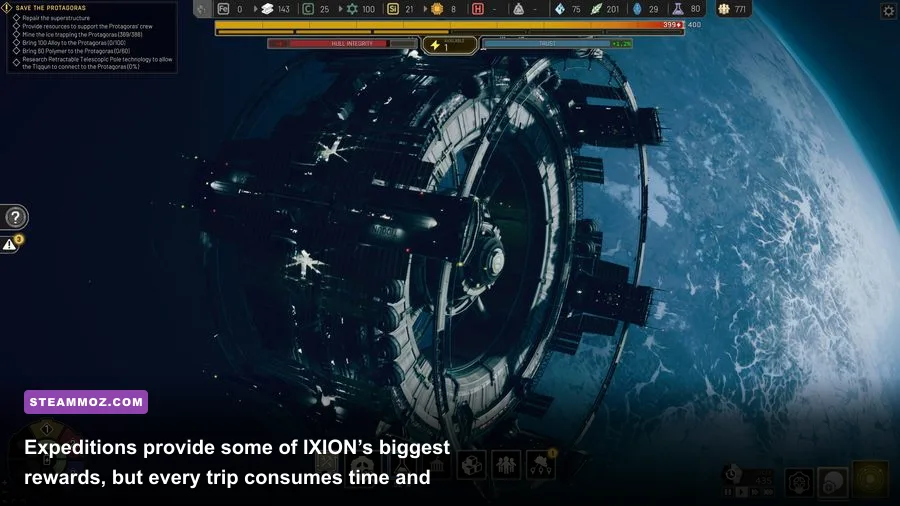
Cargo Ship fixes the sector problem
The Cargo Ship becomes essential once the Tiqqun’s sectors stop behaving like one shared room. Production may happen in one sector while housing, food, or research consumes the output in another. That is where a Cargo Ship moves from “nice support” to “the thing preventing a shutdown.” A perfectly balanced production chain is worthless if the finished resource is stranded on the wrong side of the station.
Use cargo routes deliberately. Connect high-volume, predictable transfers first: alloys from the industrial sector, food toward populated sectors, and electronics toward buildings or research that actually need them. Avoid creating a dozen routes simply because every sector has an available destination. More routes mean more traffic to monitor, and a transport network that looks busy can still fail if its source warehouse is empty or the receiving sector lacks capacity.
The Cargo Ship ranks below the Science Ship and Mining Ship because it mostly multiplies infrastructure you already own. If there is no production surplus, it has nothing useful to carry. Build it when a real distance problem appears, not because the fleet panel feels incomplete.
Probe Launcher is quiet but strategically huge
The Probe Launcher does not look like equipment in the traditional sense, but it is one of the strongest information tools in the game. Probes reveal points of interest, identify resource opportunities, and help you plan the next expedition before your current one returns. Information lets you spend ships and materials with intent instead of reacting to whichever icon happens to be closest.
Keep probe production aligned with your electronics and alloy economy. Launching probes constantly is powerful only when the station can afford the materials. If probe construction consumes the same electronics needed for critical repairs or life-support infrastructure, slow down. The best probe is the one that reveals a useful route without triggering a production crisis at home.
| Tool | Primary job | Common mistake | Expert use |
|---|---|---|---|
| Science Ship | Expeditions and discoveries | Sending it out during a food or hull emergency | Plan missions around predicted shortages and research timing |
| Mining Ship | Resource extraction | Mining whatever is nearby without checking consumption | Target the resource your next construction chain will exhaust |
| Cargo Ship | Inter-sector transport | Creating routes without source or destination capacity | Prioritize stable, high-volume transfers between specialized sectors |
| Probe Launcher | Map discovery and scouting | Burning electronics on low-value scans | Reveal deposits and locations before committing ships |
B-Tier equipment and the danger of overbuilding
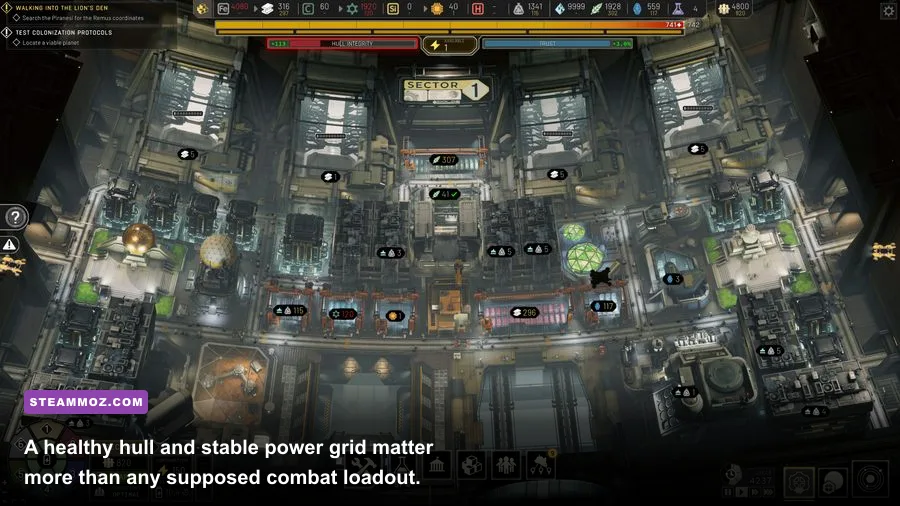
Additional ships and support upgrades land in B-tier not because they are weak, but because their value is conditional. IXION punishes premature expansion. Every new building adds demands on power, workforce, maintenance, storage, or transport. A second specialist ship may solve a genuine bottleneck, but it can also become another asset you need to feed while the station is already running on emergency reserves.
Before adding a duplicate, ask three questions. Is the current ship busy enough to justify replacement capacity? Is the relevant resource actually available? Can the station support the extra electronics, alloys, power, and workforce pressure? If any answer is no, improve the existing chain first.
This is especially important for players who treat the game like a traditional 4X title and try to build a large fleet immediately. IXION’s progression curve rewards a compact, efficient operation. A single well-timed Science Ship can outperform two underused ships because it returns to the Tiqqun before your next crisis and keeps your research pipeline moving.
Station equipment outranks fleet size
Hull integrity, power generation, storage, housing, and food infrastructure are your defensive equipment. If a new ship delays repairs or forces you to run an unstable power grid, it is not an upgrade. It is a liability with a launch animation.
Keep hull integrity visible whenever you plan an expedition. The station’s outer shell is not a cosmetic health bar; when it drops too far, the entire colony becomes a countdown. Emergency repairs can consume materials you had planned for expansion, so prevention is vastly cheaper. The same logic applies to food. A Science Ship cannot save a run if the population is already entering a starvation spiral.
Players who enjoy tuning demanding games should also check Steamoz’s Crimzon Clover settings guide and Don’t Escape 4 performance guide. IXION’s graphics options are less combat-focused, but stable performance still makes it easier to catch warning icons and follow moving logistics chains.
Best IXION progression order for equipment
The strongest build order is not a rigid checklist because map positions, event choices, and resource availability vary. Still, a reliable progression curve emerges in most campaigns. First establish the minimum station economy, then unlock the fleet tools that expand your options, and only afterward add redundancy.
Step 1: stabilize the Tiqqun
Start with power, housing, food, storage, and the basic industrial chain. Keep enough materials available for repairs and avoid filling every available tile with production. Your goal is a station that can absorb a surprise event without stopping construction entirely. Watch workforce allocation as closely as physical resources; a building that has materials but no workers is still effectively offline.
Step 2: unlock the first Science Ship
Once the Space Dock and supporting infrastructure are affordable, prioritize the Science Ship. Use the first expeditions to learn the map and secure research opportunities, but do not let the ship’s absence blindside the station. Pause before departure, review storage levels, and make sure the next construction project does not depend on a resource you cannot replace.
Step 3: add Mining Ship capacity around consumption
Build the Mining Ship when your resource demand begins to outpace passive or starting reserves. Send it to deposits that match the production chain you are about to expand. Mining is not about collecting the largest possible number; it is about keeping the next critical building, repair, or research project supplied.
Step 4: introduce cargo logistics when sectors specialize
As sectors develop different roles, use Cargo Ships to keep materials moving. Create routes only after identifying the source, destination, quantity, and priority. If a route repeatedly stalls, check warehouse capacity, production staffing, and whether another route is consuming the same output. The ship may be functioning perfectly while the network around it is broken.
Step 5: buy redundancy after proving the bottleneck
Extra ships are the final step, not the opening move. Add them when a Science Ship is permanently booked, a Mining Ship cannot keep up with actual consumption, or a Cargo Ship is creating a visible transport delay. Redundancy is excellent insurance in the midgame, but only after the station can pay for it without sacrificing hull, food, or power stability.
| Progression stage | Priority equipment | What to verify first | Failure to avoid |
|---|---|---|---|
| Opening station | Basic power, food, storage, and industry | Workforce, hull condition, and emergency materials | Building a fleet before the colony can support it |
| Early exploration | Science Ship and Probe Launcher | Food reserves and expedition timing | Sending the only specialist out during a crisis |
| Resource expansion | Mining Ship | Which resource the next chain will consume | Mining a surplus while another material hits zero |
| Multi-sector operation | Cargo Ship and deliberate routes | Warehouse capacity and route destinations | Creating transport routes with no stable source |
| Midgame redundancy | Duplicate specialist ships | Persistent throughput bottlenecks | Paying maintenance for idle equipment |
The final IXION ranking verdict
If you want the shortest possible answer to the IXION weapon tier list question, build and protect the Science Ship first, use a Mining Ship to secure the resource economy, then add a Cargo Ship when sectors begin fighting over materials. Keep the Probe Launcher active, but never let scouting consume the electronics needed to keep the station alive. There are no guns to min-max, so your “loadout” is the order in which you turn information, raw resources, and transport capacity into stability.
The best IXION players are not the ones with the biggest fleet panel. They are the ones who know exactly why each ship exists, what it should be doing next, and how long the Tiqqun can survive while it is away. Treat every equipment choice as part of a living supply chain, and the game’s harshest crises become manageable rather than mysterious.
For official details, compare the game’s IXION Steam page, the developer’s official IXION site, and publisher Kasedo Games’ IXION page. When you want more practical strategy writing, Steamoz’s Cult of the Lamb survival tips offers another useful example of prioritizing systems before flashy upgrades.