
Yes, Stumble Guys is still worth playing for free in 2026—but only if you treat it as a sharp, social party game rather than a serious competitive platformer. Its core loop remains excellent: up to 32 players enter a short obstacle-course match, the field is cut down across rounds, and every victory comes from reading hazards, controlling momentum, and surviving somebody else's panic. The catch is equally clear. The free-to-play economy, rotating events, repetitive map pool, and occasional connection or matchmaking frustrations make it much less compelling as a daily grind than as a brilliant 20-minute game to play with friends.
That distinction matters. Stumble Guys has never needed a deep combat system or a huge progression tree to work. Its appeal is the instant readability of a falling platform, a badly timed dive, and one opponent accidentally launching you toward the finish line. In 2026, the question isn't whether the basic game is fun. It is whether the free version gives you enough variety and control to keep that fun alive after the novelty wears off.
What Stumble Guys Actually Does Well
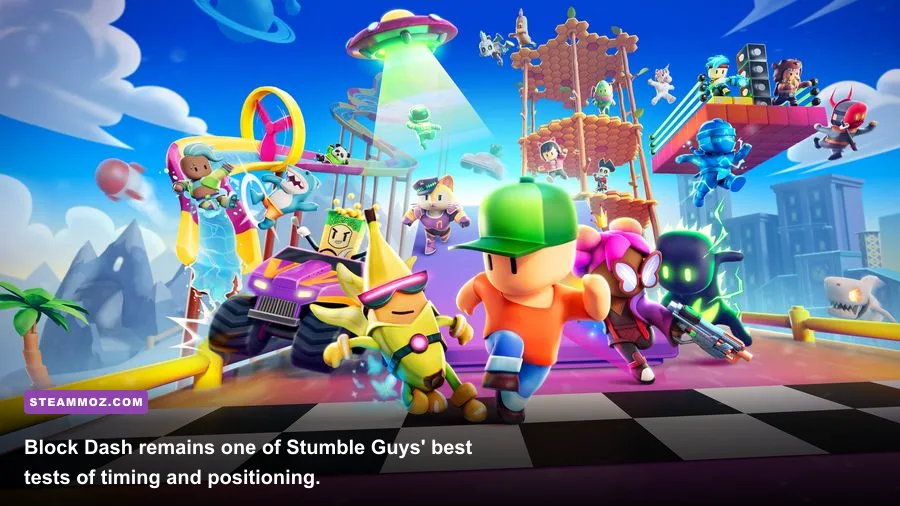
Stumble Guys is the free-to-play answer to the party-game chaos popularized by Fall Guys, but its best moments aren't simply copies of another game's formula. The controls are deliberately compact: movement, jump, dive, and sometimes an emote or ability depending on the current mode. That tiny toolkit creates a surprisingly broad skill ceiling.
Jumping gets you over gaps, but diving extends a leap and lets you recover from awkward landings. A dive can also turn a finish-line stumble into a qualification. The trade-off is recovery time: diving too early leaves your character flailing while a rotating bar, puncher, or moving block arrives. Good players don't spam the dive button. They use it as a commitment tool.
That is why maps such as Icy Heights, Cannon Climb, Floor Flip, and Space Race remain replayable. Each asks a different question. Icy Heights tests momentum on slippery surfaces; Cannon Climb asks you to read projectile timing; Floor Flip punishes players who follow the crowd without checking the next tile; Space Race layers jumps, gravity changes, and moving platforms into a longer route.
The most successful rounds also have clean visual language. A rotating beam telegraphs its path. A puncher signals its cycle. A disappearing tile tells you that the safe route is temporary. When you fail, you can usually identify the mistake immediately. That clarity is a huge reason the game works for children, casual players, and experienced platform-game fans at the same time.
| Core Feature | Why It Works | 2026 Limitation |
|---|---|---|
| 32-player opening rounds | Instant chaos and readable competition | Large lobbies can feel random on crowded maps |
| Jump and dive movement | Easy controls with meaningful timing | Physics can feel inconsistent after collisions |
| Three-round structure | Matches stay short and easy to replay | Repeated maps become noticeable quickly |
| Cosmetic progression | Frequent rewards give casual goals | Paid currency and rotating offers can feel noisy |
Is the Free Version Generous Enough?
The free download gives you the important part: the full basic multiplayer experience. You aren't buying access to the obstacle courses, and you don't need a premium skin to qualify, win, or learn the maps. That makes Stumble Guys a genuinely accessible game rather than a trial version disguised as free software.
The monetization lives around the match. You will encounter skins, emotes, footsteps, animations, bundles, event rewards, and the Stumble Pass. Some rewards can be earned through regular play, while premium tracks and selected shop items are tied to paid currency. The exact offers and event structure change frequently, so anyone promising a permanent 2026 price or reward list is overselling certainty.
That changing storefront is the main irritation. The game is at its best when you are focused on the next jump; it is less charming when menus constantly point toward limited-time bundles. None of those cosmetics should affect your route choice, but the presentation can make a simple party game feel more like a retail app.
My advice is simple: play the free track first and wait before buying the Stumble Pass. A pass makes sense only if you are still playing several weeks later and genuinely want the cosmetic rewards. Do not buy it because a challenge system implies that you are behind. You are not behind. The courses do not care what your outfit cost.
For a useful comparison, the free model is closer to a lightweight social game than a traditional premium platformer. You can install it from the official Stumble Guys Steam page, check the current platform information through the official Stumble Guys website, and decide whether the active events matter to your group.
How the Best Maps Reward Skill

Stumble Guys is not purely luck, although collisions can make it look that way. The biggest improvement comes from separating route selection from movement execution. First decide where the hazard is going. Then commit to the jump. Players who react only after a bar or block reaches them are already late.
Block Dash
In Block Dash, the safest position is usually near the center of the available platform, not pressed against another player. Watch the incoming wall's shape and identify gaps before jumping. A low wall may be cleared with a normal jump, while a taller arrangement often rewards a jump followed by a controlled dive. Avoid diving toward a crowd: a collision can turn a successful landing into a chain reaction.
Laser Tracer
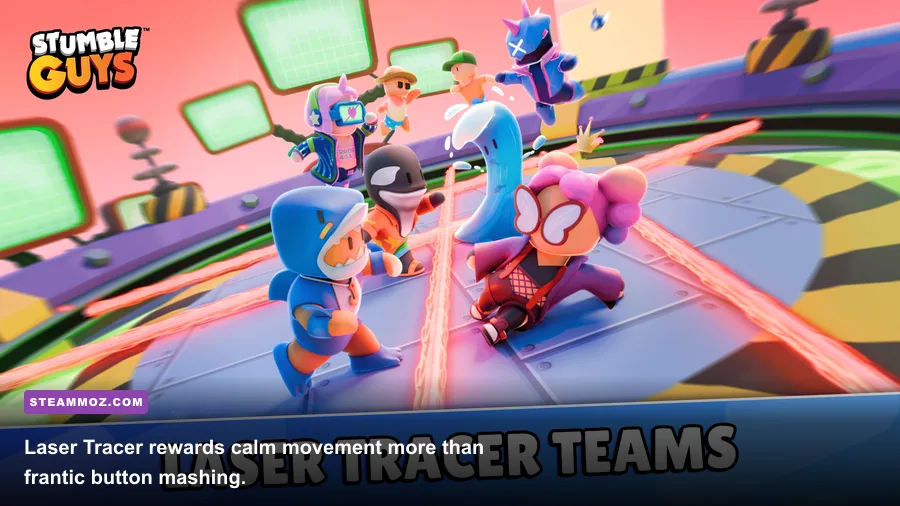
Laser Tracer is a patience check. The laser's rotation gives you a predictable rhythm, so short hops are safer than long panic jumps. Stay near the center when possible, because the outer edge offers less recovery space. If two beams overlap, jump late enough to clear the first and land before the second reaches your position. Early jumps are what cause most double hits.
Honey Drop and Floor Flip
Honey Drop rewards route planning. Move across the upper layer only when it preserves an escape path, and avoid following the player who is already burning through tiles. In Floor Flip, don't assume the crowd has found the correct route. Test a tile from a position that lets you step back, and watch which panels have already changed state. The fastest player is often the one who loses the fewest seconds to a wrong guess.
| Map | Main Danger | Reliable Counter | Skill Ceiling |
|---|---|---|---|
| Block Dash | Wall collisions and crowded gaps | Read wall shapes early; jump late | High |
| Laser Tracer | Overlapping rotating beams | Short hops and central positioning | High |
| Honey Drop | Destroying your own escape route | Preserve tiles and watch opponents | Medium-high |
| Cannon Climb | Projectile timing and bottlenecks | Use cover, then move during reload gaps | Medium |
| Floor Flip | False routes and crowd assumptions | Probe tiles from a retreatable angle | Medium |
Performance on PC, Mobile, and Older Hardware
Stumble Guys is technically light, but that doesn't mean every device delivers the same experience. The competitive advantage is not higher texture quality; it is stable input and consistent frame pacing. A locked 60 frames per second feels far better than a fluctuating 90 or 120 that hitches whenever a crowded lobby loads.
On PC, start with the game's listed minimum requirements rather than assuming integrated graphics are automatically safe. The Steam listing has historically placed the target around a 64-bit Windows installation, 4 GB of RAM, a Core i5-class processor, DirectX 11 support, and a GTX 660-class GPU, though requirements and supported configurations can change. Check the current listing before upgrading around an old machine.
On mobile, close background apps, disable battery-saving modes during matches, and use a stable Wi-Fi connection where possible. Touch controls are perfectly usable, but the virtual buttons can become awkward when your thumb covers the landing point. A controller-supported setup is worth testing if your phone, tablet, or platform supports it.
| Profile | Recommended Settings | Expected Benefit | Best For |
|---|---|---|---|
| Competitive PC | Lower effects, native resolution, 60 FPS target | Cleaner hazards and steadier input | Ranked or high-stakes rounds |
| Balanced PC | Medium quality, native resolution, capped frame rate | Good clarity without unnecessary GPU load | Most laptops and desktops |
| Older PC | Low effects, reduced resolution, background apps closed | Fewer stutters in crowded scenes | Integrated or aging graphics |
| Mobile battery mode | Lower brightness, stable network, performance mode | Less heat and fewer mid-match slowdowns | Long sessions away from a charger |
If you are troubleshooting a broader PC setup, Steamoz's guides on PC crashes and FPS fixes and higher-FPS settings cover the same useful basics: update drivers, remove overlays, verify files, and watch temperatures before blaming the game.
Playing Solo Versus Playing With Friends
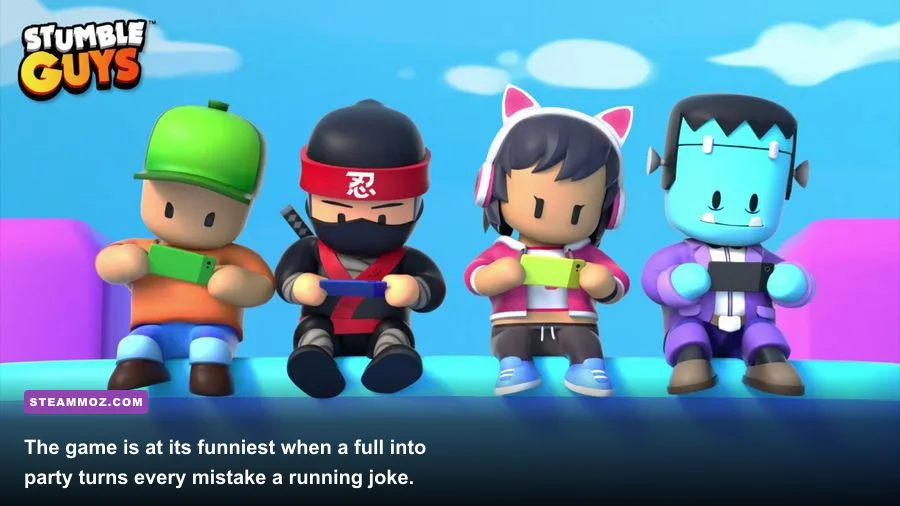
Solo Stumble Guys is fun in short bursts, but the social layer is what keeps it installed. A private party turns every elimination into a story, especially when a friend who was bragging about a shortcut gets flattened by the next obstacle. The game also works well for mixed-skill groups because a beginner can qualify through careful play while an experienced player experiments with risky shortcuts.
Solo matchmaking has a different problem: the emotional payoff depends heavily on the lobby. Some rounds feel like a clean test of timing. Others are decided by a collision at a narrow ramp or by several players occupying the same launch point. That volatility is entertaining when you're relaxed and maddening when you are chasing a daily objective.
Cross-platform and account features can vary by platform and region, so check the current details in the game's official support material rather than assuming every device shares every feature. The official Stumble Guys support center is the sensible place to confirm account, party, purchase, and troubleshooting information.
What Has Aged Poorly by 2026
The first weakness is repetition. Stumble Guys can offer a large catalog of maps, but your actual session depends on the current rotation, playlist, and matchmaking. If your group prefers the same handful of rounds, the novelty fades faster than the cosmetics can replace it.
The second is the gap between mechanical skill and collision chaos. You can choose the correct route and still get bumped off a platform. That isn't always bad; unpredictable failures are part of the comedy. But the game rarely gives you enough information to distinguish a personal mistake from a physics problem, which can make long solo sessions feel less fair.
The third is progression fatigue. XP, crowns, missions, events, currency, and pass rewards can turn a relaxed game into a checklist. The smart approach is to ignore anything that makes you play a map you dislike. A cosmetic reward is not worth grinding through an hour of frustration.
These flaws don't destroy the game. They define the right dosage. Stumble Guys is strongest as a social palate cleanser, not as the only multiplayer game on your hard drive. If you want a deeper long-term progression loop, Steamoz's guides to leveling and farming systems or hidden rewards worth hunting point toward games with more substantial advancement.
The Verdict: Download It, But Don't Grind It Blindly
Stumble Guys is still worth playing for free in 2026 because its foundation remains unusually effective. The controls take seconds to understand, the rounds are short, the maps communicate their dangers clearly, and a good party can turn a failed jump into the funniest moment of the night. Those qualities survive every shop refresh and seasonal event.
It is not worth treating as a demanding esport, a generous cosmetic collection, or an endless solo progression game. The free version gives you enough to judge the experience without spending anything. Play several sessions, try the current maps, test the controls on your preferred device, and see whether your friends actually want to queue together. If the answer is yes, Stumble Guys earns a place in your rotation. If you're already bored after a few matches, buying the pass won't fix the underlying problem.
Final score: 8/10 for free social play, 6/10 as a daily solo grind. Download it for the chaos, stay for the clutch dives, and ignore the pressure to purchase every colorful costume that appears in the shop.