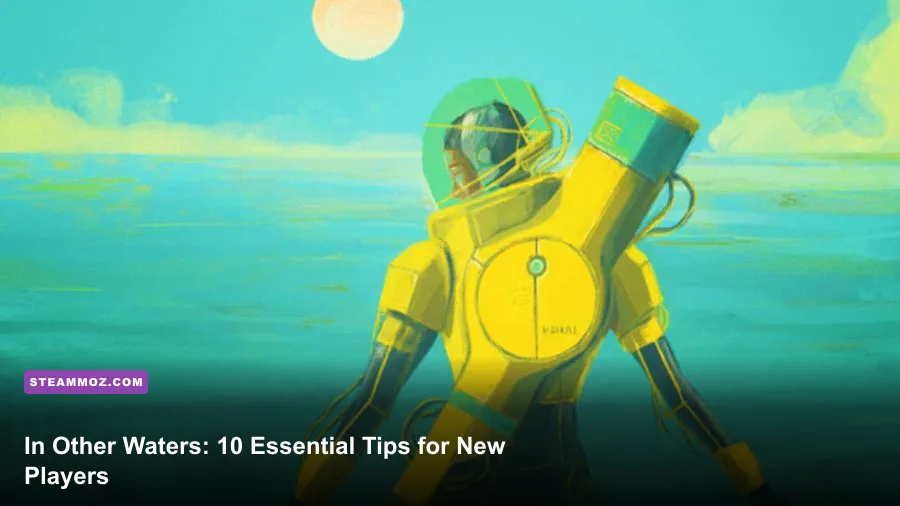
The best way to approach In Other Waters is to treat it as a field-research simulator, not a conventional adventure game. You aren't hunting enemies, stacking weapons, or chasing a minimap marker. You're operating an artificial intelligence aboard a stranded research submarine, guiding xenobiologist Ellery Vas through an alien ocean one uncertain reading at a time. Follow sonar patterns, scan before collecting, keep a research loop running, and never waste a trip because you forgot what a site contained. These 10 tips make the game's deliberately quiet exploration feel purposeful instead of opaque.
Developed by Jump Over the Age and published by Raw Fury, In Other Waters on Steam is built around attention. Its interface resembles a scientific instrument panel, and the game expects you to interpret information rather than simply react to it. That design is unusual, but once the basic rhythm clicks, the ocean becomes remarkably readable.
1. Learn the interface before chasing the story
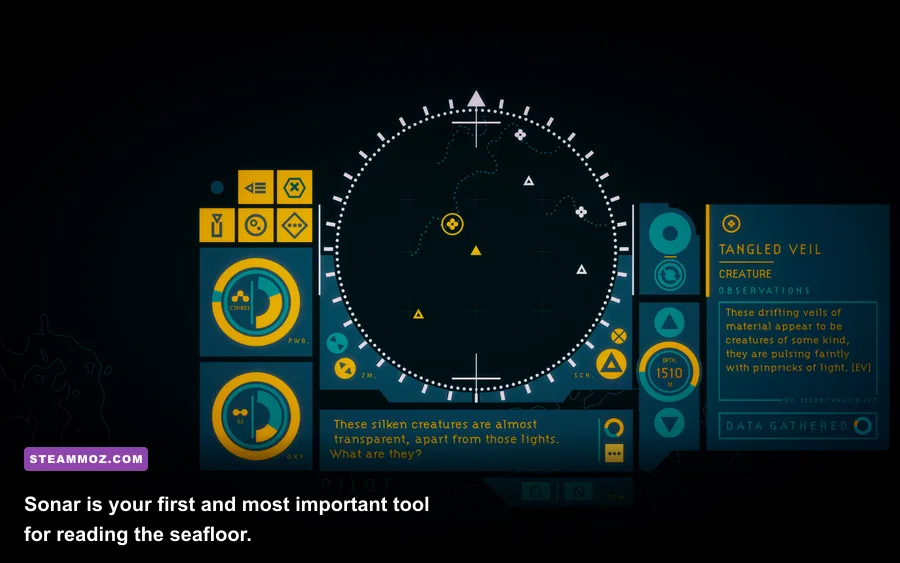
The opening hours are a tutorial in disguise. The left side of the interface handles your current view and navigation, while the central display gives you the most useful information about nearby terrain, signals, and organisms. Read every label. The game is sparse, but almost every icon has a practical meaning.
Before moving, pause long enough to identify your current position, the direction of nearby points of interest, and whether a signal is a destination or simply something detected in passing. New players often click toward the most visually prominent marker and then wonder why the submarine arrives with no obvious interaction. In Other Waters rewards deliberate selection: select the site, inspect its description, then choose the appropriate action.
There is no traditional minimap with a convenient player arrow and quest route. Your map is a record of observations. The sooner you stop expecting it to behave like a standard open-world map, the less disorienting the game becomes.

🎮 In Other Waters
Looking to experience this game? Grab your digital key directly on our store for $3.74.
View on Steammoz Store →2. Use sonar as a navigation tool, not background decoration
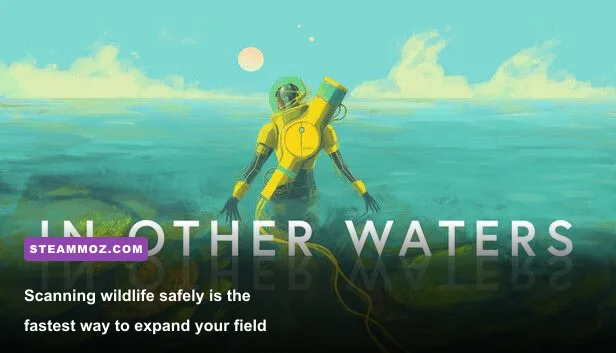
Sonar is your main source of certainty. It tells you that something exists before the story, your eyes, or Ellery's notes can explain what it is. When entering a new area, sweep the surrounding space and make a mental note of every return. A single trip devoted to mapping the immediate area is often more efficient than repeatedly travelling blind.
Pay attention to distance and direction rather than only the icon itself. A nearby signal may be a specimen, terrain feature, resource, or route into another zone. A distant point can be worth remembering, but it usually shouldn't take priority over the site directly in front of you. If the interface presents several options, investigate the one that teaches you the area's layout first.
Keep your route simple. Zigzagging between every detected signal burns time and makes it harder to understand how locations connect. Visit one cluster, finish the available observations, and then return toward the next cluster. This sounds slower; in practice, it prevents the frustrating “I know I saw that somewhere” problem that makes early exploration feel random.
3. Scan every unfamiliar organism before collecting anything
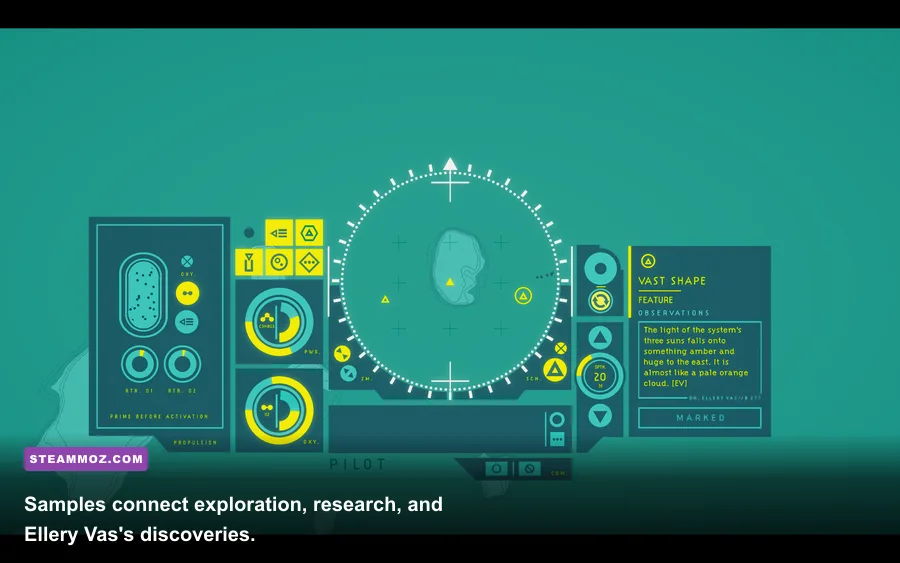
When an organism appears, scan it before attempting to gather a sample. Scanning is the low-risk information step: it lets the AI and Ellery identify the creature, record useful observations, and reveal whether the organism reacts to the submarine. Sampling is more committed, and approaching without understanding the target can waste a promising encounter.
Not every creature behaves like a threat. Some move away, some remain passive, and some respond to proximity or equipment. The important distinction is that unknown does not mean hostile. In Other Waters is a game about interpreting alien behavior, so the correct response to a strange silhouette is curiosity followed by caution—not an immediate retreat and not reckless contact.
Build a habit of checking the information panel after each scan. You may learn a creature's preferred environment, movement pattern, or relationship to nearby life. Those details aren't just flavor. They help you decide where to search next and make later sample collection far more predictable.
4. Treat samples as part of a research loop
Collecting a biological sample is only half the job. The real payoff comes from returning that information to the wider research process and using it to guide the next expedition. New entries can unlock context, connect species to habitats, and make previously confusing locations understandable.
Don't grab the first available sample and immediately abandon all other observations. If two organisms are sharing the same environment, scan both before leaving. The relationship between them may be more valuable than either entry by itself. Likewise, a terrain scan can explain why a species appears in one section but not another.
Your research log is effectively a second map. Read it when you return to the lab rather than treating it as a collection of optional lore. Ellery's notes often transform a vague clue into a practical lead. If the story suggests a particular habitat or organism, search your recorded entries before making another unplanned journey.
| Research action | What it gives you | Best time to use it | Common mistake |
|---|---|---|---|
| Sonar sweep | Nearby signals and route awareness | Immediately after entering a new area | Travelling before checking the surrounding space |
| Creature scan | Identification and behavior clues | Before any sample attempt | Assuming every unknown organism is dangerous |
| Sample collection | Material for research and new entries | After confirming the target and surroundings | Leaving without checking nearby related life |
| Log review | Context, links, and future leads | At the lab between expeditions | Treating notes as optional story text |
5. Return to the lab with a reason
The laboratory is more than a save point or story checkpoint. It is where your discoveries become usable knowledge. Before launching again, look over new entries, dialogue, available equipment, and any newly revealed direction. A return trip with no plan is usually a sign that you haven't processed the information you already gathered.
A productive expedition should have a clear purpose: inspect a newly revealed signal, collect a specific sample, investigate a habitat, or follow a story lead. You don't need a perfect checklist, but you should know what success looks like before leaving. This approach also keeps the game's pacing under control. In Other Waters is intentionally contemplative, and wandering without a goal can make that calm feel like aimlessness.
Use Ellery's conversations as strategic guidance. Her scientific curiosity points toward the game's real priorities, while the AI's observations frequently provide the practical details. Read both sides rather than clicking through dialogue as quickly as possible.
6. Don't confuse danger with combat
There are no conventional weapons, damage numbers, character classes, or boss health bars in In Other Waters. The submarine is a research vessel, and survival depends on navigation, awareness, and choosing when to disengage. That difference matters if you're arriving from games such as Excubitors or Fatal Fury: City of the Wolves, where combat build decisions define your progress.
When an encounter becomes unsafe, your answer is generally to create distance, select a safer route, or return later with better information or equipment. Don't search for a hidden attack button. The tension comes from uncertainty: you may not yet know what a creature will do, how a route behaves, or whether an area can be safely crossed.
The best “combat strategy” is therefore observation. Watch the target's movement, avoid crowding multiple unknown organisms, and keep an escape route in mind before you interact. If an encounter feels confusing, retreating is not failure—it is data collection.
7. Upgrade for access before convenience
Submarine improvements are valuable because they expand the ocean you can meaningfully investigate. Prioritize equipment that lets you reach deeper areas, endure environmental pressure, interpret signals, or interact with previously inaccessible sites. A small convenience upgrade is nice, but access upgrades change the shape of the map.
Think of progression as a set of locked research questions. If a location is clearly beyond your current capability, mark it mentally and move on rather than repeatedly testing the same route. The game will give you a reason to return once the relevant equipment or information is available.
Don't assume that every upgrade should be used immediately. After gaining new equipment, revisit your notes and scan for earlier locations that sounded incomplete. Backtracking is often intentional. The game's world is designed around layered knowledge, with an old site becoming more interesting once you understand what you are looking at.
| Priority | Upgrade type | Why it matters | How to judge it |
|---|---|---|---|
| S-Tier | Depth or environmental access | Opens entirely new habitats and routes | Choose it when the story points toward inaccessible water |
| A-Tier | Improved scanning or signal interpretation | Turns ambiguous discoveries into useful leads | Strong choice when several areas remain poorly documented |
| A-Tier | Safer movement or retreat options | Reduces wasted expeditions in hazardous zones | Prioritize before exploring a region with unpredictable encounters |
| B-Tier | Pure convenience improvements | Saves time without opening new content | Take after access and information needs are covered |
8. Use the color and icon language consistently
In Other Waters communicates through a restrained visual vocabulary. Color, shape, pulses, and interface placement are not decoration; they are the game's substitute for a conventional 3D world full of obvious landmarks. Spend time learning what each signal looks like when it is unknown, identified, selected, or unavailable.
If a marker appears different from the one beside it, assume that difference matters. The interface may be telling you that the site contains a new interaction, that you lack the required equipment, or that the point is connected to an earlier discovery. Read the accompanying text before clicking away.
This is also why rushing through the interface causes so many avoidable mistakes. The screen is minimal, but it isn't simple. Give each panel a second to update, especially after entering a new location or completing a scan. A tiny change can be the clue that separates a productive route from a dead end.
9. Keep a personal expedition notebook
The in-game log is useful, but a short personal note can save enormous time. Write down what a location contained, which route was blocked, what a creature was doing, and which clue sent you there. You don't need a full walkthrough. A handful of phrases—“return after depth upgrade,” “passive species near thermal terrain,” “sample still missing”—is enough.
This is especially helpful because In Other Waters deliberately avoids constant quest markers. The game expects you to remember relationships between places, organisms, and research questions. A notebook turns that expectation into a strength. Instead of revisiting every site, you can target the one that actually matches your current objective.
Keep notes chronological when possible. The order in which you encounter clues often mirrors the intended progression, while an out-of-context late-game observation may make an earlier location suddenly worth revisiting.
10. Play slowly, but never play passively
The game's quiet soundtrack, dark ocean palette, and text-heavy interface can create a wonderfully meditative mood. Still, “slow” doesn't mean switching your brain off. Every expedition should involve a decision: what are you testing, what evidence are you gathering, and what will you do if the site doesn't behave as expected?
Set small objectives. Scan one new organism. Chart one route. Return with one useful sample. That structure keeps the pacing satisfying without turning the game into a checklist. It also makes the story's emotional moments land harder because you understand the work behind Ellery's discoveries.
If you enjoy games that make atmosphere and observation do the heavy lifting, Steamoz's coverage of Gone Home is a useful comparison. If you're coming from more technical PC experiences, our guides to Hacknet's PC settings and Everdream Valley performance cover a very different kind of optimization, but the principle is similar: understand the tools before blaming the experience.
A simple first-expedition routine
For a reliable opening routine, begin at the lab by reading all new dialogue and reviewing the research log. Launch, perform a sonar sweep, and select the closest unexplored signal rather than the most distant one. Scan every unfamiliar organism before attempting a sample. Check the site description after each interaction, then return when your immediate objective is complete.
At the lab, process what you found, read the new notes, and identify the next locked route or unanswered question. Repeat that loop. It sounds modest, but it matches the game's intended progression almost perfectly: observe, interpret, collect, return, and go deeper with better knowledge.
For official background, visit the developer's In Other Waters page and publisher Raw Fury's game listing. You can also check the game's official Steam page for current platform information.
Most importantly, don't measure In Other Waters by how quickly you clear locations. Measure it by how much more legible the ocean becomes. Once sonar, scanning, samples, upgrades, and Ellery's research start feeding into one another, the alien sea stops feeling empty. It starts feeling alive—and you become much better at listening to it.