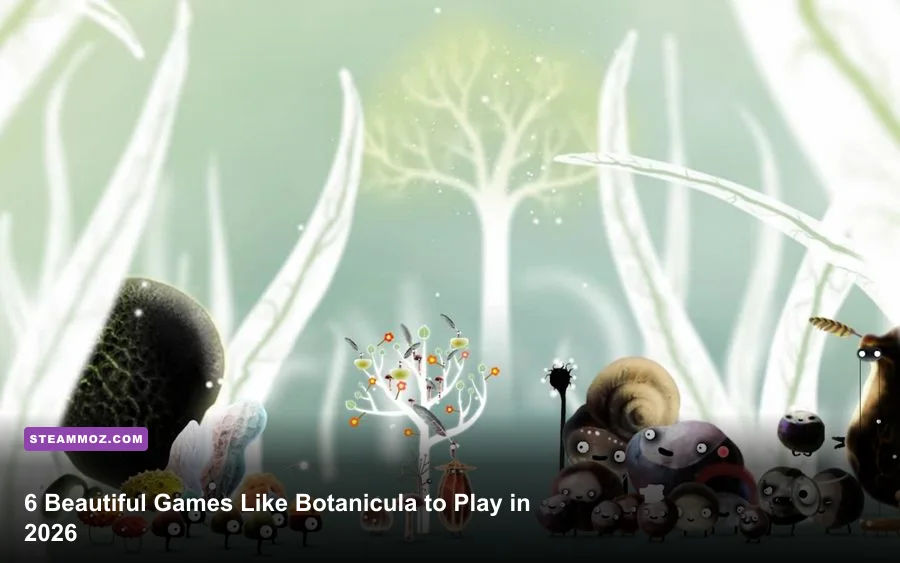
If Botanicula Collector's Edition won you over with hand-drawn creatures, wordless storytelling, and puzzles that reward curiosity rather than reflexes, start with Samorost 3, Machinarium, and Creaks. They capture the same tactile charm, but each pushes Amanita Design's formula in a different direction. For shorter, sillier, or more abstract adventures, CHUCHEL, Pilgrims, and Gorogoa are the best games like Botanicula to play in 2026.
Botanicula is unusual even by point-and-click standards. You control five tiny tree-dwelling heroes, click on almost everything, and solve problems through animation, sound, and visual reactions instead of conventional dialogue. The Collector's Edition also includes the soundtrack and bonus material, so the ideal follow-up isn't simply another adventure with an inventory. It needs personality, playful experimentation, and a world worth poking.
The best Botanicula alternatives ranked
These games rank highly because they preserve Botanicula's core pleasures: discoverable interactions, distinctive art direction, low-pressure progression, and a story that trusts you to notice details. The biggest split is between games with classic inventory puzzles and games built around direct visual experimentation.
| Game | Tier | What it shares with Botanicula | Biggest difference |
|---|---|---|---|
| Samorost 3 | S-Tier | Surreal nature, silent characters, layered sound design | Larger world and tougher observation puzzles |
| Machinarium | S-Tier | Wordless storytelling, hand-drawn animation, inventive clicks | More traditional inventory and item-combination puzzles |
| Creaks | A-Tier | Hand-painted environments and gentle discovery | Platforming and enemy-pattern puzzles matter more |
| Gorogoa | A-Tier | Visual storytelling and experimentation | No character inventory or conventional dialogue |
| CHUCHEL | A-Tier | Amanita humor, expressive animation, playful clicking | Shorter and almost entirely comedy-focused |
| Pilgrims | B-Tier | Animated oddballs and multiple puzzle solutions | Card-based interactions can feel less atmospheric |
S-Tier: Samorost 3 and Machinarium
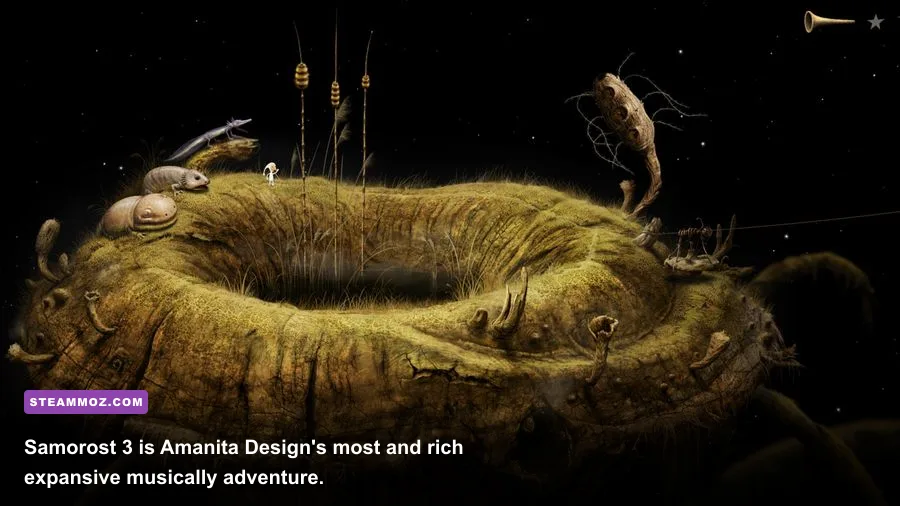
Samorost 3 is the closest spiritual successor. You play a small white-hatted space gnome exploring five planets and a moon while searching for the origins of a mysterious trumpet. There are no spoken conversations to decode. Instead, creatures communicate through expressive sounds, gestures, and animated thought bubbles. The puzzle design is broader than Botanicula's click-and-react structure: you combine tools, inspect environmental clues, and return to earlier locations after learning a new interaction.
The game's best moments come from its audio logic. A strange animal may respond to a specific rhythm, while a machine might only activate after you reproduce a sound pattern. Use headphones, because the soundtrack by Floex is not decoration; it often signals mood, timing, and the importance of a location. Samorost 3 is also a great pick for players who found Botanicula too brief. Expect roughly 6 to 8 hours for a first playthrough, with optional discoveries adding more.
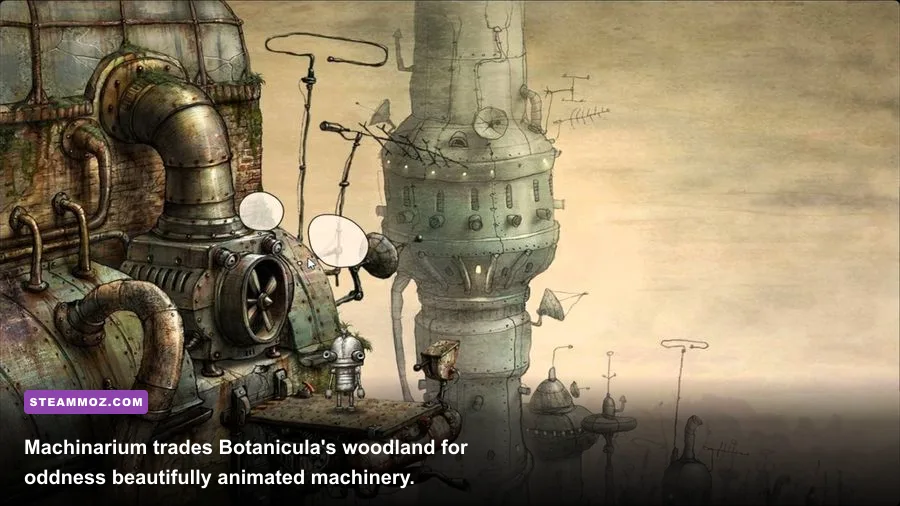
Machinarium is the sharper, more mechanical alternative. Its protagonist, Josef, is a small robot dumped in a scrapyard outside the city. The opening teaches the game's central rule immediately: click objects, read animations, and test combinations until the environment reveals its logic. Josef's extendable body is a genuine puzzle tool. He can stretch to reach objects, shrink to interact with low mechanisms, and collect a compact inventory of practical items.
Machinarium's puzzles are more structured than Botanicula's. The city includes a jail, a central plaza, a clock tower, a band area, and the final tower sequence, with several classic item chains connecting them. The hint system is unusually fair: Josef can access a clue after completing a small arcade-style challenge, rather than simply skipping the problem. That makes it ideal if you want Amanita's visual warmth but prefer clearer objectives. See the official Machinarium page for the developer's game details.

🎮 Botanicula Collector's Edition
Looking to experience this game? Grab your digital key directly on our store for $2.99.
View on Steammoz Store →Why Creaks is the best pick for deeper puzzles
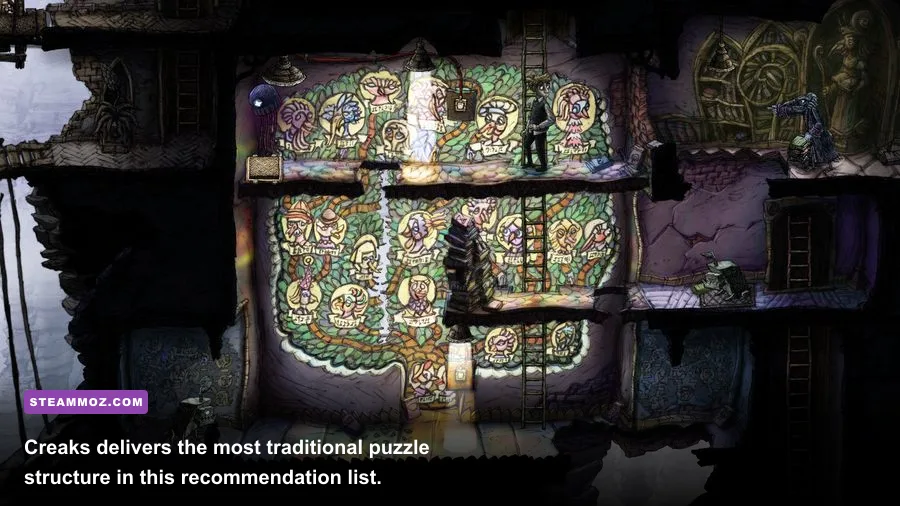
Creaks is the recommendation for anyone who loves Botanicula's art but wants more demanding mechanics. Its unnamed protagonist falls through a bedroom wall into an underground world of tiled rooms, mechanical architecture, and bird-like inhabitants. The signature enemies are living furniture monsters. They patrol fixed paths, and your job is to manipulate lamps, switches, elevators, and doors so their movement becomes useful rather than dangerous.
The central rule is wonderfully readable: certain light sources transform monsters into harmless furniture. That single idea grows into multi-room timing puzzles involving ladders, pressure plates, moving platforms, and chained switches. Unlike Botanicula, where many interactions are whimsical one-off surprises, Creaks teaches a system and then keeps remixing it. You can usually identify the solution by watching patrol routes for a few seconds, but rushing creates unnecessary deaths.
There is also a light platforming layer. It never turns Creaks into a precision platformer, yet it changes the rhythm. You might solve a room's logic, then cross a narrow passage while tracking a monster's animation cycle. The safest approach is to stand still and observe before touching a switch. Enemy telegraphs are generous, and the game rarely asks for frame-perfect input. That makes Creaks excellent for players who want brainwork without the frustration of a punishing action game.
| Game | Puzzle style | Difficulty curve | Best session length |
|---|---|---|---|
| Botanicula | Environmental clicking and object reactions | Gentle, with occasional lateral leaps | 20 to 40 minutes |
| Creaks | Light, patrol routes, switches, platform timing | Moderate, steadily escalating | 45 to 90 minutes |
| Machinarium | Inventory chains and contextual interactions | Moderate, with a few obscure steps | 30 to 60 minutes |
| Gorogoa | Panel layering and visual transformations | Moderate, highly abstract | 20 to 45 minutes |
For a broader look at Amanita's quietly strange catalogue, the studio's official Creaks page is worth bookmarking. Also, don't expect a combat system, skill tree, or upgrade loop here. The reward is seeing the machine you mentally built finally operate.
CHUCHEL and Pilgrims deliver the biggest laughs
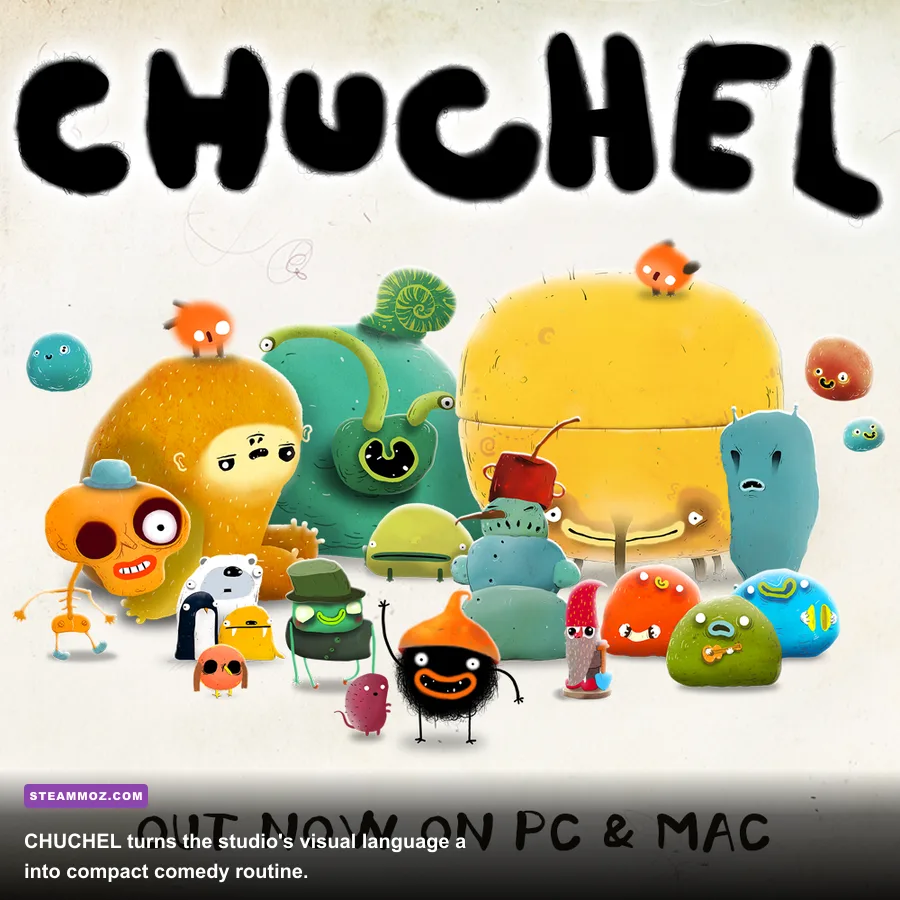
CHUCHEL is the shortest and funniest game on this list. Its orange, dust-covered hero wants one thing: a cherry. Every chapter turns that simple objective into a miniature slapstick routine involving spiders, monsters, musical instruments, and absurd machines. The puzzles are intentionally tactile. You click a creature, watch its response, then try another object to push the scene toward the next gag.
CHUCHEL doesn't aim for Botanicula's soft woodland atmosphere. It is louder, more immediate, and packed with exaggerated sound effects. That makes it a perfect palate cleanser after a longer puzzle adventure. A complete run commonly takes around 2 to 3 hours, though replaying scenes to see alternate reactions is part of the appeal. The game is also a strong choice for families because failure is harmless and the visual communication is exceptionally clear.
Pilgrims takes Amanita's recurring characters and builds a more replayable structure around them. You travel across a small map as a group of eccentric travelers, collecting cards that represent people, objects, and solutions. Instead of finding one correct answer, you can often solve the same obstacle in multiple ways. Give a character an item, combine two cards, or bring a different companion into the scene and the outcome changes.
That card system gives Pilgrims more experimentation than Botanicula, but it can also make the game feel less focused. Keep every card visible in your hand and try combinations even when they seem ridiculous; the funniest solutions are often the intended ones. The game is built around short runs, and discovering alternate outcomes is the real progression. Amanita's official Pilgrims listing shows the game's colorful cast and card-based design.
Gorogoa is the ideal choice for visual puzzle fans
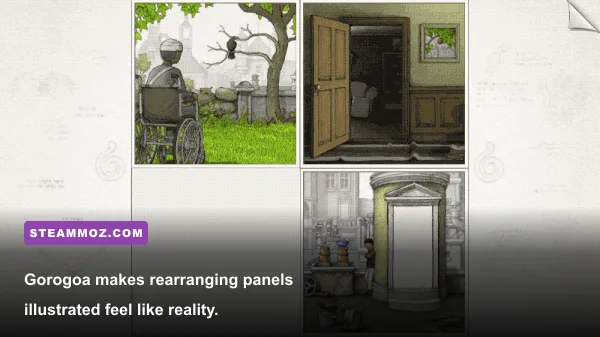
Gorogoa is not an Amanita game, but it understands Botanicula's strongest lesson: a picture can be a puzzle system. Every scene is drawn as an illustrated panel. You can slide panels, stack them, zoom into details, and align objects so one image transforms into another. A doorway in one panel may become a frame in the next; a tiny symbol can connect two otherwise unrelated scenes.
The mechanics stay simple, but the implications become increasingly strange. There is no inventory, no dialogue tree, and no explicit objective marker. Progress comes from recognizing visual rhymes and testing spatial relationships. If you are stuck, don't click randomly. Look for repeated shapes, matching edges, and objects that remain visually important after a panel moves. The game's roughly 2-hour length is deliberate: every chapter is tightly composed, with almost no padding between its major ideas.
Gorogoa is best played with a mouse or touchscreen. A controller works, but panel placement feels more precise when you can drag directly. It also runs comfortably on modest hardware, so there is little reason to sacrifice image quality. Its hand-drawn art is the point, and the cleanest presentation makes subtle overlaps easier to read.
Choose your next game by mood, not just mechanics
The right follow-up depends on which part of Botanicula mattered most to you. If it was the strange natural world, choose Samorost 3. If it was Amanita's robot-and-machine craftsmanship, Machinarium remains essential. If you wanted tougher logic, Creaks is the clear winner. CHUCHEL is the quick comedy break, Pilgrims is the replayable experiment, and Gorogoa is the purest visual puzzle.
| If you want... | Play this first | Why it fits | Watch out for |
|---|---|---|---|
| More woodland weirdness | Samorost 3 | Surreal creatures, music, and wordless exploration | Some clues are deliberately indirect |
| A classic adventure structure | Machinarium | Inventory puzzles and a memorable protagonist | A few item chains require careful backtracking |
| Harder systems-based puzzles | Creaks | Readable enemy patrols and light mechanics | Platforming adds pressure to later rooms |
| Fast, funny chapters | CHUCHEL | Immediate feedback and constant visual gags | Its short runtime may disappoint |
| Multiple puzzle solutions | Pilgrims | Cards support experimentation and replay | Some solutions feel intentionally chaotic |
| Abstract visual logic | Gorogoa | Panel manipulation replaces inventory systems | Very little conventional guidance |
All six are lightweight PC games, so performance is rarely the deciding factor. Still, check your preferred control method before buying: Gorogoa benefits from mouse dragging, Creaks feels natural with a controller, and Machinarium's point-and-click precision is strongest with a mouse. If your library already includes other story-heavy adventures, Steamoz's guides to Harvey's New Eyes and Filament cover two very different puzzle traditions.
My personal 2026 order is Samorost 3, Creaks, Machinarium, Gorogoa, Pilgrims, then CHUCHEL. That isn't a quality ranking so much as a pacing recommendation: begin with Amanita's richest world, move into its most disciplined puzzle design, then finish with shorter and more experimental adventures. Whatever route you take, these games prove Botanicula wasn't a one-off curiosity. It belongs to a wonderfully strange family of games that ask you to slow down, click the odd thing in the corner, and see what smiles back.
For more developer information, visit Amanita Design's official website and the Botanicula Steam page.