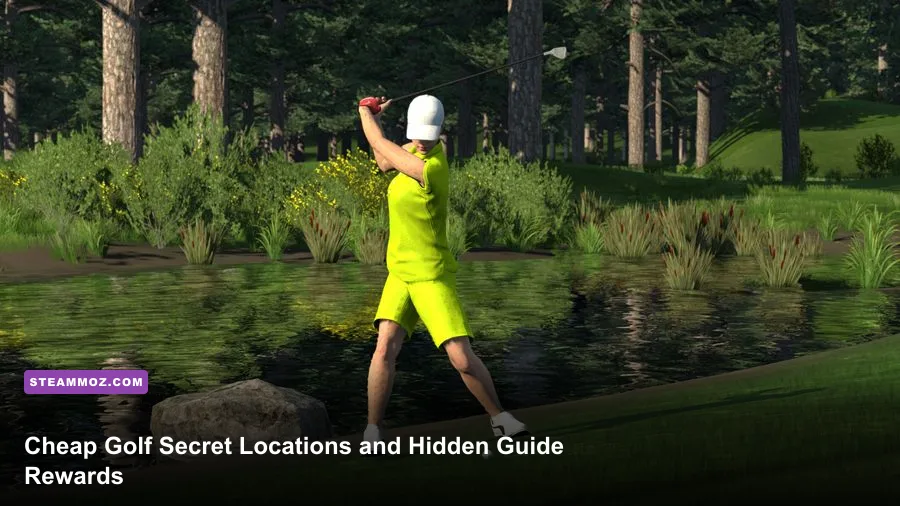
Cheap Golf hides its best rewards away from the cleanest line to the hole. To find every secret, replay each course with free camera movement, test suspicious walls and out-of-bounds gaps, and inspect the area behind the cup after the ball drops. The most reliable pattern is to search in three places: behind the tee, along the extreme edges of the arena, and beyond the normal finishing area. Hidden rewards are commonly triggered by touching a concealed object, entering an alternate route, or finishing a hole from an unusual angle rather than simply shooting under par.
This guide focuses on the PC version of Cheap Golf and is written for players chasing full completion instead of a quick par. The game does not always announce that you have found something, so keep an eye on the course-select progress indicators and replay any hole whose layout contains a suspicious dead end, isolated platform, dark gap, or decorative object that reacts to the ball. If you are coming to Cheap Golf after another exploration-heavy game, our guides to Eternal Destiny hidden rewards and Everspace 2 secret locations use the same sensible rule: collect the secret first, then optimize the route.
How Cheap Golf secrets actually work

Cheap Golf’s secret hunting is less about memorizing a giant collectible list and more about reading the geometry of each hole. The standard route points toward the flag, but the level designers frequently leave space behind scenery, below platforms, or around the outer rim. A shot that looks terrible on a scorecard can be the correct shot for discovery.
Start by playing a hole normally once. This first run tells you where the hazards are, which surfaces bounce the ball, and whether the camera hides any side platforms. On the second run, stop thinking like a speedrunner. Aim at every suspicious opening and use low-power taps to examine collision boundaries. If the ball rolls through a gap that looked decorative, follow it instead of resetting.
There are four useful signs that a route is worth investigating:
- Unusually clean negative space: an empty strip beside the fairway often marks a side route rather than wasted scenery.
- Objects with stronger contrast: bright markers, isolated lamps, colored panels, and lone signs are easier to see because they frequently sit near interactions.
- Walls that stop short: a half-height barrier can be a launch point. Try a controlled bounce instead of hitting directly over it.
- Space behind the cup: many players stop moving as soon as the ball reaches the hole, but the finishing platform can contain a trigger or alternate exit.
Use the official Steam listing and community updates to check your installed build before comparing completion totals. Cheap Golf has received small fixes that can alter collision behavior, and a route that worked in an early build may now require a softer shot.
| Secret clue | What to test | Best shot | Why it works |
|---|---|---|---|
| Gap beside the fairway | Roll along the outer edge | Low-power straight putt | Preserves control and reveals hidden floor |
| Raised side platform | Bank off a nearby wall | Medium-power angled shot | Reaches areas a direct shot cannot |
| Object behind scenery | Strike the object from both sides | Short tap | Tests whether it is decorative or interactive |
| Area beyond the cup | Let the ball continue after sinking | Overshoot deliberately | Can activate a rear trigger or alternate exit |
Do not assume a secret must be collected with the ball. Some discoveries register when the ball passes through a zone, while others only count after the hole is completed. If you locate something interesting and the completion marker does not change, finish the hole without restarting. Restarting can reset the trigger.

🎮 Cheap Golf
Looking to experience this game? Grab your digital key directly on our store for $2.49.
View on Steammoz Store →Early-course secret locations worth checking first

The early courses teach Cheap Golf’s visual language, and their secrets are usually generous. They are also the best places to practice controlled exploration because the hazards are less punishing and the distance between the tee and the cup is short.
Behind the opening tee
On the first hole of a new course, turn the camera before taking your opening shot. Check the space directly behind the tee and both corners of the starting platform. A common mistake is assuming the tee area is only a spawn point. If the camera reveals a narrow ledge or a darker patch of floor, send a gentle shot backward or sideways. Keep the power low; a full swing can carry the ball past the trigger before you see it.
The first wide hazard
When an early hole presents a large water, void, or sand hazard, inspect both edges before taking the obvious bridge. The outside edge is often wider than it appears from the starting camera. The safer discovery method is to use two small shots: first land beside the hazard, then roll parallel to its border. This gives you time to spot a ramp, opening, or alternate landing platform.
Dead ends near the flag
Early finishing areas often include a short corridor that looks like a failed route. Treat it as suspicious. Aim past the cup with enough power to reach the corridor, then use the walls to stop the ball. If the ball drops into a side recess, wait a moment before moving the camera or restarting. Some interactions are subtle and do not produce a large on-screen message.
The important trick in this section is shot discipline. Cheap Golf’s physics can turn a tiny angle into a major ricochet, especially near corners. Use the smallest power input that moves the ball, and avoid repeatedly correcting the camera while charging a shot. A stable camera makes it easier to judge whether the ball is rolling toward a secret or simply falling off the course.
| Area | Search direction | Recommended power | Completion check |
|---|---|---|---|
| Starting tee | Behind and to the outer corners | Very low | Finish the hole after touching the area |
| First major hazard | Follow the far boundary | Low to medium | Look for a side platform or alternate landing zone |
| First ramp | Test the underside and rear face | Medium bank shot | Replay if the ball clips through scenery |
| Finishing platform | Continue beyond the cup | Medium overshoot | Wait for any delayed trigger before resetting |
If a hole refuses to cooperate, leave it and return later with a better understanding of the bounce model. Chasing one awkward secret for ten minutes usually creates worse information than clearing several nearby holes and learning how Cheap Golf’s surfaces behave.
Mid-game secrets, shortcuts, and hidden routes
Mid-game courses are where Cheap Golf stops hiding secrets in plain sight. The routes become more vertical, the camera becomes less trustworthy, and the quickest path to the cup is often not the path that exposes the reward. Slow down whenever a hole gives you multiple elevation levels.
Search underneath elevated fairways
If the main lane crosses above another piece of terrain, immediately inspect the underside. Move the camera low and look for a shadow that does not match the surrounding lighting. A lower route may be accessible from a side bounce, a gap beside a support, or a drop from the edge of the fairway. Do not hit directly toward the dark space with maximum power. Land near the entrance, then use short taps to keep the ball from rolling out.
Use bank shots to reach isolated platforms
Several mid-game secrets sit on platforms that cannot be reached by a straight shot. The correct solution is usually a bank off a wall. Aim at the wall rather than the platform, and make the impact angle shallow. A steep impact sends the ball back toward the tee; a shallow impact redirects it along the wall and preserves forward speed. If you overshoot, reduce power before changing the angle. Power controls distance, while angle controls the route.
Check alternate exits after a secret
Finding a hidden area is not always the end of the puzzle. Look for a second opening, a ramp behind the reward, or a path that returns to the main fairway. Some secrets are easier to register if you enter from one side and leave from another. After the ball touches the hidden space, do not immediately aim for the cup. Rotate the camera and inspect the entire enclosure.
Mid-game exploration also rewards a deliberate restart strategy. Take a discovery shot, note the result, and then restart only after you understand the collision. Keep a simple note with the hole number, the landmark, the successful angle, and whether the reward registered on contact or completion. This is far more dependable than relying on memory, particularly when several courses use similar colors and repeated architectural pieces.
Players hunting secrets should also avoid chasing a low score during the first exploration pass. A par-focused route tends to keep the ball in the center of the course, exactly where the designers expect it to travel. Hidden routes live at the edges. Take the extra stroke, map the space, and return later for the clean run.
Late-game hidden rewards and difficult discovery shots

Late-game secrets are less forgiving because the arenas combine narrow platforms, aggressive slopes, and long drops. The safest approach is to separate discovery from execution. First locate the hidden area with low-risk shots. Then restart and reproduce the route with a planned sequence.
Make a three-shot plan
Before committing, identify the launch point, the landing point, and the recovery surface. The launch point is where the ball gains access to the secret route. The landing point is where it must stop without falling away. The recovery surface is the floor or wall that lets you continue if the shot is imperfect. If you cannot identify all three, lower the power and search for a closer setup position.
Favor controlled ricochets over full drives
Full drives are tempting on long late-game holes, but they erase useful information. A controlled ricochet lets you read the ball’s response and adjust one variable at a time. Start with a medium-power shot at a broad wall. If the rebound reaches the correct side but falls short, increase power slightly. If it reaches the side but flies past the platform, change the impact angle instead. This distinction matters because random changes make the physics impossible to learn.
Recover from failed attempts
Do not reset every time the ball misses. A failed shot may land on a lower ledge that gives you a better view of the secret. Move the camera around the ball and check whether the route can still be completed from the new position. Late-game stages often include recovery shelves that are invisible from the tee. Treat a miss as scouting data unless the ball is fully trapped.
Some hidden rewards are placed close to the ideal hole line but are easy to miss because the cup animation takes over the camera. After sinking the ball, wait until control returns and inspect the finishing area. If you see a path leading behind the flag, replay the hole and intentionally add enough power to travel beyond the cup. The correct reward may require crossing a trigger after the normal objective rather than before it.
| Late-game problem | Danger | Counter strategy | Ideal tool |
|---|---|---|---|
| Narrow launch platform | Ball falls before the bank | Use a short setup tap first | Low power |
| Blind vertical drop | Overshooting the landing zone | Move the camera below the platform | Low-to-medium power |
| Multiple rebound walls | Small angle errors compound | Change one variable per attempt | Medium bank shot |
| Secret behind the cup | Completion animation hides the route | Overshoot deliberately and wait | Medium power |
For PC players, keep the game at a stable frame rate while learning a precise route. Physics-driven games can feel inconsistent when frame pacing is poor, even if the average frame rate looks high. Our Filament performance settings guide covers the same practical priorities: stable frame pacing first, visual quality second.
Completion route and the fastest way to verify every reward
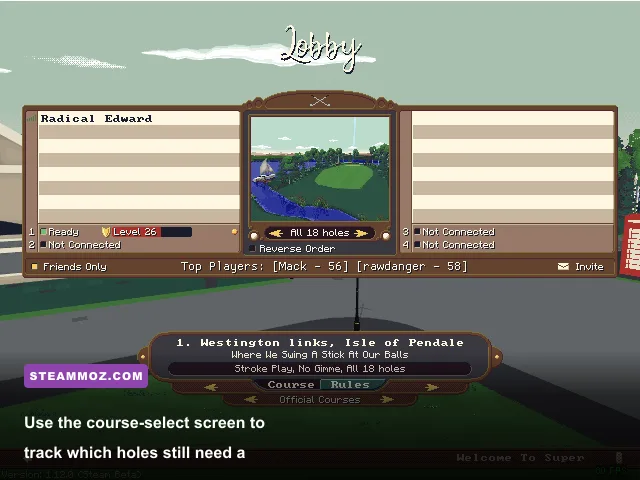
The fastest completion method is not clearing every hole perfectly in order. Use a three-pass route that turns secret hunting into a manageable checklist.
- Pass one: normal clear. Complete every available hole using the obvious route. This reveals the full course structure and gives you a baseline for the course-select progress screen.
- Pass two: edge sweep. Replay each hole and inspect the rear of the tee, both outer edges, the underside of raised paths, and the space behind the cup. Use low-power shots and record any suspicious landmark.
- Pass three: route confirmation. Return only to holes with unresolved clues. Reproduce the successful shot, touch the hidden area, and finish the hole. Check the completion indicator after returning to course selection.
Keep your notes specific. Do not write secret near water. Write hole number, camera direction, landmark, approximate power, rebound wall, and result. For example, a useful note says: side platform left of the first hazard, medium bank from the near wall, reward registered after finishing. That entry can be reproduced; a vague note cannot.
If your total still looks incomplete, check the holes you finished under par first. Efficient routes are the most likely to bypass a side area. Next, revisit holes with unusual scenery, isolated lights, dead-end corridors, or a suspicious camera shift. Finally, replay the first and last holes of each course, because players tend to rush the tutorial-style opening and assume the final cup is the only destination.
Do not confuse a high score with a hidden reward. A low-stroke run proves that you reached the cup efficiently; it does not necessarily prove that you touched every secret trigger. Conversely, a messy run can still count if the ball entered the correct zone before the hole ended.
Cheap Golf is at its best when you stop treating each stage as a straight line from tee to flag. Its hidden rewards are built around curiosity, awkward angles, and the willingness to hit a shot that looks completely wrong. Once you learn to read empty space, inspect the back of every structure, and confirm progress after completing the hole, the secret locations become much less mysterious.
For updates, patch notes, and player discussion, check the official Steam Community search and the game’s developer information on Steam. If another PC game is giving you technical trouble while you hunt collectibles, Steamoz also has guides for ELEX crash fixes and EscapeVR performance problems.