Yes, Gundam Breaker 4 is worth playing in 2026—but mainly if you enjoy building, tuning, and endlessly repainting Gunpla as much as you enjoy smashing enemy mobile suits. Its campaign combat is repetitive, the story takes too long to get moving, and the PC version still benefits from sensible graphics settings. Yet the enormous parts library, flexible weapon systems, split-screen support, online co-op, and excellent Diorama Mode make it the strongest customization-focused Gundam game in years. Buy it confidently on sale, or at full price if Gunpla is already your hobby.
This is not a traditional Gundam simulator. You aren't managing armor meters, squad tactics, or a serious war narrative. Gundam Breaker 4 is a loot-driven action RPG built around plastic model kits. Missions throw waves of enemies at you, parts fly off during battle, and you collect those pieces to create a machine that can look like the RX-78-2 Gundam, a nightmare mash-up of Barbatos and Aerial, or something that belongs in a Saturday-morning anime. That core loop remains unusually satisfying in 2026 because the builder is both deep and immediately playful.
For context, Bandai Namco has continued to support the game with balance adjustments, downloadable content, and additional Gunpla content since launch. Check the official Steam page for the current PC build, DLC bundles, and system requirements before buying.

The short verdict: a must-play for builders, a maybe for brawlers

Gundam Breaker 4 succeeds because it understands what players actually want from a Gunpla game: control over the silhouette, access to recognizable parts, and enough mechanical depth to make a ridiculous-looking suit work. You can equip a Gundam head on a Zaku torso, stretch proportions with builder parts, attach funnels or binders in unexpected places, and then save the result as a complete loadout. The game doesn't punish experimentation. It actively rewards it.
The catch is that the mission structure doesn't evolve as quickly as the builder. Most stages are variations on moving through an arena, destroying groups of mobile suits, collecting dropped parts, and defeating a boss or rival. Enemy variety is serviceable rather than thrilling. Higher difficulties add pressure and tougher targets, but they rarely transform the basic rhythm. If you need a dramatic campaign with intricate boss design, this won't be your next Armored Core.
My 2026 recommendation is straightforward:
- Buy now or at full price: Gunpla fans, Gundam collectors, co-op groups, and players who love loot optimization.
- Buy during a sale: action RPG players who don't care about model customization but enjoy flashy melee combat.
- Skip or sample first: anyone looking for a realistic Gundam war story, demanding simulation mechanics, or a campaign that changes dramatically from chapter to chapter.
That places it comfortably above New Gundam Breaker, whose launch systems and combat feel far less coherent, while keeping it below the best pure action games in terms of enemy design and encounter variety.
| Player Type | 2026 Verdict | Why |
|---|---|---|
| Gunpla collector | S-Tier purchase | Huge parts library, painting, scaling, and saved builds |
| Solo action RPG fan | A-Tier purchase | Fast combat and satisfying loot, but repetitive missions |
| Co-op group | A-Tier purchase | Four-player missions and build variety create great replay value |
| Gundam story fan | B-Tier purchase | Fun character cameos, lightweight narrative, limited drama |
| Simulation enthusiast | C-Tier purchase | Arcade combat rather than authentic mobile-suit handling |
🎮 GUNDAM BREAKER 4
Looking to experience this game? Grab your digital key directly on our store for $19.79.
View on Steammoz Store →Why the Gunpla builder still carries the game

The builder is where Gundam Breaker 4 earns its keep. Every suit has separate head, torso, arms, legs, backpack, melee weapon, ranged weapon, shield, and builder-part slots. You aren't just changing cosmetics: each physical component contributes stats, skills, tags, and a visual identity. The result is a system that lets you chase performance without forcing every optimized machine to look identical.
Parts come in grades and rarities, and duplicate drops are useful rather than dead weight. You can dismantle unwanted equipment for resources, merge parts to improve them, and manage your inventory through a clear, if occasionally busy, interface. The part level matters, but so do the abilities attached to it. A lower-level component with a valuable skill can remain relevant while you improve its base statistics.
The best design choice is the separation between appearance and practical build logic. You can adjust a part's scale and placement, then use the builder to create a coherent silhouette even when your strongest equipment comes from completely different mobile suits. That freedom is the reason you'll spend “five minutes” in the workshop and emerge an hour later with three new variants.
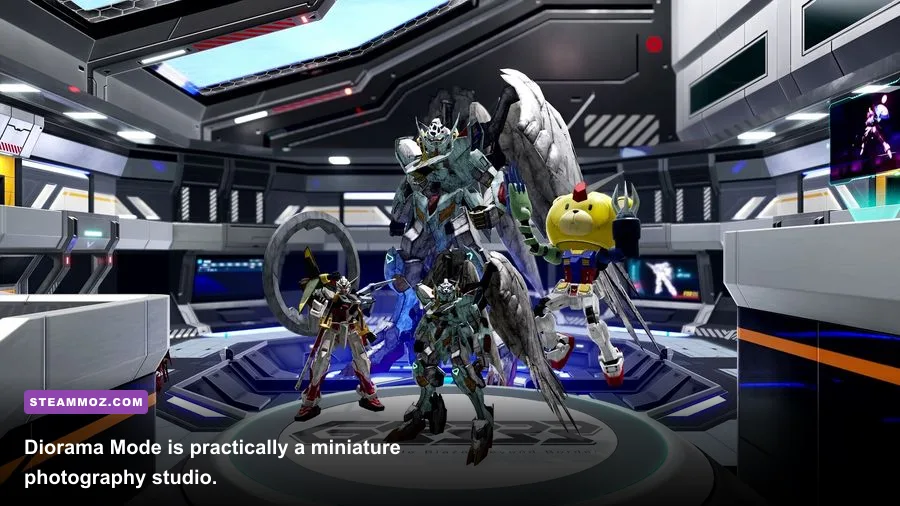
There is also a strong distinction between a combat build and a display build. A battle suit needs stable damage, survivability, and skills that can be activated reliably. A Diorama creation cares about pose, lighting, effect parts, background objects, and camera composition. Gundam Breaker 4 respects both audiences instead of treating photography as a throwaway bonus mode.
For new players, don't dismantle every duplicate immediately. Keep parts with useful EX Skills, OP Skills, high rarity, or strong ability traits. The inventory fills quickly, but early indiscriminate selling can leave you without the pieces needed for a later build experiment. If you enjoy optimization-heavy loot games, our weapon tier-list approach for Ecognomix offers a similar rule: judge gear by synergy, not by one large number.
The most important build decisions
Your two weapon slots should cover different combat situations. A fast melee weapon such as dual blades or beam sabers can shred exposed targets, while a ranged option such as a beam rifle, long rifle, or bazooka gives you a safer way to break parts and interrupt enemies. Weapon categories have their own attack strings, reach, launch potential, and EX Skill access, so swapping a weapon changes the feel of a suit more than a cosmetic part ever will.
EX Skills are the centerpiece of a reliable loadout. These are high-impact attacks or support actions assigned to your face buttons and triggered by a resource gauge. OP Skills are generally more direct equipment abilities, often tied to the physical parts you have equipped. A strong build mixes immediate damage with control: use a ranged or projectile skill to stagger, close distance with a gap-closer, then spend EX resources on a launcher, burst attack, or finisher.
| Build Focus | Recommended Equipment | Useful Skill Pattern | Best Situation |
|---|---|---|---|
| Close-range breaker | Dual blades, beam sabers, claw-style melee | Gap closer, stun, rapid EX combo | Breaking limbs and staying on bosses |
| Ranged pressure | Beam rifle, long rifle, shield | Lock-on attack, stagger tool, defensive skill | Safer solo play and flying targets |
| Heavy burst | Bazooka, giant sword, heavy arms | Knockdown, charged hit, high-cost finisher | Large enemies and boss openings |
| All-rounder | Fast melee plus rifle | Stagger, mobility, sustained damage | Campaign progression and co-op |
Combat is flashy, fast, and occasionally too familiar
Moment to moment, Gundam Breaker 4 feels better than its mission design suggests. Attacks have clear impact, parts visibly break away, and a successful combo can turn a recognizable enemy into a pile of scattered armor. The lock-on system is functional rather than perfect, but it lets you focus on specific body sections, which matters when you're farming a head, backpack, or weapon from a particular opponent.
The most satisfying encounters are built around part destruction. Targeting an enemy's arms or legs isn't merely cosmetic: it changes the visual state of the opponent and helps create the sensation that you're dismantling a model piece by piece. Bosses and larger machines are especially fun when you stop blindly attacking the center mass and start identifying the part you actually need.
Still, the combat loop can become predictable. The same basic answer works against many groups: lock on, stagger, launch a skill chain, collect parts, repeat. Enemies can feel like health bars with different silhouettes, and the camera occasionally struggles when multiple large suits occupy a tight arena. Co-op softens that repetition because four players create chaos, cover weaknesses, and make unusual builds viable.
Don't burn every EX Skill the moment its gauge fills. Save one control option for an enemy's recovery animation, particularly on higher difficulty missions where a missed burst leaves you exposed. A practical rotation is to open with ranged pressure, use a mobility skill to reach a weak section, perform your melee string, then trigger your strongest EX attack once the target is staggered. This is more efficient than chaining expensive skills into an armored enemy that hasn't been interrupted.
Boss fights reward observation more than twitch reactions
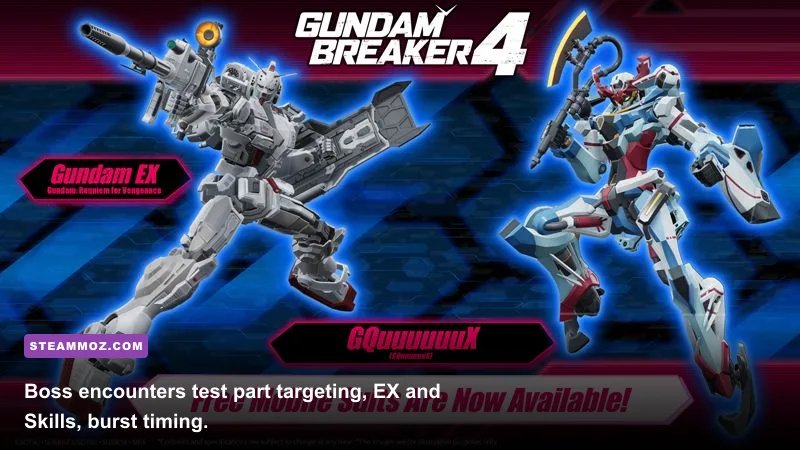
Large enemies telegraph their most dangerous attacks with visible movement and audio cues. A raised weapon, glowing effect, or sudden repositioning usually signals an incoming charge, beam, or area attack. Dodge sideways rather than retreating in a straight line, and use the opening after the attack to target a specific part. If the arena is crowded, disengage early; getting trapped behind a boss model is one of the easiest ways to lose a run.
Part drops also change how you should approach bosses. If you're hunting a particular component, avoid finishing the encounter before checking which section is still intact. Concentrated attacks are more useful than broad area damage when the goal is a backpack or weapon. That small shift—from “kill the boss” to “preserve and break the right part”—is where the loot system becomes genuinely strategic.
Story, missions, and replay value in 2026

The campaign uses a playful Gunpla-centered setup rather than a serious Universal Century war narrative. Characters build and battle model suits, while familiar Gundam designs appear as opponents, allies, and collectible parts. The tone is cheerful and accessible, but the story takes a while to establish momentum. Dialogue scenes can feel like connective tissue between the battles rather than a reason to keep playing.
That isn't necessarily a deal-breaker. The real progression is the steady expansion of your workshop. Early missions teach basic assembly and combat; later content introduces tougher enemies, rarer drops, higher-level parts, and more reasons to revisit completed stages. Difficulty gives the loot chase a purpose, although the game could do more to make repeated missions feel meaningfully different.
Online co-op supports up to four players and is one of the best reasons to keep returning. A group can cover different roles without rigid classes: one player can focus on melee pressure, another on ranged stagger, another on support skills, and the fourth on high-risk burst damage. Because every player brings a custom suit, co-op also becomes a showcase for the community's imagination.
There is local split-screen support as well, which makes Gundam Breaker 4 unusually appealing for a couch session. Performance and readability can suffer when the screen is busy, but sharing a ridiculous custom Gunpla with a friend is precisely the kind of low-stakes fun this series does best. If you like cooperative dungeon runs, compare that social rhythm with our Crawl review; both games are stronger when the room is part of the experience.
DLC adds more mobile suits and build possibilities, but the base game already contains enough content to justify dozens of hours. The question isn't whether you'll run out of parts quickly. It's whether you enjoy chasing one particular visual idea long enough to finish it.
PC performance and the settings worth changing
On PC, Gundam Breaker 4 is generally easy to run compared with visually heavier modern action games, but crowded battles expose stutter and frame-time spikes more than quiet menus do. The important distinction is between average FPS and responsiveness: a counter may report a comfortable number while effects, co-op players, and large enemy groups still produce uneven frame pacing.
Start with the game's recommended preset, then adjust shadows, effects, anti-aliasing, and resolution scaling. Effects quality is the first setting I'd lower if a boss fight becomes messy, because beam attacks, explosions, funnels, and part debris can stack up rapidly. Texture quality has a smaller impact on performance when you have enough VRAM, so keep it higher than shadows if your graphics card allows.
| Setting | Recommended Value | Performance Impact | Visual Trade-Off |
|---|---|---|---|
| Resolution | Native, or 90% scale on weaker GPUs | Very high | Lower scale softens fine Gunpla edges |
| Texture Quality | High with 6GB or more VRAM | Low to medium | Lower values blur decals and painted surfaces |
| Shadow Quality | Medium | Medium to high | Mostly affects contact shadows and arena depth |
| Effects Quality | Medium for stable combat | High in large battles | Reduces beam, explosion, and particle density |
| Anti-Aliasing | High unless GPU-limited | Medium | Lower values produce jagged parts and weapons |
| Frame Rate | 60 FPS cap for consistency | Depends on hardware | A stable cap feels better than fluctuating highs |
The published PC requirements are modest by 2026 standards: the Steam listing specifies Windows 10 64-bit, 8GB of RAM, and a GTX 1060-class graphics card for the minimum configuration, with a stronger CPU/GPU and 16GB of memory recommended. Treat those numbers as a floor rather than a promise of flawless 60 FPS in every four-player battle. An SSD is also worthwhile because mission loading and asset streaming feel more comfortable from solid-state storage.
If you're troubleshooting, cap the frame rate to a level your system can actually hold, close overlays, and test exclusive fullscreen against borderless mode. Players who have already dealt with PC stutter can also use our Eiyuden Chronicle performance settings and stutter-fixing checklist as general frame-pacing references. They aren't Gundam-specific fixes, but the same principles apply.
What Gundam Breaker 4 gets right—and where it falls short
The strongest part of Gundam Breaker 4 is its respect for player creativity. Most loot games ask you to choose between looking good and being powerful. This one gives you enough control to do both. You can create a serious tournament-style machine, a compact mobile suit with exaggerated proportions, or an intentionally absurd model covered in weapons and effect parts. The game rarely tells you that your idea is invalid.
Its second major strength is accessibility. You don't need deep Gundam knowledge to understand the parts, and you don't need to follow a rigid meta to clear the campaign. Weapon categories communicate their purpose quickly, skills are easy to test, and the builder invites experimentation before you've mastered every statistic. That makes it a good entry point for someone whose first Gundam game is also their first Gunpla project.
The weaknesses are equally clear. Mission objectives blur together, the narrative is lightweight, and enemy encounters don't always provide enough tactical variety for the amount of time the campaign asks from you. Menus can become cluttered once your inventory grows, and the volume of parts means comparing upgrades is sometimes more tedious than exciting. The game gives you a workshop full of possibilities, then occasionally makes you do too much spreadsheet work to manage them.
Those flaws matter less with friends and more in a long solo grind. If you're playing alone for a few hours at a time, the builder provides plenty of motivation. If you're trying to marathon the campaign in one weekend, repetition becomes impossible to ignore. This is a game best enjoyed in cycles: clear missions, improve a build, take screenshots, test a new weapon combination, then return when the urge to make another machine hits.
For more build-focused progression advice across other action RPGs, our Eldest Souls beginner build guide is useful in a different but related way: prioritize tools that change how you play rather than blindly chasing a larger damage number.
Final verdict: should you play Gundam Breaker 4 in 2026?
Yes—provided you want a Gunpla sandbox with action combat attached, not an elite combat game that happens to use Gundam designs. Gundam Breaker 4's campaigns won't replace the best character-action titles, and its story won't satisfy players searching for serious anime drama. But no other recent Gundam release offers this same combination of part collecting, visual customization, weapon experimentation, Diorama photography, and four-player co-op.
In 2026, the value proposition is even clearer. The game's rough edges are familiar, but the central builder remains distinctive, generous, and remarkably easy to lose yourself in. Build a close-range Barbatos-style bruiser, a funnel-heavy ranged suit, or a completely impossible Gunpla assembled from your favorite designs. Then take it online, break enemy parts, bring home new loot, and do it all again.
Steamoz score: 8/10. Gundam Breaker 4 is a brilliant customization playground wrapped in a merely decent action campaign. It is absolutely worth playing if the phrase “make your own Gundam” makes your brain light up. Everyone else should wait for a discount—but even skeptics may find that the workshop has more staying power than expected.
For official updates, patches, and downloadable content, follow Bandai Namco's Gundam Breaker 4 page and the game's official website. If you want to see the series' broader history before jumping in, the official Gundam information portal is a useful starting point.