
Yes, Crawl is still worth playing in 2026—but only if you want a brutally competitive local multiplayer game rather than a traditional solo roguelike. Powerhoof's dungeon crawler remains one of the smartest couch-game designs on Steam: one player controls the hero, while the other players become monsters, traps, and dungeon rooms actively trying to kill them. It is fast, readable, wonderfully mean, and at its best with three friends sitting around the same screen. Playing alone is possible, but it misses the spark that makes Crawl special.
That distinction matters. Crawl is not a huge campaign, not a loot treadmill, and not a four-player co-op adventure where everyone stays on the same team. It is a compact race through procedurally generated dungeons, with every death changing who gets to be the hero. If your group enjoys couch competition, revenge kills, and laughing when a friend walks into an obviously suspicious room, this 2017 indie still deserves a place in your library. If you mainly want a deep solo progression system, its short runs and limited long-term structure will feel thin.
What makes Crawl different in 2026
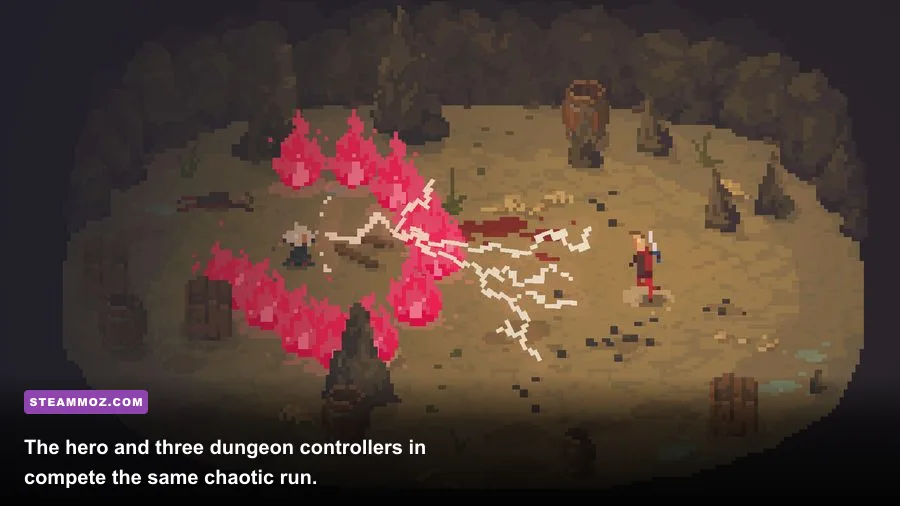
Crawl's central idea is wonderfully simple. One player begins as the hero and explores a dungeon in real time. Everyone else controls monsters inside the rooms. The monster players are not throwing random enemies at the hero from a menu; they directly possess creatures, activate traps, and spend earned resources to make each room more dangerous. When the hero dies, the player who delivered the killing blow takes over the hero role, while the former hero joins the hunt.
That creates a competitive loop with almost no downtime. You are never eliminated for more than a few seconds. Dead players immediately have something meaningful to do, and the dungeon itself becomes a rotating weapon. A player may spend one moment trying to survive a pack of enemies and the next controlling the monster that ambushed them. The result is personal without becoming permanently frustrating: every death is also a chance to retaliate.
The basic structure is closer to a competitive arcade game than to Hades or The Binding of Isaac. You clear rooms, collect gold and experience, find equipment, and push toward the final confrontation. Your hero gets stronger, but so do the players controlling the dungeon. That catch-up system is crucial. A player who falls behind can still earn blood through monster kills and unlock more dangerous creatures, preventing the winning hero from simply snowballing through the entire run.
There is also a clever social pressure built into the camera and room design. Crawl's top-down pixel-art arenas are easy to read, but they are packed with hazards that punish tunnel vision. A room may contain spike traps, narrow corridors, explosive objects, moving platforms, or enemies that force you to reposition. The best attacks are often not the flashiest ones. They are the attacks that push the hero into another player's trap.
That design still feels fresh because it solves a problem many multiplayer dungeon crawlers never address: what does everyone do when they are not the main character? In Crawl, the answer is “make the current hero panic.”

🎮 Crawl
Looking to experience this game? Grab your digital key directly on our store for $4.94.
View on Steammoz Store →Combat, heroes, and the progression curve
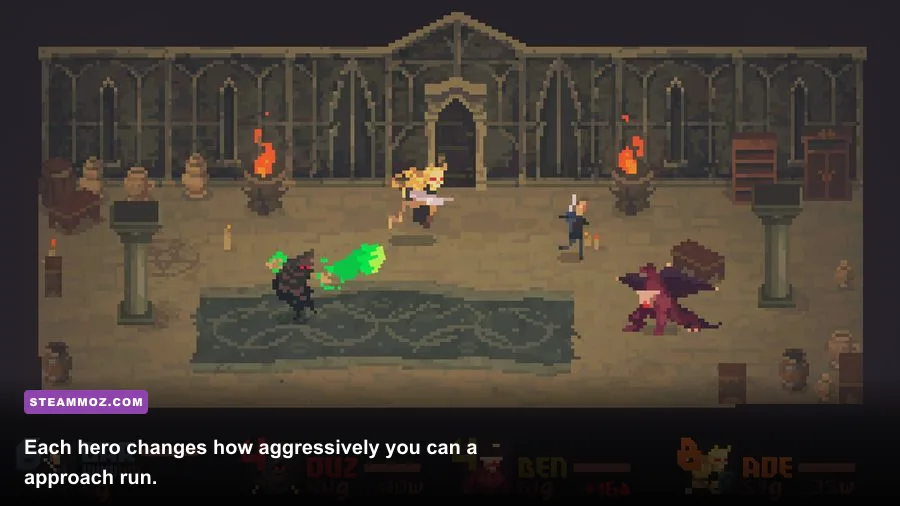
The hero roster gives each run a different rhythm. The Warrior is the most approachable starting point, built around direct melee pressure and reliable close-range damage. The Valkyrie rewards players who like sustained melee combat but offers a different feel from the Warrior through its weapon and defensive options. The Wizard is much more dependent on spacing, spell timing, and reading enemy movement. The Thief is the trickier choice, favoring mobility and opportunistic damage over standing in the middle of a room.
You do not need to memorize a giant skill tree to understand Crawl. Its progression is deliberately readable: gain experience, select upgrades, buy or discover equipment, and adapt to the dungeon you have been given. That simplicity is a strength during a four-player match because nobody spends ten minutes comparing menus while the rest of the group waits. It is also a limitation for players expecting a modern action RPG with dozens of permanent build paths.
| Hero | Primary strength | Main weakness | Best for |
|---|---|---|---|
| Warrior | Reliable melee damage and straightforward survivability | Must fight close to hazards and enemy bodies | New players and aggressive front-line play |
| Valkyrie | Strong close-range pressure with flexible combat options | Can struggle when enemies control space | Players who want melee without using the Warrior |
| Wizard | Ranged spells and strong area control | Fragile when surrounded or caught without resources | Experienced players who can kite |
| Thief | Fast movement and opportunistic attacks | Less forgiving when attacks miss | Players who prefer mobility and hit-and-run tactics |
The important strategic point is that equipment should support the room, not just your favorite hero. A powerful melee weapon is less useful when the dungeon is full of open spaces and ranged monsters. Conversely, a spell-focused setup can become awkward in tight rooms where multiple players can body-block your escape. Watch what the dungeon controllers are buying. If one opponent is investing in creatures that chase aggressively, prioritize movement, defensive timing, and attacks that clear space.
For players coming from other action RPGs, our Blood Rush beginner build guide covers a more traditional build-driven combat system. Crawl is much less about perfecting a permanent character and much more about making the best tactical choice during a single run.
How to win a Crawl run

The strongest Crawl players understand that survival begins before combat. Entering every room at full speed is a reliable way to walk into an ambush. Pause at the threshold, scan for enemy spawn points, identify the exits, and note anything that could trap your movement. You do not need to clear every room quickly. You need to avoid giving the dungeon controllers the easy kill they are waiting for.
Movement is your most valuable defensive tool. Keep enough room behind you to retreat, especially when fighting creatures with lunges or contact damage. Do not hug walls unless you know the room layout; walls can protect you from one angle while leaving you perfectly positioned for a trap from another. When several players are controlling monsters, assume the first enemy is a distraction and the second threat is the real attack.
Resource management separates a decent hero from a winning one. Gold is useful for improving your immediate loadout, but spending everything early can leave you unable to respond to a bad room or an unexpectedly strong monster. Experience upgrades are more consistent, while a situational item can completely change a fight. If you are already ahead, choose reliable survivability. If you are behind, take the option that gives you a way to burst down a dangerous room before the opposing players build momentum.
As a monster controller, stop treating every creature as disposable. The best ambushes combine roles. Use a fast monster to force movement, then place a slower heavy hitter where the hero wants to escape. Traps are most effective when the hero is already distracted, not when they have a clear view of the floor. If you have access to a room with narrow lanes, save your strongest spawn for the moment the hero commits to the entrance.
| Situation | Hero priority | Monster-player counter | Common mistake |
|---|---|---|---|
| Entering an unexplored room | Check exits and keep retreat space | Attack from two angles instead of one | Charging toward the nearest enemy |
| Facing several small enemies | Use area damage and avoid cornering yourself | Force the hero toward hazards | Focusing only on damage numbers |
| Low health near a shop or upgrade | Take the safest route and preserve resources | Spend blood to create a burst ambush | Assuming the room is safe because it looks empty |
| Opponent has a strong lead | Prioritize efficient rooms and direct objectives | Coordinate pressure rather than feeding kills | Attacking alone with weak creatures |
The winning move is often patience. Crawl rewards the player who waits until the hero's dodge, spell, or escape route is unavailable. That is why experienced groups become dramatically better after a few matches: they learn to read each other's habits. The friend who always runs clockwise can be cornered. The player who saves every ability can be baited. The person who checks every chest can be punished for predictable timing.
The final fight is where Crawl gets personal
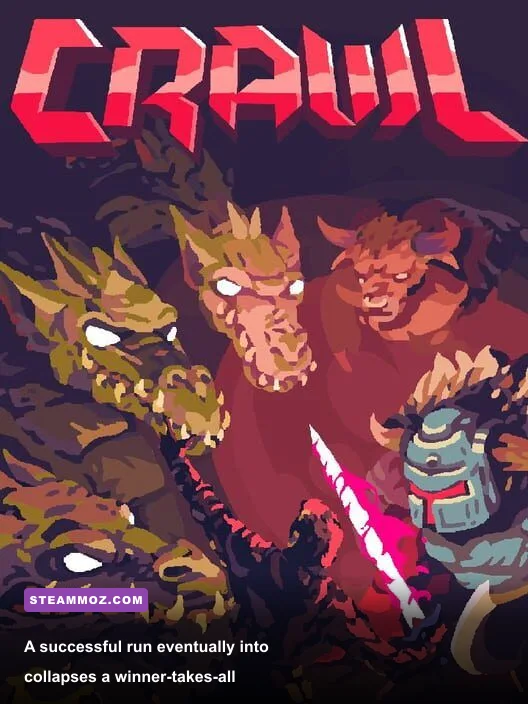
Reaching the end of the dungeon does not mean the run is over. Crawl's climactic boss sequence turns the earlier competition into a final contest for the crown. The exact pressure comes from the boss arena and the enemies selected throughout the run, but the principle stays consistent: the player who arrives as hero must survive a concentrated final challenge while the others get one last opportunity to interfere.
Do not enter the final battle assuming your highest damage option is automatically best. Boss arenas punish players who stand still, and the dungeon controllers are waiting for you to commit to a predictable attack pattern. Save mobility tools for the boss's most dangerous telegraph. If the arena gives you pillars, corners, or lanes, use them to break enemy approaches—but do not trap yourself against the edge when multiple threats are active.
For monster players, coordination matters even more here. A premature spawn gives the hero time to recover and may waste the only opening you get. Let one player pressure the hero's movement while another waits for the dodge or attack animation to finish. The strongest final encounters feel like a tiny multiplayer raid where every person understands their job, even though everyone is trying to win individually.
This is also where Crawl's short-run structure works in its favor. A failed final fight hurts, but it rarely feels like losing a 20-hour character. You can start another run quickly, change heroes, and immediately test whether your new plan works. That low commitment is one reason Crawl remains a good party game in 2026, when many multiplayer releases demand daily progression and lengthy seasonal grinds.
Performance, controls, and playing on PC
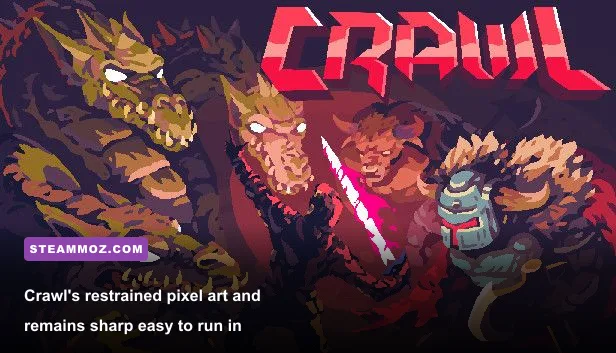
Crawl is technically undemanding by modern standards. Its pixel-art presentation, compact rooms, and simple effects mean almost any contemporary gaming PC can run it without serious trouble. The important hardware requirement is not your graphics card; it is having enough controllers for the group. Keyboard sharing works in a pinch, but four separate gamepads make movement, menus, and local competition much more comfortable.
| Profile | Recommended setup | Expected result | Best use |
|---|---|---|---|
| Low-end laptop | Windowed or 720p, effects reduced if needed | Stable play with minimal visual compromise | Older notebooks and casual travel setups |
| Standard gaming PC | 1080p fullscreen, native pixel scaling | Sharp visuals and responsive local multiplayer | Most living-room PCs |
| High-refresh monitor | Fullscreen at native resolution with uncapped display refresh | Cleaner input feel, though the game remains visually stylized | Players sensitive to controller latency |
| Steam Deck or handheld PC | Native display resolution, controller layout checked before launch | Comfortable solo play and excellent portable practice | Learning heroes before a couch session |
On a modern system, the bigger concern is input setup. Test every controller before starting a competitive match, especially if you are using Bluetooth pads. A disconnected controller in the middle of a room can turn a close fight into an accidental free kill. If the game does not immediately recognize your preferred layout, fix it before the run rather than trying to explain button mappings while a friend is being chased by monsters.
The game benefits from a television or large monitor because room hazards are easier to read at a distance. Pixel art remains colorful and clear, but a tiny laptop display can make visual clutter more frustrating when four players, several monsters, and multiple effects occupy the same space. For general troubleshooting habits, Steamoz's guide to turning stutter into smoother FPS is useful, although Crawl itself should not require heavy optimization.
You can check the current platform information and controller details on the official Crawl Steam page. Powerhoof's official Crawl site also gives the clearest snapshot of the game's premise and multiplayer focus.
Is Crawl worth playing in 2026?
Crawl is worth playing in 2026 if you have the right audience. It remains an outstanding pick for a group that wants competitive couch multiplayer, short replayable sessions, and mechanics that create stories instead of simply handing out rewards. A friend stealing the hero role, surviving with a sliver of health, and then being killed by the same person they defeated seconds earlier is exactly the kind of nonsense Crawl produces at its best.
Its weaknesses are just as clear. Solo players will encounter the least interesting version of the design because the human mind—or the game's available opposition—cannot fully replace three friends improvising together. The progression is intentionally light, so anyone expecting permanent unlocks, a huge bestiary, or an endless endgame may run out of reasons to return. Crawl can also feel harsh when one player understands the room layouts and timing better than everyone else.
That imbalance is manageable with house rules. Rotate the opening hero, change who gets the first killing blow, and avoid repeatedly targeting the newest player. You can also play several short runs instead of treating one victory as the entire evening. Crawl is better when the group embraces the chaos rather than trying to turn every match into a perfectly balanced esports contest.
If you want a longer solo experience, games such as the Borderlands series offer much deeper loot progression; our Borderlands 3 new-player tips are a good starting point. If hidden exploration is your priority, Steamoz's guide to Borderlands 2 secret locations points toward a very different kind of replay value. Crawl is not competing with those games on scope. It wins through immediacy.
Final verdict: 8/10. Crawl is a compact, vicious, exceptionally replayable party game that still feels designed rather than disposable. Buy it for local multiplayer, bring three controllers, and expect the first few runs to end in loud accusations. Buy it for a deep single-player campaign, and you may wonder where the rest of the game is. In 2026, its pixel art is dated only in the best way; its central multiplayer idea is still sharp enough to draw blood.
For release details, updates, and the developer's broader work, visit Powerhoof's official Steam developer page. Crawl may not be chasing a modern live-service audience, and that is precisely why it remains easy to recommend: start it, hand out controllers, and the game gets to the fun almost instantly.