Edna & Harvey: The Breakout rewards patience, curiosity, and a willingness to click on objects that look completely useless. These 10 tips will help new players escape the asylum without burning through every possible dialogue option, missing a vital hotspot, or resorting to a walkthrough too early.
Daedalic's point-and-click adventure is deliberately old-school. There are no combat stats, skill trees, or reaction-heavy boss encounters to master. Your real tools are Edna's inventory, Harvey's imagination, the game's dialogue system, and your ability to notice absurd connections between ordinary objects. The puzzles can be wonderfully clever, but a few are also opaque enough to punish rushed players. The smartest approach is to build a reliable investigation routine from the first room.
1. Learn the interface before chasing the escape
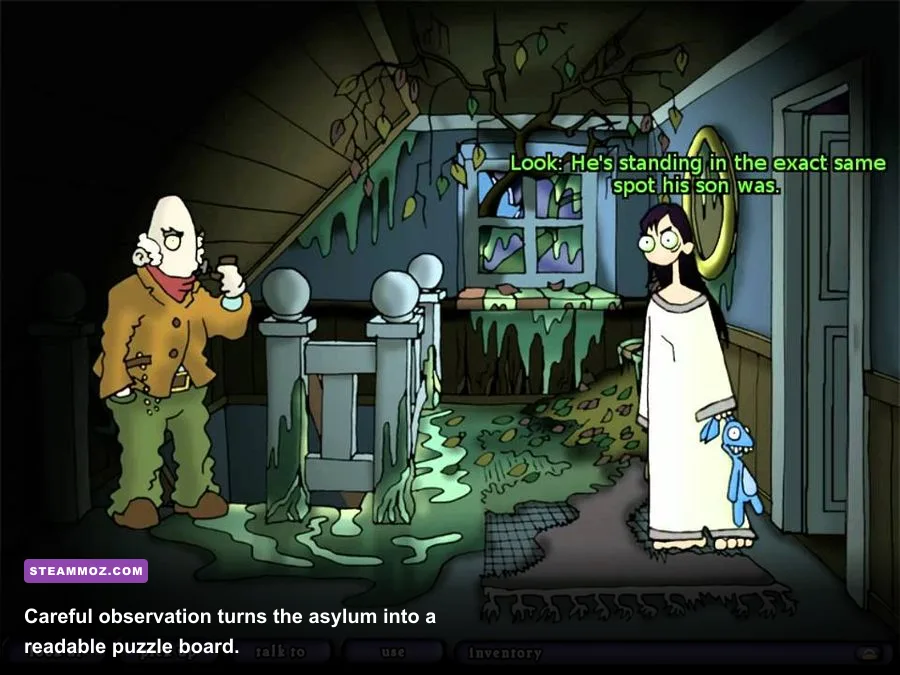
The opening minutes teach you almost everything that matters mechanically. Move Edna around each room, inspect the environment, speak to every available character, and test the interaction verbs on objects that seem decorative. Depending on the edition you're playing, the interface may use a modernized control layout, but the underlying logic remains classic adventure-game design: look, talk, use, and pick up are separate ways of interrogating the same scene.
Don't assume that a failed action is wasted time. Edna's comments are often a miniature hint system. If she says an object is too far away, too disgusting, or not useful yet, that response still tells you something about the puzzle's current state. If she gives a sarcastic observation, pay attention to the noun she mentions. The game frequently highlights a future interaction through a joke before it becomes mechanically relevant.
Tip 1: Perform a full sweep whenever you enter a new screen. Move the cursor over corners, furniture, wall fixtures, doors, and characters, then use the look command even when the hotspot appears obvious. Adventure games often hide the meaningful interaction inside a second description rather than a glowing outline.
Tip 2: Check the verb behavior on important objects instead of clicking the same command repeatedly. Looking at a locked door may reveal its condition, while using an inventory item on it can produce a different clue. Talking to a character before and after you change the room can also unlock new lines.
The game's charm depends on this friction. It wants you to think like a detective with a very strange sense of humor, not like a player following objective markers. If you enjoy this style but need technical advice for other quirky PC adventures, Steamoz's Funtime review explores a similarly unusual adventure-game experience.
🎮 Edna & Harvey: The Breakout
Looking to experience this game? Grab your digital key directly on our store for $1.49.
View on Steammoz Store →2. Treat every room as a checklist
The asylum is compact compared with a modern open-world game, but its screens are dense with possible interactions. The most common beginner mistake is leaving a room after finding one useful item. That usually means you have only completed the first layer of the puzzle.
Before leaving, use this four-part routine: inspect every object, speak to every person, check every exit, and revisit any object that produced a suspicious response. Write down unusual details if you need to. A character's comment about a smell, sound, habit, or locked area may not pay off until several screens later, but it is rarely random.
Tip 3: Mark each location mentally as “cleared,” “blocked,” or “unfinished.” A cleared room has no new dialogue, no unexplored hotspot, and no item that currently accepts one of your tools. A blocked room contains a clear obstacle, such as a locked passage or unreachable object. An unfinished room has a fresh line of dialogue or an interaction that changed after your last action.
Tip 4: Revisit old screens after major progress. The Breakout regularly changes what characters say and how objects behave after you acquire an item or trigger a conversation. If you obtain something with no obvious purpose, return to the rooms you have already searched. The item may be designed for a hotspot you dismissed earlier.
That backtracking is not busywork; it's how the game's progression curve works. Instead of handing you a quest list, The Breakout creates a chain of small discoveries. One conversation opens an experiment, the experiment produces a new item, and that item changes an older room. Once you understand the loop, the asylum feels less like a maze and more like a board where pieces gradually become active.
| Room Status | What It Means | Your Next Move |
|---|---|---|
| Cleared | No new hotspots or dialogue are available | Continue to another location |
| Blocked | A visible obstacle cannot be solved yet | Record the obstacle and search elsewhere |
| Unfinished | An interaction or conversation has changed | Test the new state immediately |
| Suspicious | An item or comment has no obvious purpose | Revisit earlier rooms and characters |
3. Build an inventory system instead of hoarding blindly
Edna's inventory quickly fills with objects that look like junk. That's intentional. The game wants you to ask what an item could represent, not just what it physically is. A mundane object may function as a key, a distraction, a replacement part, or the first half of a ridiculous joke-based solution.
Tip 5: Group your items by possible function. Keep a mental list of tools that can open, cut, reach, distract, clean, or communicate. If you pick up something that seems edible, wearable, noisy, or sticky, test it against characters and environmental objects with the same qualities. The correct solution is often based on association rather than realism.
Tip 6: Don't combine or spend an item just because the game allows an interaction. Before committing, look at every nearby hotspot and talk to the relevant character. Some items have multiple possible uses, and a joke response can make you think the puzzle is solved when it has only acknowledged your attempt.
Inventory puzzles in The Breakout also rely on “state changes.” An item may be useless in its original form but valuable after someone examines it, reacts to it, or gives you information about it. When Edna comments that an object is broken, dirty, too dangerous, or unsuitable, treat that as a prompt to find a way to alter its condition.
Keep an eye on the cursor and inventory behavior as well. If the game makes an item appear selected, move it over every plausible target instead of assuming the most obvious one is correct. Point-and-click adventures rarely explain their internal logic, so testing combinations is part of the intended experience. The trick is to test methodically, not randomly.
For comparison, players coming from RPGs often expect every item to have a measurable upgrade value. That instinct will mislead you here. There are no weapon tiers or character builds to optimize. The best item is the one that creates a new conversation, changes an animation, or makes an inaccessible object reachable.
4. Exhaust dialogue, but listen for the actionable detail
Edna, Harvey, Dr Marcel, and the asylum's other residents are more than story delivery systems. Their dialogue is the game's equivalent of a quest log, except the instructions arrive disguised as jokes, evasions, and wildly unreliable memories.
Tip 7: Use every available dialogue topic with important characters before trying random items. Characters often reveal a preference, fear, routine, or contradiction that tells you how to approach them. If a subject disappears after you obtain an item, that change is a strong signal that the item matters to the conversation.
Tip 8: Listen for repeated nouns and oddly specific descriptions. If a character mentions a particular object, location, sound, or behavior twice, write it down. The game uses repetition to draw attention without placing a literal objective on screen. A throwaway line about a locked cabinet can be more valuable than an obvious description of the cabinet itself.
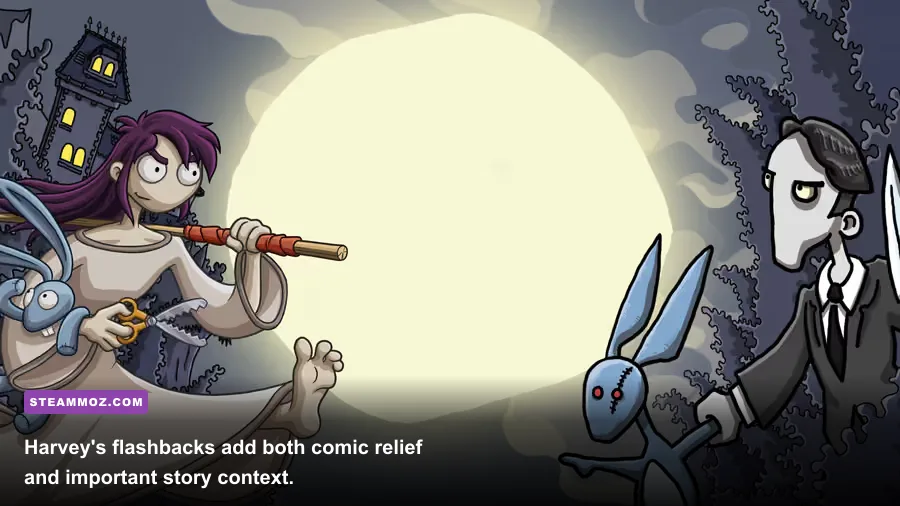
Harvey deserves special attention. His imaginary-rabbit persona is funny, but his presence also reflects Edna's memories and emotional state. When Harvey appears during a flashback or reacts strongly to a subject, don't treat the scene as pure comedy. It may explain why Edna interprets the asylum's events in a particular way or point toward the next narrative trigger.
There is a useful distinction between a clue and a solution. Dialogue usually gives you the former. A character may tell you that someone hates a certain thing, but the game expects you to connect that fact to an object in another room. If you immediately search for a literal key, you may miss the social manipulation at the heart of the puzzle.
The same rule applies to Dr Marcel. His authority makes him look like the obvious source of answers, but conversations with him can be deliberately evasive. Pay attention to what he refuses to discuss as much as what he explains. In a game built around unreliable perspectives, silence is often a mechanical hint.
5. Solve puzzles with a disciplined ten-minute rule
When a puzzle stalls you, don't click every inventory item on every hotspot forever. Use a short, repeatable process. It keeps experimentation productive and prevents the classic adventure-game spiral where you forget why you entered a room in the first place.
Tip 9: Give a puzzle ten focused minutes. First, describe the obstacle in one sentence: “The door is inaccessible,” “The character won't cooperate,” or “The object is out of reach.” Next, list the facts you know. Finally, test only items and dialogue options that could change one of those facts. If nothing moves after ten minutes, leave the screen and pursue another thread.
Tip 10: Return with a fresh hypothesis, not fresh desperation. The Breakout's best puzzles usually require a three-step chain: learn a character's need, locate an object that addresses it, then use the resulting change to reach a new area or item. If you are stuck, ask which link in that chain you have not discovered yet.
Use saving as a safety net, especially before trying an unusual interaction. The game's humor encourages experimentation, and some actions can create a response you don't want to repeat. Save in separate slots at the start of a chapter or before a major escape sequence. That is more useful than relying on one autosave and discovering too late that you need to retrace half the asylum.
Walkthroughs should be your last resort, but there is no shame in checking one precise hint after you have identified the problem. Search for the specific room or obstacle rather than reading the entire solution. Full walkthroughs flatten the game's best moments because the satisfaction comes from connecting two ridiculous clues yourself.
New players should also resist the urge to judge a puzzle by real-world logic. Edna & Harvey: The Breakout operates on cartoon logic, character psychology, and visual wordplay. Ask what would be funny, symbolically appropriate, or dramatically inconvenient—not only what would work in a real asylum. That mindset shift solves more puzzles than brute-force clicking ever will.
Performance, editions, and a clean first playthrough
The Breakout is not a demanding game by modern PC standards. Its hand-drawn 2D presentation and fixed-screen adventure design generally run comfortably on modest hardware. The more important technical issue is compatibility: different releases can vary in display scaling, input behavior, language support, and how older widescreen resolutions are handled.
Before troubleshooting, confirm which version you own. The official Steam listing is the safest place to check the current PC release, supported languages, and community discussions. You can also compare platform information on Daedalic Entertainment's official website.
| Setting or Habit | Recommended Choice | Why It Helps | Trade-Off |
|---|---|---|---|
| Display mode | Native resolution or integer-scaled window | Keeps hand-drawn details sharp | Windowed play uses less screen space |
| Aspect ratio | Use the game's intended ratio when possible | Avoids stretched characters and hotspots | Black bars may appear on ultrawide monitors |
| Input | Mouse for hotspot inspection | More precise than a controller for tiny objects | Less comfortable from a couch |
| Save strategy | Three rotating manual save slots | Protects progress before risky experiments | Requires a little housekeeping |
| Translation | Choose the language with the clearest text for you | Dialogue clues are mechanically important | Some jokes may lose their original flavor |
Don't chase frame-rate settings as if this were a competitive shooter. A stable presentation matters, but the real performance win is making text and cursor movement easy to read. If you encounter stutter in another 2D PC title, Steamoz's guide to settings that reduce stutter offers broadly useful Windows advice. For older adventure software, also check the practical PC troubleshooting approach in Deadlight: Director's Cut PC fixes.
Finally, play the first run without obsessing over a perfect sequence. The Breakout is a story-driven puzzle adventure, and its strange detours are part of the point. Talk to people even when you think you know the answer, inspect objects that look like background art, and let Edna's bizarre logic lead you somewhere unexpected.
If you remember only one routine, make it this: clear the room, exhaust the dialogue, describe the obstacle, test plausible items, then leave and return after the next story beat. That process turns the asylum's apparent randomness into a manageable investigation—and lets the game's sharp writing and unsettling humor land the way they should.