
Digimon Survive becomes much easier when you treat it as two games at once: a choice-driven visual novel and a positioning-heavy tactical RPG. Prioritize affinity, recruit Digimon instead of relying only on partners, protect your evolution items, and save before major decisions. These 10 tips will help new players survive the early chapters, build a flexible team, and avoid the costly mistakes that can lock you out of stronger evolutions or story routes.
The game rewards preparation more than grinding. A perfectly evolved Digimon can still get wrecked if it starts a battle surrounded, while a lower-level rookie with the right type, terrain bonus, and support skill can punch well above its weight. Keep that balance in mind throughout your first playthrough.

1. Save before every major dialogue decision

Digimon Survive does not treat dialogue as decoration. Takuma’s choices influence three Karma alignments: Moral, Harmony, and Wrathful. They also affect affinity with human companions and can change which route becomes available later. The game does not always explain the consequence immediately, which is exactly why a manual save is so valuable.
Create a rotating set of saves before entering a new story area, before major conversations, and before making a decision involving Saki, Aoi, Kaito, Miu, or Ryo. Autosaves are useful, but they are not a replacement for a deliberate save. If you want to see alternate outcomes without replaying several chapters, this habit saves hours.
There is no single universally correct Karma alignment. Moral generally favors direct, principled decisions; Harmony leans toward cooperation and compassion; Wrathful favors forceful, decisive answers. Pick the personality you actually want to role-play, but stay consistent if you want to push one alignment efficiently.
🎮 Digimon Survive
Looking to experience this game? Grab your digital key directly on our store for $9.59.
View on Steammoz Store →2. Raise affinity before you need the ability
Affinity is one of the most important progression systems in Digimon Survive because it improves a companion’s support effects and unlocks story-related benefits. Speaking with a character during free time is usually more valuable than wandering around hoping to find a battle.
Prioritize companions whose Digimon fill a role your current squad lacks. Aoi’s support-oriented strengths, Kaito’s aggressive style, and Minoru’s more utility-focused presence all become more useful when you invest in them early. Ryo is especially important because his storyline can be affected by your decisions and relationship progress.
Do not spread free-time conversations evenly just because every character is on the map. Pick two or three relationships and push them consistently. Check the affinity result after each conversation, then reload if you chose an answer that produced a poor response. The best answer is not always the kindest one; match the character’s personality and the tone of the conversation.
3. Build a team around type, not favorite faces
Digimon Survive uses a three-way attribute system: Vaccine, Data, and Virus. Vaccine is strong against Virus, Virus beats Data, and Data counters Vaccine. A favorable matchup is useful, but it should not override basic positioning. A type advantage from the wrong side of an enemy is still a bad attack.
Keep at least one reliable option for each attribute in your active roster. Agumon gives you a dependable early-game attacker, but partner Digimon alone are not enough for every map. Recruit free Digimon to cover gaps in movement, range, healing, and elemental attacks. A team with only short-range physical attackers will struggle against elevated enemies, hazards, and maps with awkward terrain.
| Team Role | What to Look For | Why It Matters | Beginner Priority |
|---|---|---|---|
| Front-line attacker | High HP, strong physical skill, solid mobility | Holds chokepoints and finishes weakened enemies | Essential |
| Ranged attacker | Two- or three-tile attack range | Hits enemies without exposing the front line | Essential |
| Support unit | Healing, buffs, or status recovery | Keeps long encounters from becoming attrition fights | High |
| Flanker | Good movement and rear-attack potential | Reaches isolated targets and exploits weak defenses | Useful |
Pay attention to each Digimon’s attack range and movement as much as its level. A unit that can cross one extra tile often contributes more damage over a full map than a slightly stronger bruiser that spends several turns walking.
4. Recruit Digimon instead of defeating every encounter

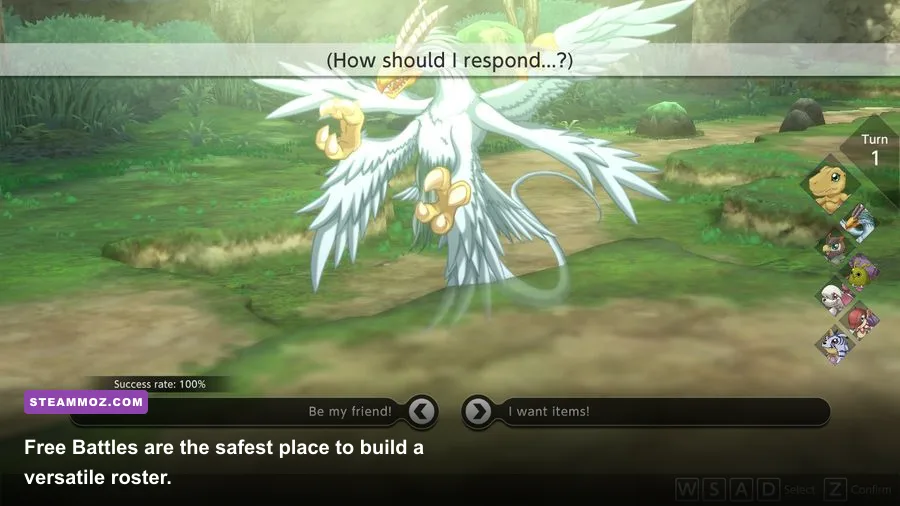
During a Free Battle, you can talk to certain enemies and attempt to recruit them. The conversation has three questions, and each answer changes the enemy’s mood. The correct response depends on the Digimon, so there is no single answer sequence that works for every species.
Read the enemy’s statement carefully. Some Digimon want reassurance, some respect strength, and others respond to playful or self-centered answers. When the mood gauge is high enough, choose the recruit option. If the conversation fails, you can still finish the battle, but you lose a chance to add that species to your collection.
Save before trying to recruit a rare Digimon. This is especially useful when you encounter a species that covers a hole in your lineup or appears in a limited story window. You can also use the official Digimon Survive Steam page to verify platform and edition information before planning a PC playthrough.
Recruitment is more than a completionist activity. A newly recruited Digimon arrives with a different skill set and attribute, giving you a replacement when a partner is unavailable or a map punishes your usual strategy.
5. Understand evolution before spending slabs

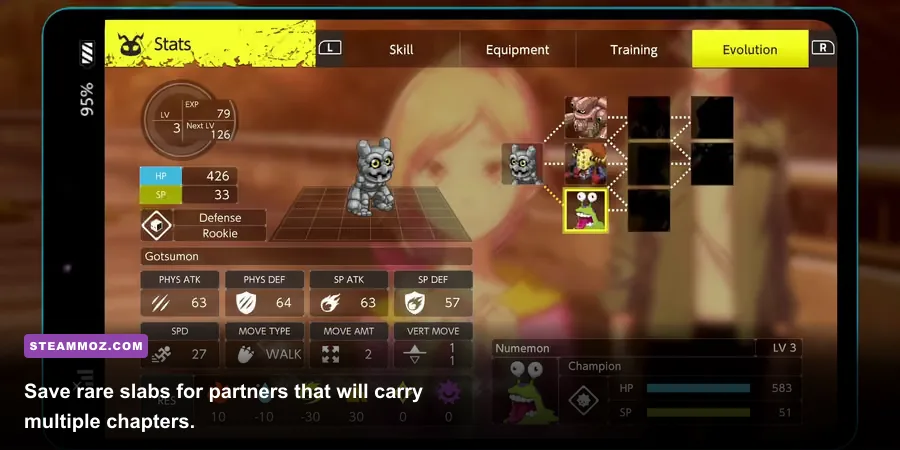
Partner Digimon and recruited Digimon evolve differently. Partner evolutions are usually tied to story progression, while many recruited Digimon use items such as Mature Enlightenment Slabs, Perfect Enlightenment Slabs, and Ultimate Enlightenment Slabs. The important catch is that evolution can be permanent for that individual Digimon, so spending an item casually can leave you short later.
Do not evolve every recruit the moment an item appears in your inventory. First inspect the Digimon’s available evolution paths and decide whether its new form improves a role you genuinely need. A powerful evolution with poor movement or awkward attack range may be less useful than a lower form that fits your team.
Keep a reserve of rare slabs for high-affinity partners or recruits with excellent skills. Evolution also changes the unit’s statistics, resistances, and sometimes its available attacks, so compare the full result rather than chasing the highest-looking number. If a Digimon is carrying an ability you rely on, check whether the evolution keeps the same combat identity.
6. Use the battlefield’s rear and side bonuses
Positioning decides more fights than raw level. Attacking from the side or rear improves your chance of landing a stronger hit, while attacking from the front gives the enemy the safest defensive angle. Before selecting an attack, rotate the camera and inspect the predicted damage from multiple tiles.
Start each battle by identifying the enemy with the greatest movement range. Fast enemies can slip around your front line and attack fragile support units, so block narrow routes with a durable Digimon. Do not rush every unit forward on turn one. Advance in a compact formation, let the enemy enter your attack range, and then collapse on isolated targets.
Terrain and elevation also matter. A unit standing on higher ground can gain a useful tactical edge, while certain attacks and movement paths become worse across difficult terrain. Use the map preview before committing. If a target is one tile away from your attacker but separated by a bad angle, moving around it for a rear hit can be worth more than attacking immediately.
7. Rotate units and manage SP carefully
Special attacks are tempting, but SP is a limited resource during a battle. Burning your strongest skill on the first weak enemy can leave you unable to answer a boss phase or reinforced wave. Open with basic attacks when the damage is enough, then spend SP for a guaranteed knockout, a favorable type matchup, or an emergency heal.
Use the wait command intelligently. Waiting can preserve a unit’s position and let enemies move into range instead of forcing you to overextend. When a Digimon has already acted but is exposed, ending its turn in a protected tile is often better than chasing one more attack.
Rotate injured units out of danger rather than hoping they survive another enemy turn. Healing is strongest when used before a unit reaches critical HP, especially because several enemies can chain attacks against the same target. A retreat is not wasted momentum if it prevents a knockout and preserves your action economy.
8. Spend equipment on roles, not raw power
Equipment bonuses are easy to underestimate. A defensive item on a front-line Digimon can prevent repeated knockouts, while an accessory that improves SP or skill performance may let a ranged attacker contribute every turn. Give each item to the unit that benefits from its function, not automatically to the highest-level character.
For attackers, prioritize bonuses that improve consistent damage or help them secure one-hit knockouts. For support units, survivability and SP efficiency are usually better than a small attack increase. Check whether a unit already has a weakness before amplifying its strengths; a glass-cannon attacker does not need more damage if it keeps dying before its second turn.
Review equipment whenever a Digimon evolves. A new form can change its statistics and role, making an old accessory a poor fit. This quick inventory check is especially important before boss battles, where a single defensive or range advantage can change the entire opening exchange.
9. Treat Free Battles as targeted training
Free Battles are useful, but grinding blindly is inefficient. Enter them with a clear goal: recruit a missing attribute, raise a specific partner’s level, test an evolution, or collect money and items. The best training session is one that improves your roster instead of simply inflating experience numbers.
Use the lowest-risk map that still gives meaningful experience. Bring one or two units that need levels and surround them with reliable partners. Keep a save before attempting recruitment, then finish the map quickly once you have the Digimon you wanted. This approach reduces the time spent on battles that no longer improve your team.
Difficulty spikes usually punish weak composition rather than low level. If your units are being defeated despite decent experience, replace a redundant attacker with a healer, ranged unit, or different attribute. You can also consult Steamoz’s fast-leveling guide for broader resource-management habits that carry over to other strategy games.
10. Explore every area before advancing the story
Free Time and exploration phases are where many of Digimon Survive’s best rewards hide. Search every available location, inspect interactable objects, and speak to characters before selecting the next story destination. Items, recruitable Digimon, and affinity opportunities can disappear when the phase ends.
Use the camera and cursor methodically. A location that appears empty may contain a hidden interaction or a character who only appears after another conversation. Check the map repeatedly after each event because new destinations can open without a dramatic announcement.
Exploration also gives you information. Talking to allies can reveal which relationship deserves your next free-time action, while scouting a battle area lets you decide whether to bring more mobility, healing, or ranged damage. If you are unsure whether to advance, finish every optional conversation first. Story events are often easy to trigger and difficult to undo.
A practical first-playthrough plan
For a smooth first run, keep one manual save at the start of each chapter and another before major choices. During free time, focus on two companion relationships rather than scattering affinity across the entire cast. In battles, deploy a balanced group with at least one ranged attacker, one durable front-liner, and one support option. Recruit whenever a new species appears, but evolve only after checking the long-term role of the form.
| Situation | Best Immediate Action | Common Mistake | Why the Safer Choice Wins |
|---|---|---|---|
| Before a major decision | Create a manual save | Trusting autosave alone | You can test route and affinity outcomes without replaying chapters |
| New enemy species appears | Talk first and attempt recruitment | Attacking immediately | Recruitment expands your options and may be limited by progression |
| Rare evolution item acquired | Compare every available evolution | Spending it on the first eligible recruit | Slabs are valuable and evolution can permanently reshape a unit |
| Battle begins | Form a compact defensive line | Sending every unit forward | You deny flanks and force enemies into favorable attack angles |
| Free-time phase starts | Finish exploration and conversations | Triggering the next story event early | Optional rewards and affinity opportunities can vanish afterward |
Finally, do not play Digimon Survive as if every encounter needs a perfect tactical clear. The game is built around consequence, experimentation, and imperfect choices. You will miss recruits, lose battles, and occasionally make a decision that feels terrible. That tension is part of the design. The key is to understand which mistakes are temporary and which ones can reshape the entire run.
For PC players, keep your installation updated and check the official Digimon Survive website for release information. If performance problems appear, Steamoz’s PC crash and FPS troubleshooting guide covers practical diagnostic habits, while the higher-FPS settings guide explains how to approach graphics options without sacrificing stability.
Master those fundamentals and Digimon Survive’s early difficulty becomes far less intimidating. Save with intent, build for coverage, recruit aggressively, and make every turn serve a purpose. Your first run will still surprise you, but it will feel like a dangerous adventure instead of a series of avoidable disasters.