Bounty Train Trainium Edition is worth playing in 2026 only if you enjoy demanding, old-school management strategy. Its train customization, route planning, crew combat, and historical frontier setting still create a wonderfully tense loop, but the game’s awkward interface, uneven difficulty spikes, and dated presentation demand patience. The Trainium Edition is the best way to approach it because the added content gives the campaign more variety, yet it doesn’t magically smooth out the rough edges that have always defined Bounty Train.
What the Trainium Edition actually delivers
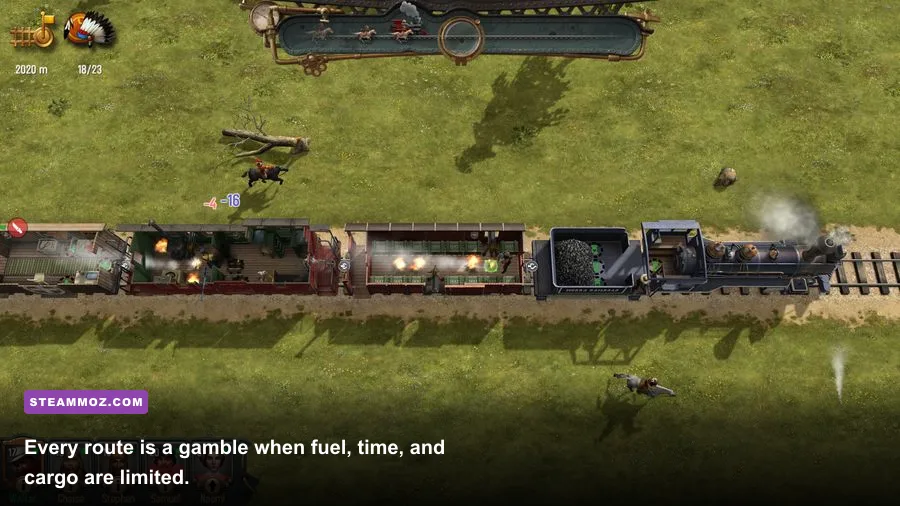
Bounty Train is a strategy game built around one brilliant idea: the train is simultaneously your base, transport, economy, and battlefield. You take control of a locomotive, recruit a crew, buy and sell cargo, accept contracts, and travel across a stylized United States during the 1860s. The campaign mixes a route-planning layer with real-time train combat and close-quarters crew battles.
The Trainium Edition bundles the base game with its major additional content rather than changing the underlying rules. That means you’re getting the core campaign, extra locomotive and character options, and more scenarios in one package. It’s a content-focused edition, not a remaster. Don’t buy it expecting modern quality-of-life features, ultrawide polish, or a redesigned tutorial.
| Edition element | What it adds | Why it matters in 2026 |
|---|---|---|
| Base campaign | Route planning, contracts, trading, crew combat, and locomotive upgrades | The complete gameplay loop remains surprisingly distinctive |
| Additional scenarios | More objectives and situations beyond the opening campaign path | Improves replay value once the basic systems click |
| Extra locomotives and equipment | More ways to shape speed, cargo capacity, defense, and firepower | Makes specialized train builds more appealing |
| Additional crew options | More personnel choices for combat and support roles | Helps reduce repetition across later runs |
The important distinction is that the edition expands breadth, not depth. It doesn’t overhaul the campaign’s economy or fix every confusing tooltip. If you already bounced off the original because the first hours felt punishing, the same warning applies here.
For the current store listing and package details, check the official Bounty Train Steam page. The Corbie Games website is also useful for developer information, while Daedalic Entertainment remains the publisher reference point.

🎮 Bounty Train Trainium Edition
Looking to experience this game? Grab your digital key directly on our store for $1.49.
View on Steammoz Store →Why the train-management loop still works
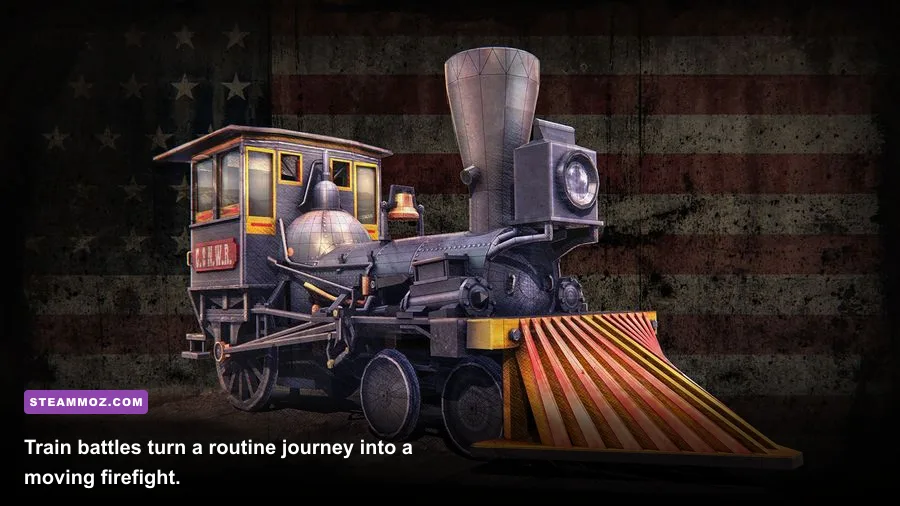
The best part of Bounty Train is how quickly small decisions become expensive problems. A faster locomotive is attractive, but engine upgrades can drain your budget before you’ve built a reliable income stream. More cargo cars create trading opportunities, yet every extra car can make the train harder to protect. Armored cars improve survivability, but they consume space that could have carried profitable goods.
That tension gives the game its personality. You’re not simply chasing a bigger number. You’re designing a moving machine around a route, a crew, and a cash-flow problem.
Build around one economic identity
Early on, choose whether your train is primarily a trader, courier, or combat platform. A trading train should prioritize cargo capacity and fuel efficiency, then add enough defensive equipment to survive ambushes. A courier setup values speed and reliability because missed deadlines can erase the profit from an entire trip. A combat-heavy train can carry stronger weapons and protective cars, but it needs a dependable income source to pay for ammunition, repairs, and recruitment.
Do not buy every upgrade as soon as it appears. Bounty Train punishes unfocused spending. Keep a cash reserve for repairs and emergency supplies, especially before accepting a contract that crosses several hostile regions. The game’s economy is more forgiving once you have repeatable trade routes, but the opening campaign is a sequence of narrow financial escapes.
| Train priority | Best early investment | Main advantage | Biggest risk |
|---|---|---|---|
| Trading | Cargo capacity plus fuel efficiency | Strong long-term income | Weak defense during ambushes |
| Courier | Speed, engine reliability, and route planning | Reliable contract completion | Low profit if deadlines are mismanaged |
| Combat | Defensive cars, weapons, and crew equipment | Can survive dangerous routes | High upkeep and poor early cash flow |
| Balanced | Moderate cargo, defense, and engine upgrades | Flexible response to random events | Never excels at one role |
Route planning is just as important as the train screen. Before leaving a station, inspect fuel needs, enemy pressure, contract deadlines, and possible trading stops. A profitable item in one settlement may be worthless two stops later, so treat the map as a chain of connected opportunities rather than a straight campaign path.
If you enjoy this kind of deliberate resource juggling, our Banners of Ruin leveling and gold guide offers a similar look at making every purchase count.
Combat is tense, but the interface fights you
Combat takes place while your train is moving through an encounter. Hostile forces can attack the locomotive, damage individual cars, or board the train and force your crew into direct fights. The goal is rarely just “kill everything.” You’re protecting key systems, keeping the engine alive, and trying not to burn through supplies that you need for the next leg.
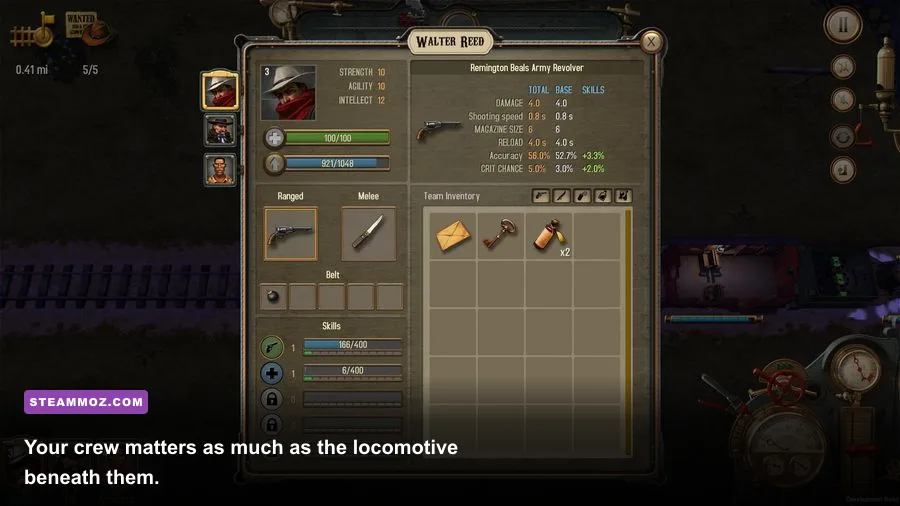
Your crew members have different strengths, weapons, and equipment needs. A character with strong ranged potential should be positioned where they can fire without wasting turns moving across the train. Short-range fighters are useful when enemies board, but they become liabilities if you leave them isolated. Keep your best defensive personnel close to vulnerable cars instead of spreading everyone evenly across the convoy.
How to survive the first ambushes
Pause immediately when a battle begins and identify the threat direction. Check which car is taking damage, then move the nearest capable fighter into support range. Don’t chase a retreating enemy across the train if another attacker is damaging the engine. Losing a crew member is painful; losing the locomotive can end the entire run.
Ammo and healing supplies are not background details. They are part of your combat budget. Fire only when the shot is useful, and avoid spending premium consumables on weak enemies that can be handled with basic attacks. The game’s combat feels clumsy until you start treating every encounter as an interruption to your logistics plan rather than a self-contained action sequence.
| Combat problem | Danger signal | Counterplay | Priority target |
|---|---|---|---|
| Engine attack | Locomotive health drops while crew is distracted | Fall back and protect the front cars | Enemies near the engine |
| Boarding action | Hostiles appear inside or beside the train | Use close-range crew and block access routes | Boarders threatening crew or machinery |
| Ranged pressure | Repeated damage from outside the train | Return accurate fire and use cover where available | High-damage ranged attackers |
| Attrition fight | Victory is possible but supplies are running low | Use basic attacks and preserve healing items | Enemies that can disable the train |
The system is strategic enough to create memorable saves, but it never feels as clean as the best tactical games. Target selection can be fiddly, movement feedback is not always immediate, and the visual language for danger is easy to miss during a busy encounter. That friction is a major reason Bounty Train feels older than its 2017 release date.
Progression rewards planning, not grinding
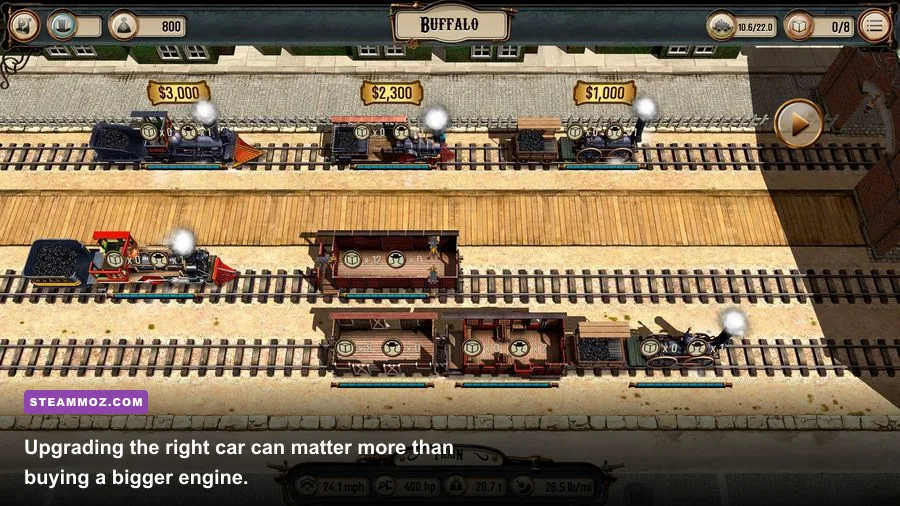
There isn’t a conventional character-leveling treadmill here that lets you brute-force every problem. Progress comes from improving the locomotive, expanding the train, equipping crew members, and learning which contracts are safe to accept. Money is the real progression gate, and reputation or story progress opens opportunities that your starting train simply can’t handle.
The strongest early strategy is conservative expansion. Upgrade the engine enough to make routes manageable, add cargo space only when you have a trade plan, and recruit crew members who fill a clear role. A crowded roster sounds powerful, but wages and equipment costs can quietly destroy your operating budget.
Save before major purchases and before committing to a long route. Bounty Train has enough unpredictable events that a bad contract, ambush, or repair bill can turn a winning run into a restart. That’s not elegant modern design, but it’s part of the game’s old-school rhythm. You’re expected to learn from failed logistics, not simply reload every inconvenience.
| Progression stage | Recommended focus | Common mistake | Practical checkpoint |
|---|---|---|---|
| Opening hours | Fuel, basic defense, and one reliable income route | Buying expensive equipment too early | Can complete short contracts without emergency repairs |
| Established train | Specialize cargo, speed, or combat role | Trying to maximize every stat at once | Regularly finish routes with cash remaining |
| Mid-campaign | Prepare for hostile regions and longer contracts | Ignoring crew upkeep and supply consumption | Can survive an ambush without losing key personnel |
| Late campaign | Optimize the train around high-value objectives | Accepting missions without checking route risk | Has reserves for repairs, ammunition, and replacement crew |
This is also where the Trainium Edition earns its keep. More options make repeated campaigns less predictable, but they don’t remove the need to understand the basic economy. Extra content is valuable after you’ve learned the rules; it won’t save a careless first run.
How it performs on modern PCs in 2026
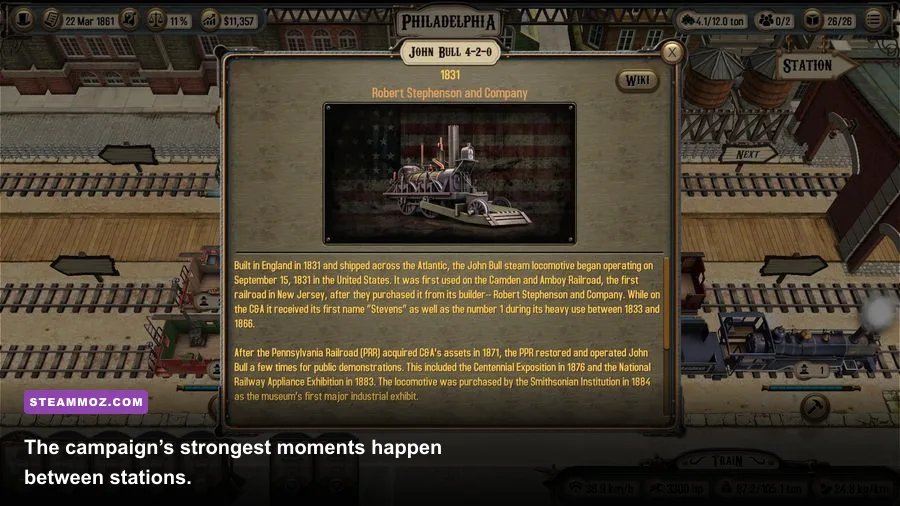
Bounty Train is lightweight by modern standards. Its 2D presentation, small battlefields, and modest effects mean most current Windows gaming PCs should run it comfortably at 1080p. The bigger concern isn’t raw GPU power. It’s compatibility around display scaling, older middleware, resolution switching, and input behavior on high-DPI monitors.
Start with the native desktop resolution, use windowed or borderless mode if fullscreen behaves strangely, and disable overlays one at a time if the game refuses to launch correctly. On a modern laptop, the game should be easy on battery compared with a 3D strategy title, although background frame-rate limits can help reduce unnecessary power use.
| Setting or setup | Recommended value | Performance impact | Visual note |
|---|---|---|---|
| Resolution | Native monitor resolution | Low on modern GPUs | Best clarity for menus and small text |
| Display mode | Borderless or windowed if fullscreen misbehaves | Negligible | Usually easier for alt-tab and scaling |
| Steam Overlay | Enable only if stable | Usually negligible | Disable for troubleshooting crashes |
| Battery play | Use a frame cap through your GPU driver | Reduces power draw | Little visible loss in a menu-heavy strategy game |
| Text scaling | Keep Windows scaling consistent | No FPS effect | Prevents blurry or clipped interface elements |
For broader PC troubleshooting habits, see Steamoz’s PC fixes for crashes and low FPS. You can also compare its modest demands with our Dreamscape system requirements guide and Assassin’s Creed Brotherhood performance settings.
Is Bounty Train worth playing in 2026?
Yes, with conditions. Bounty Train Trainium Edition is worth playing if you want a compact strategy game where money, movement, combat, and preparation constantly collide. The train itself remains an excellent central mechanic, and the American frontier setting gives every contract a stronger sense of place than a generic management sandbox.
It’s a good recommendation for players who enjoy Frostpunk-style pressure, route planning, trading systems, and tactical encounters that punish poor preparation. It’s less suitable if you want a smooth tutorial, fast progression, highly readable combat, or modern accessibility options. The first few hours can feel less like a welcoming introduction and more like an exam you didn’t know you were taking.
My verdict is 7/10. The Trainium Edition is the version to buy, especially during a discount, because the extra scenarios, equipment, and crew choices make the campaign more replayable. Just approach it as a demanding historical strategy game rather than a polished train simulator. Learn the economy, protect the engine, specialize your train, and accept that some failed journeys are the price of admission.
If that sounds appealing, Bounty Train still has a trip worth taking in 2026. It’s rough around the edges, occasionally unfair, and often a little obscure—but when a damaged locomotive limps into a station with one surviving crew member and just enough cash for repairs, its scrappy frontier drama is hard to beat.