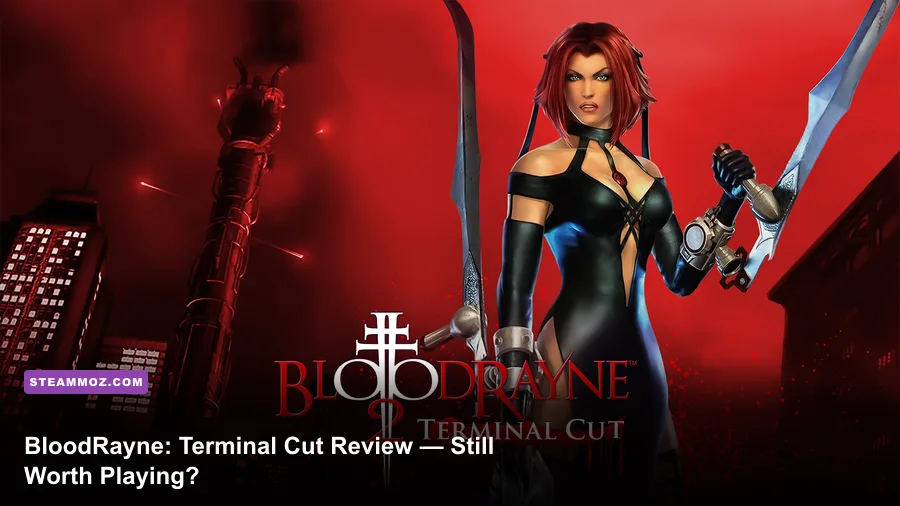
BloodRayne: Terminal Cut is worth playing in 2026—but only if you want a compact, shamelessly old-school action game rather than a modern character-action masterpiece. Rayne's blade-and-bite combat still has terrific momentum, the three-chapter pulp-horror journey remains entertaining, and the Unreal Engine 4 upgrade makes the 2002 original far easier to revisit. However, awkward platforming, dated enemy behavior, repetitive encounters, and a camera that occasionally fights you keep it firmly in “good retro revival,” not “essential modern classic,” territory.
That distinction matters. Terminal Cut doesn't rebuild BloodRayne from the ground up. It preserves the original level layouts, combat rhythm, mission structure, and occasionally clumsy design while improving resolution support, lighting, textures, controls, and hardware compatibility. If you played the original on PlayStation 2 or PC, this is the cleanest official way to return. If you're discovering Rayne for the first time, expect a stylish 2000s action game with sharper edges than its new presentation suggests.
What Terminal Cut actually changes

Terminal Cut is a remastered version of BloodRayne, the 2002 third-person action game developed by Terminal Reality. The updated edition was released by Ziggurat Interactive and built with Unreal Engine 4, with WayForward involved in the remastering work. It is not a sequel, remake, or “definitive edition” with a new campaign. The story, stages, cutscenes, enemies, and fundamental combat systems remain recognizably tied to the original release.
You play as Rayne, a dhampir working for the Brimstone Society. The campaign is split into three large sections: Louisiana, Argentina, and Germany. Across those locations, Rayne hunts supernatural threats, Nazi occultists, vampires, and the remnants of the G.G.G.—the Gegengheist Group—while the plot steadily builds toward a biological and supernatural catastrophe.
The useful improvements are mostly practical. Terminal Cut supports modern display resolutions, updated visual assets, improved lighting, controller support, Steam achievements, and a more convenient PC presentation. The game also feels less like an abandoned relic when installed on a current machine. Official details are available on the BloodRayne: Terminal Cut Steam page, while the publisher's official Ziggurat Games site provides broader information about the remaster line.
| Area | Terminal Cut upgrade | What it does not fix |
|---|---|---|
| Resolution | Modern widescreen and high-resolution support | Some older interface elements still feel dated |
| Visuals | Updated textures, lighting, and Unreal Engine 4 presentation | Low-detail geometry and stiff animations remain |
| Controls | Better current PC and controller compatibility | Platforming and camera quirks survive intact |
| Content | Original three-part campaign and bonus material | No new story chapters or redesigned missions |
| Convenience | Steam achievements and easier modern installation | No modern checkpoint system or deep accessibility suite |

🎮 BloodRayne: Terminal Cut
Looking to experience this game? Grab your digital key directly on our store for $5.99.
View on Steammoz Store →Rayne's combat still has real bite
The reason to play BloodRayne in 2026 is the combat. Rayne carries her trademark Carpathian Dragon pistols and fights with two arm blades, but her body is the real weapon. She can bite enemies, drink their blood, regain health, and use that resource to fuel supernatural abilities. That creates a pleasing loop: cut through a crowd, isolate a wounded target, feed, and spend the resulting blood before the next wave arrives.
The dual blades are fast and broad enough to make crowd control feel physical. Rayne's standard attacks can be chained into sweeping strings, while directional movement helps her reposition around larger enemies. The attack system isn't as technical as Devil May Cry or Bayonetta, but it rewards aggression. Standing still and trading hits is usually the worst approach. You want to keep moving, strike the outside of a group, and use executions or bites before the room becomes dangerous.
Her firearms give the combat a second rhythm. The pistols are reliable against exposed targets and flying enemies, while heavier weapons become more valuable when a foe is difficult to reach or dangerous at close range. Ammunition isn't the only consideration: Rayne can also use environmental objects and enemy placement to create breathing room. The game rarely asks for a perfect combo, but it constantly asks you to choose the safest source of health.
Rayne's supernatural toolkit is where the original design feels surprisingly forward-thinking. Aura Vision helps identify enemies and interactive targets, while Dilated Perception slows the action and gives you a much better chance of reacting to projectiles, traps, and clustered attackers. Blood Rage increases Rayne's offensive pressure, making it ideal when a group needs to disappear quickly. Use these abilities as emergency buttons and you'll burn through opportunities; use them to control the tempo of a room and the campaign becomes much smoother.
| Tool | Best use | Main limitation | Practical advice |
|---|---|---|---|
| Dual arm blades | Groups at close range | Risky against firearms and explosives | Circle enemies instead of attacking straight into a crowd |
| Carpathian Dragon pistols | Single targets and distant enemies | Less explosive damage output | Use them while closing distance or interrupting threats |
| Bite | Restoring health and managing blood | Leaves Rayne vulnerable during the animation | Feed on isolated enemies after clearing nearby attackers |
| Dilated Perception | Projectiles, traps, and elite encounters | Consumes supernatural resource | Activate before a dangerous attack, not after taking damage |
| Blood Rage | Fast crowd clearing | Resource-dependent and easy to waste | Save it for packed arenas or durable targets |
| Aura Vision | Finding enemies, routes, and objectives | Doesn't solve environmental puzzles automatically | Toggle it when a room seems empty or directionless |
The three chapters have very different strengths
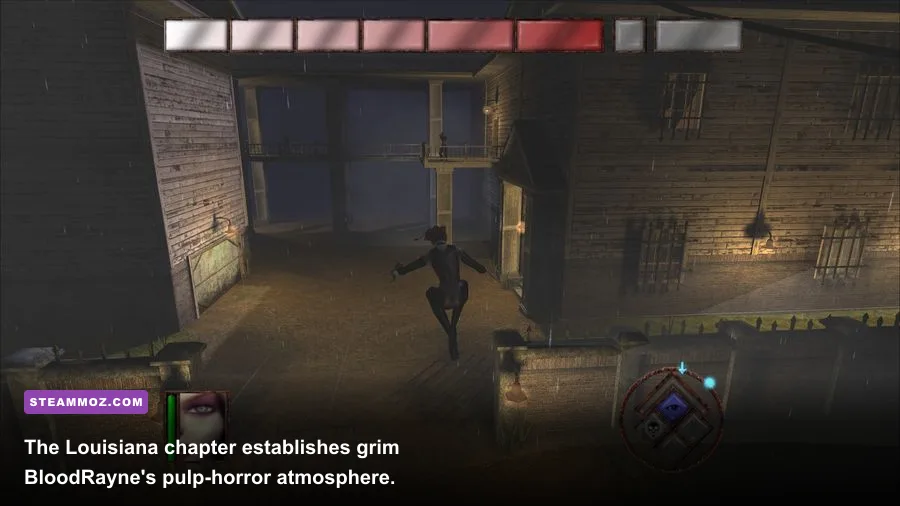
BloodRayne's campaign is roughly a compact single-player action adventure, but the exact playtime depends heavily on exploration, difficulty, and how often you replay encounters. The Louisiana section opens with swamp environments, industrial spaces, and a strong sense of occult pulp. It teaches the core rhythm without overloading you with systems. This is where Rayne's movement and bite mechanics feel freshest, even though the early enemy roster can become predictable.
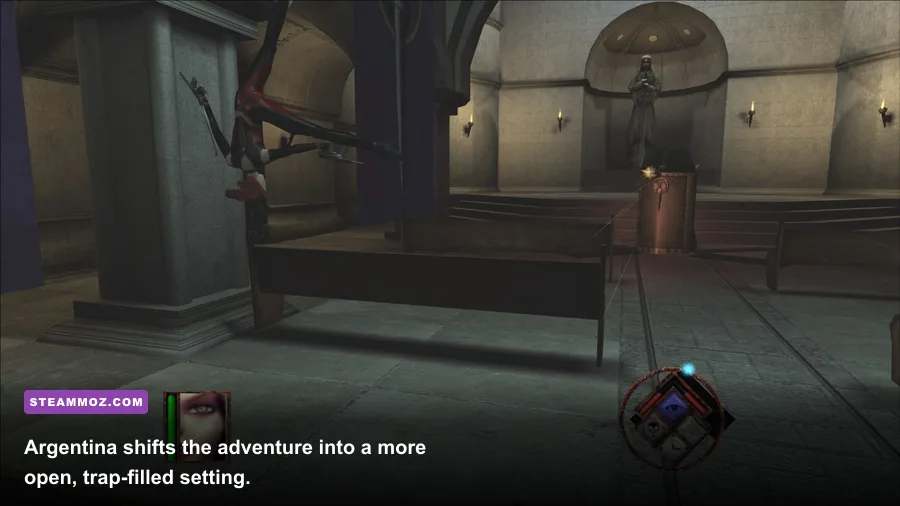
Argentina changes the texture of the campaign. Its jungle paths, ruins, and more open spaces give traversal a larger role, and that exposes one of Terminal Cut's oldest problems: Rayne's platforming is functional rather than elegant. Jump distances can feel uncertain, ledges are not always generously signposted, and the camera can hide the exact landing point. Use Aura Vision to check routes and don't rush leaps simply because the next platform looks close.
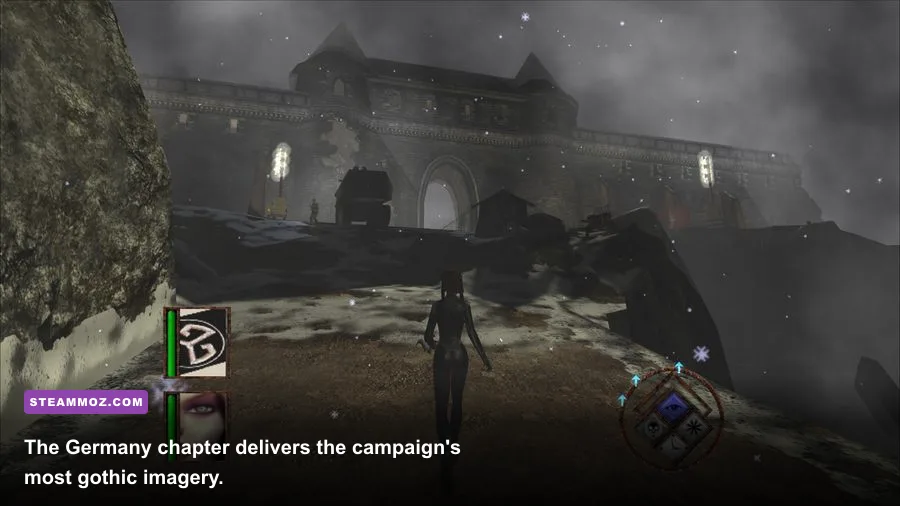
Germany is the visual high point. Castles, laboratories, and gothic interiors provide the strongest backdrop for Rayne's horror-action identity. The later levels also push enemy combinations harder, mixing ranged pressure with tougher melee threats and environmental hazards. That escalation is welcome, although the game sometimes increases difficulty by stacking enemies in cramped spaces rather than by introducing smarter behavior.
The story is knowingly pulpy. Rayne's dialogue, Nazi occult imagery, vampires, and exaggerated villains aim for comic-book momentum more than subtle character drama. The remaster's cleaner image quality helps the cutscenes, but it cannot turn the script into prestige television. The appeal is Rayne herself: confident, violent, stylish, and built around the kind of exaggerated supernatural fantasy that defined early-2000s action games.
Where the old design shows its age
Terminal Cut's biggest weakness is that it preserves the wrong things as faithfully as the right ones. Enemy AI can be inconsistent. Some opponents rush directly toward Rayne, while others stand in awkward positions and fire until the camera or level geometry gets in the way. Melee hit detection usually feels satisfying, but crowded encounters can produce cheap damage when several attacks land at once.
The camera is manageable in open rooms and troublesome near walls, staircases, and platforming sections. It isn't broken every minute, but it demands active correction. Keep the camera behind Rayne before starting a jump, avoid backing into corners, and use Dilated Perception when a projectile-heavy fight becomes visually noisy. Those habits sound basic, yet they prevent many of the deaths that initially feel random.
Checkpointing is another period-specific annoyance. BloodRayne expects you to complete sections rather than save after every successful fight. A failed platforming sequence or unexpected elite encounter can therefore erase more progress than modern players expect. The trade-off is that the campaign feels like a complete arcade-style run rather than a sequence of disposable micro-challenges.
There are also moments when Terminal Cut's modern visuals clash with its original animation work. Sharper textures and improved lighting make environments more readable, but they also draw attention to stiff facial expressions, dated character models, and repeated enemy animations. This is a remaster that improves the window into the past; it doesn't replace the past.
Best PC settings for Terminal Cut in 2026
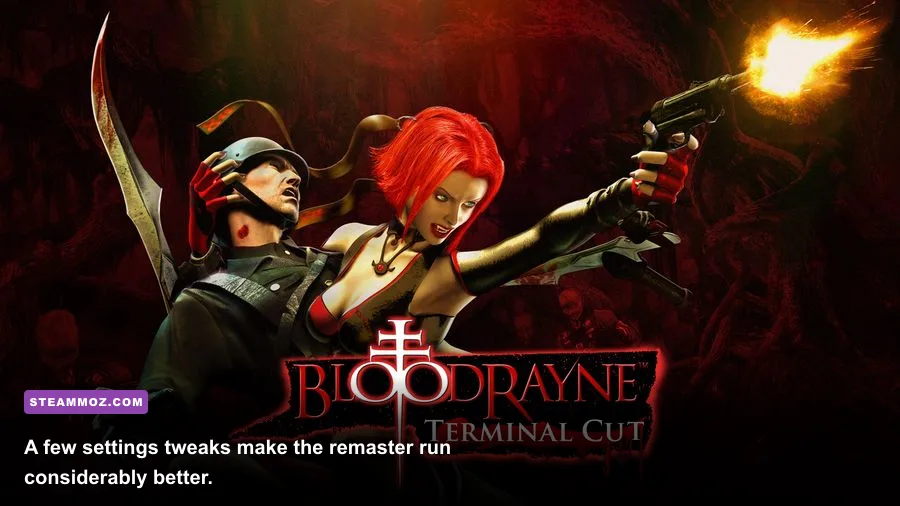
BloodRayne: Terminal Cut is not demanding by 2026 standards, but stable frame pacing matters more than chasing a high refresh rate. The game's combat is built around quick movement, projectiles, and close-range timing. A locked 60 frames per second feels better than an unstable 120 that stutters whenever lighting effects and multiple enemies appear together.
Start with the recommended PC specifications on the official Steam listing, then tune downward only if you see hitching. Players troubleshooting older Unreal Engine releases may also find useful general performance habits in Steamoz's PC fixes and FPS guide and graphics-settings optimization guide.
| Setting | Recommended value | FPS impact | Visual note |
|---|---|---|---|
| Resolution | Native monitor resolution | High at 4K | 1080p or 1440p is the sensible balance on modest hardware |
| Texture quality | High | Low to medium | Worth keeping high because environments benefit most from it |
| Shadows | Medium | Medium to high | Lower this first if dense rooms cause dips |
| Effects and lighting | High, then Medium if needed | Medium | Preserves the remaster's atmosphere but can stress older GPUs |
| Anti-aliasing | Highest stable option | Low to medium | Helps smooth Rayne's blades and distant railings |
| Frame cap | 60 FPS | Improves consistency | Matches the game's original action pacing comfortably |
| Motion blur | Off if available | Minimal | Makes fast camera turns and combat easier to read |
Is BloodRayne: Terminal Cut worth playing in 2026?
Yes, with the right expectations. Terminal Cut is a strong recommendation for players who enjoy compact retro action games, supernatural pulp, and combat systems that reward forward momentum. It is also a sensible purchase for returning fans who want modern resolution support and a cleaner installation without hunting down old patches.
It is a weaker recommendation if you expect the precision of modern character-action games. Rayne has no elaborate skill tree, no meaningful build crafting, no deep weapon upgrade economy, and no expansive open-world structure. The campaign is linear, the encounters repeat their ideas, and the platforming regularly reminds you that this design came from a very different era.
Compared with other revived classics, Terminal Cut sits in the same interesting space as games covered in Steamoz's Dungeon Siege retrospective: the original identity survives, but the question is whether you can accept old design habits alongside the nostalgia. BloodRayne's answer is helped by its short length and unusually memorable combat hook.
| Player type | Verdict | Why |
|---|---|---|
| Original BloodRayne fan | Strong buy on sale or at a fair price | The cleanest modern version with familiar content and presentation upgrades |
| First-time retro action player | Worth playing | Distinctive combat and atmosphere outweigh the dated traversal |
| Modern character-action specialist | Try before buying if possible | Combat is fun but lacks the depth and precision of newer benchmarks |
| Story-focused player | Conditional | The pulp-horror premise is entertaining, but the writing is deliberately broad |
| Completionist | Good fit | Steam achievements and a compact campaign make replay goals manageable |
My final score for 2026 is 7/10. BloodRayne: Terminal Cut succeeds because Rayne remains fun to control: blades, bullets, blood, and supernatural powers combine into a combat loop with genuine personality. It falls short of greatness because the remaster doesn't rethink the camera, platforming, checkpoint structure, or enemy AI.
If the idea of a leather-clad dhampir carving through occult soldiers in Louisiana, Argentina, and Germany sounds better than another 60-hour open-world checklist, give it a shot. Play aggressively, learn when to bite, keep Dilated Perception for danger rather than convenience, and treat the platforming with patience. In 2026, BloodRayne: Terminal Cut isn't essential—but it is still one of the more enjoyable ways to revisit the loud, strange, gloriously excessive action games of the early 2000s.
For more classic PC recommendations, Steamoz's Far Cry 2 performance coverage is another useful stop before diving into older action games on modern hardware. You can also check the official WayForward website for information on the studio behind the Terminal Cut remaster work.