Yes—Alone in the Dark Anthology is worth playing in 2026, but only if you approach it as a piece of horror history rather than a polished modern collection. The package's four games—Alone in the Dark (1992), Alone in the Dark 2, Alone in the Dark 3, and Alone in the Dark: The New Nightmare—show how survival horror evolved from tank controls, fixed camera angles, and obtuse puzzle design into the more recognizable PlayStation-era formula. The first game is the essential experience, The New Nightmare is the easiest recommendation for newcomers, and the second and third games are fascinating but much rougher. Buy it for atmosphere, design history, and genuinely strange ideas—not convenience.
This review focuses on the classic anthology, not the 2024 remake starring Emily Hartwood and Edward Carnby. That distinction matters. The anthology is built around older PC and console-era design, with limited presentation options and very little hand-holding. If you want modern movement, generous checkpoints, autosaves, and cinematic combat, this collection will feel hostile. If you want to see the DNA that later shaped Resident Evil, Silent Hill, and countless haunted-house games, it remains remarkably valuable.
What exactly is in the anthology?

The collection covers the original trilogy and The New Nightmare, a later reboot that abandons the numbered storyline. All four games revolve around paranormal investigation, but they don't play the same way. The first three use polygonal characters over pre-rendered backgrounds, while The New Nightmare moves toward fully 3D environments, dynamic lighting, and a more conventional third-person action-horror structure.
| Game | Original release | Best quality | Main drawback |
|---|---|---|---|
| Alone in the Dark | 1992 | Atmosphere and puzzle invention | Clumsy combat and harsh navigation |
| Alone in the Dark 2 | 1993 | Large set pieces and bizarre tone | Action-heavy design feels uneven |
| Alone in the Dark 3 | 1994 | Distinct supernatural western setting | Repetitive combat and dated structure |
| The New Nightmare | 2001 | Best controls and lighting | Less original than the first game |
In the original Alone in the Dark, you choose Edward Carnby or Emily Hartwood before entering Derceto Mansion. The character choice is not just cosmetic: each protagonist has different dialogue, room routes, and story context. Emily is searching for her missing uncle Jeremy Hartwood, while Carnby is investigating the suspicious death connected to the mansion. The core adventure remains the same, but playing both routes reveals enough altered encounters to make a second run worthwhile.
The trilogy's inventory system is especially important. Objects occupy limited slots, weapons and ammunition compete with puzzle items, and many apparently useless objects have a purpose several rooms later. Books are not decorative clutter; reading them can expose lore, clues, and warnings about supernatural threats. The games reward examining everything, but they also punish hoarding. You need to make decisions about what stays in your inventory and what gets left in a safe room.
For the official product listing and platform availability, check the Alone in the Dark Anthology Steam search page. The series' broader history is also documented through Atari's official website.

🎮 Alone in the Dark Anthology
Looking to experience this game? Grab your digital key directly on our store for $3.74.
View on Steammoz Store →Why the original 1992 game still matters
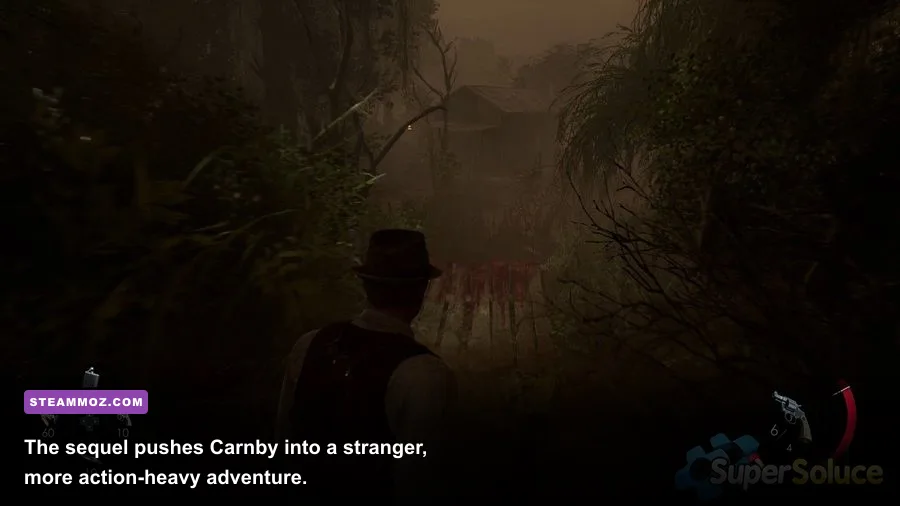
The first Alone in the Dark is the reason this anthology deserves your attention. Its fixed camera angles, polygonal figures, and deliberately awkward movement can look primitive, but the design underneath is astonishingly ambitious. Derceto Mansion is not merely a sequence of rooms leading to boss fights. It is a puzzle box full of readable books, hidden passages, traps, supernatural creatures, and objects that behave according to a consistent internal logic.
The opening minutes establish the game's unusual rhythm. You begin in an attic, search for a way down, and quickly learn that the environment itself is dangerous. A falling enemy can kill you before you've found a weapon. A chair, mirror, chest, or fireplace may be part of a solution. Combat is deliberately unreliable: Carnby or Emily can aim, fire, and dodge, but the camera can obscure an enemy and positioning matters more than twitch reflexes. The smartest move is often to avoid a fight entirely.
That philosophy remains fresh in 2026. Modern survival horror often gives you a clear objective marker and a clean combat loop. Alone in the Dark instead asks you to build a mental map. It expects you to remember that a key was found behind a painting, that a book described a creature's weakness, or that a locked door had a symbol matching an object upstairs. The reward is not merely progression; it's the satisfying click of understanding how Derceto fits together.
The controls are the real barrier
Don't mistake the game's age for a lack of challenge. Tank-style movement means pressing up moves the character forward relative to their current facing, while left and right rotate them. Backing away from an enemy is slower and less precise than turning and repositioning. That sounds basic, but it makes every corridor encounter stressful. Save often, keep healing items accessible, and never enter an unfamiliar room with a full inventory of puzzle objects but no usable weapon.
The PC presentation is also very much of its era. Expect low-resolution pre-rendered backgrounds, abrupt camera changes, and animations that can feel more theatrical than functional. Community fixes and compatibility tools may improve the experience depending on your version, but they won't transform it into a modern remaster. For comparison, players who enjoy tuning older games may also appreciate Steamoz's practical guide to PC fixes for Bottle Pilgrim; just remember that the anthology's biggest problems are design-era limitations, not simply frame-rate issues.
How the sequels change the formula
Alone in the Dark 2 is the collection's wild card. It starts with Carnby investigating kidnappers and quickly becomes a bizarre trip involving pirates, gangsters, magic, and one of the strangest tonal shifts in early survival horror. The game is more action-oriented than its predecessor, with more firearms and set-piece encounters. That makes it livelier, but it also weakens the careful exploration that gave the original its identity.
The sequel's combat is at its best when you prepare the room before pulling the trigger. Enemies can block narrow routes, ammunition is limited, and the fixed camera can hide threats at the edge of the screen. Entering every encounter aggressively is a mistake. Clear one target, retreat through a doorway, and use room transitions to reset your position. The game is less about precision shooting than managing sight lines and escape routes.
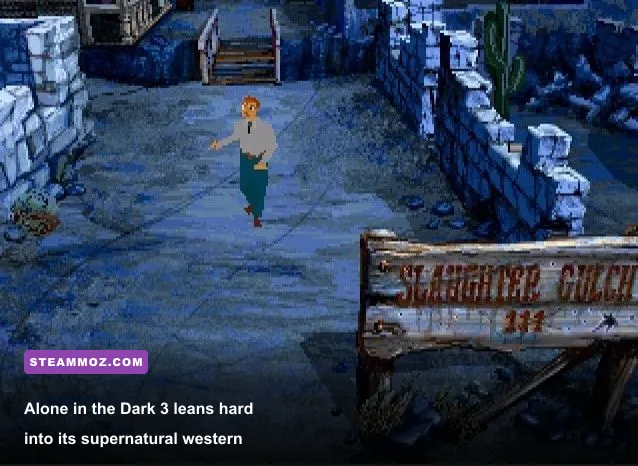
Alone in the Dark 3 commits fully to a supernatural western. Carnby travels to Slaughter Gulch, a deserted film-set-style town filled with undead gunslingers, strange machinery, and occult threats. The premise is memorable, and the location gives the game a visual identity that the second entry sometimes lacks. Unfortunately, the structure can feel repetitive: move through another dusty area, fight another enemy, search for another key item, and repeat.
| Entry | Exploration | Combat | Puzzle quality | 2026 verdict |
|---|---|---|---|---|
| Alone in the Dark | Excellent | Awkward but tense | Excellent | Must-play classic |
| Alone in the Dark 2 | Good | More prominent | Uneven | For curious retro fans |
| Alone in the Dark 3 | Moderate | Repetitive | Mixed | Optional historical tour |
| The New Nightmare | Good | Most approachable | Solid | Best starting point for newcomers |
If you only have time for two games, play the original and The New Nightmare. The second and third entries are better understood as archival curiosities: they show the developers experimenting with genre, tone, and action design before the series moved in a different direction.
The New Nightmare is the easiest recommendation
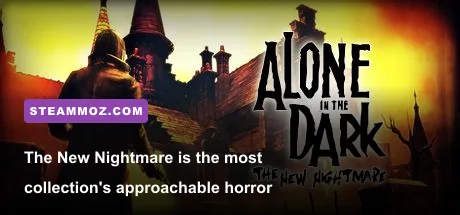
The New Nightmare is the anthology's bridge between old-school survival horror and the early-2000s console style popularized by Resident Evil. You can play as Edward Carnby or Aline Cedrac, and the choice affects the campaign's route, story scenes, and available encounters. Carnby's campaign emphasizes direct investigation and combat, while Aline's path places more focus on Shadow Island's mythology and puzzle progression.
Its biggest technical improvement is the use of dynamic lighting. Darkness is not just a visual filter; it shapes how you read a room and where threats may appear. The flashlight makes exploration easier but can also reveal enemies and draw your attention away from environmental clues. The game feels more readable than the 1992 original, yet it retains limited ammunition, key-item backtracking, and a generally cautious pace.
Weapons are more familiar here, including a handgun and heavier firearms, but ammunition conservation still matters. Don't unload into every creature you meet. Stun or bypass weaker enemies when the layout allows it, and reserve stronger ammunition for encounters where the room's geometry prevents a clean escape. The game also benefits from a slower, deliberate approach to puzzles: inspect inscriptions, read documents, and revisit areas after major story events rather than wandering randomly.
The weakness is originality. The New Nightmare is polished for its time, but its camera, inventory, combat, and progression feel like a competent response to survival-horror conventions rather than a reinvention of them. That is exactly why it works as an entry point. New players can learn the anthology's DNA without immediately wrestling with the original's most severe control problems.
Its atmosphere also holds up better than you might expect. Shadow Island's forests, underground structures, and imposing interiors create a strong sense of place, while the lighting gives ordinary corridors a constant threat. It isn't as conceptually bold as Derceto Mansion, but it is far easier to finish without consulting a walkthrough every twenty minutes.
Performance, compatibility, and the best way to play
Don't buy the anthology expecting modern graphics options. These are old PC games, and the package's appeal comes from preservation rather than technical polish. On contemporary hardware, the raw performance demands are negligible; the real variables are display scaling, input compatibility, sound behavior, and how comfortable you are with low-resolution visuals.
| Option or approach | Recommended choice | Why it helps | Trade-off |
|---|---|---|---|
| Display mode | Integer-scaled window or centered fullscreen | Preserves pixel proportions | Black borders may appear |
| Aspect ratio | Original 4:3 presentation | Prevents stretched characters and backgrounds | Uses less horizontal screen space |
| Frame pacing | Stable cap matching the game's behavior | Reduces uneven animation | May require external compatibility tools |
| Input | Keyboard first, controller mapping second | Matches the original control assumptions | Tank movement takes practice |
| Visual filters | Light smoothing only | Keeps backgrounds readable without excessive blur | Won't resemble a modern remaster |
Use a controller only if you can map movement and inventory controls cleanly. A modern analog stick can make tank controls feel slightly less abrasive, but it doesn't remove the original game's turning rules. Keyboard controls often provide more consistent directional input, especially during combat. Whichever setup you choose, test it in a safe room before committing to a long session.
Save management deserves its own warning. Older entries can punish careless progress, and a bad save made after wasting ammunition or carrying the wrong items can turn the next hour into a slog. Keep multiple rotating saves rather than overwriting one file. This isn't glamorous advice, but it is the difference between appreciating the anthology and abandoning it after a frustrating death.
Players sensitive to technical roughness should set expectations realistically. This is not a performance-tuning case like Ankora: Lost Days settings optimization, where a few graphics changes can dramatically improve play. Here, a stable setup helps, but the biggest gains come from preserving the correct aspect ratio, using sensible input mapping, and accepting the deliberate limitations of the original presentation.
Is Alone in the Dark Anthology worth playing in 2026?
The answer depends on which kind of horror player you are. If you're a preservation-minded gamer, a survival-horror fan, or someone curious about the genre's foundations, the anthology is absolutely worth playing. The original Alone in the Dark remains the star because its mansion design, literary atmosphere, and object-based puzzles still feel inventive. The New Nightmare supplies the smoother, more approachable counterpoint.
If you're looking for a seamless binge through four equally strong campaigns, this isn't that collection. Alone in the Dark 2 and Alone in the Dark 3 can be frustrating, especially when their combat-heavy sections collide with fixed cameras and limited resources. Their value is historical and tonal. They are snapshots of a series trying to decide whether it wanted to be gothic adventure, action game, supernatural western, or survival horror.
| Player type | Recommendation | Best starting game |
|---|---|---|
| Survival-horror newcomer | Buy, but start with the modern-feeling entry | The New Nightmare |
| Retro game enthusiast | Strong buy for design history | Alone in the Dark (1992) |
| Story-focused player | Play selectively and use a guide when stuck | Alone in the Dark (1992) |
| Action-horror fan | Expect dated combat and uneven pacing | The New Nightmare |
| Modern-remake player | Try it only if you enjoy historical context | Alone in the Dark (1992) |
My recommendation is to play the games in release order, but don't force yourself to finish every chapter consecutively. Complete the original, take a break, then sample the sequels before moving to The New Nightmare. That approach makes the technological and design progression obvious without turning the rougher entries into homework.
The anthology also makes sense alongside other older PC adventures. Steamoz's Construction Simulator 2015 review and Borderlands 2: Commander Lilith review examine games that survive through distinct design strengths rather than modern presentation. Alone in the Dark belongs in that conversation, though its rough edges are considerably sharper.
Final verdict: 8/10 for the original and 7/10 for the anthology as a whole. The package is uneven, under-modernized, and occasionally irritating, yet it preserves ideas that still echo through horror games today. Play it with patience, keep rotating saves, preserve the 4:3 presentation, and treat the awkwardness as part of the archaeological experience. In 2026, Alone in the Dark Anthology isn't the easiest classic horror recommendation—but it remains one of the most revealing.