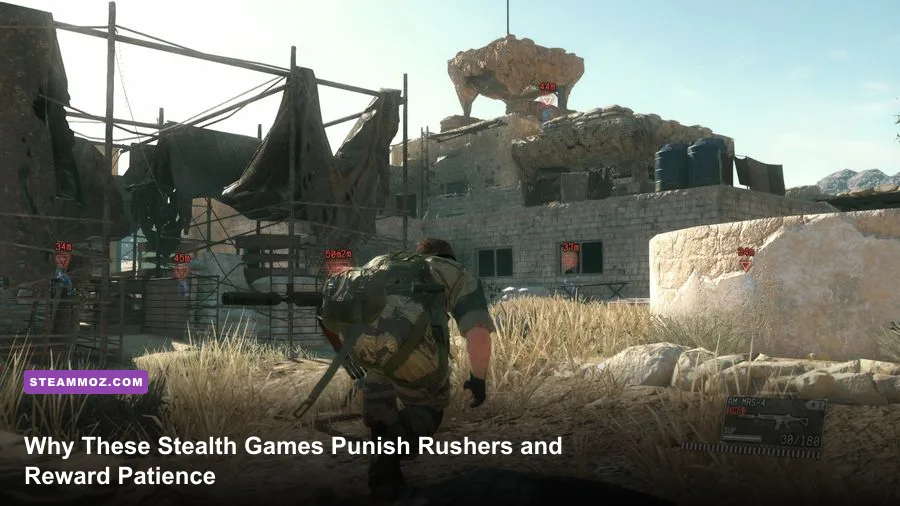
The best stealth games of all time don't hand you victory for reflexes or twitch aim — they hand it to you for waiting one more beat, reading a guard's patrol timing down to the second, and resisting the urge to just shoot your way out. Games like Metal Gear Solid V: The Phantom Pain, Splinter Cell: Chaos Theory, Thief: The Dark Project, Dishonored, and the Hitman World of Assassination trilogy remain the gold standard because every single one punishes impatience with alarms, reinforcements, or a straight-up mission failure — and rewards patience with some of the most satisfying power fantasies in gaming.
What Actually Makes a Stealth Game "Reward Patience"
It's not just about crouching behind crates. A genuinely patient-friendly stealth game gives you readable systems — vision cones, noise radii, guard AI states (Idle, Suspicious, Alert, Combat) — and then lets you exploit them with near-mathematical precision. Think about MGSV's Reflex Mode buffer, which still requires you to understand a guard's actual field of view instead of relying on it as a crutch. Or Thief's Light Gem, sitting right on your HUD, quietly screaming at you to back into the darker corner of the room. These systems aren't decoration. They're the entire skill ceiling of the genre, and the games that do it best make patience feel like mastery, not tedium.
The Guard AI Difference
Compare Splinter Cell's older titles to something like Ubisoft's more recent open-world stealth-lite games, and you'll notice patient-reward design lives or dies on AI believability. Chaos Theory's guards actually investigate a dropped body with escalating urgency — first confused, then radioing for backup if you don't hide the corpse fast enough. That tension is what makes waiting in the dark for thirty seconds feel like the smartest thing you've ever done, not a loading screen.

🎮 RUSH
Looking to experience this game? Grab your digital key directly on our store for $4.99.
View on Steammoz Store →The Tier List: Ranking Stealth Games By Patience Payoff

Here's how the genre's heavy hitters stack up when you judge them purely on how much they reward slow, deliberate, watch-and-wait play over rushing.
| Game | Tier | Why It Rewards Patience | Best Moment for Patient Players |
|---|---|---|---|
| Metal Gear Solid V: The Phantom Pain | S-Tier | Dynamic time-of-day, camo index, and Fulton extraction reward long recon before engaging | Night infiltration of Yahyah Gulch with Chicken Hat camo |
| Thief: The Dark Project | S-Tier | Light Gem forces micro-adjustments every few seconds; loud floors punish rushing instantly | The Cragscleft Prison escape sequence |
| Hitman: World of Assassination | S-Tier | Disguise trust systems and NPC routines demand full-level observation before acting | Sapienza's full silent-assassin ICA facility route |
| Splinter Cell: Chaos Theory | A-Tier | Body-hiding, sound masking, and interrogation mechanics reward methodical clearing | The Bank level's vault infiltration |
| Dishonored | A-Tier | Ghost/no-kill runs unlock unique achievements and alter the story's Chaos system | Low Chaos run through the Golden Cat brothel |
| Tenchu: Stealth Assassins | B-Tier | Grading system literally scores you higher for undetected kills over combat | Rooftop stalking sequences in feudal Japan levels |
Metal Gear Solid V: Why Waiting for Nightfall Actually Matters
MGSV isn't just "open world stealth," it's a full simulation of enemy adaptation. Spend three missions headshotting soldiers with a tranq gun and by mission four, they'll be wearing helmets. Spend your time scouting with binoculars, marking enemies, and waiting for the in-game clock to hit nighttime, and suddenly your camo index shoots past 80%, guards can barely see you at ten meters, and D-Dog can mark enemies through walls once his bond level rises. The patience loop here is brutal but fair: rush Mother Base security sweeps and you'll bleed resources; wait, plan Fulton extraction routes, and you'll walk away with an entire outpost's worth of soldiers recruited without firing a shot. Check the official Metal Gear Solid V site for the full mechanics breakdown if you want to dig into the camo index math yourself.
Thief and Splinter Cell: The Original Patience Engines
Thief: The Dark Project, released back in 1998, basically invented the modern stealth playbook. Garrett doesn't get superpowers — he gets a blackjack, water arrows to douse torches, and moss arrows to muffle loud stone floors. Every single tool exists to buy you more time in the shadows. Splinter Cell followed a similar philosophy but added Sam Fisher's signature split-jump and shadow-hugging mechanics, culminating in Chaos Theory's near-perfect balance of light, sound, and guard psychology. Both franchises taught players that the correct answer to "guard is walking toward me" is almost never "attack" — it's "wait two more seconds until his patrol path turns." You can find preserved details on both franchises through the Thief: The Dark Project archive.
Sound Design as a Patience Punisher
People underrate how much sound design carries these games. In Chaos Theory, sprinting on tile versus carpet changes your detection radius dramatically — something like a 40% increase in noise on hard surfaces. Patient players learn floor textures like a second map. Impatient players get gunned down by an alarm they never even heard trigger.
Hitman's Disguise System: The Ultimate Patience Test

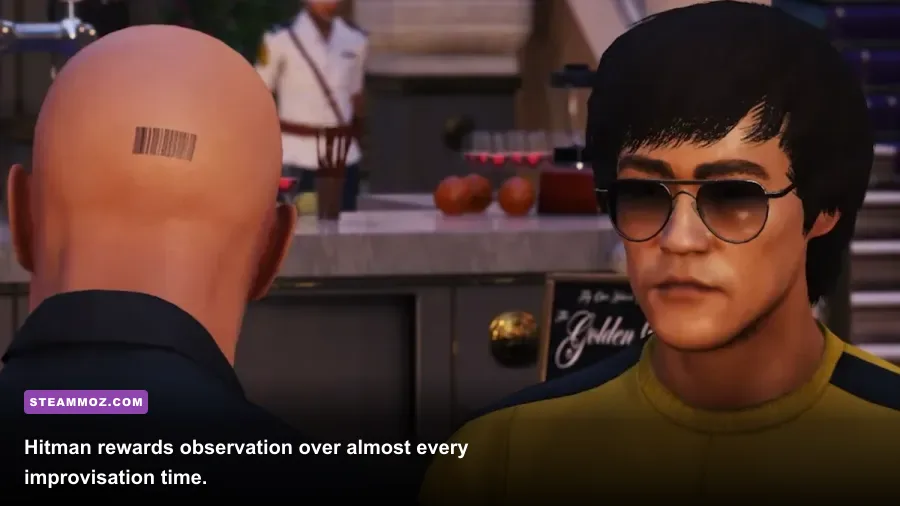
IO Interactive's Hitman World of Assassination trilogy might be the purest distillation of patient stealth design ever shipped. Agent 47 in a mechanic's jumpsuit is invisible to mechanics but instantly suspicious to security guards who know every mechanic's face. That's not random — it's the Trust System, and it means every disguise swap requires you to understand exactly which NPC archetypes will "see through" you. Rushing a Silent Assassin rating on Sapienza or Hokkaido is basically impossible; you need to loop the map two or three times just gathering intel on guard rotations, keycard locations, and target routines before you even touch a weapon. Full mechanical detail lives on the official Hitman website.
| Mechanic | Game | Patience Reward | Rush Penalty |
|---|---|---|---|
| Camo Index | MGSV | Near invisibility at night/high grass | Guards spot you at 15m+ in daylight |
| Light Gem | Thief | Invisibility in deep shadow zones | Instant detection in lit corridors |
| Trust System | Hitman | Full map access without suspicion | Blown cover, guards alerted immediately |
| Chaos System | Dishonored | Better ending, calmer world state | Rat plague worsens, guards increase |
Dishonored's Chaos System Turns Patience Into Narrative Power
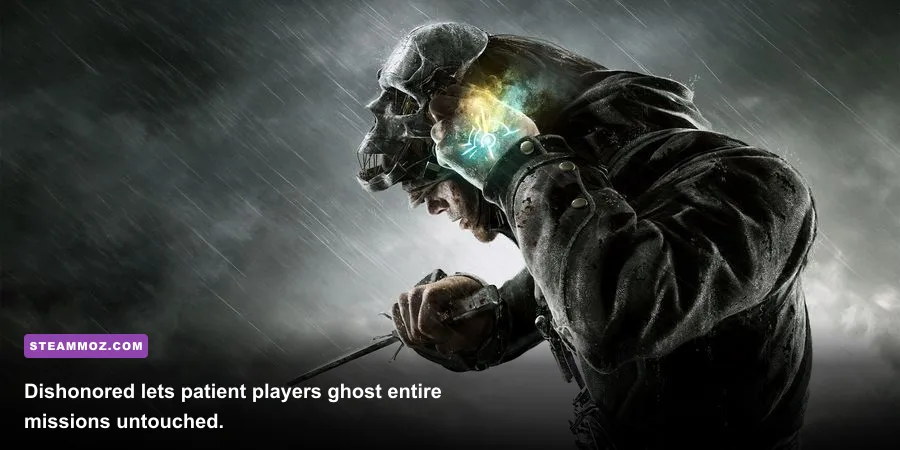
Arkane's Dishonored takes patient stealth and ties it directly into the story. Every non-lethal takedown, every ghosted guard, keeps the game's Chaos meter low — leading to a genuinely different, less bleak ending with fewer weepers roaming Dunwall's streets. Corvo's Blink ability tempts you to just zip past everyone, but the real mastery move is using Dark Vision to map guard positions from a distance, then threading through gaps in patrol routes without a single alert triggered. It's basically a puzzle box disguised as an action game, and the patient solution is almost always the more elegant one. You can grab the game and check current specs on its Steam store page.
Practical Tips for Playing Patient in Any Stealth Game
Whether you're diving into a stealth classic or something newer, a few universal habits carry across every title in this genre:
- Watch full patrol loops before moving. Most guard patterns repeat on a 15-30 second cycle — memorize it before you commit.
- Use verticality. Rooftops, vents, and ledges in Thief, Dishonored, and Splinter Cell almost always have lower guard density than ground floors.
- Bait, don't brawl. Whistle mechanics, thrown objects, or distraction gadgets exist so you never have to fight — use them liberally.
- Save extraction for last. In MGSV especially, Fulton extraction noise can attract nearby patrols, so clear the immediate area first.
- Play on higher difficulty once you're comfortable. Lower difficulties often mute footstep audio cues and guard awareness radius, softening the exact mechanics that make patience worthwhile.
If you're chasing that same methodical, high-stakes rhythm in other genres, it's worth checking out how patience and build planning pay off in guides like our breakdown on Far Cry 6's best beginner build, or how careful preparation shapes performance in our Far Cry 6 GOTY settings guide. Fans of methodical, resource-conscious play should also look at our Everspace 2 secret locations guide and the loadout-focused Far Cry 3: Blood Dragon weapons tier list for more patient-playstyle strategy across genres.
At the end of the day, the stealth genre's best entries all share one philosophy: speed is a liability, not a feature. The reward for patience isn't just avoiding a Game Over screen — it's the quiet, almost smug satisfaction of walking an entire level undetected while every guard inside it has absolutely no idea you were ever there.