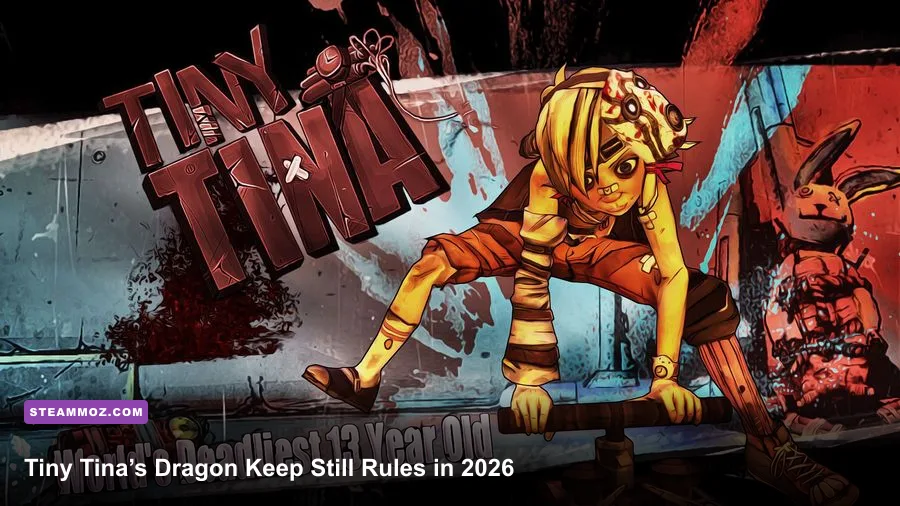
Yes, Borderlands 2: Tiny Tina’s Assault on Dragon Keep is still worth playing in 2026—especially if you enjoy co-op loot shooters, irreverent fantasy comedy, or compact campaigns with memorable set pieces. Its gunplay feels older than modern Borderlands, and the original PC release lacks some conveniences, but the writing, enemy variety, and tabletop-inspired world design still make it one of Gearbox’s strongest expansions.
The important distinction is which version you buy. The original DLC requires Borderlands 2. The 2021 standalone release, Tiny Tina’s Assault on Dragon Keep: A Wonderlands One-shot Adventure, runs by itself and is the easiest entry point. Both deliver the same core adventure, but the standalone edition is stripped down compared with the full Borderlands 2 package. If you want the complete loot treadmill, six Vault Hunters, endgame systems, and every other campaign, buy Borderlands 2 on Steam.

What you actually get in Dragon Keep
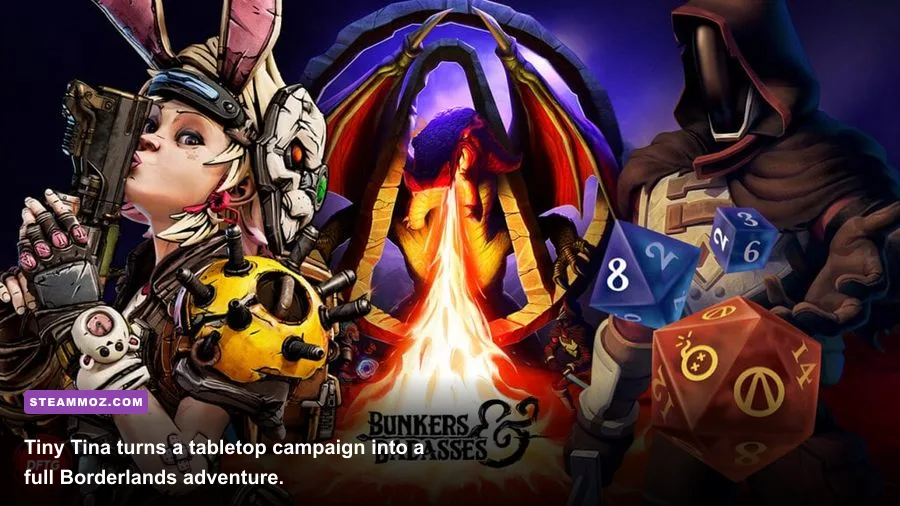
Tiny Tina’s expansion is framed as a game of Bunkers and Badasses, a fictional tabletop RPG run by twelve-year-old demolition expert Tiny Tina. Roland, Lilith, Brick, and Mordecai play exaggerated fantasy versions of themselves while Tina constantly rewrites the world around them. That premise is more than a joke generator: Tina’s emotional struggle with Roland’s death gives the campaign a surprisingly sharp center.
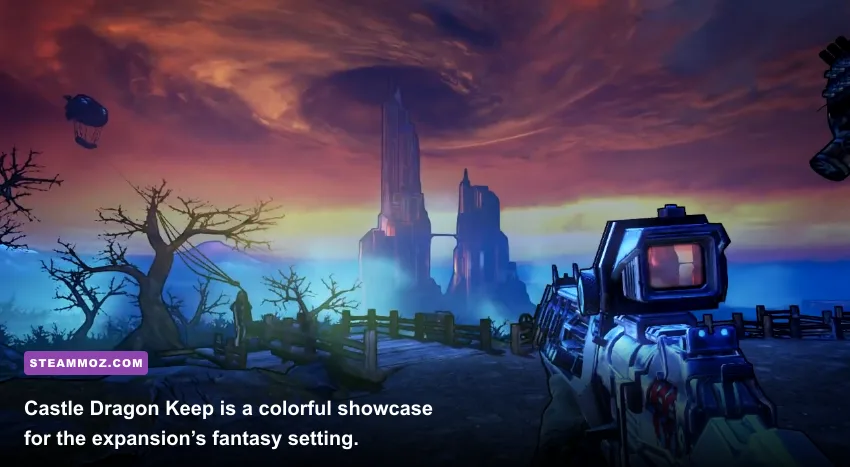
The adventure begins after the events of Borderlands 2 and takes place across a hand-built fantasy map featuring forests, caves, deserts, a haunted town, and Castle Dragon Keep. The main story usually takes around 8 to 12 hours, depending on difficulty and side quests. A completionist run can reach roughly 15 hours, particularly if you tackle the optional raid boss, side missions, and Murderlin’s Temple challenges.
Progression follows Borderlands 2’s familiar level scaling. The original DLC launched as a level 30-35 adventure on a first playthrough, while later playthroughs and Ultimate Vault Hunter Mode scale much higher. The standalone One-shot Adventure also gives players a fast route into the campaign, but it doesn’t recreate the entire long-term progression experience of the base game.
| Version | What it includes | Best for |
|---|---|---|
| Borderlands 2 DLC | Full Vault Hunter progression, other campaigns, DLC ecosystem, level-based loot | Returning players and long-term builds |
| Wonderlands One-shot | Standalone Dragon Keep campaign with a simplified package | New players who want a short fantasy shooter |
| Original 2013 release | Classic presentation and old-school PC options | Players chasing the authentic BL2 experience |
For context, this is closer to a focused expansion than a full modern live-service game. There’s no seasonal battle pass, rotating activity calendar, or endless stream of new content. That’s a strength in 2026: you can finish the story without treating it like a second job.
🎮 Borderlands 2: Tiny Tina's Assault on Dragon Keep
Looking to experience this game? Grab your digital key directly on our store for $3.29.
View on Steammoz Store →Why the writing and world design still land
Dragon Keep’s best trick is using fantasy clichés as both comedy and character development. Tina’s skeletons, wizards, dwarves, and castles are absurd on the surface, but every warped rule reflects her attempt to control a painful reality. The campaign’s famous ending works because the jokes gradually make room for grief instead of stepping around it.
The dialogue is still extremely specific. Tina’s improvised narration can change quest objectives, spawn enemies, or turn a harmless prop into a punchline. In one moment the party is hunting a dragon; in the next, Tina is arguing with the rules of her own game. It’s messy, loud, and occasionally exhausting, but it gives the expansion a personality that many more expensive add-ons never find.
The locations also have stronger visual identities than much of Borderlands 2’s main campaign. The Forest feels like a fairy-tale trap, Flamerock Refuge works as a central quest hub, and the Dwarven Mines use vertical arenas to make ordinary gunfights feel like dungeon crawls. The game still uses the series’ thick black outlines and exaggerated color palette, so it holds up better than a photorealistic 2013 shooter would.
There are limits. Some jokes rely on repetition, Tina’s voice can become grating during long sessions, and the plot assumes you understand the emotional fallout of Borderlands 2. New players can follow the basic story, but Roland’s death and the party’s reactions carry much less weight without the base campaign.
If you enjoy story-focused games with distinctive settings, Steamoz’s Dawn of Ragnarök review offers a useful comparison: both expansions succeed because their settings are more memorable than their raw campaign length.
Combat, loot, and the builds that work best
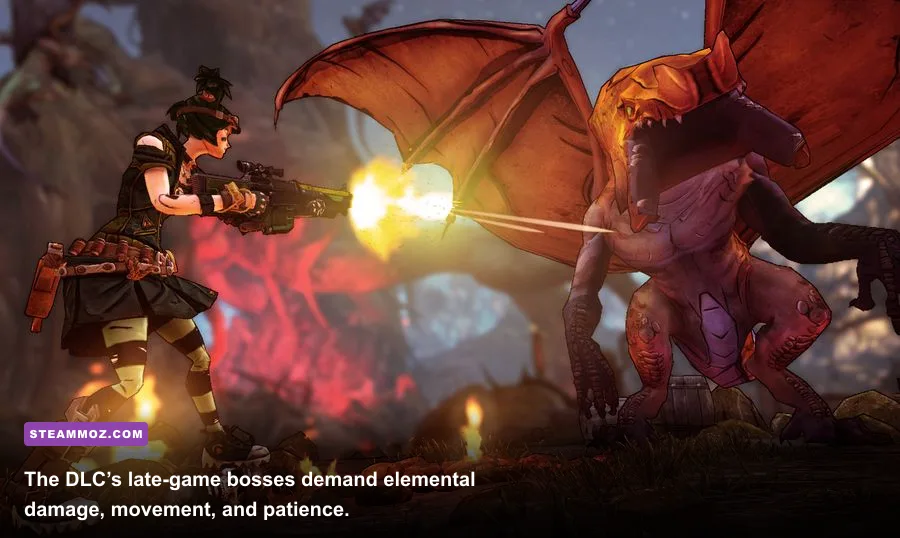
Dragon Keep uses Borderlands 2’s excellent but unforgiving combat model. Weapons are randomly generated from manufacturers such as Jakobs, Maliwan, Torgue, and Tediore, while elemental effects remain central. Incendiary damage melts flesh, corrosive damage is best against armor, shock strips shields, and explosive damage remains useful against clustered enemies. Slag is especially important in Ultimate Vault Hunter Mode, where slagged targets take a large damage multiplier before you switch to your primary weapon.
The fantasy theme adds new enemy behaviors rather than replacing the shooter foundation. Skeletons can use shields, wizards create elemental threats, orcs rush aggressively, and dragons force you to watch the arena instead of tunnel-visioning your crosshair. The most dangerous encounters punish standing still. Keep moving, identify the enemy’s health bar color, and avoid wasting ammunition on the wrong element.
| Vault Hunter | Useful skills | Why it works here | Difficulty |
|---|---|---|---|
| Salvador | Money Shot, Keep Firing!, Inconceivable | Gunzerking sustains damage and handles crowded arenas | Low |
| Maya | Converge, Ruin, Chain Reaction | Phaselock controls targets and spreads elemental effects | Low |
| Zero | B0re, Death Bl0ss0m, Execute | High burst damage against exposed bosses | High |
| Gaige | Close Enough, Anarchy, Death from Above | Ricochet and Anarchy help clear dense groups | Medium |
| Krieg | Release the Beast, Fuel the Blood, Strip the Flesh | Melee and explosive builds thrive in close quarters | High |
Maya is the safest recommendation for a first run. Converge pulls nearby enemies toward Phaselock, Ruin adds slag, shock, and corrosive effects, and Chain Reaction lets bullet damage bounce between targets. Salvador is the fastest route through normal difficulty because Gunzerking can combine a high-damage weapon with a healing or slag weapon. Zero is more demanding: B0re can produce spectacular boss damage, but missing critical angles leaves him fragile.
Gear matters more than chasing perfect rarity. A level-appropriate blue or purple weapon usually outperforms an under-leveled legendary. Look for a reliable shield, a healing item such as a Moxxi weapon, and at least two elemental options. The Unkempt Harold, Conference Call, Sand Hawk, and Magic Missile are famous Borderlands 2 choices, but their usefulness depends on level, manufacturer rolls, and build. Don’t keep a celebrated weapon if its damage has fallen behind by ten or more levels.
That same rule applies to the fantasy-themed items. The spell-like Magic Missile grenade mod is particularly valuable because it applies slag, and its homing projectiles make it much easier to prime enemies before a weapon swap. Murderlin’s Temple can reward strong gear, but its arena challenges are optional; don’t mistake them for mandatory campaign progression.
The bosses are fun, but the raid boss is a wall
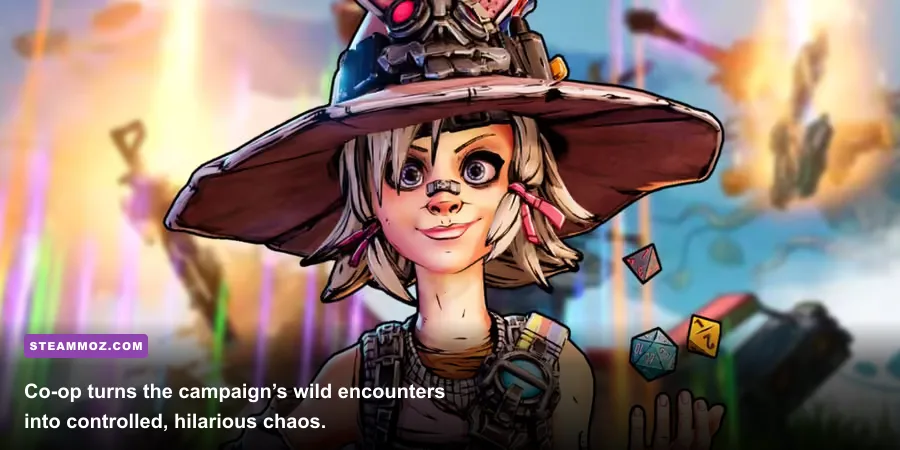
The main campaign’s bosses are generally manageable if you respect their arenas. The Ancient Dragons of Destruction are the major exception. They are an optional raid encounter with multiple dragons, elemental attacks, armor phases, and high health. They are designed for endgame characters and coordinated groups, not a casual first playthrough.
| Encounter | Main danger | Counter strategy | Recommended tool |
|---|---|---|---|
| Warlord Slog | Close-range pressure from a durable melee target | Keep distance and burn shields before committing damage | Shock weapon and high-capacity rifle |
| Haderax-style arena fights | Crossfire and limited safe space | Use cover, clear adds first, and watch elemental bars | Area damage grenade |
| Ancient Dragons of Destruction | Multiple dragons, shifting elements, raid-level health | Coordinate targets, bring slag, and use a second wind plan | Slag grenade plus high-burst weapon |
| Murderlin’s Temple | Escalating enemy waves and arena modifiers | Choose the right elemental weapon for each wave | Flexible elemental loadout |
For the dragons, communication matters more than raw aim. Split attention between airborne threats and ground-level adds, call out elemental changes, and avoid burning your best cooldowns before the arena is stable. A Siren supporting a Gunzerker can keep damage flowing while providing crowd control. Solo players should expect repeated deaths until they learn attack patterns and reliable second-wind routes.
The expansion’s enemy telegraphs are readable by 2026 standards. Projectiles glow, charging attacks have clear audio cues, and most dangerous attacks are avoidable through strafing. The real problem is visual clutter: elemental explosions, loot beams, and cel-shaded effects can obscure incoming damage on ultrawide displays.
Performance and the 2026 buying verdict
On modern PCs, Borderlands 2 is easy to run but not always perfectly smooth. The game is built on Unreal Engine 3 and can deliver high frame rates at 1080p or 1440p, yet PhysX effects may cause noticeable drops during heavy combat. NVIDIA hardware historically handles high PhysX settings better than AMD hardware, though disabling the feature is the sensible choice for consistent competitive-style frame pacing.
| Setting | Recommended value | FPS impact | Visual trade-off |
|---|---|---|---|
| Resolution | 1080p or 1440p native | Medium | Higher resolution improves distant enemy visibility |
| Texture quality | High | Low on modern GPUs | Preserves weapon and environment detail |
| View distance | High | Low to medium | Reduces pop-in across open fantasy arenas |
| Dynamic shadows | High | Medium | Lower values make interiors look flatter |
| Hardware PhysX | Low or Off | High stability gain | Fewer cloth, debris, and particle effects |
| Framerate cap | Monitor refresh rate | Improves consistency | Prevents unnecessary engine fluctuation |
Controller aiming feels perfectly serviceable, although mouse users get better precision during Zero’s critical-hit windows and long-range sniper play. Co-op remains the ideal way to experience the DLC, but PC players should check their exact version and community compatibility tools before assuming every old multiplayer issue has disappeared.
In 2026, the value calculation is simple. Buy it if you want a compact, funny, mechanically rich Borderlands campaign with excellent co-op encounters. Skip it if you dislike dated interfaces, repeated loot farming, or humor that shouts every punchline. The standalone One-shot is a good trial, but Borderlands 2’s full version is the superior investment for anyone planning multiple Vault Hunter runs.
My verdict: 8.5/10 in the full Borderlands 2 package, 7.5/10 as the standalone One-shot Adventure. Dragon Keep isn’t flawless, and its PC-era friction shows, but the combination of Tiny Tina’s unstable storytelling, smart enemy design, and satisfying elemental gunplay still beats most modern expansion campaigns. For more demanding hardware checks, see Steamoz’s Far Cry 6 performance guide and modern PC specs breakdown. If you’re shopping for another loot-focused challenge, our Death Howl weapon tier list is worth a look too.
For official details, check the Borderlands official site, the 2K Borderlands 2 page, and the 2K support hub before buying a platform-specific edition.