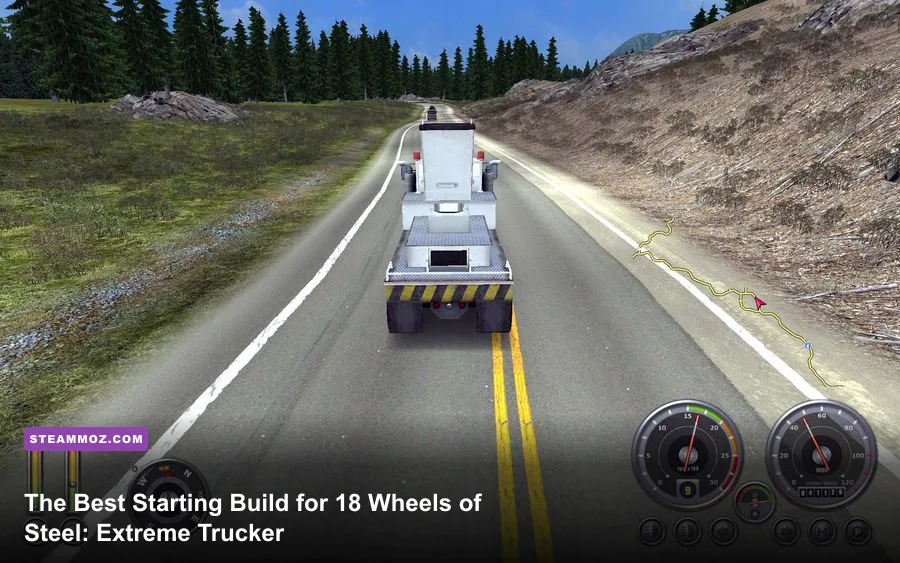
The best beginner build in 18 Wheels of Steel: Extreme Trucker is a stock, balanced tractor with the strongest braking response available, a standard-length trailer, and low-risk general cargo on Montana routes. Don't chase the biggest load or the fastest truck immediately. This setup gives you predictable acceleration, manageable turning, forgiving delivery timers, and enough cash to learn the game's real economy before the tougher Bangladesh and Australia jobs start demanding precision.
Extreme Trucker doesn't use a modern RPG skill tree, character statistics, or unlockable combat abilities. Your “build” is the combination of truck choice, cargo type, route, driving habits, and the upgrades you can afford. That distinction matters: the winning beginner setup isn't about stacking a hidden damage multiplier. It's about reducing the three things that erase early profits—collisions, missed deadlines, and fuel mistakes.
This guide focuses on the original PC game, its three campaign regions, and a practical first-career route. For context on the wider series, the official Steam listing identifies the game and its core trucking challenges, while SCS Software's official site provides the developer background. If you're also tuning older PC games, Steamoz's Far Cry 2 PC specs guide and ELEX performance fixes cover the same kind of legacy-hardware headaches.
Choose the balanced truck before the flashy one
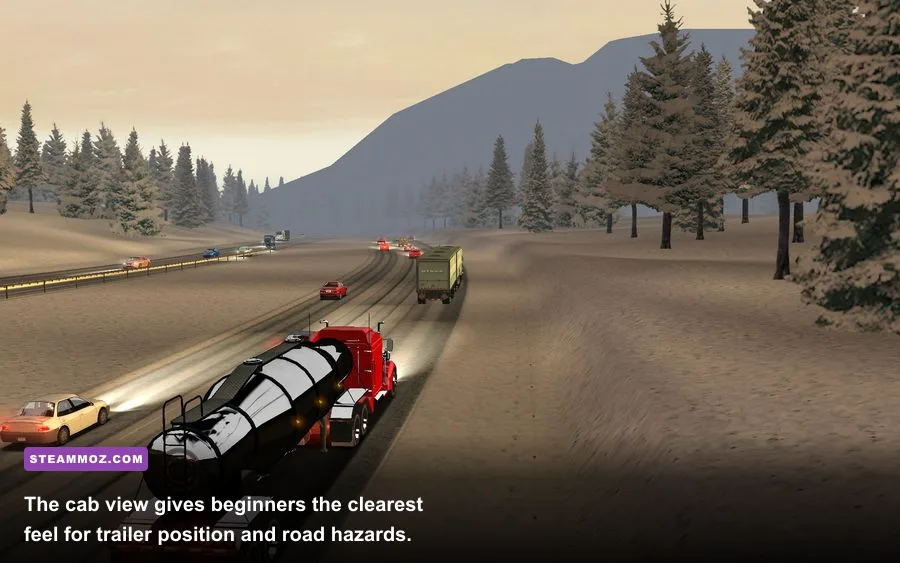
At the start, select the most conventional tractor configuration offered in your garage or job screen: a standard road truck with a normal wheelbase, moderate engine output, and no specialist handling penalty. The exact model names and performance bars can vary with the edition, language, and scenario, so judge the truck by its in-game acceleration, handling, and braking indicators rather than by badge or appearance.
A high-powered tractor looks tempting because it reaches cruising speed sooner, but that advantage is easy to waste. Extreme Trucker's roads are packed with bends, steep grades, traffic, and delivery hazards. More power also makes throttle corrections less forgiving, especially when you're pulling a heavy trailer downhill. A balanced truck keeps the steering calm and gives you time to react when a car cuts across an intersection.
| Build choice | Beginner recommendation | Why it works | When to change it |
|---|---|---|---|
| Tractor | Balanced road tractor | Predictable steering and acceleration | After you can finish five clean deliveries |
| Engine | Stock or first affordable upgrade | Preserves cash and avoids twitchy throttle response | When heavy grades repeatedly cost time |
| Trailer | Standard-length, conventional trailer | Shorter swing and easier reversing | When a contract specifically demands specialist equipment |
| Cargo | General freight with a generous timer | Low handling pressure and reliable profit | After route hazards become familiar |
| View | Cab or near-cab camera | Improves lane placement and trailer awareness | Use external view only for tight reversing |
Why the standard trailer beats heavy freight
A normal trailer gives you the cleanest introduction to the game's turning model. Watch the trailer wheels in every corner: they track inside the tractor's path, which means a turn that looks safe from the cab can still clip a sign, barrier, or parked vehicle. Long or unusually heavy cargo magnifies that error and extends braking distance. You want to learn the correction, not spend your first paycheck repairing an oversized load.
Don't spend every dollar on a cosmetic upgrade or a maximum engine option. Keep enough money for fuel and a bad delivery. A cash reserve is part of the build. If one mistake forces you to accept the next available contract rather than the best contract, the upgrade has already hurt your progression.

🎮 18 Wheels of Steel: Extreme Trucker
Looking to experience this game? Grab your digital key directly on our store for $3.99.
View on Steammoz Store →Start in Montana and build a clean-delivery streak
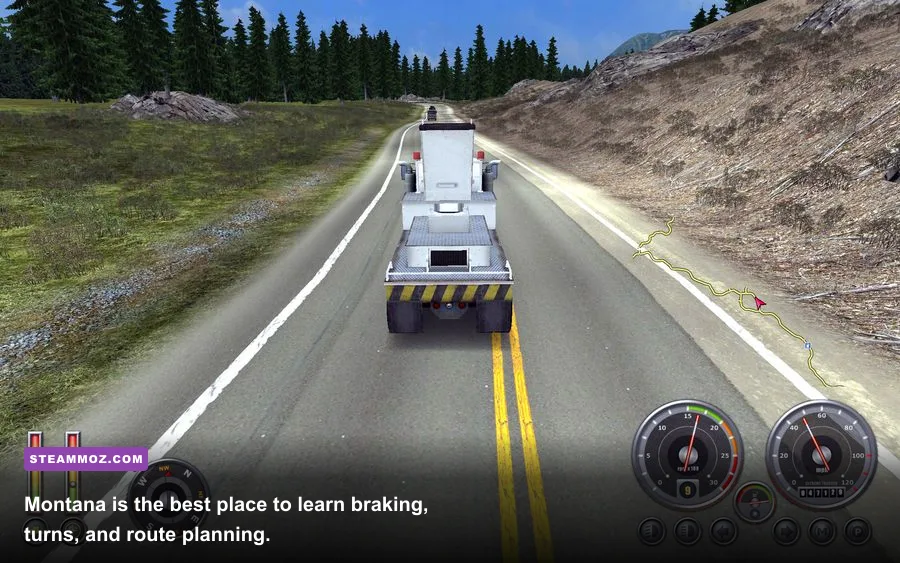
Montana should be your first serious training ground. Its roads provide space to learn lane discipline, mountain braking, and trailer placement without immediately throwing the dense traffic and unusual hazards of Bangladesh at you. Take straightforward jobs first, even if their payout is smaller. In this game, the best early currency is consistency.
Before accepting a contract, inspect four details: cargo type, destination, distance, and time pressure. A short job with a comfortable timer is often better than a long contract with a spectacular payout because damage and missed deadlines can erase the difference. Look at the route itself, too. Mountain roads demand more braking and steering input than a highway run, so don't compare payouts without considering difficulty.
| Early job profile | Tier | Accept when | Skip when |
|---|---|---|---|
| Short general cargo on a broad highway | S-Tier | You need safe money and route practice | Almost never; this is your foundation |
| Medium cargo through rolling terrain | A-Tier | You have completed several clean runs | Your truck is low on fuel or damaged |
| Heavy freight on steep mountain roads | B-Tier | You understand downhill braking | You are still hitting roadside objects |
| Long, time-sensitive specialist load | C-Tier | You know every major route hazard | During your first career sessions |
The first-five-delivery routine
For delivery one, stay below your maximum speed whenever the road narrows. Use it to learn how sharply the truck turns and how long the trailer takes to settle after a steering input. For delivery two, practice braking before the bend rather than inside it. On delivery three, make one controlled reverse at the destination instead of relying on repeated forward-and-back corrections. Delivery four is your fuel-management test. Delivery five is when you can begin taking a slightly longer route.
That sequence may sound conservative, but it teaches the exact skills the game keeps testing. If a delivery goes wrong, don't instantly restart out of frustration. Identify the cause: late braking, an optimistic overtake, a missed turn, or an awkward depot approach. Restart only when the mistake came from a control problem or an unavoidable route failure. Otherwise, the penalty is useful feedback.
Use this skill-free progression plan
Because Extreme Trucker has no traditional skill points, progression comes from better contracts and better decisions. Treat each upgrade as a solution to a problem you've already experienced. If hills are costing too much speed, improve power. If stopping is the recurring issue, prioritize braking or handling improvements. If you rarely complete a run cleanly, an expensive upgrade won't fix the underlying problem.
Save your first meaningful earnings rather than buying the first available part. The ideal early order is reliability first, performance second, specialization last. You should feel the truck becoming easier to control, not simply faster on a straight road.
| Progression stage | Priority | Target result | Common beginner mistake |
|---|---|---|---|
| First jobs | Stock balanced setup | Learn steering, braking, and depot approaches | Spending all cash before proving the route |
| Early earnings | Handling or braking improvement | Fewer collisions on bends and descents | Buying top speed instead of control |
| Mid-career | Engine improvement if grades require it | Maintain momentum without reckless speed | Using power to compensate for poor braking |
| Specialist work | Load-specific truck and trailer choices | Complete difficult contracts consistently | Accepting every large payout immediately |
What not to grind
Don't grind one route while ignoring the rest of the map. The game teaches different habits in different regions. Montana develops road reading and mountain control. Bangladesh tests traffic awareness, narrow roads, and patience. Australia introduces long, isolated stretches where fuel planning and fatigue with the route become more important than quick reactions. The strongest build is one you can operate everywhere, not one optimized for a single straight highway.
For a useful comparison, Steamoz's fast leveling and gold farming guide makes a similar point about progression: efficient growth comes from choosing repeatable, low-risk gains rather than blindly pursuing the largest reward.
Drive the truck like a professional, not a racer
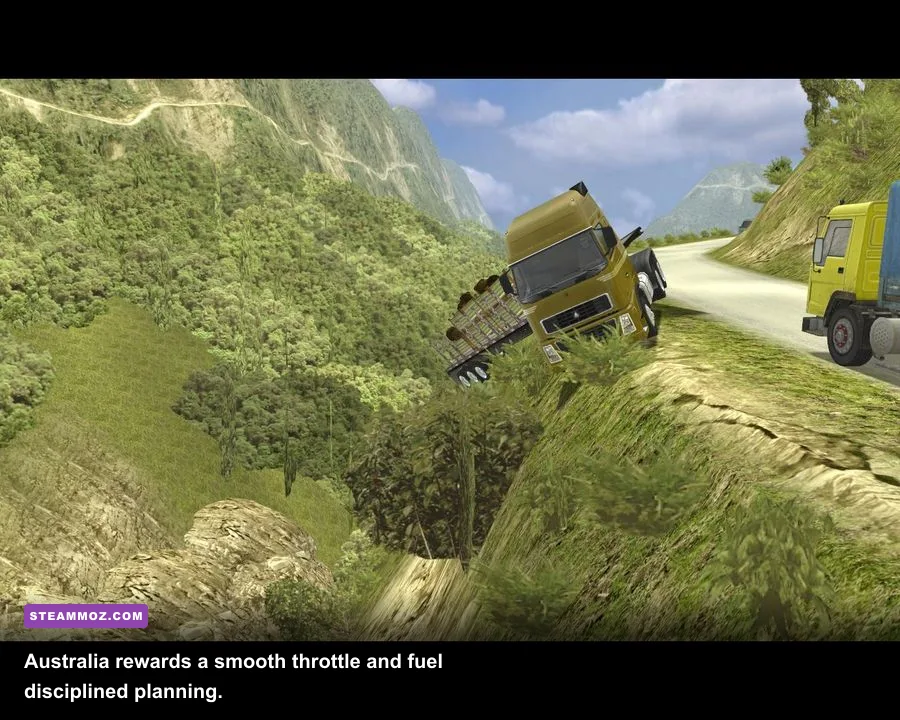
Your driving “rotation” is simple: scan, lift, brake, turn, straighten, accelerate. Start scanning far ahead for traffic, intersections, roadside objects, and the next curve. Lift off the throttle before braking. Brake in a straight line, turn with a steady input, and only accelerate once the tractor and trailer are aligned. Mashing the throttle halfway through a corner is the fastest way to push wide or make the trailer swing into trouble.
Braking and downhill control
Brake earlier than your instincts suggest. Loaded trucks carry momentum, and a downhill approach makes the problem worse. If the game gives you a choice between maintaining speed and arriving safely, sacrifice speed every time. A late brake followed by a hard steering correction creates two problems at once: you may miss the corner, and the trailer may cut across the inside line.
On long descents, use short, deliberate braking inputs instead of holding the brake continuously until the final bend. The goal is to keep your speed controlled before the corner appears. If you enter a bend already worried about stopping, you entered too quickly.
Overtaking and intersections
Only overtake when you can see enough road to complete the maneuver without forcing a blind correction. Cars can appear quickly, and a truck needs much more room to return to its lane. At intersections, ease off even when you technically have priority. The game rewards arriving with cargo intact, not winning imaginary right-of-way duels.
| Hazard | Telegraph | Counter | Best camera choice |
|---|---|---|---|
| Sharp bend | Guardrail, warning sign, narrowing road | Lift early, brake straight, turn smoothly | Cab view |
| Downhill section | Visible grade and rapidly rising speed | Control speed before the next corner | Cab view |
| Dense traffic | Multiple vehicles entering your lane | Leave a large gap; skip risky overtakes | Cab view with mirrors if available |
| Tight depot | Small entrance and limited turning room | Pull forward wide, then reverse slowly | External view for final alignment |
| Roadside obstacle | Signs, barriers, parked vehicles near the lane | Position early; don't make a last-second swerve | Cab view |
Bangladesh and Australia need different habits
Don't take the Montana setup into every region unchanged. The balanced truck remains the right foundation, but your priorities shift once the campaign gets tougher.
Bangladesh: patience is your upgrade
Bangladesh's tighter roads and heavier traffic make aggressive driving especially expensive. Reduce your speed before crowded areas, avoid squeezing between vehicles, and assume that a gap can close before your trailer clears it. Keep the tractor centered through narrow passages; correcting late usually makes the trailer hit the opposite side.
Choose cargo with a forgiving time window until you understand the route. A contract that looks profitable on paper becomes poor value if traffic forces repeated braking and you arrive damaged. This is also where the standard trailer earns its keep: shorter equipment gives you more room to recover when the road bends unexpectedly.
Australia: manage distance and fuel
Australia's open roads can trick you into driving too quickly for too long. Long straight sections make fatigue with the route a real danger: you stop scanning, miss a turn, or discover too late that your fuel plan was optimistic. Check fuel before committing to an isolated haul, and keep your speed smooth rather than constantly switching between full throttle and heavy braking.
The outback rewards anticipation. Spot the bend, grade, or junction early and prepare before it arrives. You don't need a racing engine if you preserve momentum and avoid unnecessary stops. If an engine upgrade is available and heavy loads repeatedly lose speed on grades, it becomes worthwhile—but only after braking and route discipline are already reliable.
Settings and controls for a cleaner first career
Extreme Trucker is an older PC title, so the best performance setup is usually simple. Prioritize stable frame delivery and readable road geometry over maximum visual effects. A smooth, consistent view makes steering corrections easier, especially when a trailer is close to a barrier. If your system struggles, lower demanding effects before sacrificing resolution or visibility.
| Setting or control | Recommended beginner value | Performance impact | Gameplay reason |
|---|---|---|---|
| Resolution | Native monitor resolution | Medium | Keeps signs, road edges, and traffic readable |
| Detail quality | Medium or High | Medium | Preserves useful route landmarks |
| Shadows and effects | Medium | Low to medium | Good compromise for older hardware |
| Camera sensitivity | Low to medium | None | Prevents overcorrection in corners |
| Steering sensitivity | Low to medium | None | Makes gradual lane placement easier |
| Traffic visibility | Highest stable option | Low to medium | More warning time for overtakes and junctions |
If you experience crashes or poor frame pacing, start with the basics: run the game in a compatible display mode, close overlays, test one graphics change at a time, and avoid stacking unofficial fixes without a backup of your save files. Steamoz's crashing and low-FPS troubleshooting guide has a useful general diagnostic approach, while the Filament settings guide explains why stable frame pacing matters more than a headline FPS number.
Your finished beginner build checklist
Before leaving the garage, your setup should pass this checklist:
- Use the most balanced road tractor available, not the most powerful-looking one.
- Keep the standard trailer until tight turns and reverse approaches feel routine.
- Begin with general cargo and a comfortable delivery timer.
- Run the first contracts in Montana and build a streak of clean deliveries.
- Save money for fuel, repairs, and a handling or braking improvement.
- Brake before corners, maintain a wide turning line, and accelerate only after straightening.
- Skip risky overtakes and treat every intersection as a potential hazard.
- Change the build only when a real problem—grades, braking, cargo weight, or route length—justifies it.
That is the core of the best 18 Wheels of Steel: Extreme Trucker best starting build for beginners: balanced truck, ordinary trailer, safe freight, Montana first, and upgrades earned through clean driving. Once you can complete those early jobs without scraping barriers or missing turns, the game's more demanding contracts become exciting instead of punishing. The fastest path through Extreme Trucker isn't flooring the throttle. It's arriving with the cargo, the truck, and your profits still intact.