
If you love Hop Step Sing! Nozokanaide Naked Heart for its anime idols, intimate VR presentation, and music-led visual-novel structure, start with TOKYO CHRONOS, ALTDEUS: Beyond Chronos, and Project Sekai. They cover the three strongest reasons to play it: character-focused storytelling, immersive anime performance, and a rhythm loop you can keep returning to. Gal Gun 2 and DYSCHRONIA: Chronos Alternate round out the list when you want more physical interaction or a proper mystery.
There isn't a perfect one-to-one replacement. Hop Step Sing! is unusually specific: it mixes live virtual-idol performances, short-form narrative scenes, and a close-up VR presentation that feels more like attending a private showcase than playing a conventional rhythm game. The recommendations below are ranked by how well they preserve that feeling, not simply by whether they support a headset.
Best games like Hop Step Sing! ranked for 2026
The table gives you the quick answer, but the important distinction is replay value. Some of these games are one-and-done narrative adventures, while others are designed around repeated songs, score chasing, or collecting new performances.
| Game | Best match for | VR support | Replay value |
|---|---|---|---|
| TOKYO CHRONOS | Anime character drama | PC VR, supported headsets | High through alternate routes |
| ALTDEUS: Beyond Chronos | Branching story and performances | PC VR and Quest versions | High, with multiple endings |
| Project Sekai | Idol music and rhythm play | Flat-screen mobile experience | Very high, live-service format |
| Gal Gun 2 | Active arcade-style VR interaction | PC VR and console support | Medium, mission replay |
| DYSCHRONIA: Chronos Alternate | Immersive anime mystery | PC VR and Quest versions | Medium, story-focused |
1. TOKYO CHRONOS is the closest narrative replacement
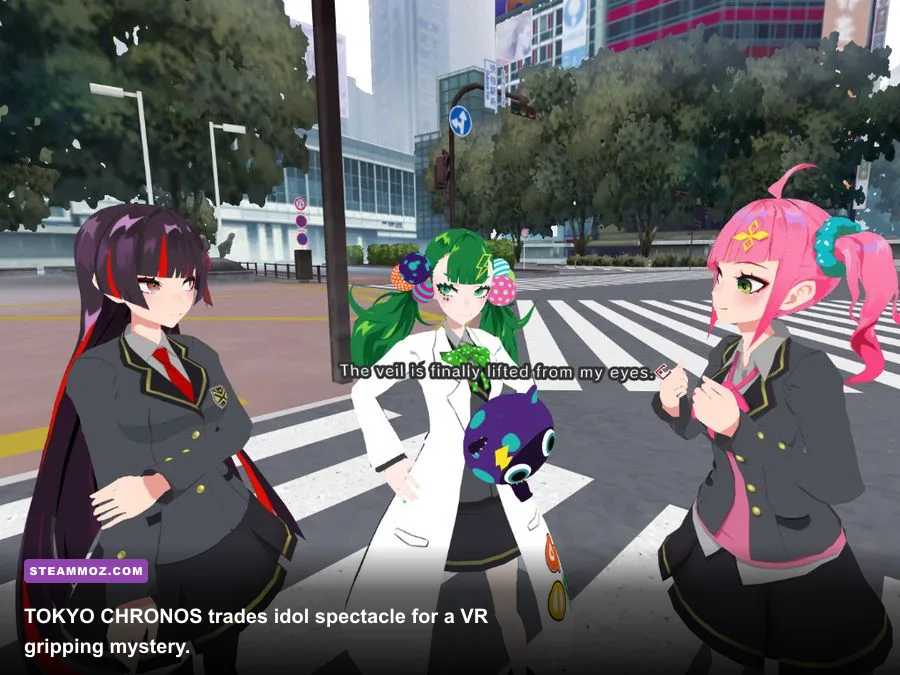
TOKYO CHRONOS on Steam is the strongest recommendation if the characters and first-person intimacy matter more to you than rhythm gameplay. It places you inside a sealed-off Shibuya where eight friends confront a murder mystery. The structure is almost entirely story-driven, but VR changes the tone: characters stand around you, eye contact lands harder, and environmental clues feel more immediate than they would in a standard visual novel.
The game uses a chapter-based route system rather than an endlessly repeatable song catalog. Expect roughly 10 to 15 hours for a first run depending on reading speed, with additional value from revisiting chapters after you learn what the cast is hiding. Its biggest strength is pacing. Conversations often pause at exactly the right moment, giving the voice acting and camera direction room to sell a reveal.
Why it works for Hop Step Sing! fans
Both games understand that VR anime works best when the cast occupies your space instead of sitting in small windows. TOKYO CHRONOS is less playful and much darker, though, so don't buy it expecting another idol concert. Choose seated play, keep subtitles enabled, and use headphones; several clues are delivered through directional voice placement rather than flashy interaction. If you prefer a conventional visual-novel interface, our guide to story-heavy games like Cabernet has a similar character-first focus.
2. ALTDEUS delivers the biggest anime spectacle
ALTDEUS: Beyond Chronos is the ambitious pick. You play Chloe, a pilot fighting colossal extraterrestrial creatures called Meteora in a future Tokyo. The scale is dramatically larger than Hop Step Sing!: you move between a cockpit, command spaces, and performance sequences while the story constantly tests whether Chloe is following orders or making her own choices.
This is still a visual novel at heart, but it has more motion and mechanical variety. The cockpit interface gives you a literal seat at the center of the action, while timed decisions and branching choices push the narrative toward different outcomes. The game also features musical performances that make the transition from dialogue to spectacle feel surprisingly natural.
ALTDEUS is at its best when it lets you sit with a character before detonating the next plot beat. The early chapters establish Chloe's relationship with Noa and the military command structure; later decisions can alter the route order and ending. Keep a save before major dialogue choices if you want to see the branches without replaying every scene. Don't rush the first ending, either. The post-completion route is where the game's emotional payoff becomes clearer.
| ALTDEUS feature | What you get | Hop Step Sing! comparison |
|---|---|---|
| Story format | Branching multi-route visual novel | More complex and longer |
| Performance scenes | Anime concert and dramatic set pieces | Less intimate, more cinematic |
| Interaction | Choices, cockpit controls, route decisions | More active than a standard VN |
| Ideal play session | 45 to 90 minutes | Good for seated VR |
3. Project Sekai wins for repeatable idol music

HATSUNE MIKU: COLORFUL STAGE!, known as Project Sekai, isn't a VR game, but it is the best choice if the music and idol side of Hop Step Sing! is what keeps you coming back. Its central loop is simple: select a song, hit notes as they reach the judgment line, earn rewards, improve your team, and unlock more story chapters. The execution is much deeper than that summary suggests.
Five groups provide different musical identities, including Leo/need, MORE MORE JUMP!, Vivid BAD SQUAD, Wonderlands x Showtime, and Nightcord at 25:00. MORE MORE JUMP! is the obvious starting point for idol-focused players, while Wonderlands x Showtime offers the brightest stage-show energy. The game supports Easy, Normal, Hard, Expert, and Master charts, with difficulty varying significantly by song. Don't jump straight to Master: Expert charts are where most players learn advanced flicks, repeated taps, and dense note streams without turning every track into a frustration test.
For a smooth session, begin with a stable 60Hz device refresh rate, disable battery-saving throttling, and lower live-performance effects before reducing note clarity. In rhythm games, a consistent frame time matters more than maximum visual effects. Use the timing calibration tool after connecting wireless headphones because Bluetooth latency can make perfect notes feel late.
4. Gal Gun 2 is the most hands-on alternative
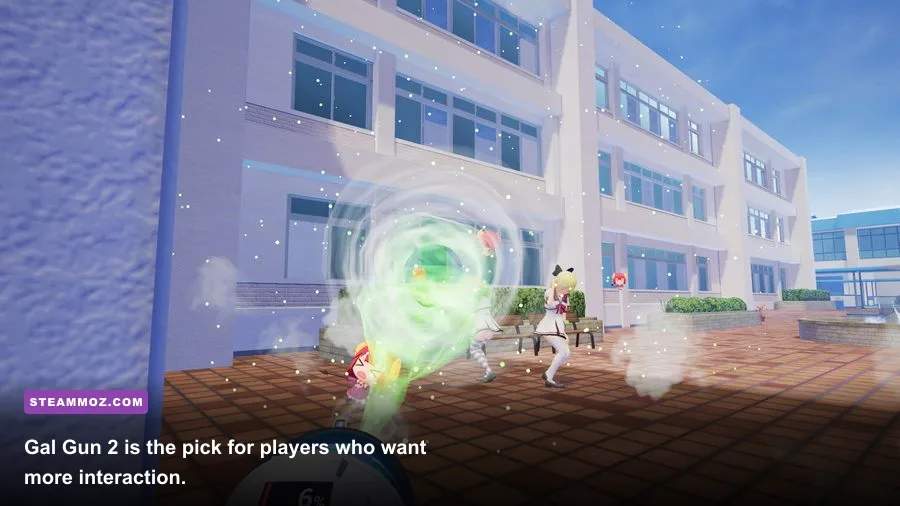
Gal Gun 2 takes anime school comedy in a completely different direction. It is a first-person arcade shooter where you use a spirit gun to deal with possessed students and supernatural trouble around Sakuradani Academy. The premise is deliberately exaggerated, and its fan-service-heavy presentation won't suit every player, but mechanically it offers something Hop Step Sing! doesn't: constant hand movement and target priority.
The key tool is the spirit gun, which lets you lock onto targets and clear encounters quickly. Missions reward fast identification rather than blind firing. Some enemies move into groups, while others appear as distractions during a short objective timer. Learn to scan from left to right, clear the nearest threat, and keep your reticle moving. The campaign's short missions make it easy to play in 20-minute bursts, and replaying stages is useful when you want better completion results.
On PC VR, prioritize stable tracking and a clean play area over visual supersampling. Use room-scale if you have space, but seated or standing front-facing play is perfectly workable for most missions. The game is more comfortable with a moderate turn setting and a generous play boundary; frantic physical movement adds little when the target-lock system is doing most of the precision work.
5. DYSCHRONIA is the pick for mystery and exploration
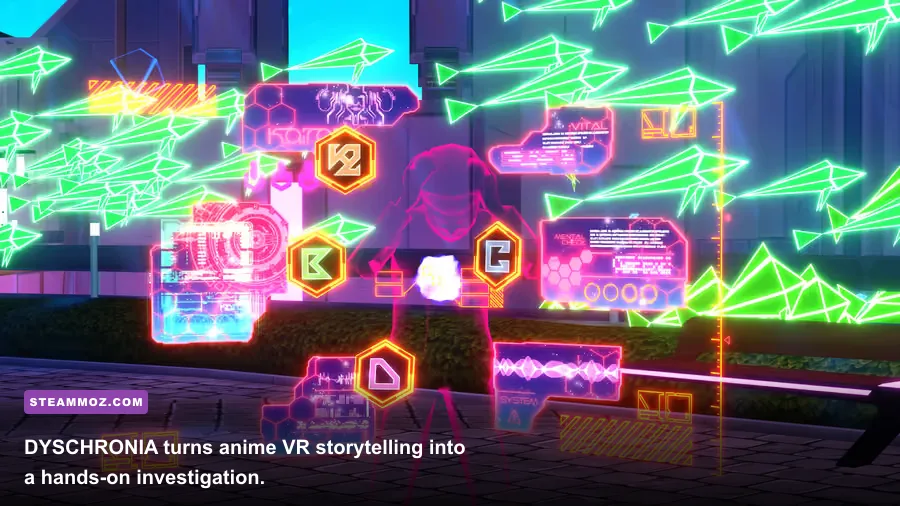
DYSCHRONIA: Chronos Alternate is the most investigative game on this list. You play Hal Scion, a special investigator in the artificial marine city Astrum Close. After the city's founder is murdered, Hal uses reconstruction abilities and physical exploration to examine spaces, recover evidence, and challenge contradictions in witness accounts.
Its standout mechanic is the ability to inspect the past of objects and locations. That makes the player feel involved instead of simply waiting for the next dialogue box. You may examine a room, identify an inconsistency, then use a recovered memory to test whether a statement can be trusted. The game also includes stealth sections involving the robotic cat Lily, so the pacing alternates between deduction, conversation, and movement.
DYSCHRONIA is less romantic and less music-driven than Hop Step Sing!, but the first-person anime presentation is excellent. It benefits from careful room scanning: look behind furniture, inspect unusual lighting, and listen for audio cues before moving on. If you prefer deeper systems and tactical planning, Steamoz's Blackguards starter build guide covers the same kind of deliberate decision-making, even though the genre is completely different.
Which game should you play first?
Your best first choice depends on the part of Hop Step Sing! you want to preserve. For a seated VR visual novel, choose TOKYO CHRONOS. For branching routes, giant robots, and bigger musical moments, choose ALTDEUS. Project Sekai is the clear answer for an ongoing idol-music loop, while Gal Gun 2 is better if you want to physically aim and react. DYSCHRONIA belongs on your list when story investigation matters most.
| Player priority | Best game | Why it wins | Main warning |
|---|---|---|---|
| Closest VR anime story | TOKYO CHRONOS | Strong cast and intimate presentation | Little traditional gameplay |
| Branching narrative | ALTDEUS | Multiple routes and major choices | Needs several sessions for full impact |
| Idol rhythm gameplay | Project Sekai | Large song catalog and live updates | Mobile free-to-play progression |
| Arcade interaction | Gal Gun 2 | Fast target-based VR missions | Very specific fan-service tone |
| Detective immersion | DYSCHRONIA | Evidence gathering and exploration | More serious and less musical |
VR settings that make these games feel better
These titles are not demanding in the same way as a modern open-world game, but comfort and consistency still matter. A locked 72Hz or 90Hz headset mode is preferable to unstable supersampling. If your PC struggles, reduce render resolution first, then shadows and post-processing. Keep character textures high because anime faces lose detail quickly when resolution drops.
| Setting | Recommended value | Performance impact | Visual trade-off |
|---|---|---|---|
| Headset refresh rate | 72Hz or 90Hz locked | Low to medium | Stable motion is better than unstable 120Hz |
| Render resolution | 100% native, then 80% if needed | High | Lower values soften text and faces |
| Shadows | Medium | Medium | Small loss in room depth |
| Anti-aliasing | Medium or application default | Low to medium | Reduce only after resolution changes |
| Motion blur | Off | Low | Sharper camera movement |
| Audio | Wired headphones when possible | None | Lower input and dialogue latency |
For PC troubleshooting, compare your hardware against Steamoz's PC settings guide for Katamari Damacy REROLL; its practical advice on resolution scaling applies well to lighter VR releases too. If you play on Quest, close background apps, keep the headset cool, and download large story chapters before starting a long session.
The final recommendation
Start with TOKYO CHRONOS if you want the closest emotional and structural match, then move to ALTDEUS: Beyond Chronos for a larger, more ambitious follow-up. Keep Project Sekai installed if you want daily songs and character stories rather than a finished campaign. Gal Gun 2 and DYSCHRONIA are worthwhile detours because they prove how flexible anime VR can be when it moves beyond passive viewing.
Just remember the key difference: Hop Step Sing! is built around the fantasy of being close to a virtual idol. These games reinterpret that closeness through mystery, branching drama, arcade action, or rhythm mastery. That variety is exactly why they belong on a 2026 shortlist—and why the right recommendation depends on what you actually did in Naked Heart: watched, listened, chose, or played.