
If Cabernet hooked you with its 19th-century vampire drama, moral choices, social manipulation, and slow-burn gothic mood, start with Vampire: The Masquerade – Coteries of New York. It is the closest overall match, while Vampyr, Vampire: The Masquerade – Swansong, The Life and Suffering of Sir Brante, and Roadwarden each capture a different part of Cabernet's appeal.
Cabernet is unusual because it isn't simply a horror game with a blood meter. You play Liza, a newly dead vampire navigating Bulgarian society during the late 19th century. Her education, ideology, relationships, feeding habits, and responses to mortals shape both her identity and the people around her. There is combat, but conversation, social status, and choosing when to indulge your nature do most of the heavy lifting.
That makes a normal “vampire games” list a poor fit. The recommendations below are ranked by what they share with Cabernet: meaningful dialogue choices, supernatural politics, character-driven consequences, oppressive atmosphere, and systems that make role-playing feel more important than simply winning fights.
Best games like Cabernet ranked for 2026

Before installing anything, decide which part of Cabernet you want more of. If it is vampire society, choose Coteries of New York. If it is detective work and supernatural abilities, Swansong is stronger. If it is the emotional cost of feeding, Vampyr remains the standout. Sir Brante is the best alternative for players who enjoyed Cabernet's social hierarchy and brutally permanent choices.
| Rank | Game | Best match for | Gameplay focus | Choice impact |
|---|---|---|---|---|
| S-Tier | Vampire: The Masquerade – Coteries of New York | Vampire politics | Dialogue, faction quests, resource management | High; route and ending changes |
| S-Tier | Vampyr | Feeding dilemmas | Action RPG combat and investigation | High; districts can collapse |
| A-Tier | Vampire: The Masquerade – Swansong | Social deduction | Investigation, dialogue skills, stealth | High; evidence and survival change |
| A-Tier | The Life and Suffering of Sir Brante | Class oppression | Text choices, stats, life management | Extreme; death and life paths are common |
| B-Tier | Roadwarden | World-building | Text exploration, quests, survival | High; factions and settlements react |
For a wider look at games built around progression and resource pressure, Steamoz's Citizen Sleeper 2 leveling guide is also worth reading. It covers the same kind of careful decision economy that makes narrative RPGs so addictive.

🎮 Cabernet
Looking to experience this game? Grab your digital key directly on our store for $11.99.
View on Steammoz Store →1. Coteries of New York is the closest Cabernet follow-up

Coteries of New York on Steam is the obvious first recommendation. Both games put you inside a vampire society where identity is shaped by ideology, alliances, and the practical problem of feeding without exposing the undead world.
You play a fledgling caught in a conflict between the Camarilla and Anarchs. The central structure is closer to an interactive novel than a traditional RPG: you visit locations, spend time with companions, complete faction tasks, and make decisions that quietly lock or unlock later scenes. That rhythm feels very familiar after Cabernet's salon conversations and relationship-driven progression.
Why it ranks S-Tier
The strongest overlap is political pressure. Coteries makes every ally feel like a position on a chessboard. D'Angelo, Hope, Tamika, and the other vampires aren't just quest markers; their worldviews pull you toward different endings. The game also understands that vampire fiction works best when power has a social cost.
Its limitations matter. You don't directly control combat, and the interface can feel like a visual novel with light management rather than a fully simulated RPG. There is less moment-to-moment freedom than in Cabernet, and the New York setting is modern rather than historical. Still, if your favorite Cabernet scenes involved arguments, secrets, and choosing which monster you wanted to become, this is the best match.
Pick Shadows of New York afterward if you want a more focused sequel with a darker mystery. It is shorter and more linear, but Julia's investigation gives the writing a sharper noir edge. Check the official World of Darkness site for the broader setting behind both games.
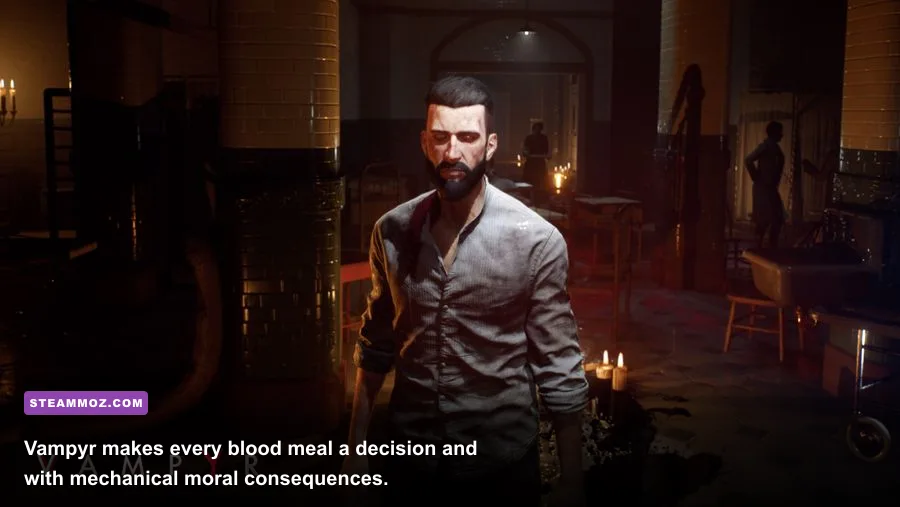
2. Vampyr makes feeding the main RPG system
Vampyr is the pick for players who wanted Cabernet to be more dangerous and mechanically active. You play Dr. Jonathan Reid in plague-ridden London in 1918. He is both a physician and a vampire, and the game constantly forces those roles into conflict.
The key system is the district citizen web. Each named resident has clues, relationships, health information, and a blood quality rating. Feeding on a citizen grants a large experience reward, but killing an important resident can remove vendors, quests, dialogue, and stabilizing services from an entire neighborhood. Refusing to feed keeps the district socially intact but makes combat much harder.
A practical Vampyr build for Cabernet fans
Use Autophagy early for healing, then invest in Blood Barrier if you struggle with groups. Claw is useful for stun buildup, while Shadow Mist punishes clustered enemies. Upgrade a fast off-hand weapon with a stun effect and pair it with a slow firearm or two-handed weapon for damage. The most reliable rotation is parry or dodge, apply stun, use Claw, then execute a bite when the enemy is staggered.
| Priority | Ability or tool | Why it matters | Best use |
|---|---|---|---|
| 1 | Autophagy | Reliable self-healing | Recover after a risky encounter |
| 2 | Blood Barrier | Blocks burst damage | Groups and elite enemies |
| 3 | Claw | Builds stun quickly | Opening a bite opportunity |
| 4 | Shadow Mist | Area damage and pressure | Enemies packed near doors |
| 5 | Stun off-hand weapon | Creates safe executions | Hunters and Skal clusters |
Vampyr is less subtle than Cabernet, but its moral pressure is stronger because the reward is immediate. A healthy citizen can be worth thousands of experience points, and that temptation makes restraint feel like a self-imposed challenge rather than a dialogue preference. For combat survival advice, compare it with Steamoz's Daymare 1998 survival tips.
3. Swansong turns vampire role-play into detective work
Vampire: The Masquerade – Swansong follows three protagonists: Galeb, Emem, and Leysha. Their chapters are built around a vampire gathering that goes catastrophically wrong, forcing them to investigate a conspiracy while obeying the Masquerade.
This is the strongest choice if Cabernet's skill checks and social reading were your favorite features. Swansong uses attributes such as Deduction, Psychology, Persuasion, Intimidation, and Security. Dialogue scenes become contests of information and willpower rather than simple good-or-bad answers. You can spend Willpower to guarantee certain outcomes, but that resource is limited, so even a strong character has to choose where certainty matters.
The three protagonists also encourage different approaches. Galeb is built for authority and direct interrogation. Emem relies more on mobility, technology, and vampire disciplines. Leysha's disguise ability lets her impersonate people, but maintaining the right details is crucial; being caught with incorrect information can close off evidence or trigger a dangerous confrontation.
How to get more from Swansong
Search every room before starting a major conversation. Read documents, inspect objects, and use heightened senses to collect information before spending skill points. Don't automatically maximize Persuasion. A failed check can reveal that you lack a crucial clue, while a successful Psychology exchange may expose a contradiction that unlocks a better route later.
The game runs on Unreal Engine 4 and its visual fidelity is noticeably heavier than Cabernet's illustrated presentation. On PC, a 60fps target is generally easier at 1080p with shadows and volumetric effects reduced. If you're tuning an older machine, Steamoz's BloodRayne 2 PC settings guide is a useful companion for balancing gothic atmosphere against performance.
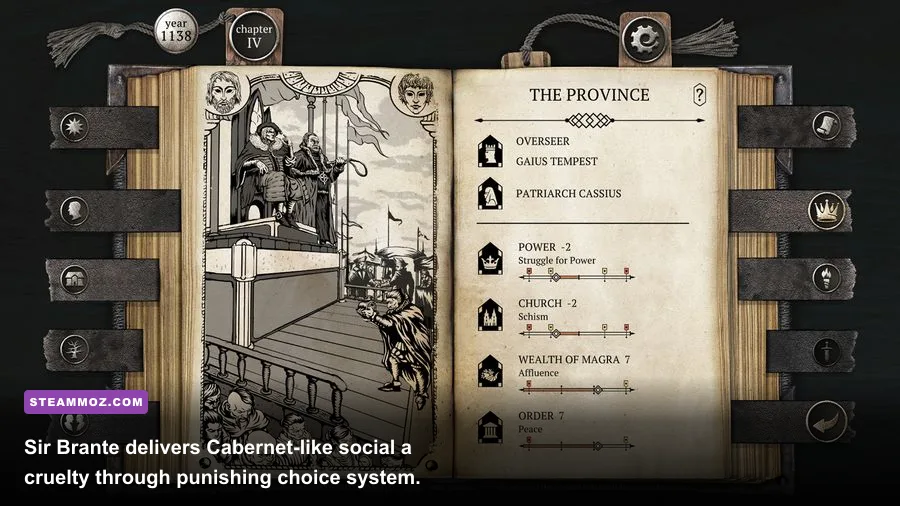
4. Sir Brante delivers Cabernet's harshest social choices
The Life and Suffering of Sir Brante has no vampires, but it understands class violence and inherited power better than almost any narrative RPG. You are born into a rigid society where Nobles, Clergy, and commoners occupy different legal worlds. Your choices determine whether you survive, rebel, assimilate, or become part of the machine hurting you.
The game tracks stats including Strength, Endurance, Agility, and Intellect, plus social qualities such as Reputation and Faith. These aren't decorative numbers. A failed event can remove a relationship, damage your health, create a permanent injury, or alter which factions will tolerate you. Like Cabernet, it rewards role-playing a coherent person rather than selecting the supposedly correct answer every time.
Why it belongs in the S or A-Tier conversation
Sir Brante is more punishing than Cabernet. Death is possible, and the life-story structure means you often learn the consequences only after committing to a decision. The trick is to track the game's timeline and spend action opportunities deliberately. Training Strength helps with physical survival, while Intellect opens investigation and legal options. Reputation and Faith are situational, but ignoring both can strand you when a faction demands proof of loyalty.
| Play style | Primary stats | Useful outcome | Main risk |
|---|---|---|---|
| Rebel | Strength, Endurance | Survive violence and repression | Execution or injury |
| Investigator | Intellect, Reputation | Expose lies and gain legal leverage | Social isolation |
| Faithful climber | Faith, Reputation | Access institutions and protection | Compromise your principles |
| Pragmatic survivor | Balanced stats | More flexible event solutions | Fewer exceptional routes |
Choose Sir Brante if what you really want is the feeling that the world was designed to make your character fail. Its monochrome illustrations and event-book presentation are a long way from Cabernet's manor interiors, but the emotional texture is remarkably close.
5. Roadwarden is the best slow-burn alternative
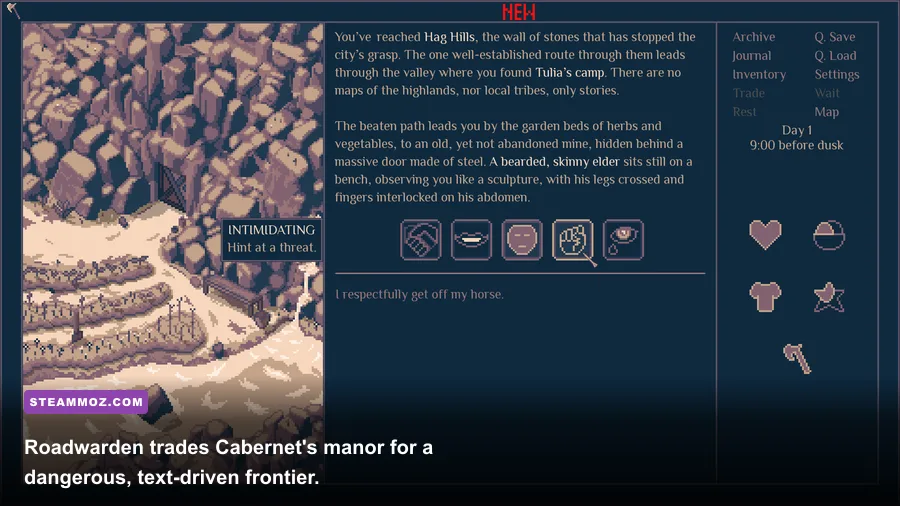
Roadwarden swaps vampire salons for a hostile fantasy frontier, yet it shares Cabernet's patience. You are a roadwarden sent to explore the eastern territories, map settlements, build trust, and uncover why the region is becoming more dangerous.
There is no traditional combat system. Instead, Roadwarden uses text, time, supplies, reputation, and skill checks. You choose a background such as Fighter, Scholar, or Mage, then manage hunger, fatigue, weather, and travel routes. A conversation in one settlement can change what another faction tells you days later. The result feels like a tabletop campaign where information is the real currency.
Roadwarden is especially good at making small choices accumulate. Helping a merchant may cost time needed to reach a village before winter. Showing sympathy to one faction can shut down another. The game has fewer flashy supernatural systems than Cabernet, but it delivers the same satisfaction of watching a network of relationships respond to your behavior.
Who should play it
Pick Roadwarden if you enjoy reading every line, making notes, and replaying to test a different social strategy. It is not a replacement for Vampyr's combat or Swansong's cinematic presentation. It is a replacement for the quiet investigative loop: travel, observe, remember, and decide who deserves your trust.
For another unusual recommendation built around exploration and hidden information, see Steamoz's Cosmic Express secret locations guide. It scratches a similar “there's more to this place” itch.
Which Cabernet-like game should you play first?
Choose Coteries of New York for the closest vampire-politics experience. Choose Vampyr if you want every feeding decision to affect an explorable city and you don't mind real-time combat. Choose Swansong for clue hunting, vampire disciplines, and tense social checks. Choose Sir Brante for the most punishing class system and the strongest sense of irreversible consequence. Choose Roadwarden when you want a slower, more literary journey where preparation beats reflexes.
| If you loved Cabernet's... | Play this first | What you gain | What you give up |
|---|---|---|---|
| Vampire identity and politics | Coteries of New York | Factions, clans, social intrigue | Less direct RPG freedom |
| Moral cost of feeding | Vampyr | Citizens, blood, district consequences | More combat and repetition |
| Skill checks and secrets | Swansong | Detective systems and disciplines | More linear chapters |
| Historical social pressure | Sir Brante | Class, faith, reputation, permanent outcomes | No vampire fantasy |
| Slow exploration and relationships | Roadwarden | Faction trust and world-building | Text-heavy presentation |
My personal order for 2026 is Coteries first, Vampyr second, then Swansong. That sequence moves from Cabernet's closest thematic cousin into a more systems-heavy vampire RPG and finally a polished investigation game. Keep Sir Brante and Roadwarden for when you want the same moral tension without another vampire story.
Cabernet's real strength is that it treats monstrosity as a social problem, not just a combat gimmick. These five games understand that idea from different angles. They ask whether power changes your values, whether survival excuses cruelty, and whether a single conversation can matter more than a boss fight. That's exactly why they remain the best games like Cabernet you need to play in 2026.