For fast leveling and reliable credits in Citizen Sleeper 2: Starward Vector, stop searching for a traditional grinding loop: the winning route is to chain contracts, spend dice on high-value guaranteed progress, keep your crew’s condition healthy, and upgrade the ship before chasing expensive side rewards. Contracts pay the bills, skill checks generate progression, and smart routing prevents the stress and repair costs that quietly erase your profits.

How Progression and Credits Actually Work
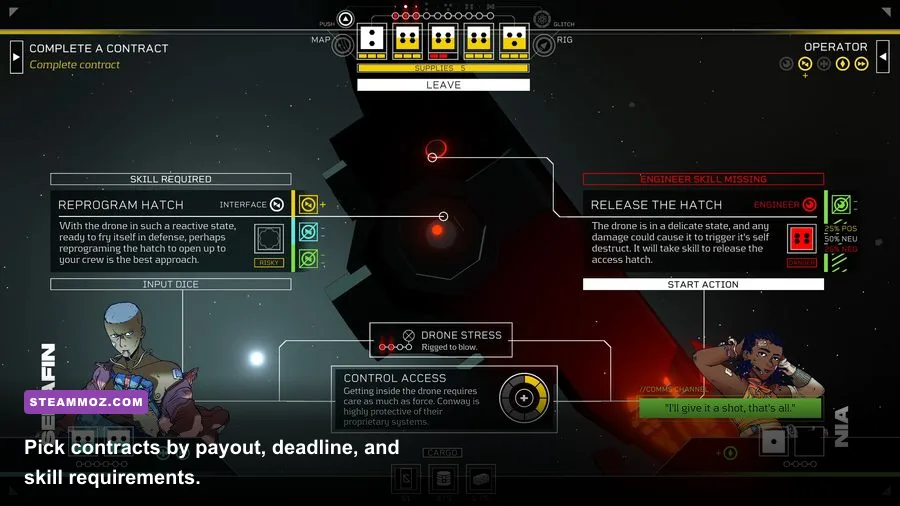
Starward Vector doesn't treat experience and money like separate RPG chores. Your crew improves by taking actions, completing contract objectives, and investing skill points into the abilities that make future checks safer. Credits arrive through completed contracts, salvage and local jobs, story rewards, and selected side activities. The important distinction is that not every action is profitable. A low-value job can still be excellent if it advances a relationship, unlocks a new route, or gives a crew member a skill point. Repeating it blindly, however, wastes cycles and exposes you to more failure.
Every cycle gives you a limited set of dice. Their values matter, but so does timing: a weak die can be pushed into a useful result, while a six spent on a low-payout check may cost you a much better opportunity later. Failed checks can also create stress, damage condition, or force extra work. That makes the best farming strategy less about rolling more dice and more about converting each die into either money, permanent progression, or a route unlock.
| Activity | Main Reward | Best Use | Profit Warning |
|---|---|---|---|
| Contracts | Credits, skill progress, story access | Primary income source | Deadlines punish inefficient routing |
| Local gigs | Credits and relationship progress | Filling spare cycles | Some pay poorly for the risk involved |
| Salvage and exploration | Materials, credits, discoveries | When your ship has spare capacity | Bad rolls can cost condition or time |
| Story objectives | Large rewards and unlocks | Long-term progression | Don't delay them solely to farm cash |
For a useful overview of how this sequel expands the original formula, check the official Steam page. It also helps to remember that this isn't a combat RPG where enemies respawn for unlimited loot. Your economy is built around decisions.

🎮 Citizen Sleeper 2: Starward Vector
Looking to experience this game? Grab your digital key directly on our store for $12.49.
View on Steammoz Store →The Fastest Contract Route for Early Credits
At the start, accept contracts that overlap geographically and use the same two or three crew strengths. Completing one isolated job may give a tempting payout, but stacking nearby objectives lets you turn a single trip into several completed milestones. Read the contract's deadline, required actions, payout, and failure consequence before committing. A large reward with a brutal penalty is not automatically better than two modest jobs you can finish safely.
Prioritize contracts with three features: a short route, multiple available skill approaches, and rewards that include a new crew option or ship resource alongside credits. Those bonuses compound. A job that pays slightly less but improves your future dice economy can outperform a flashy payout by the middle of the campaign.
- Scout the board first. Don't accept the first contract you see. Compare destinations, deadlines, and the skills each objective favors.
- Group destinations. Finish nearby work in one visit instead of spending cycles jumping between distant locations.
- Assign specialists. Use the crew member with the strongest relevant skill rather than forcing a generalist into every check.
- Spend high dice on bottlenecks. Use a six where failure blocks a contract, not where a three already succeeds.
- Cash out before overextending. Once a contract is complete, return to a safe hub and collect the reward rather than gambling your profit on one more check.
Hexport is especially useful as an early planning hub because it offers a dense cluster of activities and introductions. Treat it as a staging point, not an infinite money machine. The best income comes from moving through its available work efficiently, then following the story and contract chain into new areas.
Build a Crew That Levels Without Burning Out
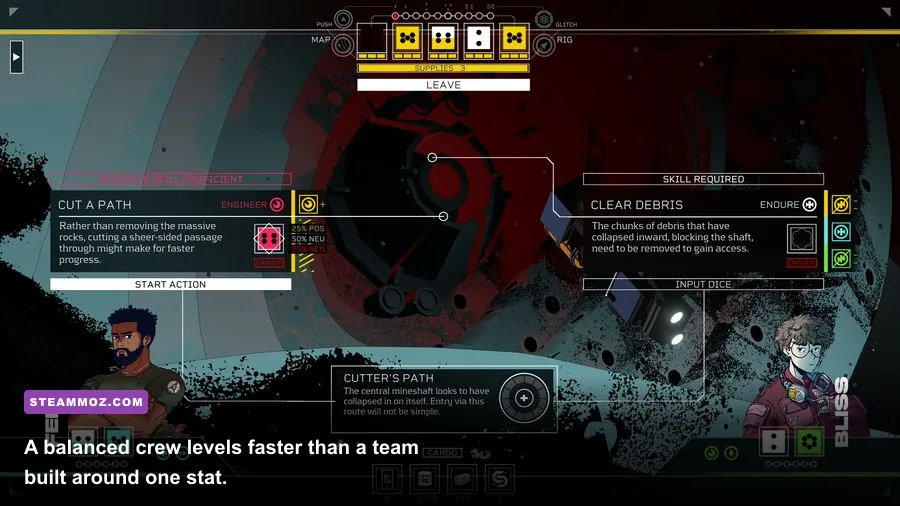
The most efficient early crew is balanced across the game's skill checks. Citizen Sleeper 2 rewards specialization, but a team with only one excellent skill will constantly spend dice compensating for blind spots. Keep at least one reliable option for technical checks, social or influence-based checks, endurance tasks, and intuitive or reflex-driven work. The exact crew composition changes as characters join, so don't lock yourself into a single “best” party.
When spending skill points, improve the skill that already supports a crew member's role before trying to patch every weakness. A specialist with a strong bonus can turn ordinary dice into consistent successes. Put a secondary point into a complementary skill only when it opens a new contract route or prevents a recurring failure pattern. This is more efficient than making every character mediocre at everything.
| Build Role | Priority | Skill-Check Pattern | Leveling Advice |
|---|---|---|---|
| Technical specialist | Engineer or Interface-style checks | Repairs, systems, ship work | Max the skill used by your most frequent contract chain |
| Field worker | Endure and physical checks | Hazards, hauling, dangerous sites | Invest early if failed checks are costing condition |
| Social operator | Influence and relationship checks | Negotiation, favors, recruitment | Strong for unlocking safer and more lucrative options |
| Flexible scout | Intuit or Reflex-style checks | Exploration and opportunistic tasks | Use as a backup rather than wasting top dice on weak rolls |
Don't ignore crew relationships. Relationship progress can unlock stronger action options and new ways through contracts, which indirectly improves both leveling speed and credit income. A side conversation that costs one cycle may be a better investment than a tiny cash job, especially when it removes a future risk.
Dice Management Is Your Real Farming Skill
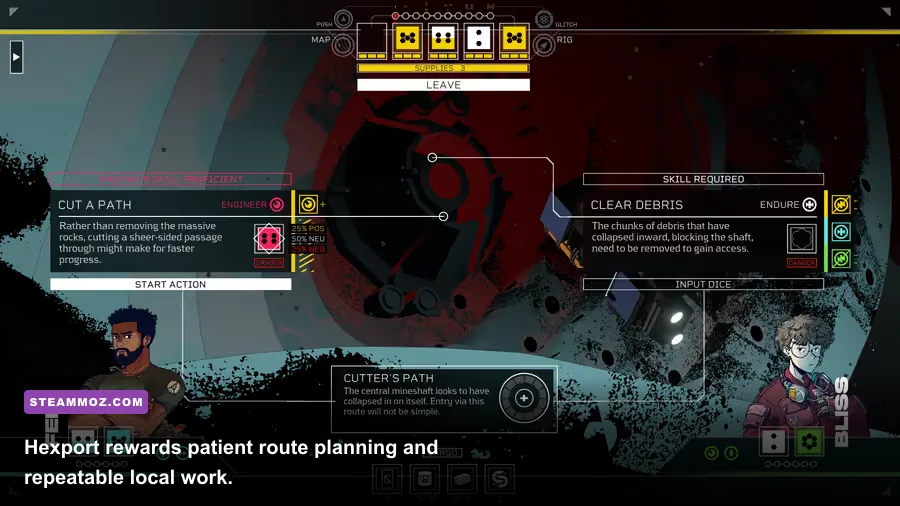
Dice are the resource that separates a profitable run from a slow collapse. Start each cycle by identifying the checks that absolutely must succeed. Reserve your best die for those. A low die is perfect for a safe action, a clock advance, or a check where the skill bonus already pushes the result over the required threshold.
Use the Push option carefully. Turning a mediocre roll into success can be worthwhile when it completes a contract clock, unlocks a payout, or prevents a serious condition penalty. It is usually a bad deal when used merely to finish a low-value task one cycle early. The same principle applies to stress: a little risk can accelerate progression, but repeated stress makes later checks more expensive and less predictable.
Before ending a cycle, spend leftover dice on safe progression. A spare die placed into a low-risk skill check is better than letting it disappear, but don't chase every available action. If the choice is a two-credit errand with a failure penalty or saving resources for tomorrow's contract, save the resources. The game rewards a clean schedule more than a busy action list.
How to Turn Ship Upgrades Into More Money
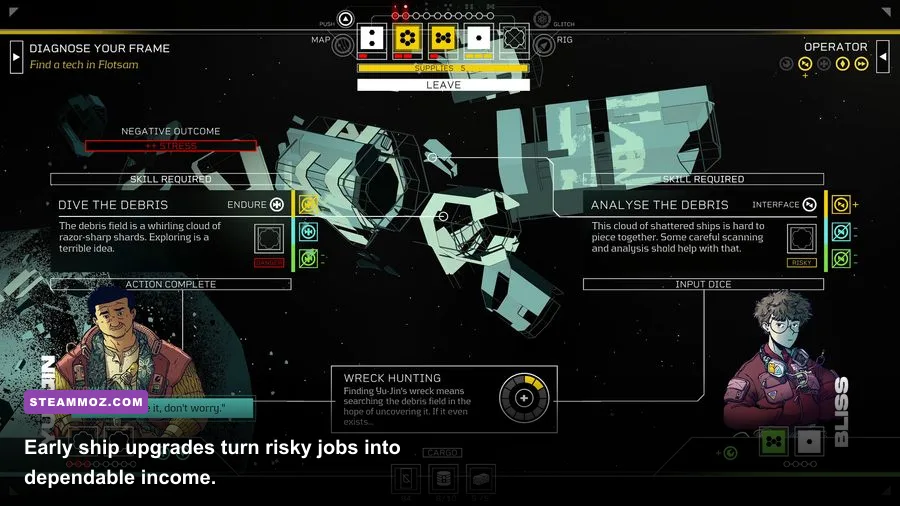
Ship upgrades are not cosmetic spending. They improve your ability to accept, survive, and complete contracts. Early credits should generally go toward upgrades that increase reliability, capacity, or access to new routes rather than hoarding cash for a distant purchase. A ship that can carry more useful materials or withstand one bad event will earn back its cost across several contracts.
Watch your condition and repair needs. A contract's headline payout is misleading if completing it leaves the ship damaged enough to require multiple cycles of recovery. Likewise, don't accept cargo or objectives that overload your current capacity just because they offer a large reward. Upgrade when a limitation is appearing repeatedly, not simply because the upgrade menu has an available button.
The Jump Over the Age developer site is worth checking for official game information, while the Fellow Traveller game page provides the publisher's overview. For players who enjoy digging into older systems-heavy RPGs, Steamoz's Anachronox beginner tips have the same useful focus on resource discipline.
| Upgrade Decision | Buy Early? | Why It Helps | Delay When |
|---|---|---|---|
| Capacity improvement | Usually | Lets profitable contracts travel together | Your current jobs rarely fill the ship |
| Condition or repair support | Yes after repeated damage | Prevents payouts being erased by recovery | You are completing safe local work |
| Route or access upgrade | When story requires it | Opens higher-value contract chains | The area is still too dangerous for your crew |
| Luxury or convenience purchase | Usually later | Improves comfort more than immediate income | You still lack core reliability upgrades |
A Safe Midgame Farming Loop
Once your crew has several dependable skills and the ship can handle longer routes, use a three-part loop. First, inspect every available contract and choose a primary job with the best payout-to-risk ratio. Second, fill the route with a nearby secondary objective or relationship task that uses leftover dice. Third, return to a hub, repair only what you need, collect rewards, and reassess the board.
Keep a small credit reserve instead of spending down to zero. You need flexibility for repairs, recruitment opportunities, and choices that unlock better contract outcomes. A reserve also lets you absorb one unlucky cycle without abandoning a profitable chain. If a contract starts producing repeated failures, cut the loss. Finishing it at any price is not farming; it's sunk-cost thinking.
For PC players, performance problems can also make long planning sessions miserable. Steamoz's guides to crashes and low FPS and PC stability fixes are useful general troubleshooting references, although Citizen Sleeper 2 is far less demanding than either action game.
The Mistakes That Slow Every Run
The biggest mistake is treating every available action as mandatory. You don't need to clear the board. You need to complete the right work with the fewest risky checks. Another common error is spending high dice on early flavor actions, then discovering that the contract's final objective requires a six. Read the whole chain before committing.
Don't sell or spend useful materials just to hit a short-term credit target, and don't ignore relationship scenes because they don't pay immediately. Unlocks are often the strongest form of farming: they create safer checks, new approaches, and better contract routes. Finally, avoid restarting after every bad roll. The game is built around imperfect runs, and a failed check can reveal a cheaper route than the one you originally planned.
The short version is simple: stack contracts by location, specialize your crew, protect high dice for decisive checks, upgrade the ship when a limitation repeats, and treat relationships as investments. Follow that rhythm and your crew will gain skills quickly while credits keep moving in the right direction—without turning Starward Vector into a tedious spreadsheet.