
The honest Layers of Fear weapon tier list has no weapons in it. Bloober Team’s psychological horror series does not give you guns, melee weapons, damage stats, skill trees, or a conventional equipment screen. You cannot build a loadout, stagger enemies, or turn a revolver into an S-tier solution. What you can rank is the game’s small set of interaction tools and habits: light sources, keys, documents, puzzle objects, and your ability to read environmental changes. That distinction matters, because treating Layers of Fear like an action-horror game will make every chapter feel more confusing than it needs to be.
This guide focuses on the 2023 Layers of Fear release and its connected stories, including The Painter’s Story, The Actor’s Story, The Lighthouse, and The Final Note. It also applies broadly to the earlier Layers of Fear games. For the official release details, compare the Layers of Fear Steam page with Bloober Team’s official game page. The short version is simple: there is no best weapon, but there is absolutely a best way to handle the tools the game gives you.
The real equipment system is environmental
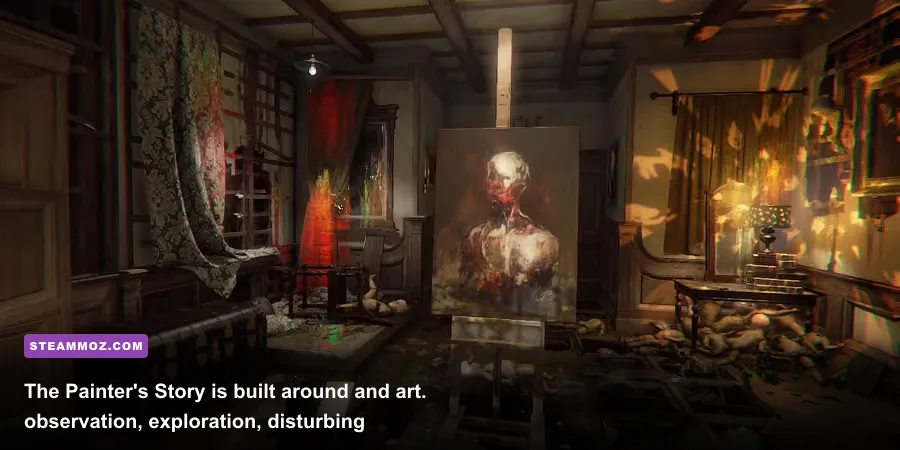
Layers of Fear uses equipment as a temporary interaction, not as persistent gear. A key opens one door. A combination clue solves one lock. A lantern or light source reveals a space, changes what you can inspect, or frames a scripted scare. Notes and paintings provide context and puzzle information rather than passive bonuses. Once the scene has served its purpose, the object usually stops mattering.
That design is deliberate. The game wants your attention on the room, not on a damage-per-second number in the corner. You are meant to notice a painting that changes when you turn away, a corridor that no longer matches the floor plan, or a sound that confirms something has moved behind you. The lack of an inventory is part of the pressure. You cannot hoard ten healing items and brute-force your way through a dangerous section.
There are also no character attributes to improve. No strength, sanity, stamina, accuracy, stealth, or weapon proficiency exists in the normal RPG sense. That means traditional build advice is useless here. The strongest “build” is a patient exploration style: inspect readable objects, remember room landmarks, and avoid sprinting through a scene before you understand its trigger.
| Rank | Tool or habit | What it actually does | Best use |
|---|---|---|---|
| S-Tier | Environmental observation | Reveals changes, clues, and progression triggers | Every chapter and puzzle room |
| S-Tier | Light sources | Improves visibility and supports specific interactions | Dark corridors and staged encounters |
| A-Tier | Keys and combination clues | Unlocks progression gates | Locked doors, drawers, and safes |
| A-Tier | Documents and paintings | Builds context and can reveal puzzle information | Story investigation |
| B-Tier | Optional collectibles | Adds lore and completion value | Second playthroughs |
| F-Tier | Imaginary weapon builds | Does not exist in the game | Nowhere |
That final row is not a joke at your expense. Search results often mix Layers of Fear with other horror games that include weapons, inventory slots, or enemy combat. In this series, a weapon-shaped object is still part of the fiction, not a selectable combat item. If an apparent weapon appears in a scene, treat it as a narrative prop or puzzle clue unless the game explicitly lets you equip and use it.

🎮 Layers of Fear
Looking to experience this game? Grab your digital key directly on our store for $11.99.
View on Steammoz Store →S-Tier: light, clues, and simply looking twice
S-Tier — environmental observation
Your eyes are the strongest tool in the entire game. The Painter’s Story constantly asks you to compare what a room looked like a moment ago with what it looks like now. A doorway may appear after a turn, an object can vanish from a table, or the intended route can become obvious only after the scene has changed. These are not random glitches. They are the game’s progression language.
Use a three-pass approach. First, scan the room for interactable objects and obvious exits. Second, inspect documents, paintings, telephones, drawers, and unusual props. Third, turn around and re-check the route you entered through. That last step catches a surprising number of transitions. Layers of Fear often hides progress in a visual reset rather than a conventional quest marker.
S-Tier — light sources
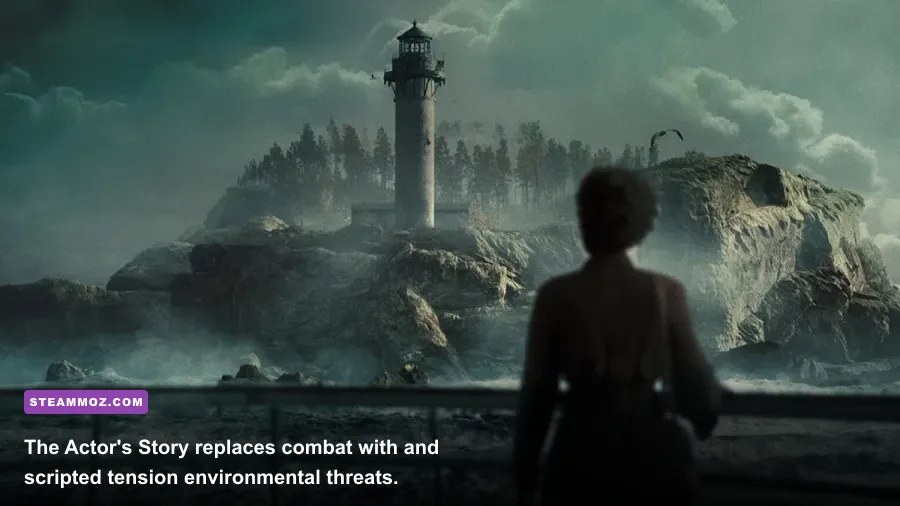
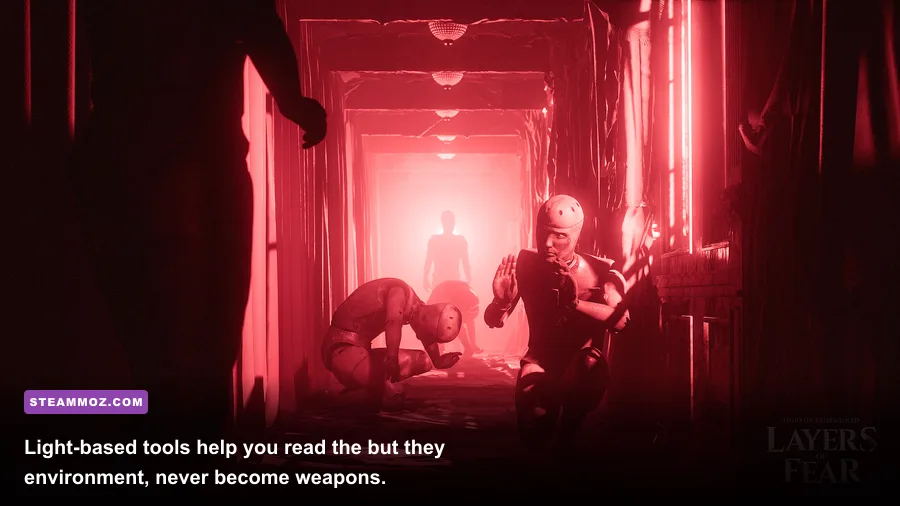
Light is not a damage tool, but it is often the closest thing the series has to equipment with a mechanical identity. In dark spaces, a light source helps you identify doors, read environmental details, and understand where a scripted sequence wants you to look. The Actor’s Story and The Lighthouse lean especially hard on controlled visibility, staging, and the fear of what sits just outside the illuminated area.
Do not assume that every dark corner contains a collectible. Some darkness is there to control pacing. If you keep circling the same room searching for a hidden weapon or secret switch, you may be fighting the scene’s intended direction. Follow visible affordances first: a newly lit passage, a highlighted object, a sound cue, or a door that has become interactable.
A-Tier — keys, codes, and clue chains
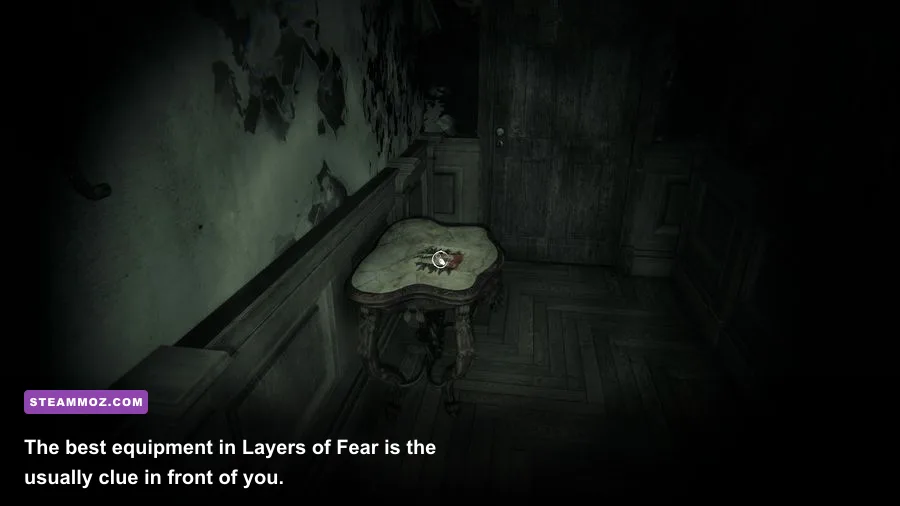
Keys and combination clues rank just below observation because they matter only when the game has placed a specific gate in your way. Their value is situational, but their role is clear. A code found on a note, a number suggested by a painting, or a key discovered in an altered room is usually the bridge between exploration and the next narrative beat.
| Tool | Tier | Typical signal | Efficient response |
|---|---|---|---|
| Room inspection | S | Visual change after turning or entering | Stop, re-scan landmarks, then test new objects |
| Light source | S | Dark route or focused set piece | Use it to read the scene, not hunt enemies |
| Key | A | Locked door, drawer, or cabinet | Remember the matching location and return directly |
| Code clue | A | Dial, keypad, safe, or numbered prop | Write down the clue and test the obvious order |
| Document | A | Readable page or letter | Inspect it before leaving the room |
| Collectible | B | Optional unusual object | Prioritize it after understanding the main route |
A-Tier strategies for every major story
The Painter’s Story
The Painter’s Story is the clearest demonstration of why a weapon ranking does not fit. The studio and mansion are built around repetition, transformation, and unreliable space. A route that looks finished can become active again after you inspect the central object in the room. Keep track of broad landmarks—studio, hallway, bedroom, storage areas—rather than trying to memorize every turn.
Its most useful “equipment” is the ability to recognize a reset. When the lighting, furniture, or artwork changes, assume the room has been deliberately refreshed. Revisit doors that were previously dead ends. Inspect the new focal point. The game rarely expects pixel hunting; it expects you to notice that the scene has changed and respond to that change.
The Actor’s Story
The Actor’s Story shifts the mood to a ship and uses stronger set-piece direction. Audio cues, moving scenery, and narrow corridors can make it feel as if an enemy is hunting you, but the solution is usually movement through the intended route rather than combat preparation. A lantern or other light-focused interaction may help you read the space, yet it never turns the protagonist into a fighter.
When a chase-like sequence begins, avoid stopping to test every side object. Move toward the clearly signposted opening, follow the light, and watch for the next transition. If you die or loop, identify the trigger you missed rather than searching for a stronger item. The chapter’s danger is mostly about timing and orientation.
The Lighthouse and The Final Note
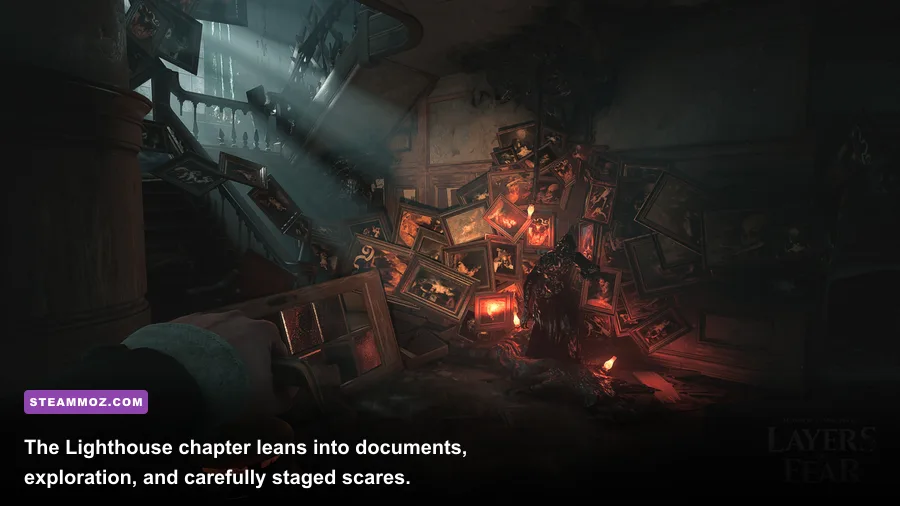
The Lighthouse chapter rewards careful inspection of documents, rooms, and visual echoes. The Final Note adds context to the Painter’s history, so players chasing story completion should treat readable material as more than decoration. Neither chapter introduces a conventional arsenal. The most effective approach is still to pause at narrative objects, listen to audio, and check whether a previously familiar route has been re-authored.
If you want a useful comparison, this is closer to the clue-driven exploration of other story horror games than to an FPS. Steamoz’s Gone Home review covers a similarly investigation-first rhythm, while the Decay: The Mare PC guide is a useful reminder that atmosphere-heavy horror can also benefit from sensible technical setup.
What counts as a “best build” in Layers of Fear?
There is no skill build, but there are three practical playstyles. The first is the story-first build: follow the main route, inspect mandatory objects, and ignore optional collectibles until the chapter is complete. This is the best choice for a first run because it protects the pacing and reduces backtracking.
The second is the completionist build: inspect every side room, reread documents, and revisit altered spaces after major transitions. It takes longer and can weaken the scare rhythm, but it is the right choice if you want every piece of lore. The third is the performance build: prioritize stable frame pacing, clear image quality, and headphones over maximum visual effects. Horror depends on timing, and stutter can make an audio cue feel broken rather than unsettling.
| Playstyle | Priority | Recommended behavior | Main drawback |
|---|---|---|---|
| Story-first | Progression | Follow clear cues and inspect required objects | May miss optional lore |
| Completionist | Exploration | Revisit changed rooms and inspect every document | More backtracking and fewer surprises |
| Atmosphere-first | Immersion | Use headphones, a stable frame rate, and minimal distractions | Less efficient completion |
| Speed-focused | Route knowledge | Skip optional interactions and commit to transitions | Misses story details and collectibles |
For PC players, start with the preset that keeps frame pacing stable, then adjust shadows, volumetric effects, and post-processing before lowering texture quality. Texture detail usually has a smaller impact on the atmosphere than lighting and volumetric effects. If performance becomes uneven, use a sensible frame cap instead of chasing a fluctuating peak number. The Steamoz FPS settings guide explains the same general principle for other demanding PC games: consistent delivery feels better than an unstable headline average.
Why combat advice makes Layers of Fear worse
The biggest mistake is importing habits from Resident Evil, Amnesia: The Bunker, or a conventional survival-horror game. You do not need to conserve ammunition, angle melee swings, stagger an enemy, or calculate whether a weapon upgrade is worth its cost. Looking for those systems creates false objectives and makes scripted encounters seem unfair.
Instead, learn the game’s telegraphs. A sudden lighting change often signals that the room has entered a new state. A repeated sound can direct you toward an interaction. A door that closes behind you may be a pacing transition rather than a combat arena. A visible threat is frequently there to force movement or attention, not to invite a fight.
When a scene becomes dangerous, use this sequence:
- Identify the route. Look for the lit doorway, open passage, or recently changed landmark.
- Commit to movement. Do not waste time testing decorative props once the sequence is active.
- Use the camera deliberately. Check behind you only when the game gives you space; constant spinning ruins orientation.
- Reassess after the transition. If the room resets, treat it as a new puzzle state.
This is also why audio matters more than a hypothetical weapon stat. Play with headphones if possible, keep dialogue and effects audible, and avoid overpowering the game with music or external videos. The scare may be visual, but the cue that tells you where to look is often sound.
Players who enjoy ranking systems can still borrow a useful framework from other games. The Bug Fables weapon tier list works because that game has real equipment with measurable combat roles. Layers of Fear does not. Its strongest item is the clue that solves the current scene, and that item is always temporary by design.
Final ranking: the only loadout worth using
So, what is the final Layers of Fear weapon tier list and best equipment ranking? Put environmental observation and light sources in S-Tier. Place keys, codes, documents, and paintings in A-Tier because they open routes or explain the fiction. Put optional collectibles in B-Tier because they reward patience but rarely improve moment-to-moment survival. Put weapons, upgrades, ammunition, and character builds in F-Tier because the game simply does not contain them.
| Final tier | Ranked element | Why it belongs there | How to maximize its value |
|---|---|---|---|
| S-Tier | Observation | Drives nearly every puzzle and transition | Recheck rooms after visual or audio changes |
| S-Tier | Light and sound awareness | Clarifies routes and telegraphs set pieces | Use headphones and stable brightness |
| A-Tier | Keys and codes | Directly unlock progression | Match each clue to its nearby gate |
| A-Tier | Documents and paintings | Combine story context with puzzle information | Inspect readable objects before moving on |
| B-Tier | Optional collectibles | Useful for lore and completion, not survival | Collect them on a second pass |
| F-Tier | Weapons and upgrades | Not part of Layers of Fear’s systems | Stop searching for a nonexistent loadout |
That answer may sound less exciting than naming a secret pistol, but it is far more useful. Layers of Fear is about surrendering control, not building power. The best equipment ranking is really a ranking of attention: notice the change, follow the clue, understand the sound, and let the room tell you what changed. Once you play on those terms, the series becomes much less opaque—and its most carefully staged scares land much harder.