
Short answer: Bug Fables does not use a traditional pile of equippable swords and armor. Its three “weapons” are the fixed attack systems of Vi, Kabbu, and Leif, while medals provide the real weapon tier list. Vi’s Beemerang is the best all-purpose damage tool, Leif’s Ice Magic is the strongest control weapon, and Kabbu’s Horn is the best defensive setup weapon. For medals, Power Exchange, Poison Attacker, Hard Hits, Weak Stomach, Block Heal, and TP Saver are the standouts, but the best loadout changes dramatically between ordinary exploration, superbosses, and hard-mode challenges.
That distinction matters. You cannot simply replace Vi’s Beemerang with a stronger sword after reaching the Bee Kingdom. Instead, you upgrade how each character’s attacks interact with enemy defense, status effects, front-and-back positioning, and action commands. A good equipment setup turns a modest attack into a repeatable combo engine; a bad one wastes medal points on bonuses that only look impressive on paper.
Bug Fables weapon tier list at a glance
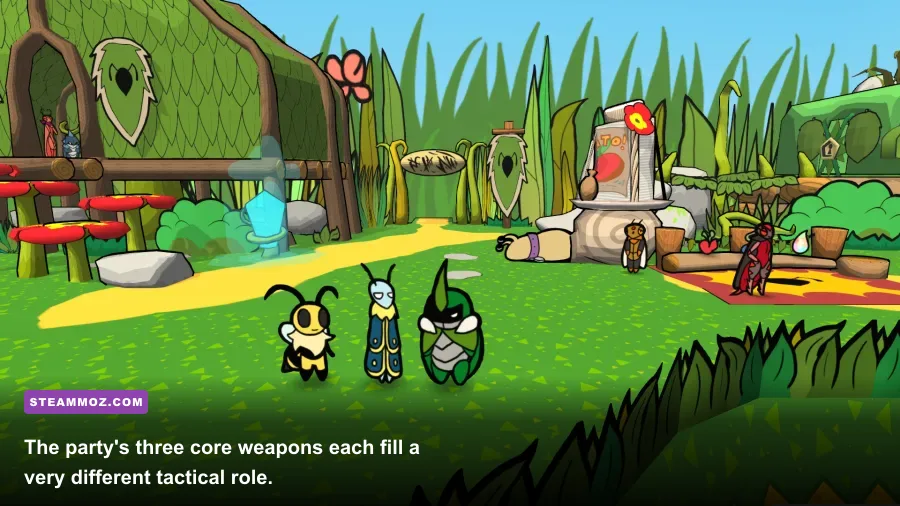
The ranking below evaluates each core weapon by damage consistency, utility, action-command difficulty, and how well it scales with medals. It assumes a normal playthrough rather than a deliberately restricted challenge run. All three weapons are viable, but they are not equally forgiving.
| Weapon system | Tier | Best user | Why it ranks here | Biggest drawback |
|---|---|---|---|---|
| Beemerang | S-Tier | Vi | Reliable multi-hit pressure, strong status synergy, excellent reach | Damage drops when enemies resist piercing or punish repeated hits |
| Ice Magic | S-Tier | Leif | Freezes, exposes weaknesses, and reaches targets other attacks struggle to touch | TP-hungry and less impressive against freeze-resistant enemies |
| Horn | A-Tier | Kabbu | Great single-target pressure and strong synergy with taunts and defensive play | Short reach and more dependence on correct positioning |
| Basic attacks | B-Tier | Everyone | Free damage that preserves TP for emergencies | Cannot match specialized skills against armored targets |
S-Tier: Vi’s Beemerang
Vi’s Beemerang earns the top spot because it asks the fewest questions of the battle. It can hit enemies at range, punish flying targets, and contribute repeated hits that make defensive buffs and poison-based medals more valuable. Its action command is also one of the most comfortable to perform consistently once you learn the timing.
Vi becomes especially dangerous when you combine her weapon with Needle Pincer, Bee Boomerang, and Leif’s status support. Poison an enemy first, then let Vi cash in on that condition with Poison Attacker. The result is not just one large number; it is a turn after turn damage advantage. That consistency is why Vi is usually the best default character for random encounters.
S-Tier: Leif’s Ice Magic
Leif’s Ice Magic is the most strategically valuable weapon in the game. It can target enemies that are awkward for Kabbu to reach, applies freeze when the matchup allows it, and gives the party time to set up without immediately eating another attack. Freeze is not a universal answer, though. Several bosses and elite enemies resist or ignore it, so building an entire party around freeze creates a nasty late-game wall.
Leif’s weapon also benefits from understanding enemy weaknesses rather than blindly repeating the same spell. Some enemies are better handled by direct Ice Magic damage, while others should be frozen briefly so Vi can stack pressure or Kabbu can prepare a charged strike. Leif is the best “problem solver,” but not always the best raw damage dealer.
A-Tier: Kabbu’s Horn
Kabbu’s Horn is less flexible than the other two weapons, yet it is vital when the party needs a dependable front-line answer. Kabbu’s kit is built around control: drawing attacks, blocking at the right moment, and using charged attacks to exploit exposed enemies. His weapon feels ordinary if you only compare damage numbers, but it becomes excellent when the rest of the party is protecting him while he controls turn order.
The biggest mistake is treating Kabbu as a pure attacker. His value comes from combining Horn attacks with Taunt, Under Strike, and defensive medals. He can absorb attention, survive the retaliation, and create a safe window for Vi or Leif to spend TP. That makes him an A-tier weapon platform and an S-tier team anchor.
🎮 Bug Fables: The Everlasting Sapling
Looking to experience this game? Grab your digital key directly on our store for $7.99.
View on Steammoz Store →The best medal tiers for damage and survivability
Medal points are limited, so every equipped badge needs a job. The strongest builds do not simply stack attack medals. They create a loop: inflict a condition, exploit it, restore resources, then repeat. This is also why equipment rankings can change after you unlock more medal points through level-ups.
| Medal | Tier | Core effect | Best pairing | Ideal use |
|---|---|---|---|---|
| Power Exchange | S-Tier | Trades defense for stronger offense | Vi damage builds or burst turns | Boss phases you can safely control |
| Poison Attacker | S-Tier | Improves attacks against poisoned targets | Vi’s multi-hit attacks and poison skills | Long fights against poison-vulnerable enemies |
| Hard Hits | A-Tier | Improves pressure against guarded or durable enemies | Kabbu’s charged attacks | Armored enemies and physical-heavy parties |
| Block Heal | A-Tier | Rewards successful blocks with healing | Kabbu, especially with Taunt | Exploration and attrition battles |
| TP Saver | A-Tier | Reduces the resource burden of skills | Leif’s Ice Magic rotation | Skill-heavy boss encounters |
| Weak Stomach | B-Tier | Raises damage against enemies with status ailments | Poison Attacker and Leif support | Dedicated status-effect teams |
| Favorite One | B-Tier | Improves a focused attacker’s output | Single-carry Vi builds | Short fights and deliberate burst setups |
S-tier medal setup: poison pressure
Poison Attacker is arguably the best damage medal for a normal run because poison is easy to apply and remains useful across a wide section of the campaign. Pair it with Weak Stomach when you can afford the points, then use Vi to turn a poisoned enemy into a priority target. Do not waste the setup on a foe that will die to a basic attack. Apply poison to enemies with enough health to survive multiple turns.
Power Exchange is more explosive but less forgiving. Giving up defense for damage is excellent when you understand an enemy’s telegraph and can block reliably. It is risky during new boss fights, where an unfamiliar multi-hit attack can erase the advantage. Equip it after learning the encounter, not before.
A-tier medal setup: the safe campaign loadout
For a first playthrough, Block Heal and TP Saver are more valuable than a tiny damage increase. Block Heal turns successful action commands into sustain, which reduces the number of items you burn between save points. TP Saver lets Leif use Ice Magic and support skills without forcing the party to spend every turn recovering resources.
This loadout shines in places such as the Lost Sands and Rubber Prison, where several fights can drain you before the next healing opportunity. It is also a better choice for players still learning enemy telegraphs. You lose some burst, but you gain enough margin to survive a missed action command.
Best equipment builds for Vi, Kabbu, and Leif
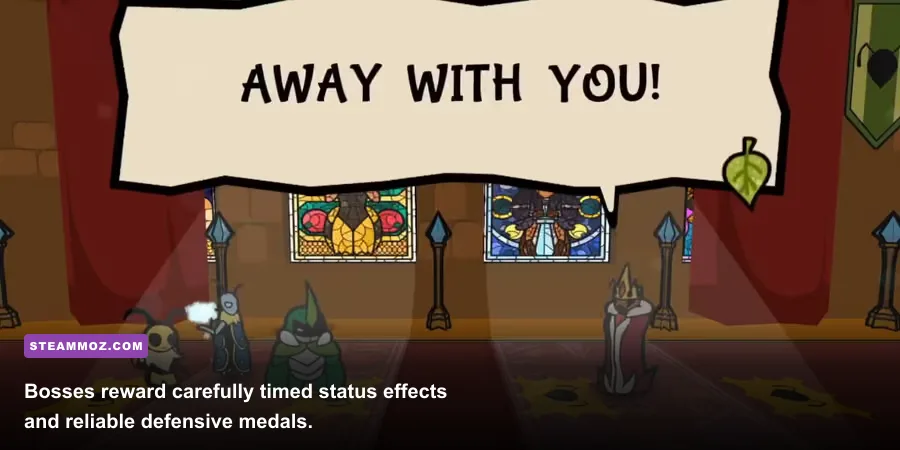
The party works best when each character has a distinct combat assignment. Vi should finish weakened targets and exploit poison. Kabbu should control attention and convert blocks into momentum. Leif should manage enemy states and cover targets that the other two cannot conveniently reach.
| Character | Recommended role | Priority medals | Combat rotation | When to change it |
|---|---|---|---|---|
| Vi | Status-assisted damage dealer | Poison Attacker, Weak Stomach, Power Exchange | Apply poison, use multi-hit Beemerang skills, finish low-health targets | Remove risky offense for defensive medals against new bosses |
| Kabbu | Tank and single-target breaker | Block Heal, Hard Hits, defensive support medals | Taunt, block the incoming hit, counter with charged Horn attacks | Use more offense when the boss cannot punish taunt reliably |
| Leif | Control and weakness specialist | TP Saver, status support, elemental damage medals | Identify weakness, freeze where possible, maintain control | Drop freeze-focused medals against resistant bosses |
Vi build: the poison executioner
Start by applying poison with the most efficient available option, then use Vi’s Beemerang skills on the poisoned target. Her multi-hit attacks are particularly good at converting a condition into meaningful damage, but do not assume every hit receives identical value against every defense type. If an enemy has high defense, use Kabbu’s defense-lowering tools or Leif’s support first.
Vi’s charged attacks also reward patience. A rushed command can turn a great damage turn into a weak one, especially when Power Exchange is equipped. If you are farming ordinary encounters, a straightforward Beemerang attack is often better than spending TP on an elaborate setup that takes longer than the fight itself.
Kabbu build: the guard-and-punish tank
Kabbu is the best home for Block Heal because he is naturally the character most likely to draw attacks. Use Taunt when you can identify the enemy’s next target, then prepare to block rather than blindly attack. A successful block protects your HP, triggers healing value, and buys the party time to spend its own turns on damage or support.
Hard Hits fits this approach because Kabbu frequently attacks enemies that are already being managed rather than full-health targets. His charged Horn attacks are strongest when the enemy is exposed or when the party has already handled its defensive gimmick. Against a boss with unpredictable area damage, skip Power Exchange and keep Kabbu sturdy.
Leif build: the battlefield controller
Leif’s best equipment is the gear that keeps his TP economy stable. TP Saver allows more Ice Magic casts over the course of a dungeon, while status-oriented medals increase the value of every successful freeze or debuff. Use him to inspect the matchup: if freeze works, it can interrupt the enemy’s rhythm; if it does not, shift immediately to damage and support rather than throwing TP away.
Leif’s Bubble Shield is also more valuable than its damage-free description suggests. It can protect the party during a dangerous telegraph and lets Vi or Kabbu survive a turn that would otherwise force an emergency item. The best Leif players are not chasing the largest spell number. They are preventing the worst enemy turn.
How weapon tiers change against bosses

Random battles favor speed, while bosses favor reliability. The Wasp King, the Venus Guardian, and later optional encounters all punish a build that assumes one status effect will work forever. Before committing to a tier-list setup, watch the boss for one full cycle. Look for whether it targets one hero, hits the whole party, summons support, or changes behavior below a health threshold.
| Encounter type | Best weapon focus | Recommended equipment | What to avoid |
|---|---|---|---|
| Flying enemy groups | Vi’s Beemerang | Reliable damage and status support | Short-range Kabbu-only setups |
| Armored targets | Kabbu’s Horn plus defense tools | Hard Hits and defense-lowering support | Repeating low-impact physical attacks |
| Freeze-vulnerable boss | Leif’s Ice Magic | TP Saver and control medals | Spending all TP before the next phase |
| Status-resistant boss | Balanced party damage | Block Heal, direct damage, defensive utility | Poison-only or freeze-only builds |
| Summoner or add-heavy fight | Vi’s multi-target pressure | Fast damage and resource sustain | Ignoring summoned enemies until they snowball |
The Wasp King is a good reality check for equipment rankings. A flashy Power Exchange build can melt a vulnerable phase, but the lost defense makes mistakes expensive. Kabbu’s Taunt is powerful when it lets you predict and block a strike; it is dangerous when used without knowing whether the boss follows with a second attack. Leif’s freeze is excellent only if the boss actually permits it.
For optional superboss content, defensive medals gain value because fights last long enough for sustain to outperform one extra burst turn. This is where Block Heal, TP Saver, and carefully timed Bubble Shield usually beat a glass-cannon setup. You can read more about the game’s official release details on the Bug Fables Steam page.
Progression tips for building the best loadout
Do not spend every level-up on the same resource without a plan. Bug Fables lets you improve HP, MP, or TP, and each choice changes what your equipment can accomplish. HP is the safest early investment because it forgives missed blocks. MP gives you more room for medals and passive bonuses. TP supports the strongest skills, but it only pays off if you actively use those skills.
For most players, a mixed progression path is best. Build enough HP to survive the current chapter’s hardest attacks, then invest in MP so your preferred medal package fits comfortably. Add TP when Leif’s skills or Vi’s multi-step attacks become central to your strategy. The exact “best” spread depends on your action-command accuracy, but a party that cannot afford its core skills is weaker than a slightly less durable party with a functioning rotation.
Three rules that prevent bad equipment choices
- Never rank a medal outside its intended matchup. Poison Attacker is outstanding when poison sticks, but it is wasted against an immune target. Swap it instead of stubbornly forcing the build.
- Protect your resource engine. TP Saver and Block Heal may look less exciting than attack bonuses, yet they create extra actions over a whole dungeon. More useful turns beat a larger number on one attack.
- Learn the action command before chasing burst. Power Exchange rewards confidence. If you are missing blocks or attack inputs, defensive equipment is not “slower”; it is more damage because you stay alive long enough to attack.
Bug Fables’ equipment system is at its best when you stop looking for one universal winner. Vi’s Beemerang is the strongest general weapon, Leif’s Ice Magic is the most valuable control tool, and Kabbu’s Horn is the foundation of the safest boss strategy. The medals decide how far those weapons can go.
For a normal campaign, start with Poison Attacker on Vi, Block Heal on Kabbu, and TP Saver on Leif. Add Power Exchange once you know an encounter, use Hard Hits against durable enemies, and remove status-dependent medals whenever a boss resists them. That flexible approach will carry you from the Golden Hills to the game’s toughest optional battles without forcing one gimmick into every fight.
Bug Fables was developed by Moonsprout Games and published by DANGEN Entertainment. If you enjoy dissecting RPG systems and optimized loadouts, Steamoz’s guides to Blackguards starter builds, Heart of the Machine beginner builds, Just Die Already weapon rankings, and Indoorlands leveling tips are worth bookmarking next.