
Yes, God Eater 2 Rage Burst is still worth playing in 2026—especially if you want a fast, story-heavy alternative to Monster Hunter rather than a realistic simulation. Its 2016 PC port looks dated, the mission structure can feel repetitive, and the opening hours throw a lot of terminology at you. Yet the God Arc weapon system, spectacular Aragami fights, generous offline party, and unusually melodramatic anime story still give it a personality most hunting games never match. Buy it on sale, commit to the campaign, and you’ll find a surprisingly deep action RPG that remains excellent for solo players.
That recommendation comes with an important condition: don’t judge Rage Burst after two hours. The early Rank 1 and Rank 2 missions are tutorials wearing combat clothes. The real build experimentation arrives through Blood Arts, Burst Arts, equipment upgrades, and later Aragami variants. If you only want an endlessly populated online game with modern matchmaking, this is a harder sell. If you want a complete campaign you can play at your own pace, it’s one of the better overlooked hunting games on Steam.
What makes Rage Burst different from Monster Hunter?
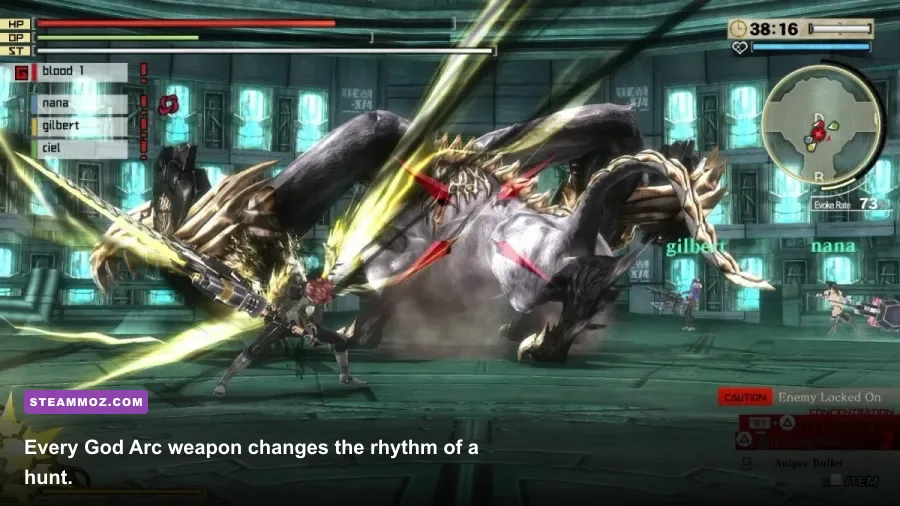
Rage Burst is built around speed and instant tactical flexibility. Your God Arc is both a weapon and a Predator Form, meaning you can swap between melee, gun, and shield functions in the middle of a hunt. Hold the Predator Form input to consume an Aragami and enter Burst, then use that temporary state to unlock stronger attacks, improved stamina management, and access to your chosen Blood Arts and Burst Arts.
That loop changes the emotional texture of a fight. Monster Hunter asks you to commit to deliberate animations and learn the weight of one weapon. Rage Burst asks you to stay in motion, read an enemy’s attack, eat a piece of it with Predator Form, and immediately turn that opening into damage. A Short Blade user can vault over a Quadriga, fire a quick shot to restore Oracle Points, then return to a ground combo before the boss has fully recovered.
The game supports Short Blade, Long Blade, Buster Blade, Boost Hammer, Charge Spear, Variant Scythe, and several gun configurations. Each melee category has a distinct attack language, not merely a different damage number. Short Blade excels at aerial pressure and quick repositioning. Buster Blade rewards patient charge timing and guard use. Boost Hammer turns stamina into explosive blunt damage, while Variant Scythe controls space with wide, satisfying sweeps.
| Weapon type | Strength | Learning curve | Best use |
|---|---|---|---|
| Short Blade | Fast attacks, aerial mobility, strong sustained pressure | Low | New players and aggressive solo hunts |
| Long Blade | Excellent reach and reliable slash damage | Low to medium | General-purpose missions |
| Buster Blade | Heavy hits, charged attacks, strong guard options | High | Players who enjoy commitment and timing |
| Boost Hammer | Powerful burst damage and mobility during Boost mode | Medium | Breaking hard parts and punishing staggers |
| Charge Spear | Precise thrusts, aerial control, powerful Charge Glide | Medium | Targeting weak points from the front |
| Variant Scythe | Wide reach and flexible transform attacks | Medium | Controlling groups and large hitboxes |
The gun side is just as important. Sniper, Assault, Blast, and Shotgun styles let you tune bullets through the in-game editor, combining modules for elemental damage, spread, homing behavior, and timing. You don’t need to become a spreadsheet scientist to finish the story, but the editor is where the combat system reveals its most ridiculous possibilities. A carefully made custom bullet can delete a weak point or refill resources while you stay outside claw range.
For a broader look at the appeal of older action games, Steamoz’s Ghost Recon Breakpoint review makes a similar case for revisiting games that improved with time. Rage Burst benefits from that same second look, although its anime presentation is far louder.

🎮 GOD EATER 2 Rage Burst
Looking to experience this game? Grab your digital key directly on our store for $4.99.
View on Steammoz Store →The combat system gets much better after the tutorial wall
The first major progression layer is Burst. You can trigger it through Predator Form, and the level of Burst affects which abilities are active. Burst Arts then let you modify attacks with special effects, while Blood Arts enhance particular moves attached to a weapon. A Short Blade might gain a Blood Art that transforms a basic ground attack into a gap-closing slash; a Buster Blade can turn a charged strike into a much more dangerous finisher.
Don’t treat Blood Arts as passive bonuses. They are invitations to change your rotation. Pick one art, use it deliberately for several missions, and watch how it interacts with stamina, Oracle Points, and enemy knockdowns. The best abilities aren’t always the ones with the largest damage description. A move that closes distance or hits an elevated weak point can outperform a slower finisher that looks better on paper.
Rage Burst also adds the Blood Rage system. This is a high-impact temporary state tied to completing objectives during a mission, such as breaking specific body parts or landing attacks under certain conditions. Activate it at the right time and your hunter becomes dramatically more dangerous. The catch is that Blood Rage is not a free panic button. You need to understand the mission’s target, save it for a vulnerable phase, and avoid wasting the window while an Aragami is burrowing or fleeing.
Equipment progression is straightforward but meaningful. You gather materials from body-part breaks and post-mission rewards, then upgrade melee weapons, guns, armor, and shields at the terminal. Elemental resistances matter against later targets, but raw upgrade rank is usually the first priority. A fashionable low-rank weapon will not compensate for entering a mission under-equipped. Check the target’s physical and elemental weaknesses, craft a weapon with the appropriate slash, crush, or pierce profile, and bring bullets designed for the part you actually intend to break.
| Build focus | Recommended weapon | Core habits | Why it works |
|---|---|---|---|
| Safe beginner | Short Blade plus Assault gun | Stay in Burst, use Predator Form often, attack legs | Fast recovery and forgiving repositioning |
| Part breaker | Boost Hammer plus Blast gun | Charge Boost attacks and target exposed appendages | Excellent stagger and break potential |
| Precision hunter | Charge Spear plus Sniper gun | Use Charge Glide on weak points and maintain distance | Rewards accurate, deliberate targeting |
| Heavy punish | Buster Blade plus Shotgun gun | Guard, charge, then punish recovery animations | Huge damage when enemy patterns are understood |
The offline AI party is a quiet advantage. Characters such as Ciel, Nana, Alisa, Lindow, and Julius bring link support skills and can keep a hunt moving when you miss a dodge. They aren’t perfect: allies sometimes stand in danger, waste healing opportunities, or attack a poor target. Still, the game is designed around a squad, and solo players never face the lonely, underpowered feeling that can plague other co-op-first hunters.
Story and characters are messy, but surprisingly compelling
Rage Burst includes the main God Eater 2 campaign and its expanded Rage Burst material. You play a new recruit joining the Blood Unit, an elite group of God Eaters operating in a world where Aragami have pushed humanity toward extinction. Julius Visconti, the unit’s commander, is at the center of the sequel’s conflict, while characters including Nana Kozuki, Ciel Alençon, Romeo Leoni, and Shio bring their own personal crises into the campaign.
The writing is unapologetically anime. There are dramatic speeches, painful flashbacks, friendship scenes, secret powers, and enough tragic destiny to fill several seasons of television. Some conversations are excellent, particularly when the story explores Julius’s burden and Ciel’s attempt to connect with the rest of the team. Other scenes drag through visual-novel-style dialogue boxes and repeated exposition about bias factors, Oracle Cells, and the Ashlands.
That uneven pacing is the largest narrative weakness. Mission chains frequently interrupt a dramatic scene, and the game’s terminology can be exhausting before the concepts become relevant. The payoff is better if you let the characters breathe instead of rushing from objective to objective. Side episodes and character interactions are not just filler; they explain why the squad works and unlock useful support capabilities.
The setting still holds up because it has a clear identity. Fenrir branches, abandoned cities, collapsing infrastructure, and the threat of the Ash Aragami create a more militarized atmosphere than Monster Hunter’s fantasy wilderness. Aragami are not simply animals waiting to be harvested. They are ecological disasters, biological weapons, and personal antagonists depending on the chapter. That gives even routine missions a stronger sense of place than their compact arenas might suggest.
Players who enjoy narrative-heavy games with a distinctive visual hook may also appreciate Steamoz’s Arcade Spirits review. The games are wildly different, but both understand that character relationships can make a familiar gameplay loop worth revisiting.
Aragami fights remain the real reason to play
The enemy roster carries Rage Burst through its rough patches. Early fights against Kongou, Vajra, and Chi-You teach the basics of reading movement and breaking parts. Later missions introduce more dangerous encounters, including Hannibal, Sariel, Quadriga, Dyaus Pita, and the Corrosive Hannibal. Their silhouettes are immediately readable, and most have attacks that communicate danger through sound, posture, or a visible charge.
Hannibal is the standout. It fights like a furious dragon-knight, mixing lunges, sweeping flame attacks, and sudden repositioning. The Corrosive Hannibal adds a more punishing variant that demands sharper positioning and better equipment preparation. Dyaus Pita is another memorable test because its mobility and burst attacks punish players who tunnel vision on damage instead of watching the arena.
Part breaks are central to the strategy. A broken horn, leg, wing, tail, or armor section can change an Aragami’s behavior and expose a safer damage zone. Use Oracle Blade or the Predator Form bite to maintain Burst, then focus your melee pattern on a specific part rather than mashing into the largest visible body mass. When an enemy enters a devouring animation, use the tell to disengage or interrupt it; letting the attack connect can swing the mission’s momentum against you.
| Aragami | Main danger | Counter strategy | Useful approach |
|---|---|---|---|
| Kongou | Wide swipes and charging attacks | Stay near the rear legs and punish recovery | Short Blade or Long Blade |
| Vajra | Fast leaps and lightning pressure | Break the head and avoid frontal overcommitment | Sniper shots plus aerial attacks |
| Quadriga | Large-area explosives and frontal armor | Circle behind it and target legs or exposed parts | Boost Hammer and Blast bullets |
| Hannibal | Flame sweeps, lunges, and sudden turns | Watch the shoulders, dodge late, punish after combos | Guarding Buster Blade or precise Spear |
| Dyaus Pita | High mobility and dangerous burst attacks | Keep stamina for escape and attack after its leap | Short Blade with a defensive shield |
Difficulty rises through mission rank rather than a simple enemy-level slider. You’ll see familiar Aragami with tougher statistics, mixed encounters, and more demanding time pressure. The game occasionally leans too hard on damage inflation, but upgrading armor and carrying restorative items keeps the curve manageable. If a hunt feels unfair, it usually means you need to change elemental defense, target a different part, or stop saving Burst resources for a perfect moment that never arrives.
PC performance and 2026 buying advice
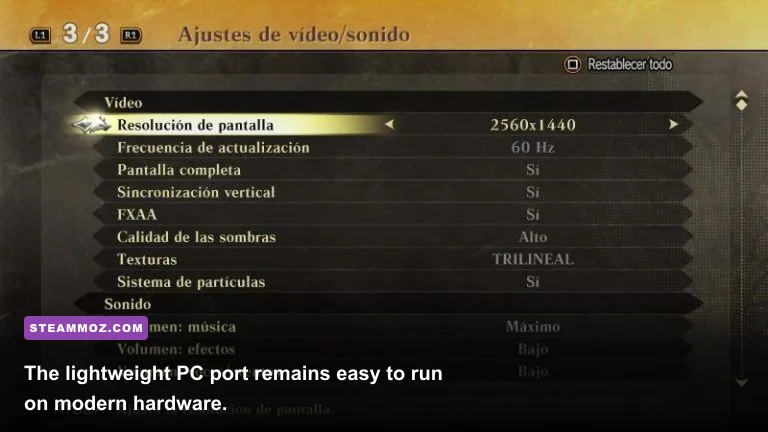
The PC version is technically old-fashioned, but that’s mostly good news. Rage Burst does not need a modern gaming rig. Bandai Namco’s Steam listing gives a minimum target around an Intel Core i5-3470, 4 GB of RAM, and a GeForce GTX 660-class graphics card, with roughly 25 GB of storage. A contemporary integrated GPU or entry-level laptop should have no trouble at 1080p, although battery life and driver behavior matter more on portable systems than raw power.
| Setting or hardware | Recommended value | Performance impact | Visual note |
|---|---|---|---|
| Resolution | 1920x1080 | Low on modern GPUs | Cleanest balance for character outlines |
| Anti-aliasing | Highest stable option | Small to moderate | Reduces jagged edges on weapon effects |
| Shadow quality | High | Moderate on older GPUs | Lower this first if crowded hunts stutter |
| Texture quality | High | Mostly VRAM dependent | Preserves armor and Aragami detail |
| V-sync | Enabled if tearing appears | May add input latency | Disable with a good VRR display |
| Frame-rate target | 60 FPS | Easy for current hardware | Better dodge timing and smoother camera motion |
There are caveats. The presentation is locked to the visual language of a mid-2010s anime action game, menus are dense, and some cutscenes feel compressed. Don’t expect modern ultrawide support, advanced lighting, or a photographic world. What you do get is stable combat, quick loading on an SSD, and a game that scales beautifully to a handheld PC. On Steam Deck-class hardware, a 60 FPS target is realistic with sensible settings, though battery draw will depend on the device’s TDP profile.
The biggest value question is price. Rage Burst is a strong buy during a deep Steam discount, especially if the bundle includes the original campaign content and DLC you want. At full price, its age, repetitive mission layouts, and limited modern online population make the recommendation less automatic. Check the current official Steam page for the latest edition and regional pricing before buying.
You can also compare its mission-based structure with Steamoz’s games like Titanium Court recommendations or use the site’s PC settings guide as a reminder that older games often need only a little tuning to run well on current hardware.
Final verdict: worth playing, with the right expectations
God Eater 2 Rage Burst is worth playing in 2026 because its core ideas remain unusually generous. You get a full campaign, a flexible party, seven melee weapon categories, a creative gun editor, Blood Arts, Blood Rage, breakable Aragami parts, and enough equipment depth to support experimentation without demanding an online community. Few hunting games make you feel this mobile or let you rewrite your combat style so freely.
It is not flawless. The story takes too long to explain itself, the mission environments are functional rather than beautiful, and the early progression is much slower than the combat’s eventual potential suggests. Some bosses are more exhausting than exciting, particularly when higher ranks increase health without adding enough new behavior. The PC port is serviceable, not lovingly modernized.
Those flaws are easier to accept once you understand what Rage Burst is trying to be: a stylish squad action RPG where the reward is mastering a personal God Arc and watching a group of damaged characters grow into a team. Start with Short Blade if you’re new, use Predator Form constantly, invest in equipment upgrades instead of hoarding materials, and don’t ignore side episodes. By the time Hannibal enters the picture, the systems should finally click.
Steamoz verdict: 8/10. Buy it on sale without hesitation if you enjoy anime action RPGs, solo-friendly hunting games, or deep weapon customization. Skip it only if you need modern visuals, seamless online matchmaking, or a story that gets to the point quickly. For everyone else, Rage Burst is an old favorite with enough bite left to make 2026’s crowded action-RPG library feel a little less predictable.
For developer information and franchise context, visit the official Bandai Namco game page and the official God Eater website.