
Yes, Arcade Spirits is still worth playing in 2026 if you want a warm, funny visual novel with genuine character chemistry rather than a mechanically demanding arcade simulator. Its romance routes, expressive cast, and affectionate look at arcade culture remain excellent, although the management systems are light and the pacing can feel slow if you expect a full business sim.
Released by Fiction Factory Games and published by PQube, Arcade Spirits puts you behind the counter of the Funplex, a struggling arcade fighting to survive in a future where home gaming has become even more dominant. You are not saving the world with a sword or grinding a battle pass. You are repairing cabinets, helping regulars, surviving awkward conversations, and deciding what kind of person your protagonist will become.
That modest premise is exactly why the game has aged well. Arcade Spirits understands that an arcade is less about machines than the people who keep coming back. In 2026, that emotional focus still gives it an edge over louder, more expensive games.
What Arcade Spirits actually is
Arcade Spirits is a choice-driven visual novel with a small arcade-management layer. You create the protagonist, take a job at the Funplex, and spend each chapter balancing the arcade’s needs with the personal problems of its staff and customers. The structure is closer to a character drama with management interludes than to Two Point Museum, Game Dev Tycoon, or a traditional dating sim.
The Funplex is managed through short decision sequences. You choose which cabinets to emphasize, respond to staff situations, and make calls that affect the venue’s identity. These choices are not backed by an intimidating spreadsheet of rent, power consumption, staff wages, and cabinet depreciation. The game wants you to feel like a new manager, not an accountant.
That design has two important consequences. First, newcomers can understand the game immediately. Second, players looking for a deep arcade tycoon will find the business side underdeveloped. The management layer creates context and consequences, but it does not carry the entire experience.
| Element | What you do | How deep it gets | 2026 verdict |
|---|---|---|---|
| Story | Read scenes and make dialogue decisions | Strong character focus with branching outcomes | Still the main attraction |
| Romance | Build relationships through choices | Several distinct routes and endings | Warm, flexible, and replayable |
| Arcade management | Make Funplex priorities and staffing decisions | Light strategy layer rather than full simulation | Useful support system |
| Arcade action | Occasional interactive cabinet moments | Brief and deliberately simple | Not a substitute for an arcade game |

🎮 Arcade Spirits
Looking to experience this game? Grab your digital key directly on our store for $1.99.
View on Steammoz Store →The Funplex cast is the real reason to play
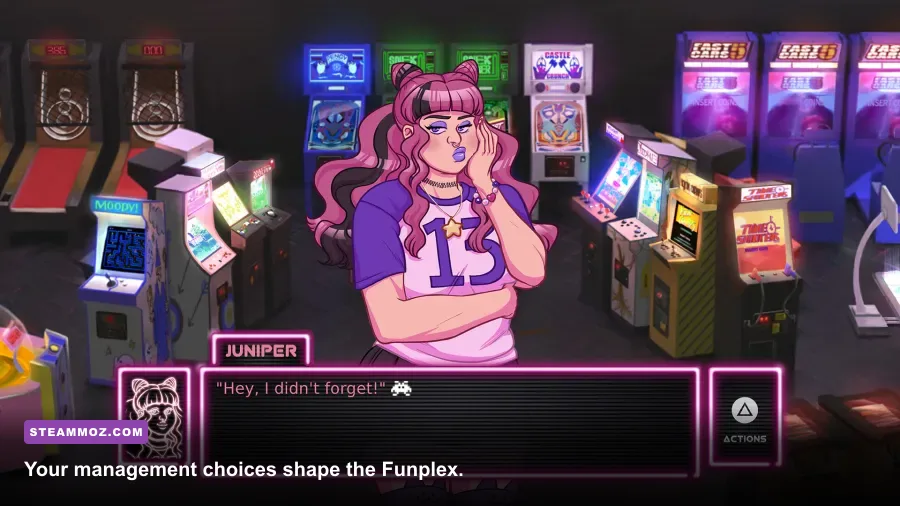
Arcade Spirits succeeds because its characters are more than romance targets arranged around a player avatar. Juniper is the energetic Funplex manager whose optimism masks the pressure of keeping the business alive. Naomi brings competitive intensity and a serious fighting-game mindset. Gavin is the technically minded repair specialist, while Queen Bee arrives with the confidence and theatricality of a streamer who knows exactly how to command attention.
Percy and Teo add different kinds of friction to the workplace. Percy’s polished, business-oriented perspective creates a useful counterweight to the arcade’s sentimental regulars. Teo is younger and more openly enthusiastic, helping the story explore the way arcade communities pass their obsessions between generations. The cast does not always avoid familiar visual-novel archetypes, but the writing gives those archetypes room to reveal contradictions.
The best scenes are rarely the obvious romantic ones. A late conversation about a failing cabinet, a disagreement over tournament culture, or a staff member admitting they are scared of the Funplex closing can land harder than a grand confession. The game understands that intimacy grows through repeated ordinary moments.
It also avoids making every character orbit the protagonist perfectly. People have their own ambitions, grudges, insecurities, and loyalties. If you choose an answer that clashes with someone’s personality, the game generally lets the discomfort breathe instead of instantly resetting the relationship.
That makes the routes more satisfying on a second playthrough. You notice how a character’s early jokes, hobbies, and defensive habits foreshadow later emotional beats. The writing is not flawless—some jokes are broad, and a few conflicts resolve more neatly than real workplace problems would—but the cast has enough texture to carry a long visual-novel campaign.
How choices, personality, and romance work
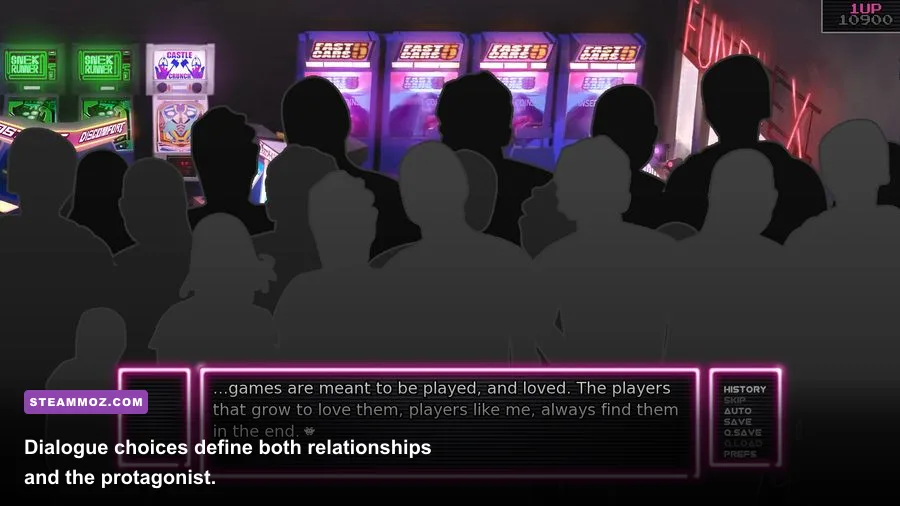
The protagonist is deliberately flexible. Early decisions establish your personality and the tone of your responses, letting you play a blunt arcade obsessive, an empathetic team player, a flirt, or a more analytical manager. You are not selecting a rigid class with combat statistics; you are shaping how the protagonist speaks and which people trust them.
Choices matter in three overlapping ways. Some alter immediate dialogue. Some push a relationship toward friendship or romance. Others influence the Funplex’s direction and the kind of ending the arcade can reach. The game usually communicates emotional consequences through character reactions rather than a visible affection meter, so paying attention is more valuable than blindly hunting for a hidden number.
That said, this is not a punishing choice labyrinth. You are unlikely to destroy a route because of one imperfect answer, and the game’s forgiving structure makes experimentation pleasant. The downside is that players who want dramatic route locks, brutal consequences, or dozens of radically different story branches may find the divergence limited.
Romance is handled with a refreshing amount of flexibility. The game does not insist that every relationship follow one narrow template, and its cast supports different orientations and approaches to connection. You can pursue a romance, prioritize friendship, or focus on the Funplex without the story treating a single ending as the only emotionally valid outcome.
For a first run, choose answers that feel natural instead of trying to optimize every scene. On a replay, use the autosave and chapter structure to test different responses. If you want a route-specific outcome, avoid constantly changing your tone; consistency tends to make the protagonist feel more coherent and makes relationship development easier to follow.
Is the arcade-management gameplay too shallow?
This is the biggest qualification in an Arcade Spirits review. The Funplex systems are enjoyable, but they are not deep enough to satisfy players buying the game for management alone. You will make meaningful choices about the venue, but you will not spend hours calculating cabinet profitability or designing a perfect floor plan.
The management sequences work best as pressure valves between dialogue-heavy chapters. They give the story stakes: a cabinet choice can reflect the audience you want to attract, and a staffing decision can reveal whether you value efficiency, loyalty, or the arcade’s social spirit. They also stop the game from becoming a completely passive read.
However, there is no complex economy demanding repeated optimization. The game does not give you the kind of granular feedback that makes a tycoon game endlessly replayable. If you are searching for a serious arcade business simulator, look elsewhere. If you want narrative decisions to feel connected to the Funplex’s survival, the system does its job.
| Player priority | Best approach in Funplex decisions | What it rewards | Potential drawback |
|---|---|---|---|
| Character relationships | Prioritize staff needs and follow through on personal conversations | More satisfying route development | Less focus on venue optimization |
| Arcade identity | Choose machines and policies that match the audience you want | A clearer sense of Funplex personality | Limited mechanical feedback |
| Business survival | Favor practical choices when the story presents financial pressure | Stronger management-focused outcomes | Some consequences remain narrative rather than numerical |
| Replay value | Reverse your priorities on a second run | Different conversations and relationship paths | Core chapter structure stays familiar |
The right comparison is not a spreadsheet simulator. It is a visual novel that uses management decisions to reinforce its theme: communities survive when people invest in one another. Once you judge it on that scale, the light mechanics feel intentional rather than unfinished.
Presentation, accessibility, and PC performance

Arcade Spirits has a bright, clean presentation built around expressive 2D character art, colorful backgrounds, and retro arcade motifs. The portraits do a lot of emotional work. A raised eyebrow, exaggerated grin, or sudden change in expression can sell a joke before the text finishes the sentence.
The pixel-art touches and cabinet imagery give the game a distinctive identity without burying the readable dialogue beneath visual noise. The soundtrack leans into upbeat electronic and retro-inspired sounds, though its repetition becomes more noticeable during long reading sessions. Headphones help, but the writing remains the star.
On PC, this is an exceptionally easy game to run. It is a 2D visual novel, so chasing high-end hardware, ray tracing, or a particular frame-rate target makes no sense. The Steam listing presents modest requirements, including Windows 7 or later, 2 GB of RAM, DirectX 9-compatible graphics, and roughly 3 GB of available storage. Modern laptops and integrated graphics should have no trouble with it.
| Component | Published minimum | Practical 2026 recommendation | Performance note |
|---|---|---|---|
| Operating system | Windows 7 or later | Current supported Windows version | No modern GPU feature required |
| Memory | 2 GB RAM | 4 GB RAM or more | Leaves room for background apps |
| Graphics | DirectX 9-compatible GPU | Any recent integrated graphics | 2D presentation has negligible GPU demand |
| Storage | About 3 GB available | 3 GB plus save-space headroom | Very small installation by modern standards |
There are no meaningful graphics profiles to tune. You will not gain anything from lowering resolution, disabling effects, or hunting for a frame-rate setting. If the game behaves strangely, verify files through Steam, update the runtime, and check display scaling before blaming your hardware. For broader PC troubleshooting, Steamoz’s guide to fixing crashes and PC lag covers the general diagnostic habits that apply here too.
What has aged well—and what has not
The strongest part of Arcade Spirits in 2026 is its sincerity. It is openly passionate about arcades without turning that passion into a lecture. The Funplex feels like a place where people can belong, and the game understands why a battered cabinet can carry memories far beyond its original hardware.
Its inclusive romance writing also remains a major strength. The protagonist’s identity is flexible, the relationships are not reduced to a single default pairing, and the story treats community as something built through effort. That warmth feels especially welcome in a genre often crowded with melodrama or wish-fulfillment.
The weaker points are easier to spot now. The pacing can drag when several exposition-heavy conversations arrive back to back. Some jokes rely on internet and gaming references that no longer hit as sharply. The management layer can feel like a promising idea that never receives the depth a larger simulation would demand.
There is also a tonal imbalance between the game’s high stakes and its forgiving mechanics. The characters may talk about the Funplex’s future as if every decision is enormous, yet the underlying systems rarely make you feel financially cornered. That is not a fatal problem, but players wanting tense resource management should lower their expectations.
Compared with a conventional dating sim, Arcade Spirits offers more workplace and community context. Compared with a pure visual novel, it offers more interactivity and a stronger sense of place. Compared with an arcade tycoon, it is dramatically lighter. Those comparisons explain both its appeal and its limits.
Who should play Arcade Spirits in 2026?
Play it if you enjoy character-driven games, found-family stories, inclusive romance, retro culture, and choices that shape the mood of a scene more than they determine life-or-death outcomes. It is a particularly good pick for players who want a low-stress evening game that can be read in focused sessions.
It is also a smart recommendation for someone curious about visual novels but intimidated by enormous route maps. The game gives you enough agency to feel involved without demanding a guide on your first attempt. Its approachable structure makes it easy to recommend to a friend who normally avoids the genre.
Skip it, or wait for a deep discount, if you need twitch gameplay, substantial economic systems, elaborate animation, or constant mechanical rewards. There is no combat build to tune, no skill tree to master, and no endgame grind. If you usually prefer games such as Total War: Warhammer 3 team-building or performance-focused action titles, Arcade Spirits asks for a completely different kind of attention.
| Player type | Recommendation | Why | Best expectation |
|---|---|---|---|
| Visual-novel newcomer | Buy or play on sale | Accessible choices and a welcoming cast | A character-first story with light management |
| Romance-focused player | Strong recommendation | Several memorable routes and flexible identity options | Replayable relationship drama |
| Arcade-history fan | Recommendation | Affectionate treatment of cabinets and arcade communities | Atmosphere over technical simulation |
| Tycoon enthusiast | Try only with adjusted expectations | Management choices are not deeply systemic | A visual novel with management flavor |
| Action-game player | Probably skip | Little sustained reflex-based gameplay | Reading, choices, and character scenes |
Final verdict on Arcade Spirits
Arcade Spirits is worth playing in 2026, especially at its regular low indie price or during a Steam sale. It is not a hidden arcade simulator waiting to replace your favorite tycoon game. It is a heartfelt visual novel about keeping a beloved place alive, populated by characters who are easy to root for and difficult to forget.
The light management systems, repetitive soundtrack, and occasional pacing wobble keep it from being a perfect recommendation. Still, those flaws sit around a genuinely appealing core. The Funplex works because the story makes you care who walks through its doors, who stays behind after closing, and what happens when the lights start to go out.
Before buying, check the official Steam page for current platform information and user reviews. You can also visit the publisher’s Arcade Spirits page or browse Fiction Factory Games for the developer’s other work. If you enjoy the cozy community side of the experience, Steamoz’s picks for free farming games offer a similar low-pressure follow-up.
Steamoz rating: 8/10. A kind, funny, highly approachable arcade romance that earns its place through character writing, even when its business simulation stays firmly in the background.