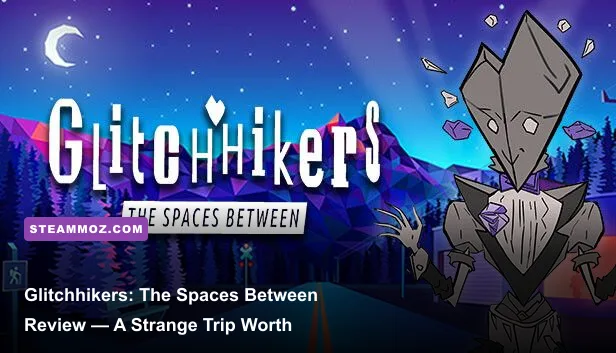
Yes, Glitchhikers: The Spaces Between is worth playing in 2026—provided you want a short, surreal narrative journey rather than a conventional game with combat, upgrades, or a traditional victory screen. The Deluxe Glitchpod Edition is at its best when you let it slow you down: drive through the night, sit with strangers, listen to strange questions, and accept that the journey matters more than any destination.
That recommendation comes with a big qualifier. This is an interactive mood piece, not an adventure game hiding a deep puzzle system underneath its neon coat. Silverstring Media builds its experience around conversation, observation, music, and the uncomfortable feeling that an ordinary trip has become slightly unreal. If you need constant objectives, mechanical mastery, or a plot that explains every symbol, the game may feel thin. If you like slow-burn mystery games and reflective indies, Glitchhikers still has a surprisingly sharp edge.
What Glitchhikers is actually trying to do
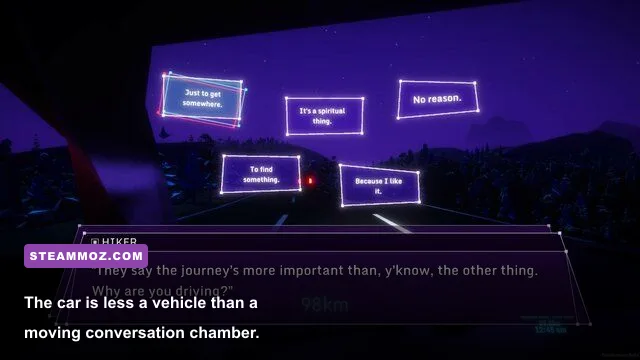
Glitchhikers: The Spaces Between is structured as a series of transitional spaces: a car ride, an airport, a train journey, and a walk through wooded surroundings are among its defining settings. These aren't levels built around enemies or checklists. They're deliberately ordinary places made strange by repetition, lighting, radio chatter, and people who seem to know more than they should.
The central idea is simple: what happens to your mind when you're between destinations? The game treats the highway, terminal, platform, and forest as psychological spaces rather than realistic locations. You aren't conquering them. You're passing through them, and your attention determines what they become.
That makes the player's role unusually passive but not pointless. You can look around, choose responses, interact with environmental details, and decide how much attention to give each encounter. Conversations don't behave like conventional dialogue trees where every answer unlocks a clearly better outcome. A question might be philosophical, playful, invasive, or deliberately nonsensical. The reward is the change in mood and the slow accumulation of meaning.
The game also understands that silence can be a mechanic. A long stretch of road with only the radio and dashboard glow may seem like dead time in another title. Here, that pause is the point. The uncomfortable gaps let previous conversations echo instead of immediately replacing them with a new objective marker.
| Core element | How it works | What to expect |
|---|---|---|
| Exploration | Move through connected travel and waiting spaces | Observation matters more than navigation skill |
| Conversation | Choose responses and engage unusual passengers | Ambiguous, thematic exchanges rather than branching quest chains |
| Progression | Advance by completing scenes and journeys | No character levels, loot, weapons, or skill tree |
| Atmosphere | Lighting, sound, radio, and environmental repetition | The strongest reason to keep playing |
That distinction is important for anyone searching for a conventional review. There are no weapon statistics to compare, no skill rotation to optimise, and no boss telegraphs to memorise. Glitchhikers' challenge is interpretive: deciding what to notice, when to answer, and whether a strange interaction deserves your trust.
🎮 Glitchhikers: The Spaces Between Deluxe Glitchpod Edition
Looking to experience this game? Grab your digital key directly on our store for $13.43.
View on Steammoz Store →The Deluxe Glitchpod Edition is for atmosphere hunters
The Deluxe Glitchpod Edition is best understood as a presentation-focused version of the experience, not a gameplay expansion that radically changes the campaign. The core appeal remains the same: the base Glitchhikers journey, its nocturnal travel spaces, its conversations, and its hazy blend of reality and unreality. Check the current official Steam listing before buying, because bundle contents and regional packaging can change over time.
That caveat matters in 2026. The word Deluxe can create the expectation of new chapters, a larger map, or a substantial mechanical upgrade. This isn't that kind of edition. Its value is tied to how much you enjoy the game's audio-visual identity and whether you want the extras offered in the current package. If you only want to experience the story once, the standard version is likely the more sensible purchase when it is discounted.
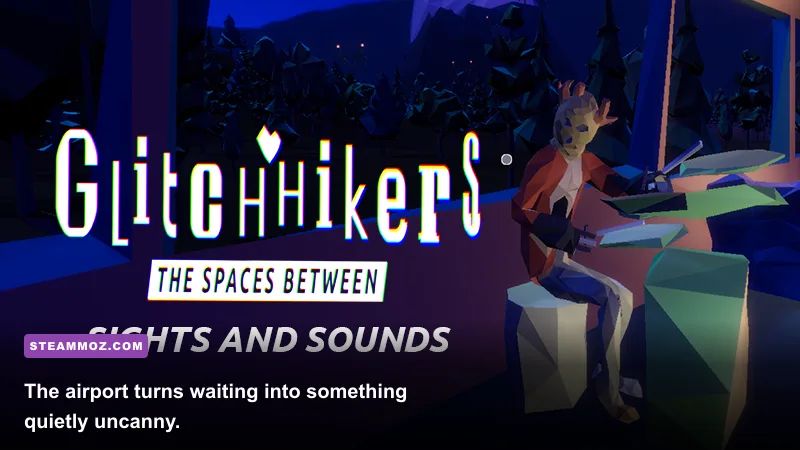
The sound design deserves special attention. Glitchhikers uses the radio, ambient hum, road noise, station announcements, and carefully placed musical shifts to make each environment feel like a different state of mind. Headphones are strongly recommended. On speakers, the game can come across as sparse; through headphones, the distance between a voice and the surrounding silence becomes part of the writing.
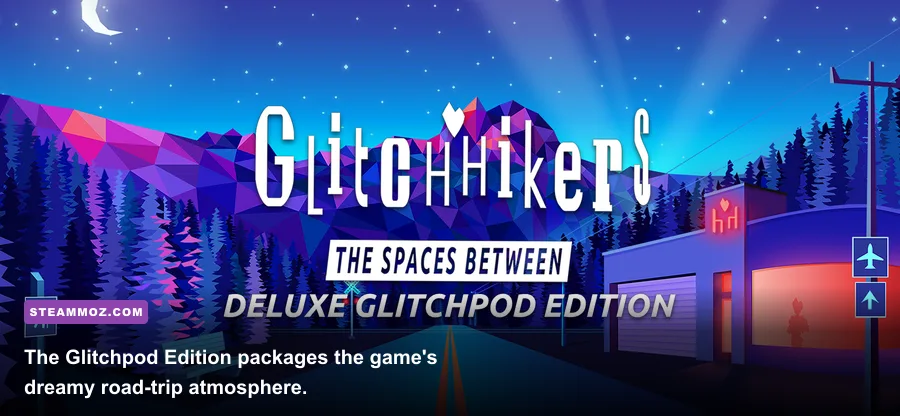
The visual style is similarly restrained. Expect stylised low-poly environments, dark skies, saturated artificial light, and scenes that look deliberately unfinished in places. That roughness is not a technical accident you should automatically judge as a flaw. The game wants locations to feel like remembered spaces: recognisable enough to trust, but unstable enough to question.
| Purchase choice | Best for | Value in 2026 |
|---|---|---|
| Standard edition | Players curious about the core journey | Best choice during a sale or for a one-night playthrough |
| Deluxe Glitchpod Edition | Fans of the soundtrack, artwork, and complete presentation | Worth the premium only when the extras matter to you |
| Wishlist and wait | Players unsure about passive narrative games | Smartest option if the asking price feels high |
For context, it sits closer to the reflective side of games like Dead Pets than to a conventional adventure. It also shares some DNA with the sort of strange, character-led experience discussed in our Arcade Spirits review, though Glitchhikers is quieter, more abstract, and much less interested in delivering a neat romantic or comedic payoff.
Every setting has a different kind of unease
The car and highway
The nighttime drive is the game's clearest statement of intent. You're enclosed in a moving vehicle, surrounded by darkness, with the dashboard and radio providing small islands of certainty. Passengers and conversations interrupt the routine, but they don't always resolve it. The road becomes a loop in your head: familiar enough to relax you, strange enough to keep you alert.
This section works because the game understands the social weirdness of accepting a ride or sharing one. A stranger can be funny, intimate, hostile, or simply impossible to place. You aren't handed a morality meter that announces the correct response. The tension comes from your own reaction to the exchange.
The airport
The airport is less intimate and more openly artificial. Bright signs, open corridors, waiting areas, and the promise of departure create a sense of movement without much actual progress. The design turns background noise into pressure. Announcements and crowds suggest an efficient system, while the conversations pull you toward questions that have nothing to do with your itinerary.
This is where the game can feel most repetitive if you rush. Look at the spaces. Let the soundscape work. The airport's strongest moments aren't necessarily the obvious dialogue scenes; they are the transitions between them, when a normal public place briefly feels staged for an audience that isn't there.
The train and station
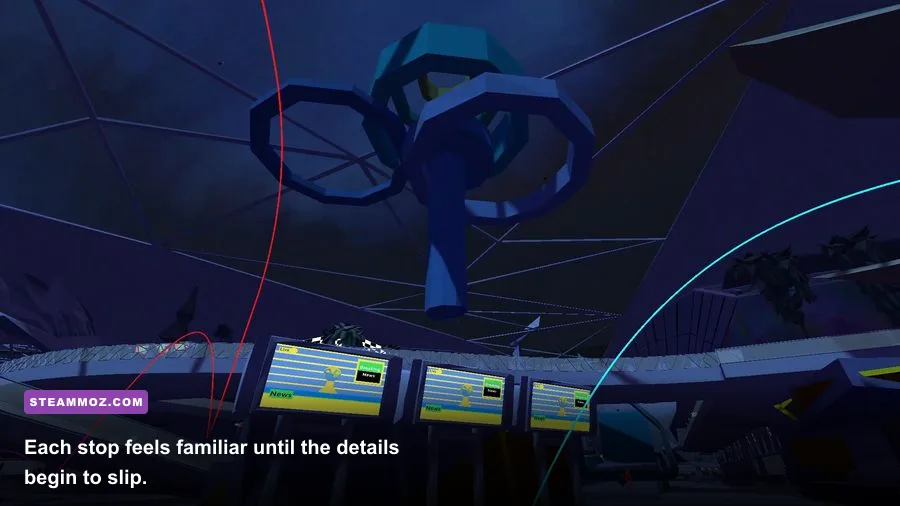
Train travel gives Glitchhikers a different rhythm. The movement is more structured than the open road, and the station's platforms create a strong sense of arrival and departure. The game uses that rhythm to explore the difference between being alone and merely being surrounded by people.
The woods and the spaces beyond
The wooded sections push furthest into dream logic. Paths, darkness, and environmental sound replace the social density of the airport or carriage. These moments can be disorienting, but they also clarify what the game has been building toward: the spaces between destinations aren't empty. They are where memory, anxiety, and imagination start filling in the gaps.
| Setting | Emotional texture | Best way to approach it | Common mistake |
|---|---|---|---|
| Highway and car | Intimate, isolated, conversational | Use headphones and don't skip quiet stretches | Expecting every passenger to provide a clear quest |
| Airport | Public, artificial, restless | Explore the transitions between conversations | Rushing from one dialogue trigger to the next |
| Train and station | Repetitive, liminal, observational | Watch how movement and waiting overlap | Treating the station as a conventional hub |
| Woods | Dreamlike, uncertain, solitary | Follow atmosphere before searching for answers | Assuming every visual detail has a literal explanation |
Performance, controls, and the best way to play
Glitchhikers is not a demanding PC game by modern standards. Its stylised environments and relatively contained spaces mean that current entry-level gaming laptops should handle it comfortably, while older systems may need a little restraint with resolution and effects. The exact experience still depends on your GPU, driver state, and display resolution, so use the live Steam requirements and in-game options as the final authority rather than assuming a 2026 laptop will automatically deliver a perfect result.
Performance matters here for a different reason than it does in a shooter. A sudden hitch during a conversation or a lighting transition can break the fragile spell. If your system struggles, lower resolution or shadow quality first. The visual identity survives a modest reduction in image quality, but stutter is much more damaging to the game's slow rhythm.
| Setting or setup | Recommended choice | Why it helps |
|---|---|---|
| Display mode | Fullscreen or borderless fullscreen | Reduces desktop interruptions during long, quiet scenes |
| Resolution | Native resolution if stable; reduce one step if needed | Preserves clarity without sacrificing smooth camera movement |
| Shadows and lighting | High on modern GPUs, medium on older laptops | These settings carry more atmosphere than distant detail |
| Frame-rate target | Stable 60 fps where available | Makes turning and environmental transitions feel cleaner |
| Audio | Headphones, moderate volume, subtitles enabled if preferred | Lets you hear subtle ambience without losing dialogue |
Controls are intentionally uncomplicated. You move, look, interact, and make dialogue choices. That simplicity is a strength because it keeps the interface from competing with the writing. A controller can make the game feel more like a late-night console journey, while mouse and keyboard offer quicker camera movement and text interaction. Neither changes the underlying experience.
My ideal setup is a stable 60 fps, headphones, a dark room, and no second screen. Don't play it while answering messages. Glitchhikers is unusually sensitive to divided attention because its best details arrive in the margins: a line on the radio, a pause before someone answers, or a visual change you might miss while looking for the next prompt.
Where the game stumbles
The same restraint that makes Glitchhikers distinctive also limits its reach. The conversations are often compelling, but not all of them land equally. Some feel profound because they catch you at the right moment; others sound like fragments from a philosophy notebook. The game rarely tells you which is which, and that inconsistency can make the experience feel self-important when the writing misses.
Its interactivity is also thinner than the presentation suggests. You can make choices, but don't expect a dramatically branching narrative with radically different endings around every turn. The pleasure is in tone and interpretation, not in discovering an optimal route. Players who enjoy replaying games to see measurable consequences may find the second run less rewarding than the first.
Pacing is another risk. A short journey can feel perfectly measured when you're in the mood for it, but painfully slow when you're not. There are stretches where you aren't solving anything and aren't being asked to make a meaningful choice. That's intentional, but intention doesn't make the downtime universally enjoyable.
Finally, the game leaves plenty unresolved. It doesn't hand you a lore document that explains every passenger, symbol, or shift in reality. The lack of answers is thematically appropriate, yet it can still feel like a missing payoff if you approached the game expecting a mystery with a final reveal.
Those weaknesses are worth weighing against other low-pressure narrative games. If you want a more system-driven experience, our Drox Operative 2 review covers a space RPG with far more mechanical texture. If you are specifically hunting for atmospheric games that run on modest hardware, our Drizzlepath Genie performance guide points toward a different but similarly contemplative lane.
Verdict: worth playing, but only at the right speed
Glitchhikers: The Spaces Between Deluxe Glitchpod Edition remains worth playing in 2026 because it offers something many bigger games still struggle to create: a convincing feeling of being between places, people, and versions of yourself. Its best scenes don't arrive as cinematic set pieces. They emerge from a voice in the dark, a fluorescent terminal, a road that seems to continue forever, or a question you weren't prepared to answer.
Buy it if you enjoy narrative experiments, surreal travel stories, atmospheric indie games, and interactive fiction that trusts you to supply some of the meaning. Play it with headphones, take the quiet sections seriously, and resist the urge to sprint toward an ending. The Deluxe Glitchpod Edition is particularly appealing when its extras are priced modestly and you care about the game's music and presentation.
Skip it—or wait for a sale—if you need combat, detailed progression, explicit puzzles, or constant feedback that your choices matter. Glitchhikers won't reward you with stronger gear or a grand final boss. Its reward is subtler: the chance to spend a few hours in a world that feels like a dream you almost remember.
Steamoz verdict: 8/10. Strange, thoughtful, occasionally too pleased with its own ambiguity, and still one of the better short trips for players willing to sit in the passenger seat.
For more information, visit Silverstring Media's official website and the game's official Steam page. Availability, edition contents, and pricing should be checked there before purchase.