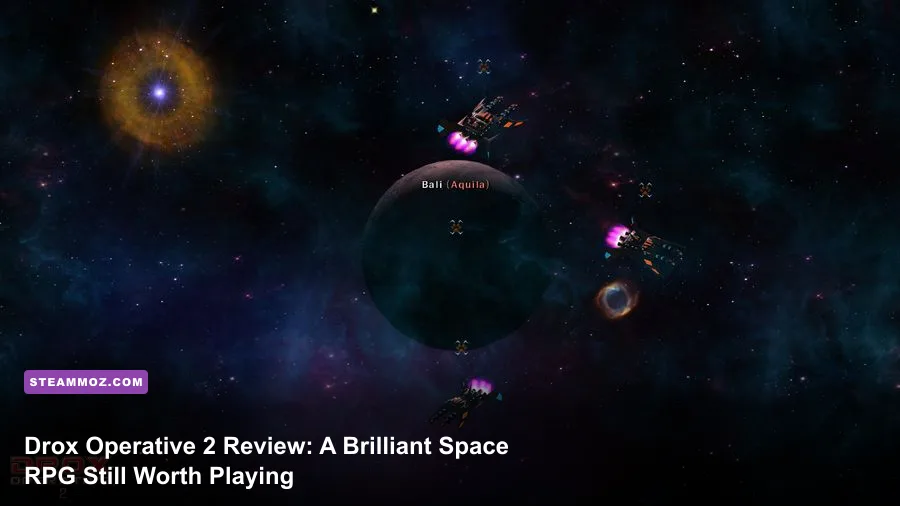
Yes, Drox Operative 2 is worth playing in 2026—especially if you want a single-player space RPG where every decision can reshape an entire galaxy. Its 2D presentation and dated interface won't impress anyone chasing Starfield-scale spectacle, but the combination of Diablo-style loot, real-time ship combat, procedural 4X politics, and permadeath creates a kind of emergent tension that newer games rarely touch. Buy it for the systems, not the screenshots.
This is a review for the player who enjoys discovering an unexpected weakness in an enemy faction, selling stolen technology to the right alien government, or watching a carefully balanced star system collapse because two races went to war. Drox Operative 2 is rough around the edges, occasionally opaque, and unapologetically old-school. Yet once its rules click, it becomes one of the most reactive space sandboxes on PC.
What makes Drox Operative 2 different
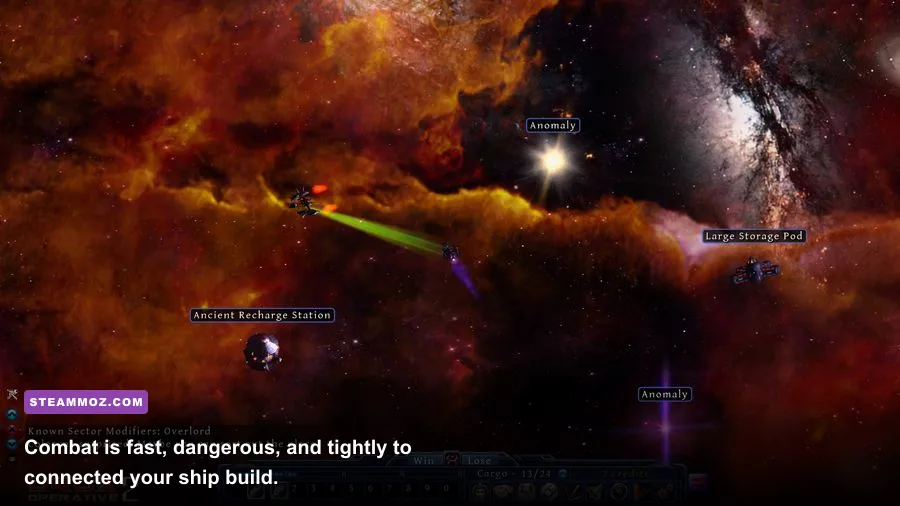
Drox Operative 2 comes from Soldak Entertainment, the studio behind Din's Curse, Depths of Peril, and the original Drox Operative. You control a Drox Operative, a mercenary working inside a procedurally generated star system. Your job is not simply to destroy everything on-screen. You explore planets, accept missions, manage faction relationships, trade equipment, locate colonies, and decide which powers deserve your help.
The galaxy is simulated rather than staged. Factions expand, lose planets, declare war, research technology, and sometimes disappear. A quest can ask you to rescue a colony, destroy a rival's installation, retrieve an artifact, or deliver information before a diplomatic timer expires. The important detail is that these objectives interact. Helping one faction can anger another; destroying a shipyard can weaken an enemy today but leave the system vulnerable to an invading race tomorrow.
That structure gives the game its strongest hook. You aren't following a clean campaign with a fixed dramatic arc. You're writing a messy space-opera story from contracts, accidents, betrayals, and loot drops. If you prefer games with a strong authored narrative, this can feel directionless. If you enjoy stories that emerge from systems, Drox Operative 2 is unusually generous.
The official Drox Operative 2 Steam page remains the best place to check current patches, user reviews, and the latest supported features. Soldak also maintains information through its official game overview.

🎮 Drox Operative 2
Looking to experience this game? Grab your digital key directly on our store for $9.99.
View on Steammoz Store →Combat is simple to learn and surprisingly deep

At first glance, combat looks like twin-stick shooting with a space coat of paint. You steer a ship through open sectors, acquire targets, and fire mounted weapons while managing shields, hull integrity, energy, and cooldowns. The deeper layer comes from equipment slots and damage types. A ship that survives through shields may fold instantly when faced with heavy hull damage, while a fast build can dodge danger but struggle to carry enough power or cargo.
Your main weapon families include beam weapons, projectile guns, missiles, and launchers. Beam systems are attractive for sustained pressure because they connect reliably, while projectile weapons reward keeping enemies inside their firing arcs. Missiles can deliver brutal burst damage, but ammunition, reload behavior, and countermeasures make them less effortless than simply holding the fire button. The right choice depends on your power budget and the enemies appearing in the current system.
Don't judge a module by its damage number alone. Range, firing rate, energy consumption, weapon requirements, mass, and bonuses to specific damage types all matter. A weapon with a larger listed DPS can be worse if it drains your reactor before a prolonged fight ends. Likewise, adding every attractive offensive component can leave your shields too weak to survive a surprise encounter with a hostile faction patrol.
A practical early-game combat plan
Start by fitting one reliable primary weapon, then spend your next equipment decisions on survivability and energy efficiency. Keep at least one defensive option that helps against the dominant damage profile in your current sector. Use hit-and-run movement against larger ships rather than circling directly through their weapon range. When several enemies appear, remove the weakest escort first; reducing incoming fire is usually more valuable than immediately attacking the largest target.
Station services and friendly planets can save a run, so note where repairs and equipment purchases are available. Do not fly deep into unexplored territory with a nearly destroyed hull simply because a quest has a generous reward. Drox Operative 2 is good at turning overconfidence into a loading screen.
| Build Focus | Best Strength | Main Risk | Use It When |
|---|---|---|---|
| Beam-focused | Reliable sustained damage | High energy demand | You can support a strong reactor and want consistent pressure |
| Projectile-focused | Flexible damage and range | Less forgiving aim and positioning | You like active piloting and controlled engagements |
| Missile-focused | Large burst damage | Reload and ammunition pressure | You can dictate distance and finish priority targets quickly |
| Defensive hybrid | Better survival and endurance | Slower kill speed | You are learning a new galaxy or playing cautiously |
That build philosophy is similar to the loadout thinking covered in our Terraria Mobile ranked PvP loadout guide, although Drox's slower battles give you more time to react. The same rule applies: a balanced setup beats a theoretically perfect damage build that collapses under pressure.
Loot, equipment, and progression reward adaptation
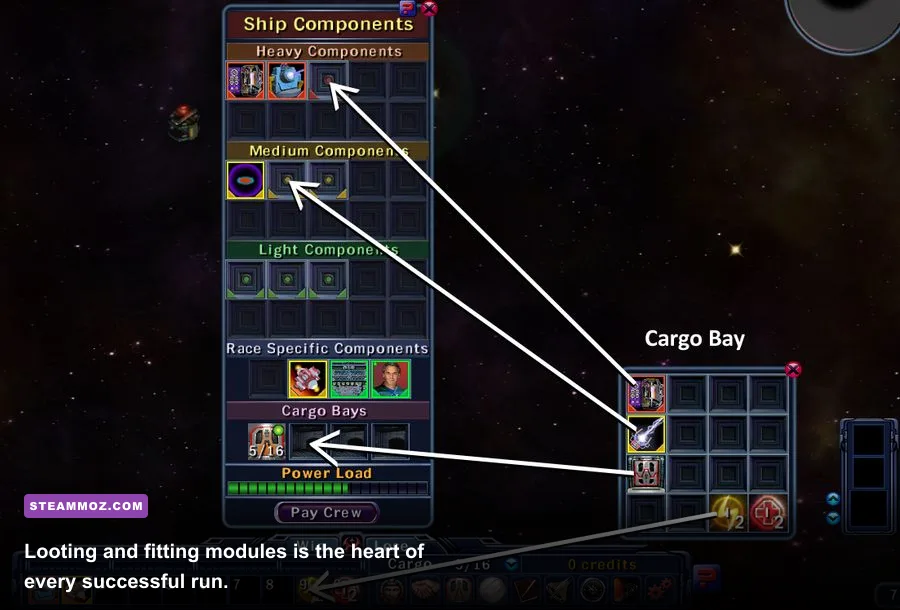
Drox Operative 2 uses the familiar action-RPG loop of kill, loot, compare, equip, and sell, but the equipment decisions are more strategic than in a typical dungeon crawler. New gear can alter your ship's role rather than merely increase a damage-per-second bar. Bonuses to shields, armor, cargo, sensors, speed, regeneration, energy, and diplomacy can all be valuable depending on the state of the galaxy.
Progression also has a useful rhythm. Early sectors are about finding a stable core setup. The middle game asks you to specialize without losing basic defenses. Later systems punish outdated equipment and force you to reconsider whether your favorite weapon still matches the threats around you. A component that felt dominant in the opening sector may become inefficient once enemies gain stronger resistances or attack in larger groups.
Pay attention to ship requirements before selling older items. Some gear is unusable until your ship meets its stat or slot demands, and keeping one or two upgrade paths open can be smarter than immediately liquidating everything. Cargo capacity matters too: extra space lets you carry quest objects and profitable equipment, but cargo upgrades compete with combat modules.
The economy is not deep enough to rival a dedicated trading simulator, yet it is meaningful. Sell items where demand and faction access make sense, buy only what fixes a clear weakness, and avoid spending every credit after a good haul. A financial buffer gives you options after a catastrophic battle or an unexpected diplomatic shift.
| Progression Stage | Priority | What to Replace | Common Mistake |
|---|---|---|---|
| Opening sector | Energy, shields, dependable weapon | Starter equipment with weak output | Chasing rare gear while ignoring repairs |
| Mid-game systems | Damage specialization and sensors | Modules that no longer match enemy defenses | Using one damage type against every target |
| Late systems | Resistances, hull survival, efficient power use | Low-level components with attractive bonuses | Entering hostile zones without an escape plan |
Players who enjoy deliberate progression may also like our guides to Valheim's best early skills and earning resources efficiently in Satisfactory. Drox is less orderly, but the underlying lesson is identical: spend resources to solve your next problem, not to make a spreadsheet look impressive.
Diplomacy is the real endgame challenge

The most interesting part of Drox Operative 2 often happens when you're not shooting. Every faction has relationships, needs, enemies, and opinions about your behavior. A friendly government can offer quests, trade opportunities, or safe access. A hostile one can send ships after you or turn a routine delivery into a dangerous detour.
Diplomacy is not a morality meter. There is no universally correct choice. A faction may be unpleasant but strategically useful because it blocks a stronger enemy. Another may be friendly but too weak to survive without your help. You have to read the map, inspect faction standings, and decide which conflict benefits your long-term run.
Before accepting a quest that targets a faction, check who owns nearby planets and how the mission will affect relationships. Information missions and deliveries can be safer ways to build standing than combat, while destroying a key structure may create immediate gains but ignite a war. When the galaxy becomes unstable, protect routes between friendly planets and keep enough mobility to leave a fight that has grown beyond your ship's limits.
This political layer is why a new run stays interesting after you understand combat. The map changes, the faction mix changes, and your own reputation changes the available options. It is closer to managing a volatile campaign than clearing a fixed sequence of levels. Fans of large-scale strategy can find a similar appetite for composition and faction synergy in our Total War: Warhammer 3 team composition guide, though Drox expresses those decisions through a single ship.
Performance, presentation, and quality-of-life problems
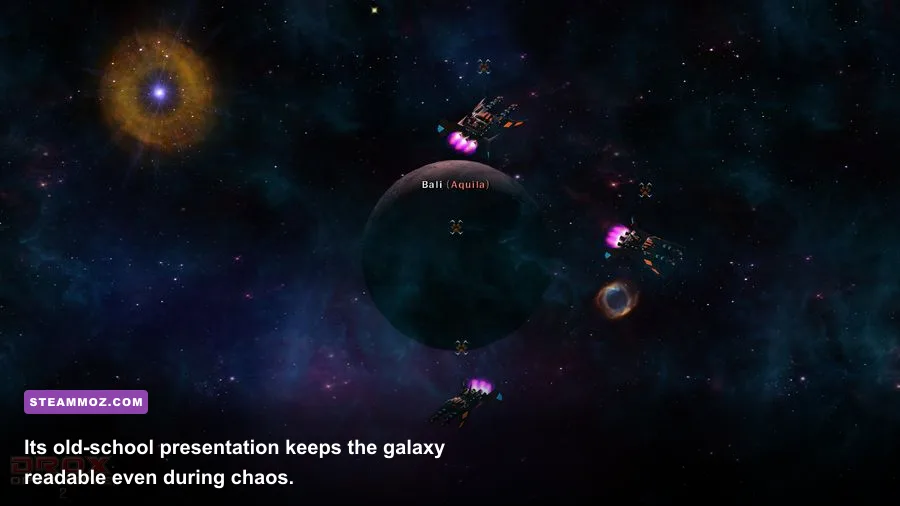
Technically, Drox Operative 2 is easy to run. The top-down 2D visuals are clear rather than lavish, and the game does not demand a modern graphics card. The more relevant performance issue is simulation load: a crowded sector with many factions, ships, projectiles, and active objectives can feel busier than an empty system. Reducing visual effects can help readability and smoothness, although most modern PCs should handle the game comfortably.
| Setting or Profile | Recommended Value | Performance Impact | Visual Result |
|---|---|---|---|
| Resolution | Native monitor resolution | Low on modern hardware | Sharper interface and ship sprites |
| Effects and particles | High unless combat becomes crowded | Moderate during large fights | Clearer weapon impacts and explosions |
| Background detail | High | Low | Better sector atmosphere with little cost |
| Screen shake and combat clutter | Lower if available or preferred | Minimal FPS gain | Improves target tracking and readability |
| Display mode | Borderless or fullscreen | Usually negligible | Choose based on alt-tab convenience |
The bigger obstacle is usability. Menus contain a lot of information, icons are not always self-explanatory, and the game rarely pauses to explain why one faction suddenly hates you. Inventory management can become tedious when you're comparing dozens of modules, and the interface feels designed for players who enjoy experimenting rather than players who want immediate clarity.
That friction is real, but it is manageable. Read item tooltips carefully, pause regularly to inspect nearby threats, and keep notes about faction relationships during a complicated run. If your PC struggles with a different modern game, our Zenless Zone Zero performance settings guide covers more demanding optimization work; Drox generally needs far less intervention.
The official Soldak Entertainment website and the developer's Steam community discussions are useful when a tooltip or unusual quest interaction leaves you guessing. The Soldak forums are also worth checking for older build advice and developer explanations.
Is Drox Operative 2 worth playing in 2026?
Drox Operative 2 is worth playing in 2026 if your ideal space game includes loot comparisons, procedural politics, real-time combat, and the possibility of losing a carefully developed operative. It remains a poor fit if you need cinematic storytelling, modern 3D visuals, a large multiplayer community, or a frictionless tutorial.
Its age shows in the interface, onboarding, and presentation, but the central simulation still feels distinctive. Few games let you move from a desperate dogfight to a diplomatic negotiation, then sell recovered technology while deciding whether a nearby faction deserves to survive. The best moments are not scripted boss fights. They are the consequences of your choices: a trade route collapsing, an ally requesting help at the worst possible time, or a supposedly weak enemy becoming a regional power because you ignored them.
My verdict is 8/10 for systems-focused players. Treat it as a compact, replayable space sandbox rather than a blockbuster RPG and it becomes much easier to appreciate. Start on a forgiving difficulty, build around reliable energy and defenses, inspect faction relationships before accepting destructive quests, and give the procedural galaxy enough time to surprise you.
Final recommendation: buy Drox Operative 2 on sale if you're curious, and buy it immediately if you already enjoy Soldak's action-RPG design. In 2026, it is still a strange, demanding, remarkably replayable game—and there is nothing else quite like it.