Yes, Digimon World: Next Order is worth playing in 2026—but only if you want a slow-burn creature-raising RPG rather than a fast, story-driven monster battler. Its real-time combat, two-partner system, brutal evolution requirements, and wonderfully weird daily routine still feel distinctive. The catch is that the game explains almost none of this well, and the first ten hours can feel like unpaid childcare with boss fights.
The 2023 PC, Nintendo Switch, and PlayStation 4 release is still the best way to experience the game outside its original Vita roots. It includes the additional content and quality-of-life improvements added to the international release, including the ability to raise two partners from the start and the Extra Training difficulty option. It is not a technical showcase, but it remains one of the few Digimon games where your relationship with a partner genuinely shapes the adventure.

What makes Next Order different in 2026

Next Order is not structured like Digimon Story: Cyber Sleuth. You do not assemble a permanent party from a menu, pick turn-based commands, and move cleanly from one plot beat to the next. Instead, you raise two living partners who need food, sleep, praise, discipline, and medical attention. They age, die, and are reborn as eggs. That cycle is the entire engine of progression.
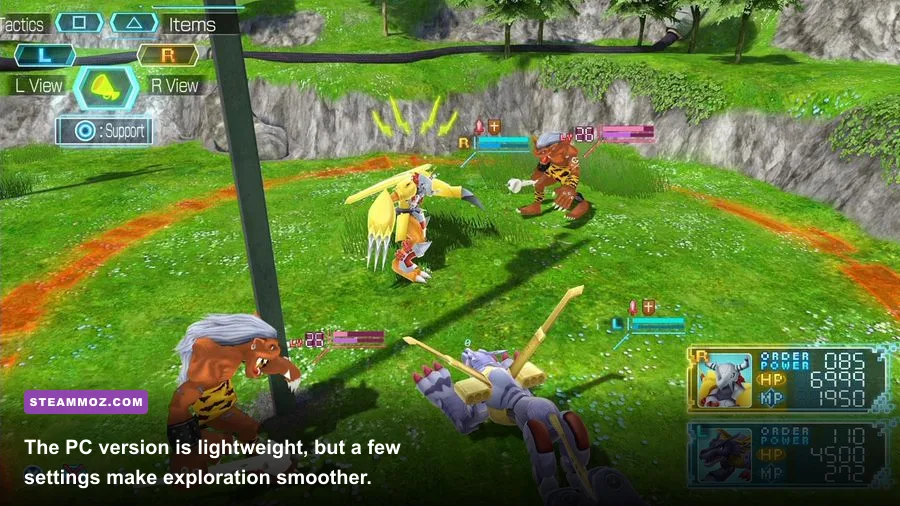
Your partners accompany you through the Digital World, but you issue broad combat commands rather than manually controlling every attack. The command wheel lets you order techniques, defend, switch targets, or spend Order Power on stronger moves. Each partner has a finite MP pool and a set of learned techniques, so combat is partly about positioning and partly about managing resources before the next training break.
The most important improvement over older Digimon World games is the two-partner format. One partner can draw attention while the other uses a high-damage technique, and both can receive support from your Tamer skills. The system creates satisfying little emergencies: one partner is low on HP, the other has enough Order Power for a finishing attack, and the boss is about to use a wide-area move.
That design also creates friction. A bad training day affects two evolution paths at once. If both partners are hungry, fatigued, or carrying injuries, the problem compounds quickly. This is why the game feels much better after you unlock more Floatia facilities. The opening is deliberately constrained; the middle game is where the systems finally start paying you back.
For a useful comparison, Next Order has more personality than the classic RPGs covered in our Dungeon Siege retrospective, but it is much less immediately readable. You are expected to experiment, fail, and keep notes.
🎮 Digimon World: Next Order
Looking to experience this game? Grab your digital key directly on our store for $9.59.
View on Steammoz Store →The training loop is the real game
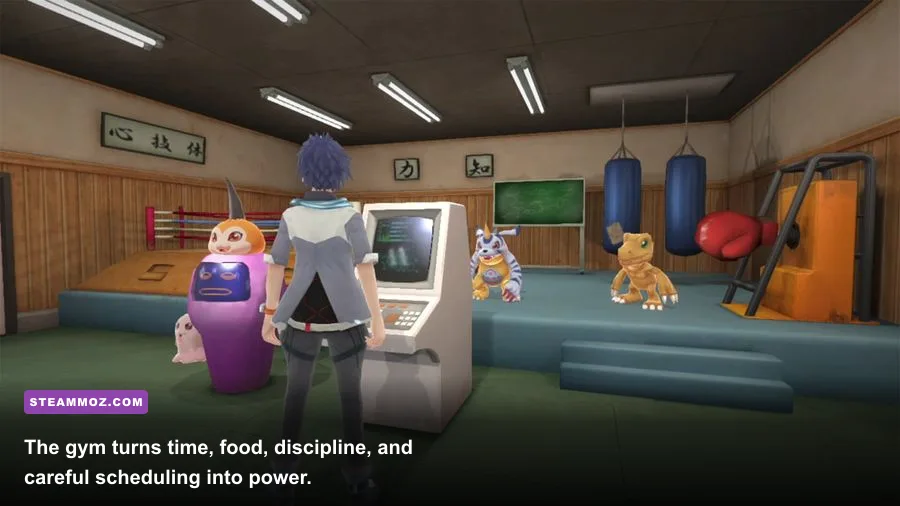
Every rookie starts with a limited set of possible evolutions. The route is determined by several requirements, including HP, MP, STR, DEF, WIS, SPD, weight, care mistakes, victories, and battle techniques. The exact requirement depends on the evolution and the partner’s current age. Raising one stat to a target number is not enough if your weight or care history pushes the partner toward another form.
Training at the Gym produces the fastest stat gains, while battles provide experience, money, techniques, and less predictable growth. The Gym contains multiple training stations, and each partner can be assigned a stat focus. A basic session increases a selected parameter while consuming time and stamina. Resting, eating, and using recovery items are not optional chores; they are how you keep the training schedule from collapsing.
Food matters more than new players expect. Meat from Tanemon’s farm gradually increases your daily supply, while better food can affect weight and mood. Weight is one of the hidden pressure valves in evolution. Feeding constantly to keep partners happy can accidentally push them toward forms you did not want. Starving them is worse: hunger lowers mood and can trigger care problems.
Care mistakes happen when you ignore a call, allow hunger or fatigue to linger, fail to treat sickness, or let a partner sleep in an unsuitable situation. You do not need a perfect record for strong evolutions, but you do need to understand that “good care” is not the same as keeping every meter full. Sometimes you deliberately accept a care mistake to reach a specific route.
Evolution requirements are easier to manage when you use the in-game Field Guide and the city’s later upgrades, but the guide is still not a complete planner. If you want a specific Champion or Ultimate, keep a manual record of current parameters and stop training once the target is safely met. Overtraining is one of the easiest ways to miss a route.
| Progression Stage | Primary Goal | Best Activity | Common Mistake |
|---|---|---|---|
| Fresh to Rookie | Establish food and basic techniques | Short Gym sessions and safe fights | Training until fatigue ruins the day |
| Champion | Unlock Floatia facilities | Recruitment trips and early quests | Chasing Ultimate stats too early |
| Ultimate | Build a reliable combat pair | Area progression and technique farming | Ignoring MP and recovery costs |
| Mega | Prepare for late bosses | Focused stat training and high-level zones | Assuming evolution alone guarantees victory |
There is a wonderful rhythm here once it clicks: explore in the morning, recruit a Digimon or gather materials, return to Floatia before fatigue spikes, train one stat, feed both partners, and sleep. It is closer to running a tiny sports team than collecting Pokémon. Players who enjoy long-term routines will love it. Players who want constant narrative momentum may bounce off hard.
Combat rewards preparation, not twitch skill
Combat takes place in real time, but it is not an action game. Your partners automatically attack and move toward targets. Your job is to select techniques, manage their positioning, use commands at the right moment, and avoid wasting MP on enemies that do not justify it. The strongest fights are won before the battle begins through stat thresholds, technique selection, food, and healing items.
Order Power is the system that gives you meaningful control. Successful actions and commands build the resource, which can be spent on more powerful partner orders and dual attacks. Save it for a boss phase or use it early to erase a dangerous enemy before it gets a second attack. The correct choice depends on whether the next area contains a healing opportunity.
Technique attributes are crucial. Fire, water, ice, thunder, wind, earth, light, and dark attacks interact with enemy weaknesses, while physical techniques can remain useful when MP is scarce. A strong pair should cover different elements instead of carrying two expensive versions of the same attack. A partner with high WIS benefits from technique damage and MP efficiency, while STR-oriented partners get more from physical attacks and direct damage.
The command menu is also where the game hides its defensive play. If a boss begins a recognizable wind-up, ordering a partner to defend can reduce incoming damage and buy time for recovery. Wide-area attacks are especially dangerous when both partners stand together. Pull one partner away, let the other maintain pressure, and avoid spending all your Order Power during the first half of a long fight.
Machinedramon is an early reality check. It has enough damage and durability to expose undertrained partners, and its attacks punish players who treat the encounter like a normal field battle. Later enemies in areas such as the Bony Resort, Logic Volcano, and Server Desert ask for the same lesson at a higher price: carry healing, watch MP, and do not enter a boss room after a training session has already exhausted your team.
| Build Focus | Priority Stats | Technique Plan | Best Use |
|---|---|---|---|
| Physical attacker | STR, HP, DEF | Low-cost physical move plus one burst attack | Long exploration runs and durable bosses |
| Technique caster | WIS, MP, HP | Two different elemental attacks | Weakness exploitation and boss phases |
| Balanced partner | HP, DEF, STR, WIS | One reliable attack and one utility option | First playthrough flexibility |
| Support partner | WIS, MP, SPD | Healing, buffs, and a cheap attack | Keeping an aggressive partner alive |
Combat is satisfying once you understand its tempo, but it will not satisfy anyone looking for precise dodges or elaborate combos. The game’s tactical depth comes from choosing when to commit resources. That can feel brilliant against a difficult boss and clumsy against a low-level Goblimon that refuses to die quickly.
Floatia turns frustration into momentum
Floatia is the reason a disappointing first generation does not feel like a total loss. Recruited Digimon return to the city and unlock services. Jijimon provides direction, while residents such as Tentomon, Veemon, and other recruitable characters expand shops, storage, training, transportation, and item production. The city slowly changes from a handful of buildings into a practical headquarters.
Recruitment is rarely just a matter of winning a fight. Some residents need a particular item, a conversation, a race, a delivery, or a specific event in an area. This is where the game’s exploration loop becomes rewarding. You revisit places with stronger partners, notice paths that were previously unsafe, and discover that an apparently minor NPC can improve your daily routine dramatically.
The builder system is not as complex as a full city-management game, but it gives progression a tangible shape. More Prosperity means more options and better infrastructure. The Gym’s facilities become more valuable as you unlock improved training, and the warehouse reduces the constant inventory pressure that dominates the opening hours.
Do not rush the main story at the expense of recruitment. A few extra residents can save more time than an hour of raw stat grinding. Conversely, do not treat every side quest as mandatory before advancing. Some requests are much easier after you have access to better travel options, stronger partners, or improved recovery supplies.
That push and pull is one of Next Order’s best ideas. The game does not simply give you a stronger monster after every chapter. It gives you a better place to live, then asks you to decide whether the next expedition is worth the risk. It is a slower form of progression, but it makes Floatia feel earned.
PC performance, visuals, and 2026 value
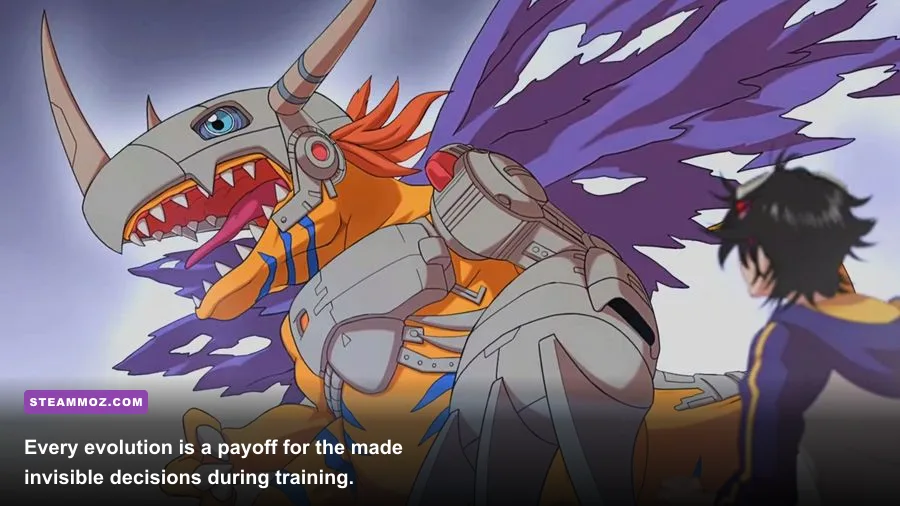
On PC, Next Order is easy to run by modern standards. The environments are built around older console hardware, textures are modest, and the character models show their age. The payoff is stable performance on mainstream gaming laptops and handheld PCs. The game is also a natural Steam Deck candidate, though text and interface elements can feel small on the seven-inch display.
The most important performance choice is not visual quality; it is consistency. Use a frame-rate cap that your hardware can sustain rather than chasing a number the engine cannot hold everywhere. Floatia, effects-heavy attacks, and busy battles can behave differently from quiet field areas. A stable 60 frames per second feels ideal when available, while 30 is perfectly playable for a turn-adjacent command system.
| Setting | Recommended Value | FPS Impact | Visual Note |
|---|---|---|---|
| Resolution | Native display resolution | Medium | Sharper UI and environment edges |
| Frame-rate cap | 60 FPS on PC, 30 FPS on weaker handhelds | High for stability | Prevents uneven frame pacing |
| Anti-aliasing | Highest stable option | Low to medium | Softens jagged foliage and models |
| Shadow quality | Medium | Medium | Lower this first on integrated graphics |
| Effects quality | High if stable | Medium | Preserves technique spectacle |
At full price, the recommendation depends on your tolerance for repetition. The game’s value comes from dozens of hours of raising, recruiting, and revisiting areas, not from a short campaign polished to a modern AAA standard. A sale makes the decision easy. If you like creature raising, old-school RPG friction, or games that let you build a routine around a party, it is a strong buy. If you need clean quest markers, instant evolution explanations, and fast travel from the opening hour, wait for a deep discount.
For broader PC optimization advice, our Dragonkin settings guide covers the same frame-pacing mindset, while our ELEX PC fixes is useful if you are troubleshooting an older machine.
Verdict: a flawed classic for the right kind of player
Digimon World: Next Order is worth playing in 2026 because nothing else quite combines creature care, city building, exploration, and real-time partner management in this way. Its best moments are specific: finally guiding a partner into the evolution you planned, returning from a dangerous expedition with a new Floatia resident, or surviving a boss because you saved enough Order Power for the final phase.
Its worst moments are just as specific. The opening tutorial barely teaches the systems that determine evolution. Training can feel repetitive. Partners die on a schedule that makes emotional attachment complicated, especially when a favorite Digimon disappears after one bad expedition. The camera and menus are functional rather than elegant, and the story is mostly a framework for sending you back into the field.
Still, the roughness is tied to the game’s identity. Next Order wants you to pay attention to your partners as creatures with needs, not as interchangeable slots. It asks you to plan around time, fatigue, food, technique costs, and the possibility that a perfect run will still end in a rebirth. That is inconvenient design, but it is also why the game remains memorable.
Check the official Steam page for current PC pricing and platform details, and compare the release information on Bandai Namco’s official Digimon page. The publisher’s game listing is also the safest place to verify supported editions and features.
My final score is 8/10 for patient monster tamers, 6/10 for everyone else. It is not the smoothest Digimon RPG, and it is not trying to be. Give it time, keep notes, accept that some partners will die, and Next Order becomes a surprisingly absorbing adventure that still feels refreshingly unlike its competition.
If you prefer more straightforward RPG progression, you may enjoy our review of Don’t Be Afraid 2. But if the idea of turning a messy digital wilderness into a functioning home sounds appealing, Next Order remains the better recommendation—and one of 2026’s most overlooked monster-raising games.