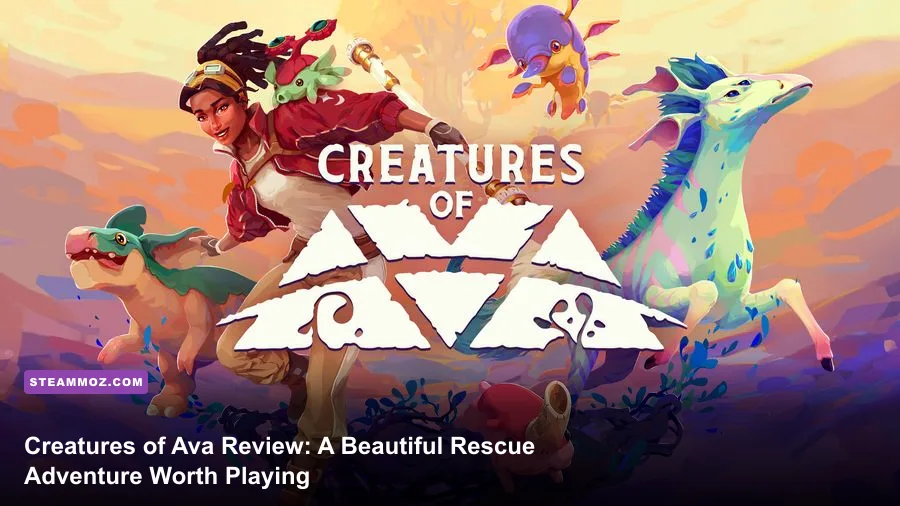
Yes, Creatures of Ava is worth playing in 2026 if you want a relaxed, story-driven adventure about saving wildlife rather than defeating it. Its creature collecting is charming, the world is gorgeous, and the rescue tools give exploration a satisfying sense of purpose. The catch is that Ava is more of a linear adventure with open zones than a true creature-collecting RPG, and its combat, progression, and side activities are deliberately lightweight. On PC, it also benefits from a little performance tuning.
That distinction matters. This isn't Pokémon with a science-fiction skin, nor is it a conventional open-world game packed with endless quests and gear drops. Developed by Inverge Studios and published by Chibig, Creatures of Ava puts you in the role of Vic, a young explorer documenting life on the planet Ava while a spreading infection threatens its ecosystems. Your job is to understand the creatures, cleanse them, and rescue them before the planet's crisis gets worse.
After revisiting the game in 2026, my verdict is straightforward: Ava is an easy recommendation for players who enjoy colorful exploration, creature behavior, environmental puzzles, and emotional stories. It is a weaker fit if you need deep combat builds, competitive mechanics, or hundreds of hours of procedural content. Think of it as a compact conservation adventure with cozy-game instincts and a surprisingly serious ecological message.
What Creatures of Ava actually does well
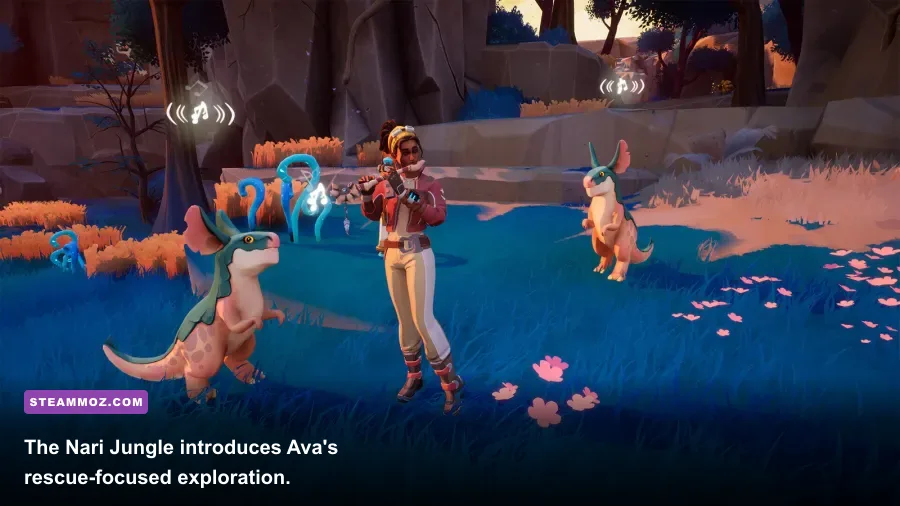
The strongest part of Creatures of Ava is the way it makes exploration feel useful. Vic isn't simply wandering through a pretty alien jungle collecting glowing objects. Each new path usually connects to a creature, an environmental obstacle, a research task, or a piece of the planet's larger mystery. You learn how Ava's wildlife behaves, identify what has been affected by the Withering, and use the correct tool to intervene.
That loop gives the game a welcome identity. The central fantasy isn't “become the strongest trainer.” It's “become competent enough to help.” That difference shows up in the design of the creatures, too. They aren't just combat statistics with fur, feathers, or extra limbs. Their animations, calls, movement patterns, and habitats make them feel like animals occupying a functioning ecosystem.
Vic's tools create the game's real progression
Vic's equipment includes the Nafitar staff, a camera, a flute, and a healing ability used to deal with the Withering. The staff is your main exploration tool, letting you interact with environmental growth and access routes that were previously blocked. The camera supports Ava's research and encourages you to stop treating the scenery as decoration. The flute is especially important because it lets you interact with creatures in a more personal way instead of reducing every encounter to a menu prompt.
There are no conventional weapons with damage values, rarity colors, or upgrade trees. That is both refreshing and limiting. You never have to compare three nearly identical rifles or grind for a better sword, but you also don't get the crunchy sense of mechanical progression found in an action RPG. New abilities unlock new possibilities, not bigger numbers.
| Tool or system | What it does | Why it matters | Best use |
|---|---|---|---|
| Nafitar staff | Interacts with environmental growth and obstacles | Opens routes and supports puzzle solving | Blocked paths, traversal puzzles, Withering-related areas |
| Camera | Records creatures and points of interest | Builds knowledge of Ava's wildlife | Research tasks and optional exploration |
| Flute | Creates a musical interaction with creatures | Strengthens the rescue and bonding fantasy | Creature encounters and calming sequences |
| Healing ability | Cleanses creatures affected by the Withering | Turns rescue into an active gameplay challenge | Infected wildlife and story encounters |
| Creature abilities | Provides situational help during exploration | Lets rescued creatures assist with access and puzzles | Environmental puzzles and hidden routes |
The result is a progression curve based on understanding rather than power. You'll revisit earlier-looking problems with a new ability and realize the game was quietly teaching you how Ava works. That design is less immediately addictive than a loot treadmill, but it suits the conservation theme far better.
If you usually prefer dense RPG progression, you may find Ava too simple. Players coming from slower adventure games, however, will likely appreciate the lack of inventory clutter. For a different kind of character-building discussion, our guide to the best beginner build for Clair Obscur: Expedition 33 shows just how different a stat-heavy RPG can feel.

🎮 Crea
Looking to experience this game? Grab your digital key directly on our store for $14.99.
View on Steammoz Store →How the creature rescue gameplay feels in practice

Creature rescue is at its best when the game gives you a reason to observe before acting. Infected animals often telegraph their condition through visual distortion, aggressive behavior, or environmental clues. You approach, identify the problem, use the appropriate cleansing interaction, and then complete the creature-specific sequence. The game is not trying to test twitch reflexes as much as it is testing whether you noticed the pattern.
That makes the experience approachable, but it also means the challenge rarely becomes demanding. The rescue encounters are more about mood and context than failure states. You won't spend hours perfecting a boss rotation or learning frame-perfect counters. Instead, the satisfaction comes from seeing an animal return to normal and eventually finding it in a safe habitat.
There is no traditional combat build to master
Creatures of Ava includes hostile situations, but its design avoids turning Vic into a conventional fighter. Your tools are built around cleansing, escaping, stunning, or navigating rather than dealing damage through weapon combos. That makes the game suitable for players who dislike violence-heavy adventure games, but it can feel underpowered if you arrive expecting a combat-focused creature RPG.
The most effective approach is to treat every dangerous encounter as an environmental puzzle. Look for the source of the Withering, pay attention to the creature's movement, and don't rush into the center of an affected area. Use the camera whenever the game introduces a new species or visual clue. Research isn't merely collectible padding; it often tells you what the creature needs and why the region is changing.
| Situation | What to watch for | Best response | Common mistake |
|---|---|---|---|
| First meeting with a creature | Movement, calls, habitat, and nearby objects | Observe and photograph before interacting | Running straight toward it |
| Creature affected by the Withering | Dark growth, visual distortion, unusual aggression | Clear the area and begin the cleansing interaction | Ignoring environmental hazards |
| Blocked exploration route | Staff-reactive growth or a creature-related obstacle | Return after unlocking the relevant ability | Assuming every path opens immediately |
| Optional research objective | Unusual behavior or a species-specific clue | Use the camera and read the journal entry | Treating research as meaningless collectibles |
The creature interactions are also where the game's emotional writing lands hardest. Ava wants you to care about individual species, not just the abstract idea of saving a planet. Some encounters are gentle and funny; others are shaped by fear, sickness, or the consequences of human intervention. It isn't subtle about its themes, but the directness works because the creatures carry the message.
For more difficult games that reward careful planning instead of improvisation, compare this approach with our Badlands Crew tips. Ava is much more forgiving, but the same principle applies: understanding the situation before committing is usually better than rushing.
World design, regions, and story pacing
Ava's world is divided into distinct regions, including the Nari Jungle and Tamura Grasslands, with each area introducing its own visual language, wildlife, hazards, and traversal rhythm. These zones feel open enough to support detours, but they are not trying to imitate a massive sandbox. The main route remains readable, and optional paths usually reward curiosity with research, lore, resources, or new creature encounters.
The Nari Jungle is the clearest expression of the game's early design. Dense vegetation makes the environment feel alive, while the staff and camera teach you to look for interaction points. The Tamura Grasslands open the view and make creature movement easier to read. Later areas push further into the effects of the Withering, creating a stronger contrast between healthy habitats and damaged ecosystems.
Why the compact structure helps
In 2026, a lot of open-world fatigue comes from games that inflate their maps with repetitive chores. Creatures of Ava avoids most of that. Its zones are large enough to explore without becoming exhausting, and its story rarely loses sight of Vic's expedition. You can finish the main adventure in a manageable weekend or spend longer photographing wildlife and cleaning up optional objectives.
The trade-off is that the world can feel artificial once you start noticing its boundaries. Some paths are clearly staged for a particular ability, and certain creature encounters are tightly choreographed. Ava is not a systemic simulation where animals create unexpected stories. It is a curated adventure that uses the appearance of an ecosystem to guide you through a sequence of emotional and mechanical beats.
That structure works especially well for players who want something relaxing after a punishing RPG. If you're hunting for a completely different kind of short-form adventure, Steamoz's list of games like 10 Second Ninja X goes in a far more arcade-focused direction, while Ava is happy to let you stop and listen to the wildlife.
PC performance and the best settings for 2026
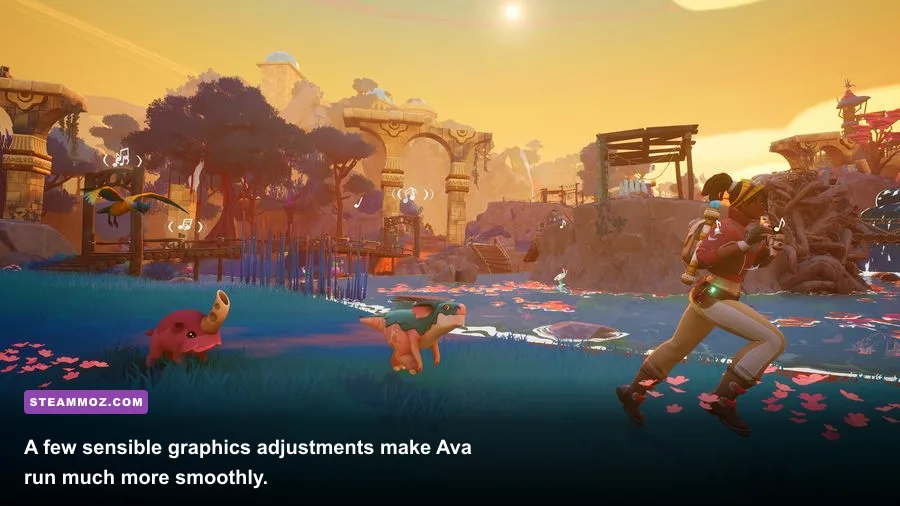
The PC version is attractive but not weightless. Dense foliage, animated creatures, volumetric effects, and wide outdoor views can make frame times uneven, particularly in the jungle regions. Your experience will depend heavily on GPU memory, resolution, and whether you prioritize image quality or stable movement during exploration.
The official Steam listing gives the minimum target as an Intel Core i5-8400 or AMD Ryzen 5 2600, 8GB of RAM, and a GeForce GTX 1060 or Radeon RX 580. The recommended target rises to an Intel Core i7-9700 or AMD Ryzen 7 3700X, 16GB of RAM, and an RTX 2070 or Radeon RX 5700 XT. Those specifications remain reasonable in 2026, though a modern six-core CPU and 16GB of RAM are the safer baseline for consistent streaming between regions.
| Setting | Recommended value | Performance impact | Visual trade-off |
|---|---|---|---|
| Resolution | Native 1080p or 1440p | Very high | Lower resolution is the fastest performance win |
| Foliage quality | High on modern GPUs; Medium on GTX 1060-class hardware | High | Medium reduces vegetation density and distance detail |
| Shadows | Medium or High | Medium to high | Medium softens distant shadows without ruining the image |
| Volumetric effects | Medium | High in misty regions | Lower settings reduce atmospheric lighting |
| Texture quality | High with 6GB or more VRAM | Low to medium | Lower textures are noticeable on rocks and creature surfaces |
| Motion blur | Off | Small | Cleaner camera movement and creature tracking |
| Frame-rate cap | 60fps, or 30fps on minimum hardware | Improves consistency | A cap can feel smoother than unstable uncapped frames |
For a balanced 1080p profile, keep textures on High, set foliage and shadows to Medium, use Medium volumetrics, disable motion blur, and cap the game at 60fps. If you are playing at 1440p, reduce volumetrics before textures; the atmosphere takes a hit, but creature detail remains intact. On handheld PCs, 30fps is a realistic target in heavier outdoor areas, while a 40fps cap can work if your device has enough headroom.
Stutter is more distracting than a lower average frame rate because Ava's experience is built around smooth camera movement and creature animation. Close background launchers, use an SSD, and let shader compilation finish if your platform performs it on first launch. Our low-FPS settings guide for A Year of Rain covers the same broader rule: fix frame pacing before chasing maximum visual quality.
Before buying, check the official Steam page for current patches, system requirements, and platform information. The Inverge Studios website is also worth checking for developer updates, while Chibig's official site provides publisher news and information about the studio's projects.
Is Creatures of Ava worth playing in 2026?
Creatures of Ava earns its recommendation through focus. It knows that not every adventure needs a combat tree, a hundred-hour map, or a mountain of loot. The rescue mechanics are simple, but they reinforce the game's central idea: pay attention, understand the creature, and help it survive. That consistency makes the quieter moments feel purposeful rather than empty.
Its shortcomings are just as clear. The story can be predictable, the puzzles rarely push experienced players, and the creature systems don't have the long-term depth of a true collecting RPG. Once you've learned the basic rescue loop, the game mostly varies the setting and context rather than radically expanding the mechanics. Completionists may also find the optional objectives more repetitive than rewarding.
| Player type | Verdict | Why |
|---|---|---|
| Cozy-game fan | Strong buy | Gentle exploration, expressive creatures, and low-pressure progression |
| Creature-collecting enthusiast | Buy on sale | Excellent creature fantasy, but limited training and battle depth |
| Open-world completionist | Maybe | Compact regions and a manageable activity list may feel too small |
| Combat-focused RPG player | Wait for a deep discount | No weapon builds, damage stats, or demanding combat loop |
| Game Pass subscriber | Definitely play | Low-risk way to experience a polished, focused adventure |
My final score for 2026 is 7.5/10. The game is not a hidden replacement for Pokémon, Horizon, or a full-scale open-world RPG. It doesn't need to be. It is a warm, visually striking expedition that uses creature rescue to tell a story about responsibility, extinction, and the uneasy relationship between scientific ambition and the natural world.
Play it if you want a colorful adventure you can finish without burning out, especially if you enjoy taking screenshots, exploring alien habitats, and helping creatures rather than hunting them. Skip it if you need deep builds or constant mechanical escalation. For everyone in between, Creatures of Ava is one of those games that becomes more appealing once you stop asking it to be something bigger and let it be the thoughtful rescue adventure it was designed to be.
If Ava leaves you wanting another focused story game afterward, Steamoz's recommendations for games like Dead Rising 4 offer a much louder, more chaotic follow-up. For a calmer next step, the game's own official community and patch notes remain the best place to track updates through the Steam news hub.