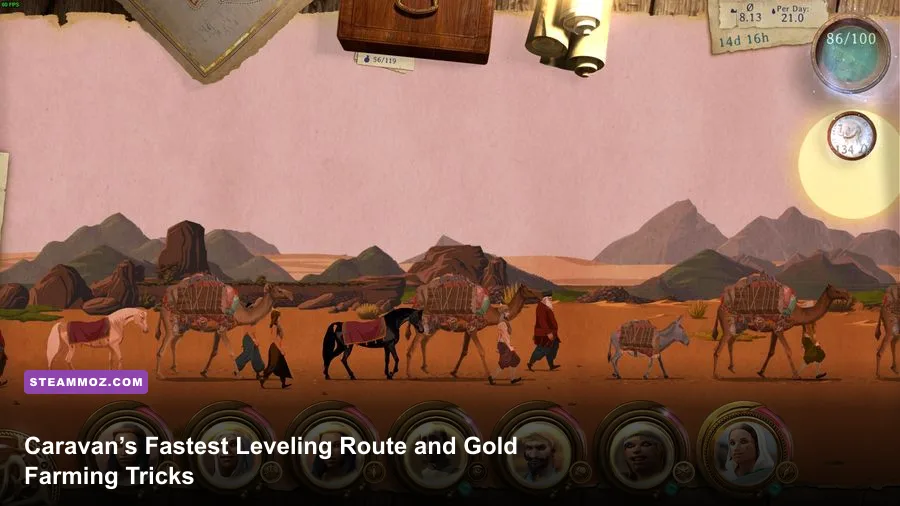
The fastest way to level in Caravan is to combine short trade loops with deliberately chosen fights, not to wander across the entire map chasing random encounters. Build a small party, keep enough food and water for one additional day, buy goods only when the local price is clearly below normal, and sell them at the nearest profitable settlement. That rhythm gives you experience, gold, equipment, and reliable progress without letting travel upkeep swallow your earnings.
Caravan rewards a very different mindset from a traditional dungeon crawler. There is no single monster-filled hallway that prints experience forever. Your caravan is a moving business, an adventuring party, and a supply chain at the same time. Every detour costs provisions, every recruit adds upkeep, and every cargo slot has an opportunity cost. The best route is therefore the one that turns the same journey into three wins: a trade profit, a manageable battle, and a return trip before your supplies become an emergency.
Start With a Lean Party and a Profitable Loop
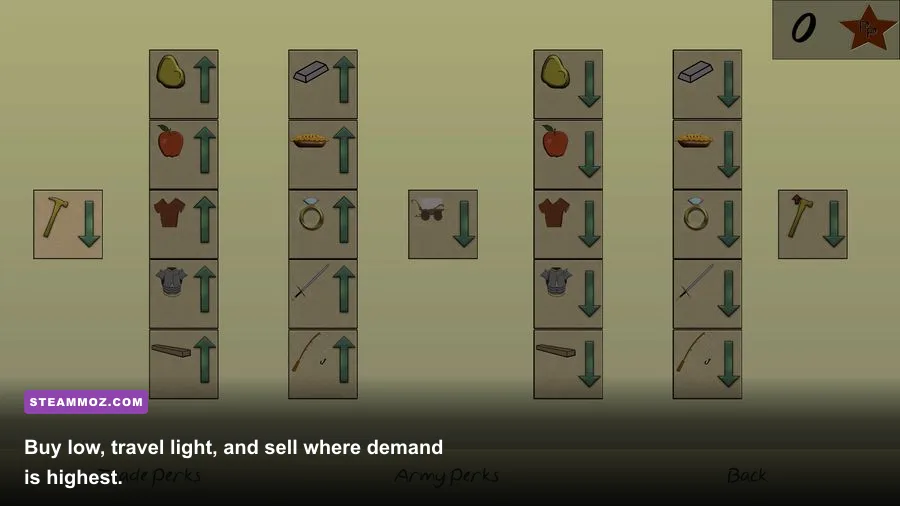
Your first priority should be stability rather than maximum party size. Hire enough companions to cover damage, survivability, and utility, but avoid filling every available slot immediately. A large roster looks powerful on the map, yet its wages and consumable requirements can erase the margin from a good trade. The opening hours are much easier when your caravan can finance itself after every circuit.
Use a three-part loop. Leave your current settlement with a modest cargo load, visit the closest location with a different economy, then return through a route containing one or two enemy encounters. The journey should be short enough that you can reach safety with at least one day of food and water remaining. If your supplies run completely dry, the penalties and emergency purchases can wipe out an otherwise excellent run.
Before leaving, check four things:
- Your party has a frontline unit capable of absorbing repeated hits.
- You have a reliable ranged attacker or skill that can finish weakened enemies.
- Your food and water cover the planned route plus one extra travel day.
- You still have enough gold to replace a damaged or defeated companion’s contribution.
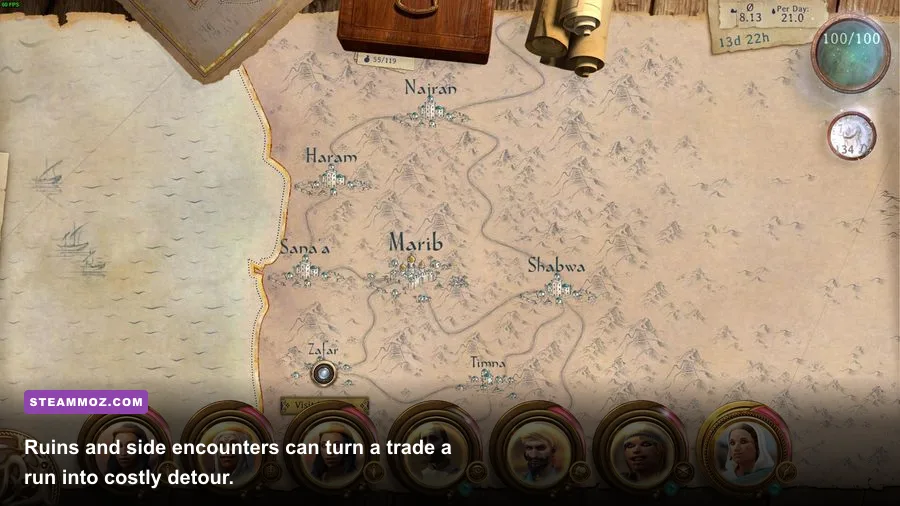
Do not treat every visible point of interest as mandatory. In Caravan, exploration is only profitable when the reward beats the cost of reaching it. A ruin that requires a long dead-end trip is usually worse than a nearby bandit group followed by a profitable market visit. This is the same basic principle behind the more aggressive route planning in our fast leveling and gold farming guide for Empires of the Undergrowth: reduce downtime, then repeat the highest-value action you can safely sustain.
| Opening Goal | Recommended Approach | Why It Works |
|---|---|---|
| First party | Frontliner, damage dealer, utility support | Covers the three jobs needed in early combat |
| First trade run | Use a short settlement-to-settlement route | Keeps upkeep and supply costs predictable |
| First upgrades | Increase carrying capacity before luxury purchases | More profitable cargo improves every future trip |
| First recruits | Add companions only when current income supports them | Prevents wages from consuming combat profits |

🎮 Caravan
Looking to experience this game? Grab your digital key directly on our store for $1.19.
View on Steammoz Store →How to Farm Experience Without Wrecking Your Caravan

Combat experience is valuable, but random combat is not automatically good combat. Pick encounters that your party can finish quickly while taking minimal damage. The ideal fight has a clear numerical advantage: you gain experience and loot, then continue travelling without spending the next leg recovering from the battle.
Target isolated enemy groups near your established trading loop. Avoid long expeditions into unexplored territory until your party has dependable damage and enough supplies to survive a bad roll. Enemy groups positioned beside a settlement are especially useful because you can sell loot, heal, restock, and immediately resume trading. That creates a repeatable experience circuit instead of a one-off victory.
Prioritize targets using this order:
- Enemies you can defeat in the opening two or three turns.
- Encounters that drop equipment useful to your active party.
- Groups located on the road between two profitable settlements.
- Fights that can be followed by a town visit before supplies fall below safe levels.
Combat efficiency comes from focus fire. Do not spread damage across the enemy line unless a skill specifically rewards multiple targets. Remove the enemy capable of dealing the most immediate damage, then finish weakened targets rather than switching constantly. A defeated enemy contributes no further damage, so concentrated attacks reduce both healing costs and the chance that a fight turns into an expensive retreat.
Use defensive abilities before the damage arrives, not after your frontline is nearly defeated. If an opponent has a visible charge-up, ranged wind-up, or attack pattern, spend a defensive action on the likely target during the preceding turn. Healing a unit at critical health is often less efficient than preventing the hit in the first place. Keep your strongest recovery option for the party member whose survival protects the rest of the formation.
Experience is also a reason to avoid letting one companion do everything. Rotate finishing blows and combat roles so new recruits do not remain permanently underdeveloped. A low-level companion may feel weak for a few encounters, but bringing that character into controlled fights is cheaper than trying to power-level them alone later.
The Gold Farming Method That Actually Scales
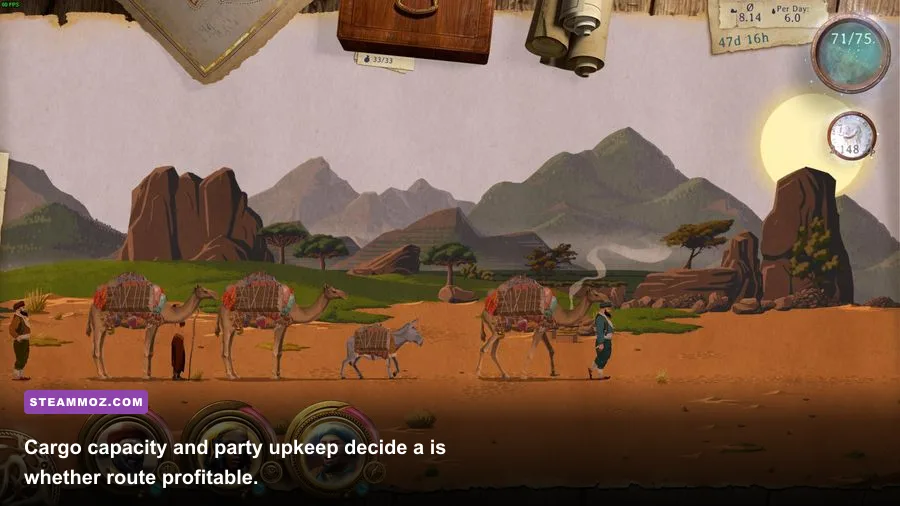
Gold farming in Caravan is a pricing game, not a loot-hoarding game. Cargo takes space, and every item should justify the space, travel time, and supply cost required to move it. The trade screen tells you whether a product is cheap or expensive in the current settlement; use that information instead of buying whatever has the highest displayed value.
Start by learning one dependable two-town route. Buy goods that the departure market values below their usual price, then sell them only when the destination shows a meaningful markup. Small profits are acceptable during the first runs because they teach you the route and build a cash buffer. Once you can consistently return with more gold than you left with after wages and provisions, increase the cargo load gradually.
A practical rule is to reserve part of your gold before every purchase. Keep enough money for emergency provisions, a replacement recruit, and one equipment upgrade. Spending your entire purse on cargo creates a fragile caravan: one unlucky battle or forced detour leaves you unable to buy the supplies needed to reach safety.
| Trade Decision | Good Signal | Bad Signal | Action |
|---|---|---|---|
| Buy cargo | Destination shows strong demand or a clear price increase | Only a tiny markup is visible | Buy a partial load and keep cash in reserve |
| Sell cargo | Sale value comfortably beats purchase cost | Profit barely covers travel supplies | Hold the goods for a better nearby market |
| Change route | Enemy encounter lies directly on your trade road | Detour adds several travel days | Take the fight only if its reward beats upkeep |
| Spend gold | Upgrade improves capacity, survival, or damage | Cosmetic or low-impact purchase delays recovery | Prioritize income-producing upgrades |
Sell unwanted battle loot whenever you return to a settlement. Gear sitting in your inventory is not helping your party, and the gold can fund provisions or a better upgrade. Keep only equipment that improves an active companion or has a clear resale advantage at another location. This is where many new players lose momentum: they carry a collection of mediocre items across the map while their caravan quietly burns money on upkeep.
For a useful comparison, our Dungeons 2 gold route guide follows the same principle from a different genre: the best farming loop is repeatable and safe, not merely the one with the largest theoretical payout.
Party Roles, Skills, and the Best Upgrade Order
Build your party around jobs rather than character rarity or personal preference. You need someone who can stand in danger, someone who can consistently deal damage, and someone who can repair mistakes through support or control. A party made entirely of fragile attackers may win spectacularly, but it will lose money every time an encounter goes slightly wrong.
Frontline priority
Your frontline character should receive the first meaningful defensive upgrade. Health, armor, protection, or any ability that reduces incoming damage has a direct economic benefit because it lowers healing and replacement costs. The frontline does not need to kill quickly if it keeps the rest of the party active long enough to deliver consistent damage.
Damage priority
Give your best offensive equipment to the character who can attack reliably every turn. Consistent ranged damage is particularly valuable when it lets you remove an enemy before that enemy reaches your formation. Burst skills are strongest when they secure a defeat; using them simply because they are available can leave you without an answer during the dangerous second half of a fight.
Support priority
Support skills are at their best when they prevent a costly interruption. A heal that keeps a companion fighting is worth more than one used after the battle, and a control effect that denies a dangerous enemy attack can save several turns of recovery. Do not overinvest in support at the expense of damage, though. A battle that takes twice as long exposes the entire caravan to more risk.
| Role | First Investment | Second Investment | Battle Job |
|---|---|---|---|
| Frontline | Survivability | Threat or control | Absorb pressure and protect damage dealers |
| Ranged damage | Reliable attack power | Critical or finishing potential | Delete priority targets before they act |
| Support | Efficient recovery | Control or party utility | Prevent deaths and shorten dangerous fights |
| Flexible recruit | Role-specific equipment | Balanced defense | Fill gaps without inflating upkeep too early |
Upgrade carrying capacity as soon as the increase lets you complete a larger profitable shipment. Capacity is not automatically good if you cannot afford to fill it. The correct timing is the moment your usual route produces enough surplus gold to pay for a bigger load while preserving your emergency reserve. After that point, capacity upgrades compound because every future trade run can move more value.
Players who enjoy party experimentation can borrow a useful lesson from our Dungeon Siege RPG breakdown: a balanced formation usually beats a collection of individually impressive characters. Caravan makes that lesson financial as well as tactical.
Supply Management Is the Hidden Leveling Mechanic

Food and water are not background meters. They define how many fights and trade opportunities you can safely chain together. Before each departure, count the travel days to your destination, add the return journey, then add one extra day for an unexpected encounter or route change. That reserve is more important than squeezing one additional cargo item into the hold.
Do not buy provisions at the first settlement you visit without checking the route ahead. A cheap purchase becomes expensive if it forces you to stop at a poor market later. Likewise, do not run a caravan so lean that one failed encounter creates a crisis. The best gold farmers maintain a buffer because a stable trip earns more over five cycles than a risky trip that produces one spectacular payout and then collapses.
Restock whenever you are already visiting a settlement to sell cargo or repair the party. Combining errands saves travel days, and saved travel days mean fewer consumed supplies. If a route requires a separate trip purely to restock, its profit calculation should include that cost. This simple accounting habit separates genuine profit from numbers that only look good in the trade window.
Difficulty also changes the correct risk threshold. On an easier setting, you can accept more marginal battles while building experience. On a harsher setting, avoid fights that leave multiple characters injured even if the experience looks attractive. Gold is useful, but a healthy party preserves both your time and your ability to exploit the next good market.
A Step-by-Step Route for the First Major Power Spike
The following route structure works regardless of which nearby settlements your current save presents. The names and prices can vary by campaign state, so treat it as a decision sequence rather than a rigid map coordinate list.
- Finish the opening objectives. Take the early tutorial rewards, learn the movement and combat systems, and avoid spending your first cash on a full roster.
- Establish a home market. Choose the settlement where you can reliably buy provisions, sell loot, and repair the party. This becomes your reset point after every risky run.
- Recruit for three roles. Add one durable frontline companion, one dependable damage dealer, and one support or control character. Stop recruiting until the loop pays for their upkeep.
- Run a partial cargo load. Make your first trade with enough free space to carry battle loot. The goal is to test prices and keep flexibility, not to gamble your entire purse.
- Take one efficient encounter. Fight an isolated group on the road only if the party can win quickly. Focus fire, use defensive abilities before incoming attacks, and rotate low-level companions into safe finishing opportunities.
- Sell at the destination. Convert cargo and unwanted equipment into gold, but keep the strongest upgrades for active characters. Refill food and water while you are already in town.
- Upgrade capacity or survival. Choose capacity when the route can support a larger shipment; choose defense when battles are creating repair, healing, or replacement costs.
- Repeat five cycles. After several runs, compare your starting and ending gold after provisions and wages. If the number is not rising, shorten the route or stop taking marginal encounters.
Once this loop is stable, push toward longer routes and harder encounters one variable at a time. Never increase party size, route length, cargo investment, and combat difficulty simultaneously. If the next run fails, you need to know which change caused it. That discipline makes progression much faster than constantly rebuilding after a caravan bankruptcy.
Common Farming Mistakes That Slow Every Campaign
The most expensive mistake is confusing movement with progress. Crossing the map may reveal interesting locations, but it also consumes supplies and delays the next profitable sale. Exploration is worth doing when it unlocks a useful route, recruit, quest, or reward. Otherwise, return to the compact loop that funds your campaign.
Another trap is treating all loot as valuable. Equipment has weight and occupies attention, while its resale value may be negligible. Compare it with the item currently used by an active companion. If it is not a direct upgrade and will not sell for a meaningful amount, leave it behind or sell it at the next convenient settlement.
Recruiting too aggressively creates the same problem in a different form. More companions can increase combat power, but they also dilute experience, raise upkeep, and make supply planning harder. Add a new member when they fill a tactical hole, not simply because the roster has room.
Finally, do not chase a perfect market price. A nearby sale that produces a dependable margin is usually better than a theoretically superior buyer several travel days away. Your best route is measured in net gold per travel day, not the largest number attached to a single item.
For players troubleshooting performance before committing to long sessions, our PC stability fixes for ELEX are useful general advice for older RPGs, while the Everspace 2 hidden rewards guide offers another good example of weighing detour value against travel cost.
When to Stop Farming and Push the Story
Gold farming has diminishing returns. Once your core party has appropriate equipment, your supply reserve is comfortable, and your caravan can complete a route without financial strain, story objectives usually provide better rewards than another low-level circuit. Grinding weak enemies beyond that point only delays access to stronger recruits, locations, and profitable opportunities.
A good checkpoint is simple: can you lose one battle, restock, and continue without selling essential equipment? If yes, your economy is healthy enough to move forward. Keep the short trade route available as a recovery tool, but spend your time on higher-value quests and tougher encounters. The strongest Caravan campaigns are not built by farming forever; they are built by farming just long enough to make the next risk affordable.
You can find the game on the official Caravan Steam page, and the publisher’s Daedalic Entertainment website remains the best place to check official publisher information. The developer’s it Matters Games site is also worth bookmarking for background on the studio.
The short version is worth remembering: keep the party lean, build one repeatable market loop, fight only battles that fit the route, preserve one extra day of supplies, and spend gold on upgrades that improve future income. Follow that formula and your caravan will level faster, carry more valuable cargo, and arrive at the next major story challenge with money in the bank instead of another emergency to solve.