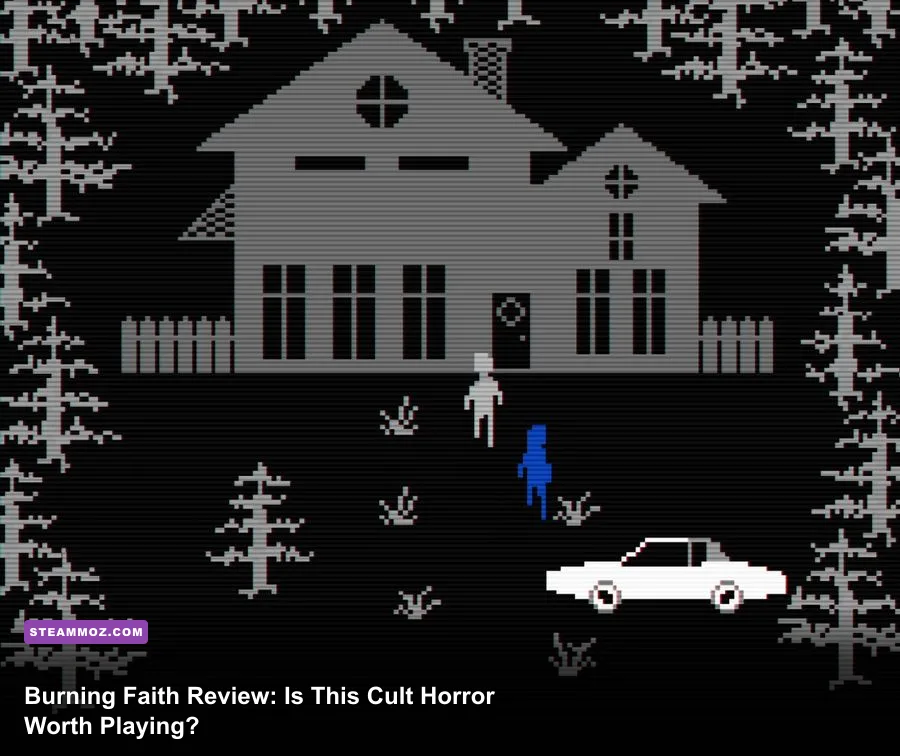
Yes, Burning Faith is worth playing in 2026—but only if you want a compact, atmosphere-first horror game rather than a long survival-horror campaign. Its religious imagery, uneasy exploration, and deliberately rough presentation create several genuinely nasty moments, while the short runtime keeps the concept from overstaying its welcome. The trade-off is equally clear: there is no deep combat system, no elaborate progression loop, and little reason to return once you have seen the available story content.
That makes this a recommendation for players who enjoy experimental indie horror, PS1-inspired presentation, and games that can be finished in one evening. If you need polished combat, extensive puzzles, or a ten-hour mystery to dissect, Burning Faith will feel thin. If you want something strange, tense, and easy to fit between larger releases, it remains a worthwhile Steam pick in 2026.
Before buying, check the current Burning Faith Steam listing for the latest price, patch notes, supported operating systems, and player feedback. The game has the kind of small-studio presentation where updates and hardware compatibility matter more than a glossy marketing page suggests.
What Burning Faith Actually Is
Burning Faith is a short first-person psychological horror experience built around exploration, environmental storytelling, religious symbolism, and sudden pressure rather than conventional action. You move through hostile, decaying spaces, inspect objects, read clues, and work out how each area connects to the next. The design is closer to a compact horror vignette than a traditional survival-horror epic.
That distinction matters. There is no satisfying skill tree to unlock, no weapon bench to upgrade, and no character build to optimize. The meaningful progression is knowledge: learning which visual details matter, recognizing when the game is signaling danger, and remembering the layout of rooms after an encounter goes wrong. Burning Faith asks you to pay attention instead of handing you a numerical power curve.
Its strongest material is the religious horror. Crosses, ritual spaces, damaged interiors, and repeated visual motifs give the world a coherent identity. The game is not simply throwing random monsters at you; it is trying to make faith, guilt, and corrupted devotion feel physically embedded in the environment. That theme will not work for everyone, but it gives the short campaign more personality than the average asset-flip horror release.
| Core Element | How It Works | 2026 Verdict |
|---|---|---|
| Exploration | First-person movement through confined, story-focused areas | Effective, though occasionally linear |
| Combat | Limited or secondary compared with avoidance and discovery | Not the reason to play |
| Puzzles | Environmental clues and straightforward progression checks | Functional rather than demanding |
| Progression | Story and player knowledge instead of levels or upgrades | Appropriate for the short runtime |
| Replay Value | Primarily comes from missed details and alternate interpretation | Modest after a first completion |
For perspective, it is closer to the compact mood pieces discussed in our Dungeon Siege review only in the broad sense that both games depend on their era-specific design priorities. Burning Faith is not an RPG, and expecting loot, stats, or party management will send you into the wrong game entirely.

🎮 Burning Faith
Looking to experience this game? Grab your digital key directly on our store for $2.99.
View on Steammoz Store →Atmosphere Does the Heavy Lifting
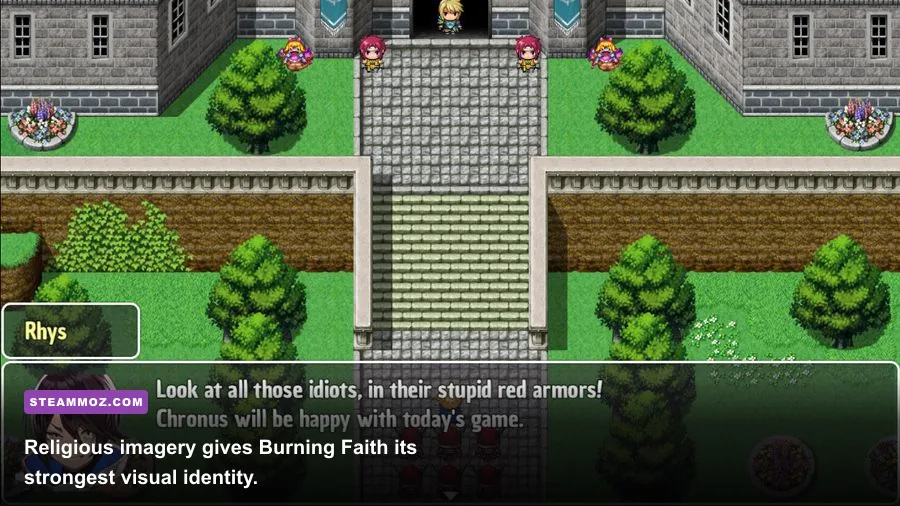
Burning Faith understands that horror often improves when the player cannot see everything. Dark corridors, abrupt changes in sound, and aggressively framed rooms create tension without requiring a monster to attack every thirty seconds. The best sequences make you hesitate before opening an ordinary door because the game has taught you that ordinary spaces are not necessarily safe.
The visual presentation is intentionally abrasive. Surfaces can look muddy, lighting can be severe, and some environmental assets lack the fine detail you would expect from a modern premium release. In a strange way, that roughness helps the game. The low-fidelity look makes spaces feel unstable, like a half-remembered nightmare assembled from damaged photographs.
Still, there is a line between deliberate ugliness and technical compromise. Texture shimmer, awkward transitions, and occasional visual clutter can make clue hunting more frustrating than frightening. I recommend increasing brightness only enough to read the environment. Raising it too far washes out the shadows that give the game its menace.
| Setting or Presentation Choice | Recommended Approach | Reason | Likely Trade-Off |
|---|---|---|---|
| Brightness | Keep near default, then adjust in small steps | Preserves contrast and visual tension | Some clues remain deliberately hard to read |
| Resolution | Use native monitor resolution first | Reduces blur on text and environmental details | May expose rough textures more clearly |
| Frame Rate | Favor a stable capped target over uncapped spikes | Consistent camera movement feels better in corridors | Peak FPS numbers will be lower |
| Audio | Use headphones and avoid excessive volume | Directional cues carry many encounters | Sudden effects can be sharp |
Players troubleshooting older PCs should also compare their setup with our PC crash and FPS fixes. Those fixes are written for ELEX rather than Burning Faith, but the practical priorities—updated drivers, sensible resolution scaling, and stable frame pacing—still apply to small PC horror games.
Exploration, Puzzles, and the Fear Curve
The campaign’s pacing follows a familiar pattern: explore a new space, locate an interaction point, interpret a clue, and then survive the consequence of moving forward. The loop works because the game generally gives you just enough information to form a plan without explaining every answer. You are often asking whether a symbol is decoration, a warning, or a direct instruction.
The puzzles are best approached as environmental reading exercises. Search rooms methodically, inspect anything that looks out of place, and remember repeated symbols rather than clicking every object at random. If progress stalls, retrace your route before assuming you missed a complicated combination. Burning Faith usually wants you to notice a connection, not solve a multi-stage logic puzzle.
That simplicity is both a strength and a weakness. It prevents the short campaign from collapsing under opaque puzzle design, but experienced horror players may clear several obstacles quickly. There is little of the elaborate lock-and-key layering found in larger survival-horror games. The tension comes from what happens after the solution, not from the solution itself.
The fear curve is similarly restrained. Early uncertainty does more work than repeated chase scenes. Once you understand the game’s vocabulary of sounds, shadows, and environmental changes, some later moments lose their bite. That is why Burning Faith is better consumed in a focused sitting than stretched across several nights. A long break can preserve the mystery; repeated backtracking can puncture it.
How to Play for the Best First Run
- Use headphones and play with minimal distractions.
- Keep brightness close to the default setting.
- Read environmental text instead of rushing through it.
- Record recurring symbols or room landmarks if you get turned around.
- Do not look up a walkthrough until you have exhausted nearby rooms.
This approach is the opposite of a farming route or min-maxed build. For another example of how much pacing changes the experience, see our Everspace 2 hidden-locations guide; Burning Faith has far fewer secrets, but the same principle applies: exploration is more rewarding when you actively read the environment.
Where Burning Faith Falls Short
The biggest problem is ambition. Burning Faith introduces unsettling ideas faster than it can develop them. The central imagery is memorable, but some story beats feel like fragments from a larger game. You may finish with a strong impression of the world and a weaker understanding of the people trapped inside it.
Characterization is especially limited. This is not a dialogue-heavy drama with a large cast whose motivations gradually change. The player’s isolation is part of the design, but it also means the emotional stakes rely on atmosphere rather than relationships. If the religious horror does not connect with you, there may not be enough character work to compensate.
Technical roughness can also interrupt immersion. Strange collision behavior, abrupt loading moments, and unclear interaction prompts are more damaging in a game built around careful observation. A modern horror release does not need photorealistic graphics, but it does need reliable feedback. When you are unsure whether a door is locked by design or simply failed to register, fear turns into irritation.
| Player Type | What You Will Like | Main Warning | Recommendation |
|---|---|---|---|
| Indie horror fan | Strong mood, religious imagery, compact runtime | Limited replay value | Buy on sale or at a modest price |
| Action-horror fan | Occasional pressure and threatening encounters | Little weapon depth or upgrade variety | Try a demo or watch spoiler-free footage |
| Story-focused player | Suggestive themes and environmental clues | Narrative leaves room for interpretation | Worth playing if ambiguity appeals |
| Completionist | Manageable campaign length | Few substantial systems to master | Best as a one-evening project |
That last point separates it from games such as Dungeons 3, where replayable systems and strategic decisions are the entire point. Burning Faith has a beginning, a middle, and an ending; it is not trying to become your next hundreds-of-hours game.
Is Burning Faith Worth Playing in 2026?
Burning Faith is worth playing in 2026 if you approach it as a focused indie horror short. Its best qualities—oppressive lighting, religious symbolism, uncomfortable spaces, and a willingness to leave questions unanswered—remain effective even beside newer releases. The game does not need a massive content update to justify its existence. Its appeal is that it delivers one concentrated idea and gets out before the atmosphere completely burns away.
It is not worth buying at any price for players searching for a full survival-horror package. There are no substantial character builds, no weapon tier list, and no long-term progression system to keep you experimenting. You will not find the kind of optimization depth covered in our weapon tier-list guide. Burning Faith is a mood-driven experience, and its limitations become obvious when you demand mechanical variety.
My verdict is 7/10. Buy it during a sale, play it with headphones, and avoid spoilers. At the right price, its short length is a benefit rather than a flaw: the game delivers a handful of sharp, memorable images without burying them beneath filler. The lack of polish and thin narrative may frustrate you, but the core atmosphere is too distinctive to dismiss.
In 2026, Burning Faith is best understood as a small horror recommendation for a specific mood—not a hidden blockbuster and not a complete replacement for a major Resident Evil-style campaign. If you want a strange, brief descent into corrupted faith, it still earns the trip.
For current platform details, community updates, and the latest user reports, check the official Steam search page, the Steam community search, and any developer links listed on the game’s store page.