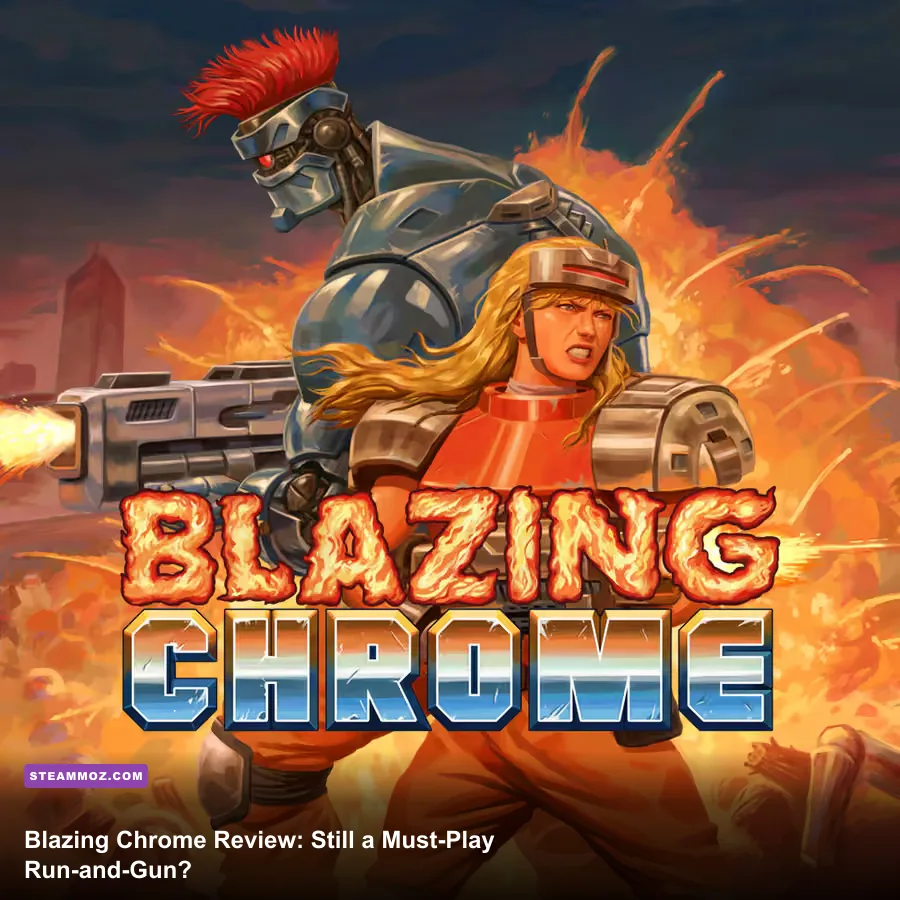
Yes—Blazing Chrome is still worth playing in 2026, especially if you want a focused, old-school run-and-gun that respects your time and punishes sloppy movement. JoyMasher’s Contra-inspired shooter is short, sharp, gorgeous, and far more disciplined than its explosive presentation suggests. It isn’t the best choice for players seeking a long campaign, modern accessibility options, or deep character progression, but its tight controls and excellent weapon-risk loop remain remarkably fresh.
That verdict matters because Blazing Chrome doesn’t pretend to be a broad action game. There’s no loot treadmill, skill tree, open world, or inflated checklist. You pick Mavra or Doyle, push through a machine-controlled wasteland, learn enemy patterns, and try to finish the stage without wasting your limited lives and continues. In 2026, that clarity feels almost rebellious.
For a useful point of comparison, Steamoz’s Dungeon Siege review looks at a much longer classic, while Blazing Chrome goes in the opposite direction: concentrated arcade action with almost no downtime.
Why Blazing Chrome Still Works in 2026
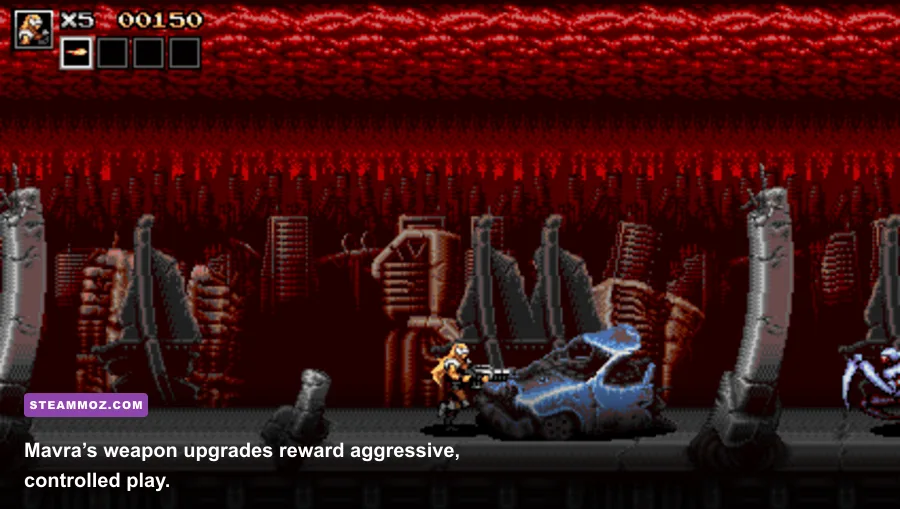
The core loop is brilliantly simple. Move right, shoot, jump, slide, roll, and survive. The game’s two playable characters share the same broad run-and-gun foundation, but the real variety comes from weapons, enemy placement, and the way each stage changes the rhythm of combat.
Mavra is the human resistance soldier and the most immediately familiar choice. Doyle is a combat robot with a different visual identity and a slightly more forgiving-feeling presence during hectic firefights. Neither character transforms the campaign into a radically different game, so don’t buy Blazing Chrome expecting a full character-class system. Their value is replayability, not a completely separate ruleset.
The campaign is built around six stages, each broken into tightly authored sections before a major boss encounter. A first clear can take roughly two to four hours depending on difficulty and how often you continue. That sounds brief, but the game expects repeat attempts. Once you know where the shielded drones, ceiling turrets, charging robots, and ambushes appear, the same level becomes a route to optimize rather than a hallway to endure.
That’s the crucial distinction: Blazing Chrome is not short because it ran out of ideas. It’s short because it wants you to master its ideas.

🎮 Blazing Chrome
Looking to experience this game? Grab your digital key directly on our store for $4.24.
View on Steammoz Store →Weapons, Power-Ups, and the Real Combat Strategy
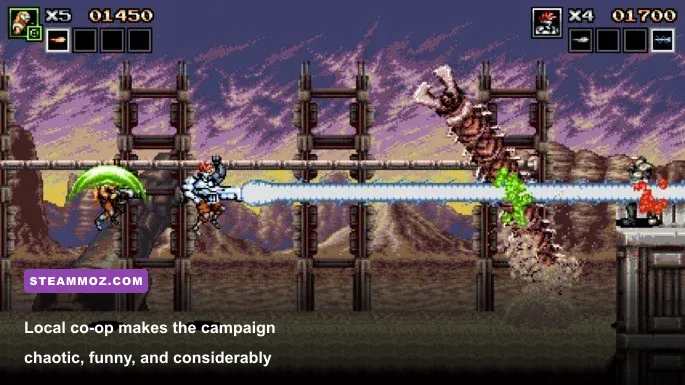
Blazing Chrome’s weapon system is deliberately readable. You begin with a standard machine gun, then collect weapon capsules that can grant the M machine gun, S spread gun, or L laser. The machine gun is the dependable all-rounder; the spread gun covers multiple angles and deletes clusters; the laser delivers concentrated damage and is especially valuable against bosses and large armored targets.
Weapon power is temporary in the practical sense: dying costs you the momentum and equipment you built during the stage. That creates a constant risk calculation. Do you push forward with the laser because the next boss is close, or grab a spread weapon to handle the swarm coming from both sides? Losing a strong weapon isn’t just inconvenient—it changes the next minute of the run.
There’s also a defensive shield pickup, and it can completely change an encounter when used intelligently. The mistake is treating it as permission to stand still. The shield buys you a short window to cross a dangerous lane, absorb a mistake, or keep firing while a boss exposes its weak point. It doesn’t remove the need to move.
| Weapon | Best Use | Main Weakness | 2026 Verdict |
|---|---|---|---|
| Machine Gun (M) | General enemies and moving targets | Less burst damage and narrow coverage | Most reliable default |
| Spread Gun (S) | Enemy groups and vertical pressure | Damage is less concentrated | Best for crowded sections |
| Laser (L) | Bosses and armored targets | Less forgiving when enemies surround you | Best burst option |
| Shield | Crossing hazards and surviving mistakes | Temporary protection only | Save it for scripted danger |
The strongest players don’t simply grab every capsule. They preserve the weapon that matches the next encounter. If a section funnels enemies into a narrow horizontal lane, the machine gun’s consistency is often better than the spread gun’s wider but less focused output. If enemies arrive from upper platforms and ground level at once, spread coverage becomes more valuable. That tiny decision-making layer gives the campaign more depth than its arcade shell suggests.
Difficulty Is the Point, Not a Design Flaw
Blazing Chrome can feel unfair during the first hour because it hides information inside enemy timing. A turret’s shot, a charging machine’s leap, and a flying drone’s approach all have distinct visual cues, but the game expects you to notice them while moving at speed. Panic-jumping is the fastest route to a death.
Normal difficulty is the intended experience for most players. Easy is a useful on-ramp if you aren’t comfortable with 16-bit shooters, while Hard is best treated as a challenge mode after you understand stage layouts. The difficulty curve is less about enemies becoming bullet sponges and more about reducing your margin for error. That’s a good choice: deaths usually teach you something specific.
Use the slide and roll as movement tools rather than emergency animations. Sliding under projectiles preserves forward momentum, while rolling can help you pass through tight danger windows when a jump would put you into another enemy. Learn to shoot while advancing instead of stopping at every target. Many encounters are designed around the assumption that you’ll keep moving.
Bosses follow the same philosophy. Their attacks are readable, but their arenas often force you to manage several threats at once. Watch the boss’s animation rather than the projectile itself. The wind-up is usually your real warning. Once you recognize the telegraph, the counter is often straightforward: move to the safe lane, fire during the exposed phase, and avoid greedily squeezing in one extra shot.
| Encounter Type | Danger | Counter Strategy | Best Tool |
|---|---|---|---|
| Ground rushers | They close distance quickly | Keep firing while sliding or jump over the lead unit | Machine Gun |
| Flying drones | They attack from off-screen angles | Use spread coverage and keep moving horizontally | Spread Gun |
| Turret lanes | Fixed shots punish hesitation | Read the firing rhythm and cross during the gap | Shield or Machine Gun |
| Large bosses | Multiple attack patterns and limited safe ground | Prioritize survival, then punish the opening | Laser |
Stages, Bosses, and Replay Value
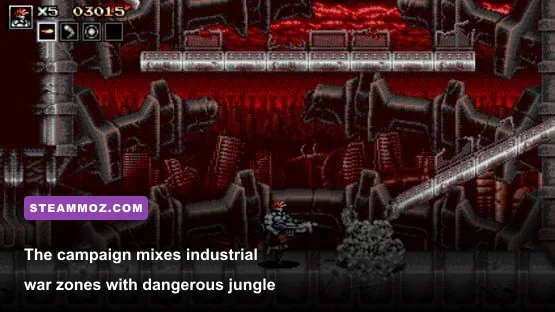
The stage design is where JoyMasher earns its reputation. Blazing Chrome moves between ruined industrial environments, hostile jungle terrain, collapsing structures, and heavily mechanized battlefields without abandoning its central rhythm. One section may ask for careful platforming around a hazard, then immediately throw a dense infantry formation at you.
The best moments are built around escalation. You first encounter a machine or hazard in isolation, then the game combines it with moving platforms, turrets, or a second enemy type. When you die, the solution usually isn’t “shoot faster.” It’s “stand somewhere else,” “wait half a second,” or “save the spread weapon.” That kind of authored challenge feels increasingly valuable in an era of procedural encounters.
Replay value comes from several places: better clears, harder difficulty, two-player local co-op, and unlockable bonus modes that give dedicated players another reason to return. Co-op is particularly entertaining, but it’s not automatically easier. More players mean more firepower, yet the screen becomes busier and mistakes can compound quickly. A coordinated partner should cover a different vertical lane instead of standing directly on top of you.
If you enjoy studying routes and cleaning up mistakes, Blazing Chrome can provide many more hours than its first clear suggests. If you only want one cinematic campaign, its compact size may leave you wanting more.
Graphics, Performance, and PC Requirements
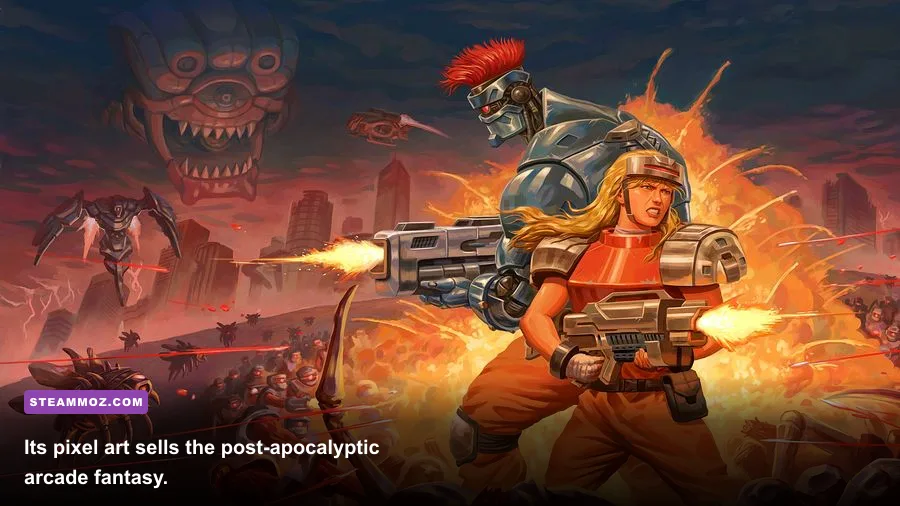
Blazing Chrome’s pixel art is one of its biggest strengths. Explosions are chunky and readable, backgrounds are packed with mechanical detail, and the animation captures the exaggerated snap of classic arcade shooters. It looks deliberately retro without becoming visually muddy.
Performance is refreshingly undemanding on PC. The game targets a smooth 60 frames per second and doesn’t need a gaming desktop, dedicated graphics card, or complicated tuning. The main technical choice is whether you prefer crisp pixel presentation or a softer filter that mimics an older display.
| Component or Setting | Minimum | Recommended | Practical Note |
|---|---|---|---|
| Operating System | Windows 7 | Windows 10 or newer | Modern Windows versions are the safer choice |
| Processor | Dual-core CPU | Modern dual-core or better | CPU demands are very light |
| Memory | 2 GB RAM | 4 GB RAM | Enough for the game and background apps |
| Graphics | OpenGL-capable integrated graphics | Any recent integrated or dedicated GPU | Pixel art does not require powerful hardware |
| Frame Rate | 60 FPS target | 60 FPS locked | Consistency matters more than high refresh rates |
For the official listing, check the Blazing Chrome Steam page. JoyMasher’s official developer site is also worth browsing if you want to see the studio’s wider retro-action catalog. Players comparing older games on modest hardware may also like Steamoz’s guide to Harvey’s New Eyes PC requirements.
Who Should Play Blazing Chrome in 2026?
Blazing Chrome is an easy recommendation for fans of Contra, Metal Slug, Gunstar Heroes, and arcade games built around mastery. It’s also a strong pick for anyone who wants a game that can be completed in an evening but still rewards dozens of repeat attempts. The controls are immediate, the weapons are meaningfully different, and every stage has a clear tactical identity.
It’s less convincing if you need extensive accessibility settings, online co-op, a long progression system, or a story that develops beyond its resistance-against-machines setup. The local-only co-op limitation is especially important in 2026, when many players expect to play with friends remotely. You can still use Steam Remote Play Together as a workaround, but that isn’t the same as native online multiplayer.
For more retro-flavored recommendations, Steamoz’s Blood Dragon weapon ranking explores a very different kind of throwback action, while the ELEX PC fixes guide is a reminder of how much smoother Blazing Chrome’s lightweight presentation feels by comparison.
Final Verdict
Blazing Chrome remains worth playing in 2026 because it understands exactly what a run-and-gun shooter should be. It gives you fast movement, recognizable weapons, memorable enemy patterns, and bosses that reward patience without drowning the experience in systems. Its short campaign and lack of online co-op are real limitations, but they don’t undermine the central achievement.
Steamoz verdict: 8/10. Buy it if you want a polished, demanding retro shooter with excellent local co-op and high replay value. Skip it only if you’re looking for a sprawling campaign or a forgiving first-time action game. Everyone else should give Mavra, Doyle, and that beautifully hostile machine army another run.