
Yes, Atomic Heart – Trapped in Limbo is worth playing in 2026—but only if you want a compact, experimental platforming expansion rather than another chunk of the base game's Soviet sci-fi shooter campaign. Its dreamlike levels, apple-based progression, alternate paths, and playful combat make it one of the more inventive Atomic Heart add-ons. The catch is equally clear: the story is thin, the repetition shows quickly, and the DLC is much better as a focused challenge run than as a full-scale RPG adventure.
That distinction matters. Trapped in Limbo is not a traditional continuation built around new hubs, long conversations, or a fresh arsenal. It takes Major Sergey Nechaev—better known as P-3—and drops him into a symbolic, hostile version of Limbo shaped by the game's endings. Mundfish uses the expansion to experiment with movement, enemy placement, collectibles, and challenge-room design. The result is strange, colorful, occasionally frustrating, and far more confident mechanically than its modest runtime suggests.

What Trapped in Limbo Actually Adds

Trapped in Limbo is a post-campaign DLC connected to Atomic Heart's ending structure. Its setting abandons the familiar VDNH exhibits, underground complexes, and snowy open-world facilities for floating islands, candy-colored architecture, bottomless drops, and visual motifs pulled from the game's surrealist imagination. You still control P-3, and the expansion still uses Atomic Heart's first-person combat foundation, but the pacing is radically different.
Instead of pushing through one large campaign map, you move through a sequence of compact Limbo stages. Each area mixes traversal, environmental hazards, combat arenas, and branching routes. The stages are designed around replaying them: the first run teaches you the route, while subsequent attempts encourage you to collect more apples, find hidden detours, and finish with fewer mistakes.
Apples replace the familiar scavenging rhythm of the base game. They act as the central resource for unlocking upgrades and improving P-3's capabilities inside Limbo. Some are placed in plain sight; others sit behind risky jumps, alternate platforms, or routes that only make sense once you've learned the level. This gives every stage a useful push-and-pull. Do you take the safe route and preserve health, or chase the apple hovering over a lethal gap?
The expansion also works as a deliberately self-contained experience. You don't need to bring a fully optimized late-game loadout to understand it, and the design doesn't demand that you remember every detail of Atomic Heart's sprawling plot. Still, playing the base game first helps. Trapped in Limbo's imagery and character context land better when you already know P-3, Charles, and the game's multiple endings.
How long is the DLC?
Expect roughly four to six hours for a straightforward first clear, depending on difficulty and how aggressively you chase collectibles. Completionists can spend considerably longer replaying stages for apples and missed routes. That makes the expansion feel fairly priced during a sale, but less convincing at full cost if you're expecting a 15-hour campaign. Check the official Steam listing for the current edition and regional price.
🎮 Atomic Heart - Trapped in Limbo
Looking to experience this game? Grab your digital key directly on our store for $5.99.
View on Steammoz Store →The Platforming Is the Real Star

The best reason to play Trapped in Limbo is movement. Atomic Heart's original platforming could feel like connective tissue between combat encounters. Here, it becomes the main event. Floating platforms, shifting routes, timed hazards, spring-like surfaces, narrow ledges, and long jumps turn each level into a readable but demanding obstacle course.
The game rarely relies on abstract precision alone. Most jumps are telegraphed through color, geometry, or repeated patterns. Once you understand the intended rhythm, a section that looked chaotic starts to feel like a route you can execute cleanly. That said, the first-person perspective can make depth judgment awkward, especially when a platform's edge disappears below your weapon or when the camera shakes after an impact.
That camera issue is the biggest mechanical blemish. A missed jump often feels fair, but not always. Some jumps require you to commit before the landing surface is fully visible, and the DLC occasionally places a collectible just far enough off the main path to tempt you into a blind leap. The checkpointing is generally forgiving, yet repeating a short platforming sequence after every failed attempt can become irritating.
Limbo's strongest stages use layered routes. The obvious path gets you forward, while a higher or more dangerous route leads to additional apples. This structure gives the DLC an appealing speedrunning flavor. You begin by surviving, then start optimizing: jump earlier, cut across the corner, ignore a minor enemy, and land directly on the upper platform. It isn't a full movement sandbox, but it does make Atomic Heart feel more agile than it did in its original campaign.
| Activity | What It Tests | Reward | Verdict |
|---|---|---|---|
| Main route | Basic movement and combat | Stage progress | Approachable and readable |
| Apple detour | Risk assessment and precision jumps | Upgrade currency | Usually worth attempting |
| Combat arena | Weapon choice and crowd control | Safe passage and resources | More intense on higher difficulty |
| Replay route | Execution speed and route knowledge | Completion progress | Best source of replay value |
Combat Has More Variety Than the Story
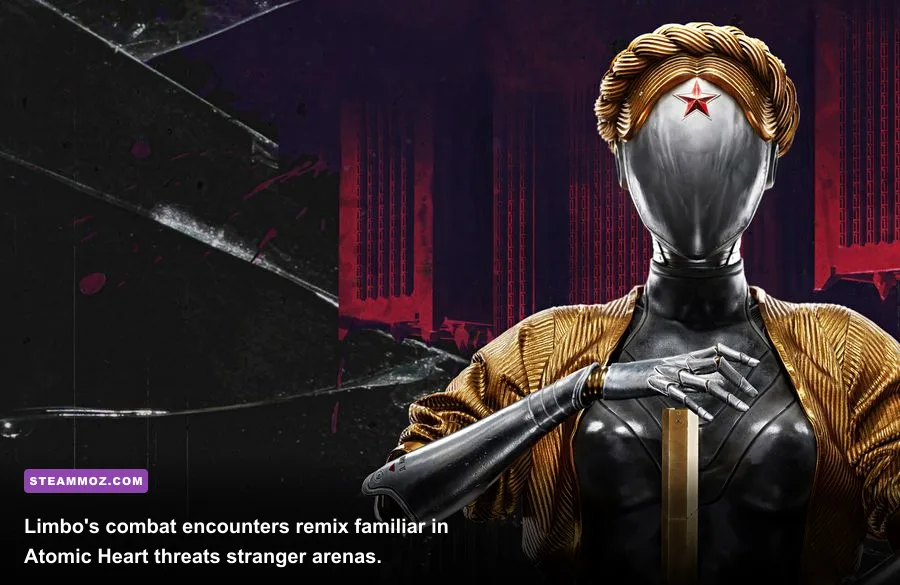
Trapped in Limbo does not reinvent Atomic Heart's combat, but its arenas make the existing toolkit feel sharper. P-3 can still combine firearms, melee weapons, and polymer abilities, with the familiar need to juggle ammunition, cooldowns, and elemental effects. The expansion's smaller spaces make crowd control more important than raw damage.
The Frostbite polymer ability remains valuable when several enemies rush at once. Freezing a priority target buys time to reload or reposition, while a melee follow-up can remove a threat before the rest of the group closes in. Mass Telekinesis is excellent in arenas with vertical space because it interrupts groups and creates breathing room. Against a single durable enemy, Shok is useful for quick stagger pressure and for dealing with mechanical targets.
For weapons, the Zvezdochka remains a dependable close-range choice when you can get inside an enemy's attack pattern, while the Kalash offers reliable mid-range damage without demanding perfect precision. The Electro is more situational, but its energy-ammo economy can be helpful when ordinary ammunition is scarce. The correct choice depends less on a permanent tier list and more on the arena's shape.
My preferred Limbo setup is a balanced melee-and-polymer loop: use Mass Telekinesis to stop a group, freeze the most dangerous enemy with Frostbite, then finish isolated targets with the Zvezdochka. Save firearms for enemies positioned across gaps or for moments when committing to melee would push you toward a hazard. This approach also reduces resource anxiety because you aren't burning rifle ammunition on every small encounter.
| Tool | Best Use | Main Weakness | Recommended Pairing |
|---|---|---|---|
| Zvezdochka | Close-range burst damage | Requires dangerous positioning | Frostbite |
| Kalash | Reliable mid-range pressure | Consumes standard ammunition | Mass Telekinesis |
| Electro | Energy-efficient ranged attacks | Less satisfying against durable targets | Shok |
| Frostbite | Freezing priority threats | Cooldown management | Zvezdochka |
| Mass Telekinesis | Interrupting groups and creating space | Less useful if enemies are widely spread | Kalash |
Combat does expose one problem: enemy variety is not as exciting as the environments. Familiar Atomic Heart machines and biological threats return in altered placements, but there aren't enough genuinely new behaviors to carry a lengthy expansion. The challenge comes from combinations, positioning, and hazards—not from a bestiary that constantly surprises you.
Progression Is Clever, But Not Deep

The apple economy is a smart fit for Limbo because it gives exploration a clear purpose. You're not collecting arbitrary documents for a completion percentage; you're hunting a resource that directly improves the character you're using. The system also supports the DLC's replayable structure: missed apples become obvious reasons to revisit a stage.
Still, don't expect a second version of Atomic Heart's full character-development system. Trapped in Limbo's progression is narrower and more arcade-like. It exists to make the next run cleaner, not to let you create radically different builds. The most useful upgrades tend to improve survivability, combat comfort, or your ability to handle the expansion's movement challenges rather than changing the entire way P-3 plays.
That limitation is intentional, and mostly successful. A large skill tree would have distracted from the tight stage design. The downside is that players who love Atomic Heart for crafting, weapon modding, and long-term experimentation may find Limbo lightweight. There is no equivalent here to spending hours tuning a fully upgraded weapon for a specific playstyle.
If you want the smoothest progression curve, spend early apples on upgrades that make mistakes less punishing or improve the abilities you use to control groups. Avoid treating every collectible as mandatory on your first attempt. Learn the route, identify where the game hides optional branches, and return later with a better sense of timing. Limbo is much less frustrating when you separate exploration from perfection.
Visuals, Performance, and Difficulty in 2026

Trapped in Limbo remains visually striking on current hardware. Its red, yellow, blue, and candy-like environments create a powerful contrast with Atomic Heart's grim industrial spaces. The art direction does more work than the technology here: silhouettes are clear, hazards stand out, and distant structures make each stage feel larger than its actual footprint.
On PC, the right settings depend heavily on your GPU and whether you're using ray tracing. The expansion can look excellent without maximum presets, and reducing costly effects is usually preferable to sacrificing frame-rate during precision jumps. A stable 60 frames per second is a much better target than a prettier but inconsistent presentation.
| Setting | Recommended Value | Performance Impact | Visual Trade-Off |
|---|---|---|---|
| Resolution | Native or quality upscaling | High | Controls overall sharpness |
| Textures | High if VRAM allows | Low to medium | Preserves surface detail |
| Shadows | Medium | Medium to high | Minor loss in depth and contact detail |
| Volumetric effects | Medium | Medium | Less atmospheric haze |
| Ray tracing | Off unless performance is strong | Very high | Reflections and lighting are less complex |
| Motion blur | Off | Negligible | Cleaner view during jumps and turns |
For troubleshooting broader Atomic Heart PC issues, Steamoz's PC fixes guide is useful as a general checklist for shader stutter, crashes, and driver problems, while the settings-focused advice in our frame-rate settings article explains the same performance priorities in more detail. The most important practical tip is simple: update your GPU driver, let shaders compile, and don't judge performance from the first few seconds after loading a stage.
Difficulty changes how much pressure combat puts on the platforming. On easier settings, you can recover from a bad route with resources to spare. On harder settings, a missed jump followed by an enemy ambush can drain healing items and ammunition quickly. The difficulty doesn't transform the level layouts, so choose based on how much punishment you want combat to deliver—not because you expect a completely different campaign.
Story, Atmosphere, and the Big Limbo Problem
The narrative is the least convincing part of the package. Trapped in Limbo is more interested in mood and symbolism than in delivering a tightly structured plot. Its strange visuals suggest ideas about identity, memory, control, and P-3's fractured reality, but the DLC often leaves those ideas hanging in the air rather than developing them through strong dialogue.
That can be refreshing after Atomic Heart's more talkative moments. The base game sometimes explains its world until the mystery loses oxygen; Limbo swings toward the opposite extreme. You get memorable imagery, unusual spaces, and flashes of character context, but not enough dramatic momentum. The expansion feels like a playable epilogue or dream sequence rather than a fully satisfying chapter in P-3's story.
Fans who want more of Charles and P-3 will find some worthwhile connective tissue, especially if they've seen the relevant base-game ending. Newcomers, however, may wonder why certain scenes matter. The DLC assumes familiarity without offering the emotional payoff that assumption should unlock. That's not a deal-breaker for a mechanically focused add-on, but it stops Limbo from becoming essential lore.
Is Trapped in Limbo Worth Playing in 2026?
Play it if: you enjoyed Atomic Heart's combat, like first-person platforming, want a colorful experimental spin-off, or can grab the expansion in a bundle or sale. Its strongest stages are inventive, its apple hunts encourage replay, and its visual identity is unlike almost anything else in the series.
Skip it if: you want a substantial story continuation, a new open-world region, a large arsenal, or a deeply branching RPG progression system. The short runtime and familiar enemy roster make the full-price purchase harder to recommend for players who aren't already invested in Atomic Heart.
| Player Type | Recommendation | Why |
|---|---|---|
| Atomic Heart completionist | Buy | Provides extra ending context and collectible-driven replay |
| Platforming fan | Buy on sight | Movement and route optimization are the DLC's best ideas |
| Story-first player | Wait for a sale | The narrative is atmospheric but underdeveloped |
| New Atomic Heart player | Play the base game first | The DLC assumes familiarity with P-3 and the endings |
| Combat-only player | Wait for a bundle | Enemy variety and weapon progression are limited |
Trapped in Limbo is best understood as a stylish mechanical experiment, not a missing second act. Mundfish takes the bones of Atomic Heart—P-3, polymer powers, brutal melee weapons, bizarre machines—and rearranges them into a platforming playground with a surprisingly strong replay loop. It doesn't completely escape the series' uneven writing or occasional control frustrations, but its compact scope keeps those flaws from becoming exhausting.
My 2026 verdict is 7/10. It isn't essential for every Atomic Heart player, and it shouldn't be sold as a full sequel-sized expansion. But if you want a bright, unsettling, occasionally fiendish set of first-person obstacle courses, Trapped in Limbo still has a distinct personality. Play it after the main campaign, aim for a steady 60 fps, ignore perfection on your first run, and return for the apple routes once the stages start to click.
For the latest patches, bundle details, and platform information, keep an eye on Atomic Heart's official website, Mundfish's developer site, and the official Atomic Heart Steam page. If you're comparing it with other older RPG experiments, Steamoz's Dungeon Siege review is a good companion read.