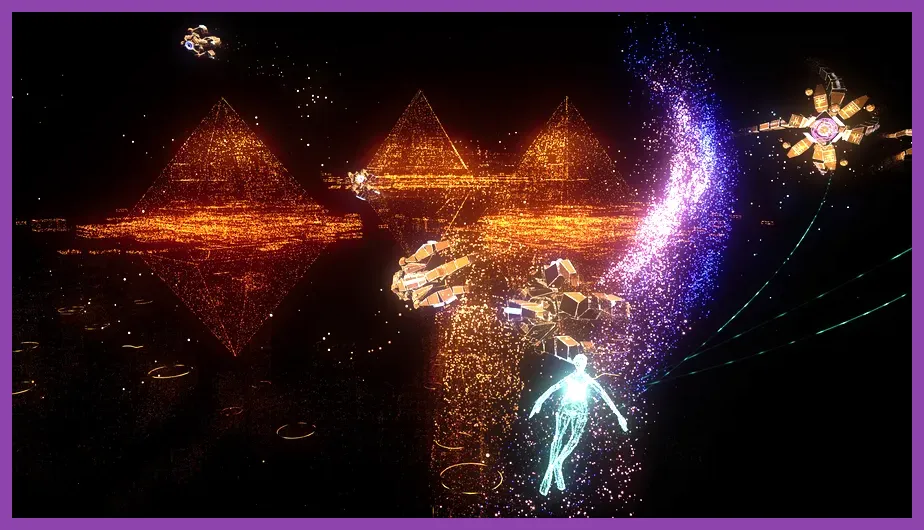
Rez Infinite still feels like the future because it turns every action into music, light, and motion without sacrificing the precision of a great arcade shooter. Its core campaign remains a compact five-area rail shooter, but the lock-on system, reactive soundtrack, and Area X expansion give it more personality than most modern rhythm games. On PC, it is also remarkably easy to run: the original game targets 60 frames per second, supports ultrawide displays, and offers optional VR rather than forcing it on every player.
That combination explains why Rez Infinite remains relevant. It is not merely an old game with a visual makeover. It is a carefully tuned audiovisual machine where shooting, movement, enemy formations, and musical arrangement all feed into one another. If you want a deeper comparison with other technically demanding PC releases, Steamoz's Sea of Thieves system requirements guide shows how different Rez's modest hardware profile is.

The Original Rez Campaign Is Still the Precision Test
The original campaign contains five areas, each built around a distinct musical and visual escalation. You control a wireframe avatar moving automatically through cyberspace, aim with a cursor, and hold the fire button to paint targets. Release the button to fire the entire lock-on salvo. You can lock onto up to eight enemies at once, so the fundamental skill is not simply aiming quickly; it is deciding when to release.
Every area also uses an evolution system. Destroying targets and collecting progression items advances the avatar through forms, increasing survivability as the run develops. Missing targets slows that momentum, while reckless firing can leave you exposed when a formation arrives from an unexpected angle. The best route through an area is therefore rhythmic: sweep across the screen, identify the maximum useful lock, release on the beat, then immediately reposition.
The Overdrive ability is your emergency weapon. It unleashes a powerful burst that clears threats and can rescue a run from a dense attack pattern. Do not spend it automatically when the meter fills. Save it for a boss transition, a crowded formation, or the final sequence of an area when a mistake would erase a high-score attempt. The campaign's later encounters are designed to test this restraint rather than simple reflexes.
Rez Infinite's bosses also demonstrate its design philosophy. Their attack patterns are readable, but their presentation constantly changes the apparent scale of the fight. Look for the telegraph before firing: large geometric structures usually signal a transition, while small targets often exist to rebuild your rhythm and evolution level. Treat each boss as a musical phrase with an opening, escalation, and release instead of a conventional health-bar encounter.
Area X Is the Reason to Play Rez Infinite Today
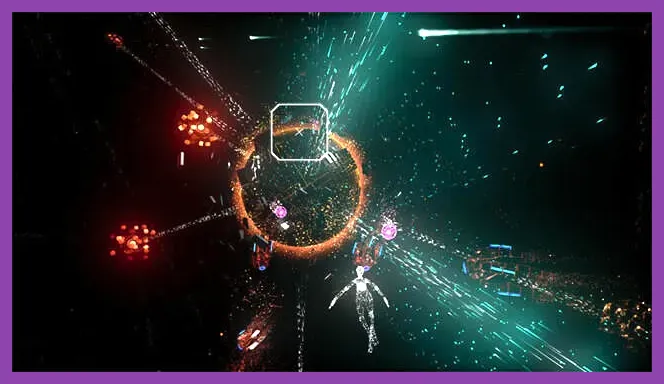
Area X is the expansion that makes Rez Infinite more than a beautifully preserved classic. Instead of following a fixed rail through five tightly authored areas, you move through a more open digital environment and influence the flow of the stage by choosing where to fly. The result is less like a traditional level and more like an interactive audiovisual installation that still understands arcade scoring.
The key difference is agency. In the original campaign, the camera controls the journey and your attention stays on target selection. In Area X, you steer through space, chase formations, and decide which visual or musical thread to pursue. Targets appear as part of the environment rather than as isolated objects placed on a straight route. That freedom makes Area X more replayable, but it also makes early runs feel less predictable.
Use the same lock-on discipline here, but move in broad arcs instead of frantic corrections. Sweep toward clusters, hold the button until you have a useful chain, and release before the group scatters. Your objective is not to touch every glowing object. It is to preserve momentum while keeping enough distance to read the next formation. Overdrive is particularly effective when several target groups overlap and your camera position makes normal locking awkward.
Area X also benefits most from headphones. The bass, percussion, and layered effects communicate information about movement and enemy arrival, while the color palette responds to the action. A television speaker can make the game seem quieter and flatter than it really is. For another example of how presentation affects gameplay readability, compare Steamoz's Smite graphics settings guide, which focuses on clarity rather than spectacle.
How to Build a Better First Run
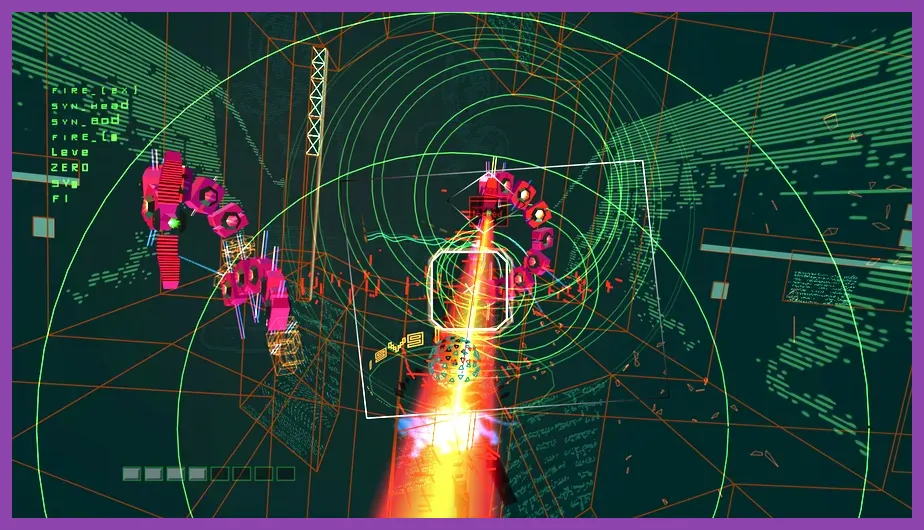
Start with the original Area 1 on Normal difficulty, not Area X. The first stage teaches the entire control language in a controlled sequence: cursor movement, eight-target locks, release timing, avatar evolution, and Overdrive management. Use a controller if you want an arcade feel, but mouse aiming is extremely accurate on PC. In VR, use the motion controller or headset-centered aiming method that feels most stable and avoid overcorrecting your wrist.
Step 1: Learn the lock-on rhythm
Hold fire while sweeping across enemies, then release when the target ring reaches a useful size. A full eight-target lock is not always optimal; two or three quick kills may be safer when enemies are approaching from multiple directions. Watch the sound and visual response after each release. Rez Infinite rewards consistent timing more than button mashing.
Step 2: Protect your evolution level
Destroy the small, easy targets first when a formation appears. They are low-risk opportunities to maintain progression and rebuild your confidence before the difficult targets enter. If you take damage, do not panic-fire. Recenter the cursor, wait for a clean group, and use the next safe sequence to recover control.
Step 3: Reserve Overdrive for danger
Keep Overdrive available for a boss phase or a screen filled with simultaneous threats. Activating it during a quiet stretch may produce impressive effects, but it wastes the tool that protects a score run. Once you know an area's transitions, spend Overdrive on the exact section where your first clear consistently breaks down.
Why VR Changes the Game Without Replacing Flat-Screen Play
VR is Rez Infinite's most dramatic presentation option, especially in Area X. The wireframe world surrounds rather than merely faces you, and enemy formations can feel as if they are arriving through your personal space. This makes spatial audio more useful and gives the visual pulses a physical quality that a standard monitor cannot reproduce.
However, VR is not automatically the best way to play. Long sessions can become tiring, and rapid visual movement may bother players who are sensitive to motion. Begin with a short Area 1 session, keep the headset fit tight but comfortable, and stop if you feel eye strain or nausea. Flat-screen mode remains excellent because the targeting system is fundamentally about cursor placement and timing, not head movement.
The PC release is also flexible enough for modern setups. Use native resolution, enable 60 fps or higher output when available, and leave motion blur disabled if your display exposes that option. In VR, prioritize a stable frame rate over supersampling. Rez's clean geometry scales well, but inconsistent frame pacing is far more distracting than slightly softer lines.
The Best Way to Chase High Scores

Score Attack is where Rez Infinite stops being a short experience and becomes a long-term arcade obsession. The first goal is survival, but the next is consistency: maximize locks, avoid missed targets, preserve your evolution level, and learn the exact order of each formation. Replays are valuable because they reveal whether a low score came from poor aim, late movement, or an Overdrive used at the wrong moment.
Do not chase a perfect run immediately. Pick one area and identify three measurable improvements. For example, reach the first boss without taking damage, finish the next transition with Overdrive unused, and increase your average lock count during the final minute. These targets produce better results than vaguely trying to “play cleaner.” Once the route is reliable, experiment with risky full locks and alternative movement lines.
Rez Infinite is also a useful reminder that difficulty does not require complexity. Its systems fit into a few inputs, yet the interaction between sound, target selection, movement, and score creates an unusually deep loop. Players who enjoy mastery-focused action games may also appreciate Steamoz's Stardew Valley weapons ranking for a different kind of deliberate optimization.
For the definitive version, see the official Steam page for Rez Infinite, check Enhance's official Rez Infinite page, and review the game's official PlayStation information before choosing a VR platform. Whether you play on a monitor or inside a headset, the central appeal remains unchanged: Rez Infinite makes accurate play look, sound, and feel like the future.