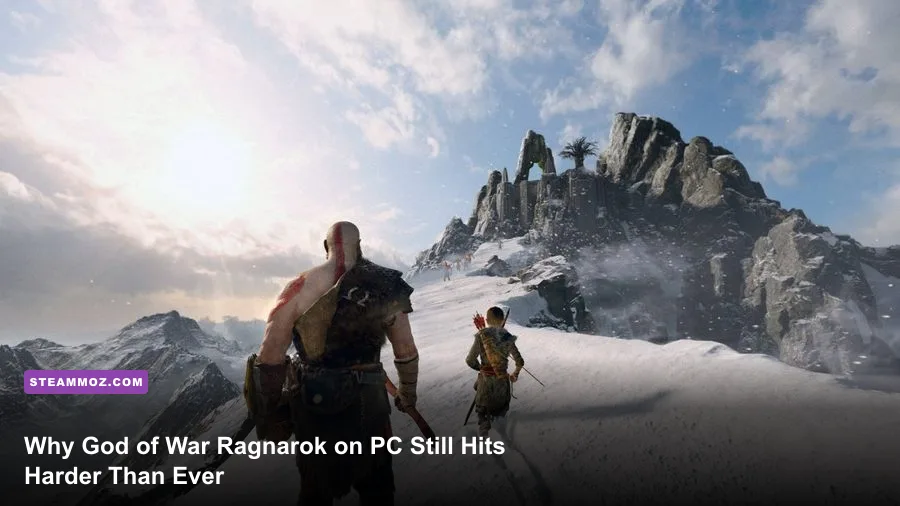
If you have been wondering whether God of War Ragnarok on PC still justifies its hefty 190 GB drive footprint and premium price tag, the short answer is an unequivocal yes. What Santa Monica Studio built and port house Jetpack Interactive polished for desktop hardware is arguably the single most mechanically satisfying third-person action brawler of its generation. Now that launch-window driver hitches, memory allocation bugs, and controversial account setup frictions have settled down, the PC build stands tall as the definitive way to experience Kratos and Atreus’s apocalyptic Norse finale. Factor in the integrated, razor-sharp Valhalla expansion included at zero extra charge, and this package delivers well over seventy hours of uncompromising combat, cinematic spectacle, and top-tier storytelling.

The Direct Verdict: Kratos on PC Still Hits Like a Freight Train
Stepping back into Midgard through an uncapped frame rate transforms the sheer physical weight of God of War Ragnarok. Back when the port landed on Steam and the Epic Games Store, enthusiast rigs were hit with unexpected VRAM ceilings and shader compilation hiccups. Multiple substantial patches later, the game runs like a dream. Armed with an Nvidia RTX 30-series or AMD Radeon RX 6000-series card or newer, you get fluid, triple-digit frame rates in 1440p and native ultrawide coverage that makes the original PS5 presentation feel tight and boxed-in.
The core narrative—navigating prophecy, generational trauma, and the looming war against Asgard's Aesir pantheon—holds up brilliantly. While some players find the mid-game pacing in Ironwood with Angrboda slightly sluggish on repeat runs, the emotional payoff of the final chapters pays out massive dividends. If you missed out during the initial console wave or held off on the PC release waiting for stability fixes, jump in right now on the official God of War Ragnarok Steam page or read up on Santa Monica Studio's release notes via PlayStation's official God of War portal. This is an epic that has genuinely aged like fine dwarven mead.
🎮 God of War
Looking to experience this game? Grab your digital key directly on our store for $49.99.
View on Steammoz Store →Combat Evolution: Why the Draupnir Spear and Weapon Swapping Never Get Old
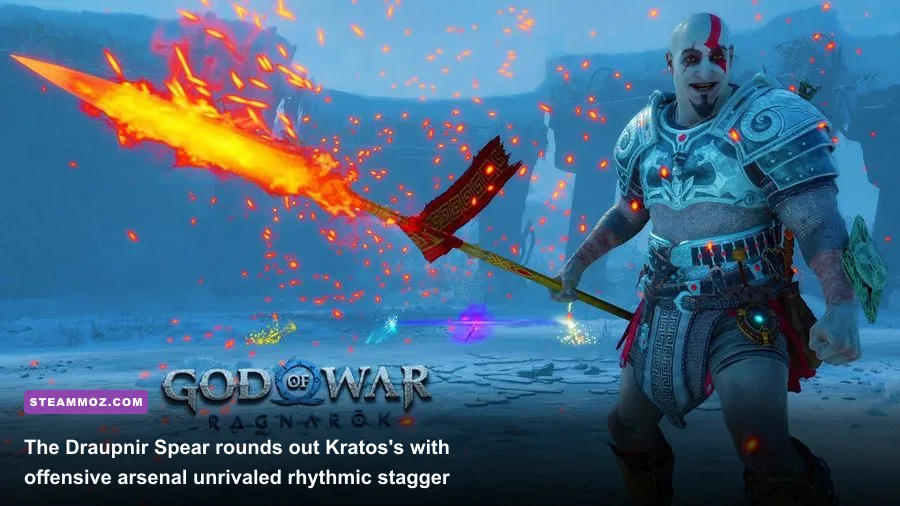
The beating heart of Ragnarok is its brutally tactical combat sandbox. Where the 2018 reboot laid the foundation with the Leviathan Axe and Blades of Chaos, Ragnarok turns combat into a vicious dance of status effects, vertical launches, and animation cancelling. The introduction of the Draupnir Spear midway through the story fundamentally alters your offensive rhythm. It is not just another stabbing tool; it is a long-range crowd management device that allows you to impale multiple enemies, detonate them with a tap of Triangle, and instantly shatter incoming charging attacks.
Each weapon features dedicated momentum meters—Permafrost for the Axe, Immolation for the Blades, and Maelstrom for the Spear. Charging these meters by dishing out clean strikes without getting clipped unlocks heightened elemental damage and secondary area-of-effect bursts. For instance, pairing the Draupnir Spear’s Maelstrom buff with the Dragon Scaled Armor rewards aggressive parrying by boosting your Strength and Defense with every deflected hit. Just like fine-tuning your loadouts in our beginner builds for upgrade passes, your gear synergies in Ragnarok matter just as much as your reflexes on Give Me God of War difficulty.
| Weapon / Tool | Scaling Focus | Mechanical Specialty | Top Synergistic Armor / Enchants |
|---|---|---|---|
| Leviathan Axe | Strength & Runic | Single-target freeze, heavy headshot pins, and brutal cleave damage via Serpent's Snare | Hunter’s Gauntlets & Belt, Inscription of Frost |
| Blades of Chaos | Runic & Strength | Wide-arc crowd control, Burn buildup, and high-damage aerial pull downs via Whiplash | Lúnda’s Lost Cuirass, Emblem of the Nine Realms |
| Draupnir Spear | Strength & Luck | Infinite range impalement, Stun gauge spikes, and siphoning elemental affinities | Dragon Scaled Set, Rond of Deflection |
| Dauntless Shield | Defense & Vitality | Frame-perfect parries, concussive shield bashes that interrupt red-ring hyper armor | Steinbjörn Armor, Rond of Expedition |
Experimentation is heavily rewarded. Stripping an enemy’s health bar by tossing the Leviathan Axe to freeze their legs, dashing in with bare-fisted punches to inflict Poison via Lúnda’s Lost Cuirass (lowering the target’s power level by 1), and then recalling the axe right through their spine remains one of the greatest tactile loops in action gaming history. When you combine this fluidity with custom keybinds or the native DualSense controller's adaptive triggers on PC, every single strike lands with bone-crunching impact.
PC Port Maturity: Optimization, VRAM Realities, and Frame-Pacing
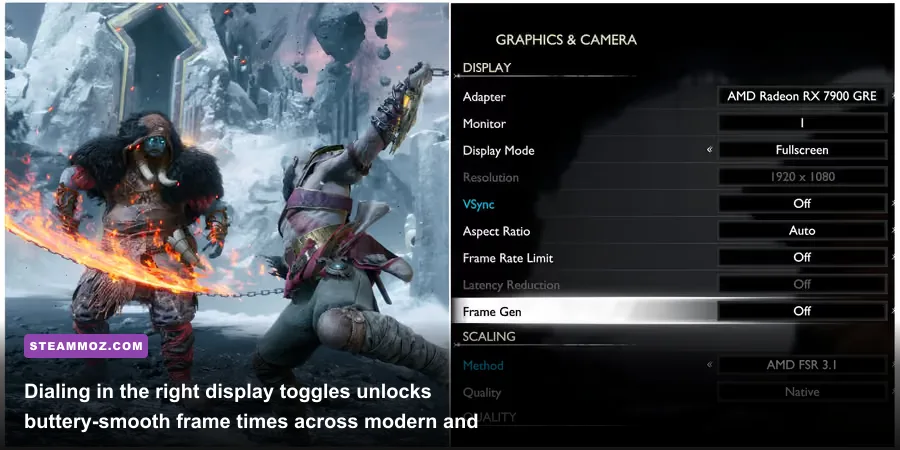
At launch, Ragnarok on PC sparked heated community discussions around its rigid hardware guardrails. Players running cards with less than 6 GB of VRAM were initially locked out entirely, and those on 8 GB cards faced occasional frame-time spikes whenever rapid realm-travel triggered heavy texture streaming. Today, those bottlenecks have been ironed out through sequential game updates and updated GPU drivers. If you have spent time tinkering with performance tweaks like our walkthrough on settings for max FPS or debugging sudden freezes via our guide on wrath of the ancients crashing fixes, you will appreciate just how accessible Ragnarok’s menu has become.
The PC version includes full support for Nvidia DLSS 3.7, AMD FSR 3.1, and Intel XeSS, including their corresponding Frame Generation suites. Running the game on a standard mid-range powerhouse like the Ryzen 5 7600 paired with an RTX 4070 delivers a locked 120+ FPS at 1440p with DLSS set to Quality. Better yet, the frame pacing is remarkably flat. Unlike many modern ports that suffer from microscopic traversal stutters whenever crossing zone thresholds, Ragnarok uses DirectStorage-like background asset streaming to keep the journey seamless.
| Graphic Setting | Recommended Value | Estimated FPS Cost | Visual Impact & Optimization Guidance |
|---|---|---|---|
| Model Quality | High | ~3% | Ultra pushes draw distances for minor background rocks; High keeps character detail razor-sharp. |
| Tessellation | Ultra | <1% | Deforms snow trails in Midgard and mud in Svartalfheim. Negligible performance penalty. |
| Shadows | High | ~9-12% | Ultra softens distant penumbra realistically, but High claws back massive GPU overhead with minimal loss. |
| Reflections | High | ~6-8% | Screen-space reflections on wet marble and jungle rivers. Ultra introduces heavy ray sampling costs. |
| Atmospherics / Fog | Medium | ~7% | Volumetric clouds and Niflheim mists. Dropping from Ultra to Medium buys you 5-8 stable frames immediately. |
| Anisotropic Filtering | Ultra (16x) | <1% | Zero real performance hit on modern hardware; preserves crisp ground surface textures at steep angles. |
A huge win for PC players is the expanded Field of View (FOV) slider. The original console release locked the camera tightly behind Kratos's back, which occasionally made situational awareness during chaotic Berserker fights feel frustrating. Pushing the FOV back by even 10-15% dramatically improves battlefield clarity without breaking the dramatic immersion of Santa Monica Studio’s signature no-cut single-camera perspective. If your PC has ever struggled with unstable frame pacing in unoptimized titles, as detailed in our analysis of settings for higher FPS, rest assured that Ragnarok stands among Sony’s best-tuned PC ports.
World Design and The Crater: The Best Content Most Players Almost Missed
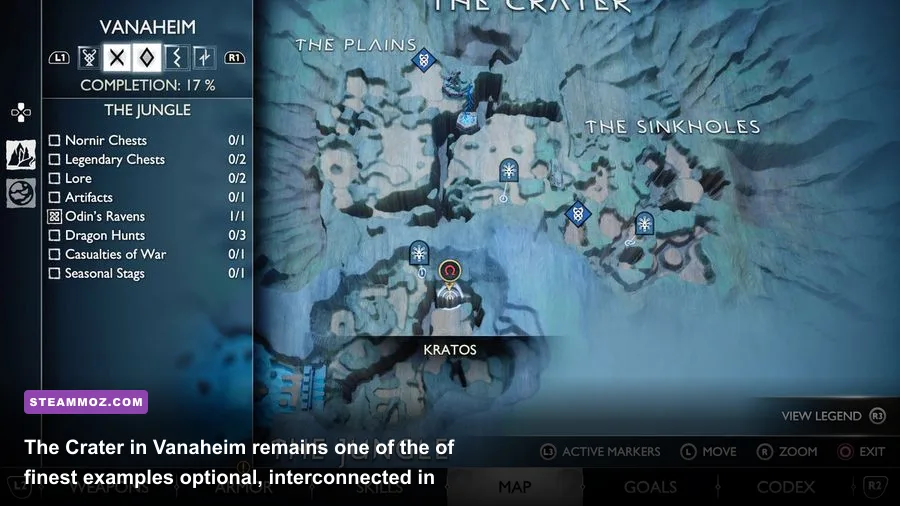
One of the biggest misconceptions about God of War Ragnarok is that it is a rigid, hallway-driven action game. While the Golden Path follows tightly scripted story beats, the optional content hidden across the realms is staggering in scale. Nowhere is this clearer than in Vanaheim’s massive hidden region: The Crater. Unlocked only if you pursue the scent of a wounded beast through the "Scent of Survival" Favor, The Crater is essentially a full standalone open-world expansion hiding inside the base game.
Here, the game shifts gear entirely. You are handed the freedom to dam and flood river canyons, shift the time of day from day to night to open celestial gates, track down ancient dragons, and conquer brutal environmental puzzles. The reward structure is phenomenal. Rather than handing out generic crafting materials, deep exploration yields Runic Summons, unique Relics like the Hilt of Hofuð (which slows down time itself), and crucial Frozen/Gale Flames needed to push your weapons to Level 9. It brings that exhilarating feeling of unearthing secrets you might remember from hunting down secret locations and hidden rewards in expansive space sims.
Even the smaller realms like Alfheim and Svartalfheim feature massive open sands and sprawling wetland bayous filled with environmental lore, Nornir chests, and lingering spirits seeking closure. The companion dialogue between Kratos, Mimir, and Atreus (or Freya) organically reflects where you are in the story, reacting dynamically to your accomplishments. It makes cleaning up the map feel like a narrative victory rather than a tedious checklist.
Endgame Mastery, Valhalla DLC, and the Boss Gauntlets
Beating the final story boss is nowhere near the end of what Ragnarok has to offer. The post-game gauntlet features some of the most mechanically demanding boss encounters in the entire action-adventure genre. The twelve Berserker Gravestones culminate in an all-out war against King Hrólf Kraki, while the new Valkyrie Queen, Gná, stands as a terrifying test of parry discipline, crowd control, and weapon weaving. Gná in particular requires you to recognize split-second blue-ring attacks (which must be interrupted with a double-tap shield bash) and switch between Sonic and Sigil arrows on the fly to dismantle her elemental shields.
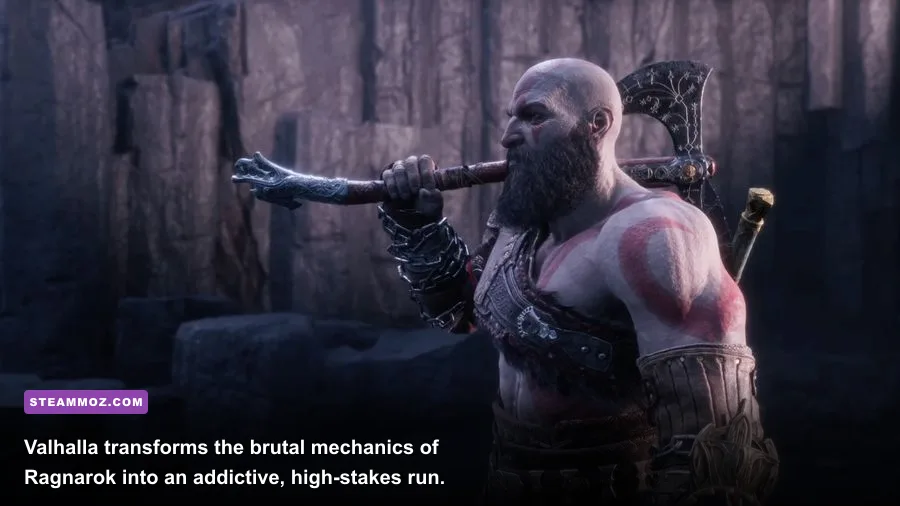
Then there is the Valhalla DLC—an update so substantial it could have easily been sold as a standalone release. Blending Kratos’s devastating combat loop with a full-fledged roguelite structure, Valhalla strips away your end-game armor values and forces you to rebuild a run from scratch. Each chamber inside Valhalla challenges you to choose temporary Runic attacks, stat buffs, weapon glyphs, and relic perks while climbing towards psychological confrontations with Kratos's Grecian past.
What makes Valhalla truly special is that it addresses the long-running critique that players fall into single-weapon comfort zones. Because glyphs buff specific aspects of your kit—such as granting a 50% critical strike chance on Draupnir Spear thrusts or turning the Leviathan Axe’s Frost Awaken into an explosive frost nova—you are constantly pushed to master every stance, dodge-counter, and shield strike. The encounters rival the twitch reflexes needed in competitive fighting titles, matching the intensity we broke down in our breakdown of fast-paced fighting mechanics and specs. You can explore deeper boss strategy breakdowns on community hubs like the God of War community database.
Is It Worth Your Money and Time Today?
Looking at the modern gaming landscape, few single-player experiences match the raw craft, scale, and polish packed into God of War Ragnarok on PC. It succeeds on every front: as an emotional farewell to Kratos's Norse saga, as an expansive showcase for high-refresh PC hardware, and as a brutal, mechanics-first combat simulator that will push your spatial awareness to its limits. Any early technical rough edges or hardware barriers have been cleanly resolved through consistent patching, making the current release rock-solid.
If you love meaty combat, rich character development, jaw-dropping art direction, and an endgame that keeps you challenged for dozens of hours beyond the credits, Ragnarok remains an absolute masterpiece. Clear out the 190 GB on your NVMe SSD, plug in a controller or dial in your custom mouse bindings, and dive into the Nine Realms. You will not regret a single second of the journey.