
Yes, Assetto Corsa Competizione (ACC) remains emphatically worth playing on PC right now, and it still wears the crown as the definitive dedicated GT3 and GT4 simulator. While newer sandbox sims and upcoming successors tease the horizon, Kunos Simulazioni's focused masterpiece delivers a depth of chassis physics, tire thermodynamics, and competitive esports infrastructure that rivals costing ten times as much struggle to match. If you own a direct drive wheel, load cell pedals, or even a trustworthy entry-level belt drive, ACC provides arguably the finest out-of-the-box force feedback and Balance of Performance (BoP) racing ecosystem money can buy on Steam.

The v1.9 Physics and Tire Model: Why the Driving Feel Has Aged Like Fine Wine
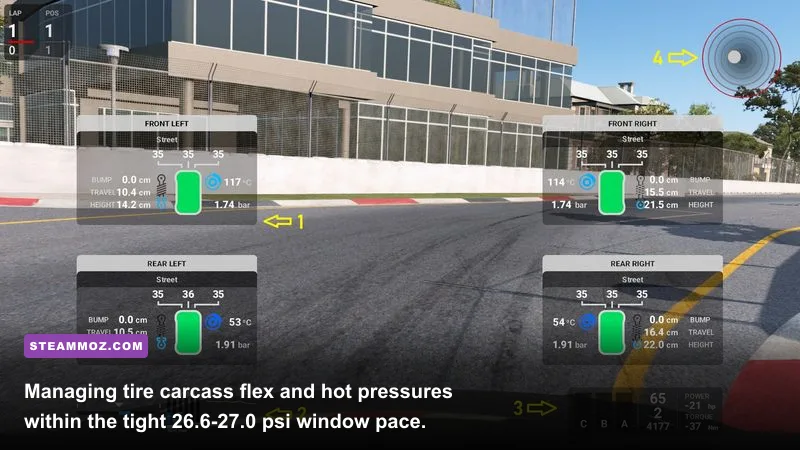
What sets ACC apart from almost every other driving simulator on the market is the sheer tactile depth introduced in its watershed physics overhaul. Earlier versions of the sim suffered from narrow slip-angle limits and odd curb-damping physics that forced drivers into artificial, overly stiff suspension setups. That changed radically with the introduction of the overhauled five-point tire contact patch model, realistic tire carcass flex, and true-to-life bumpstop behavior.
Today, cars react organically when you load the outside rubber through high-load compressions like Eau Rouge at Spa or the sweeping Turn 8 at Circuit Paul Ricard. The tire operates inside a living, breathing thermal window. Overdrive your fronts on corner entry by inducing understeer, and you'll immediately see tire surface temperatures spike to 105°C on your dash, shredding your grip for the next three corners while your hot pressures blow past the critical 27.2 psi ceiling.
The nuances between car architectures feel remarkably distinct. The mid-engine Ferrari 296 GT3 pivots instantly around its vertical axis under trail braking, trading raw straight-line speed for astonishing aero stability through medium-speed kinks. Compare that to the rear-engine Porsche 992 GT3 R: it still demands old-school weight transfer mastery. You have to keep the nose pinned with subtle pedal overlap, using that rear-biased 4.2-liter flat-six momentum to slingshot out of tight hairpins while managing snap oversteer across kerbs.
If you enjoy tinkering with telemetry, the game hooks directly into real-world MoTeC i2 Pro analysis software. You can pull suspension travel traces, shock velocity histograms, and wheel slip ratios directly from your local replay files to dial out high-speed pitch sensitivity—a level of engineering authenticity that casual racing games simply cannot touch.
| GT3 Platform | Drivetrain / Layout | Optimum Hot PSI Window | Core Handling Strengths | Inherent Driving Pitfalls |
|---|---|---|---|---|
| Ferrari 296 GT3 | Mid-Engine Twin-Turbo V6 | 26.6 – 27.0 psi | Incredible mid-corner aero grip, flat curb compliance | High pitch sensitivity; snappy under aggressive low-speed trail brake |
| Porsche 992 GT3 R | Rear-Engine Naturally Aspirated Flat-6 | 26.5 – 26.9 psi | Unbeatable braking stability, unmatched traction off slow apexes | Violent pendulum snap-oversteer if throttle is lifted abruptly mid-turn |
| BMW M4 GT3 | Front-Engine Twin-Turbo Inline-6 | 26.7 – 27.1 psi | Massive curb-eating suspension, highly forgiving over rough surfaces | Sluggish directional change through tight chicanes (long wheelbase) |
| Aston Martin Vantage V8 | Front-Mid Twin-Turbo V8 | 26.6 – 27.0 psi | Tremendous mechanical grip, high mechanical torque off apex | Prone to front-end tire scrubbing during lengthy 45-minute stints |
| Audi R8 LMS Evo II | Mid-Engine Naturally Aspirated V10 | 26.5 – 26.8 psi | Razor-sharp turn-in rotation, thrilling top-end engine response | Extremely nervous over high sausage kerbs; unforgiving aero stall |

🎮 Assetto Corsa Competizione
Looking to experience this game? Grab your digital key directly on our store for $39.99.
View on Steammoz Store →Competitive Multiplayer and the Low Fuel Motorsport Revolution
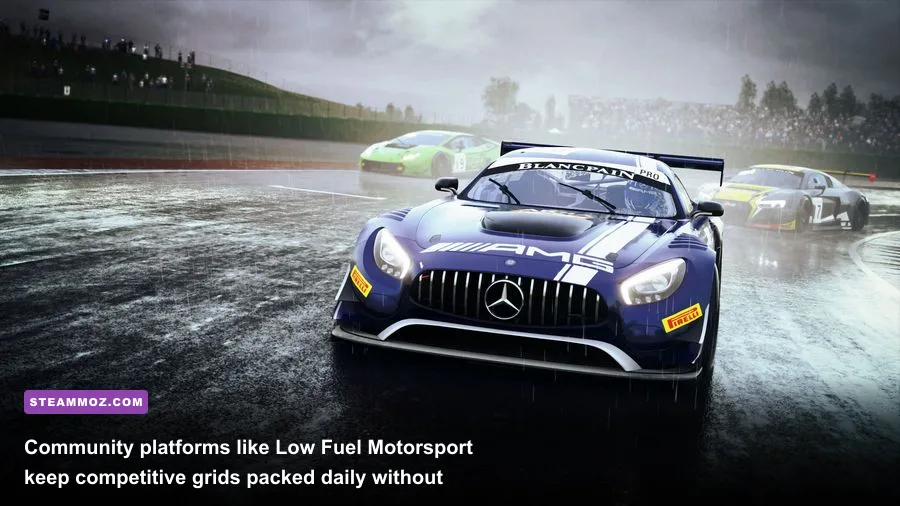
Single-player sim racers will find competent AI in ACC that fights cleanly across variable aggression levels, but multiplayer is where the title permanently secures its modern relevance. In the game's earlier years, finding clean public lobbies was a frustrating gamble dominated by Monza turn-one pileups. While the built-in Safety Rating (SA) and Competition Servers helped, third-party infrastructure completely transformed the landscape.
Enter Low Fuel Motorsport (LFM). By utilizing ACC's deep server backend, LFM introduced a free, structured matchmaking system featuring dynamic Safety Ratings, Elo-based Driver Ratings, hourly sprint splits, and licensed endurance leagues. It brings the premier ranked experience of a high-cost service like iRacing right into ACC without charging you a monthly subscription fee.
Gridding up in an LFM top-split race means diving into a 30-car field where the top fifteen drivers qualify within six-tenths of a second. Everyone respects yellow flags, drivers actively practice cold-tire out-lap discipline, and safety car periods require genuine tactical pit coordination. If you run into technical hitches or performance drops while joining massive multiplayer grids, you can check out these essential stability troubleshooting fixes to prevent game hangs from tanking your safety license.
Unreal Engine 4 in the Modern Era: Optimization, VR, and Frame Pacing
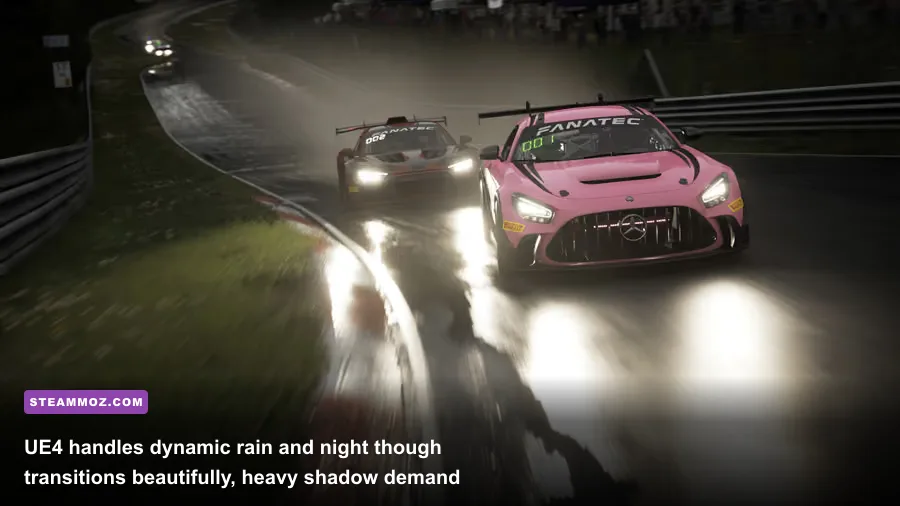
Unlike original Kunos titles powered by custom in-house graphics engines, ACC runs on Epic's Unreal Engine 4. Visually, this grants the sim breathtaking wet-weather track reflections, authentic headlight illumination during night transitions, and tactile rubber build-up along the racing line. However, it also brings well-documented optimization quirks that PC sim racers must dial in properly.
UE4's forward rendering engine can introduce visual blurring when paired with aggressive Temporal Anti-Aliasing (TAA). To run ACC with crystal clarity on modern 1440p or 4K monitors, running NVIDIA DLSS or AMD FSR in 'Quality' mode paired with in-game sharpness set to roughly 150% delivers the cleanest balance of high fidelity and locked frame pacing. For triple-screen racers, ACC natively supports multi-viewport projection, meaning side monitors accurately project side angles without the severe image stretching that plagues titles lacking proper viewport math.
Virtual reality remains demanding. While headsets like the Meta Quest 3 and Bigscreen Beyond can push incredible immersion inside the roll cage, ACC requires aggressive GPU headroom to hit a native 90Hz refresh rate without motion reprojection. Dialing in your settings makes all the difference between a butter-smooth apex lock and disorienting micro-stutters. Just as competitive players look for fine-tuned settings profiles for max FPS, sim racers need dedicated tuning presets to keep frametimes consistent across wet, 40-car endurance grids.
| Graphics Setting | Competitive Preset | Performance Cost | Visual Impact / Strategic Advantage |
|---|---|---|---|
| Resolution Scale | 100% (Native) | High | Maintains razor-sharp track markers and braking board distances |
| Shadows | Mid | Heavy | High values tank frame rates under night track lighting without adding clarity |
| Temporal Anti-Aliasing | High + Gen5 TAA | Low | Eliminates shimmering along safety fences and track barriers |
| Advanced Sharpen Filter | Enabled (150%) | Zero | Counteracts UE4 temporal blur; brings out tarmac grain textures |
| Visible Opponent Cars | 18 - 22 Cars | CPU Bound | Cuts massive CPU draw calls on race starts; hidden cars still calculate physics |
| Foliage Quality | Low | Moderate | Removes peripheral tree clutter; keeps 1% low frame rates stable |
| DLSS / FSR Profile | Quality / Native AA | Improves FPS | Essential for keeping 120+ FPS locked on triple 1440p displays |
Sim racers fighting random frame pacing dips or unexpected hitching during night-to-day transitions can also benefit from our breakdown on settings adjustments for high refresh rate setups. Clearing out unnecessary GPU background overhead is critical when every millisecond of force feedback input latency matters.
Track Roster and Immersion: From Monza Carnage to the 24-Hour Nordschleife
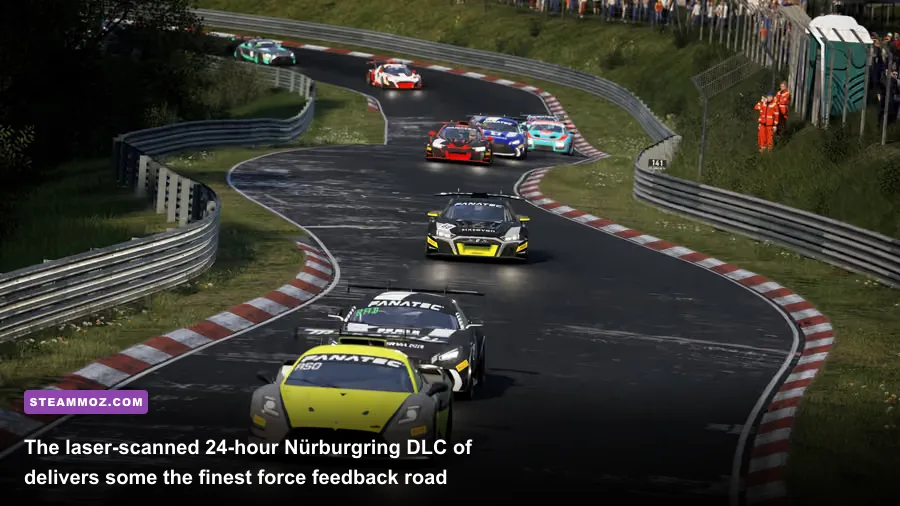
The track lineup in ACC is arguably the most laser-accurate collection of asphalt ever rendered for consumer hardware. Because the game is the official simulator of the SRO Fanatec GT World Challenge, every single circuit—from Brands Hatch and Mount Panorama (Bathurst) to Circuit de Spa-Francorchamps—is constructed strictly using millimeter-accurate LiDAR laser scans.
This precision is fundamentally transformative when running through a modern direct drive wheel base like a Simucube, Fanatec ClubSport DD+, or Moza R12. Every crack in the tarmac, every asphalt seam, and every harsh transition onto serrated rumble strips translates directly into the steering rack. When you clip the apex curb at Zolder's Kleine Chicane, the steering wheel pulls and unloads with exact force feedback telemetry, telling you instantly whether the dampers have absorbed the hit or if your front splitter is about to bottom out.
The crown jewel arrived with the release of the 24-Hour Nürburgring Nordschleife layout. Combining the modern GP track with the historic 20.8-kilometer Green Hell, tackling this combined circuit in the dark during a rain shower is the ultimate badge of honor in PC sim racing. Flying over the crest at Flugplatz or clinging to the concrete banking of the Karussell demands absolute trust in your machine's setup. If you run into unexpected system hangs or hardware bottlenecks trying to render the Nordschleife's massive 24-kilometer scenery, exploring our guide on deciphering modern PC hardware demands can help ensure your CPU and RAM speeds aren't choking under heavy asset streaming.
Value Comparison: ACC vs The Modern Competition
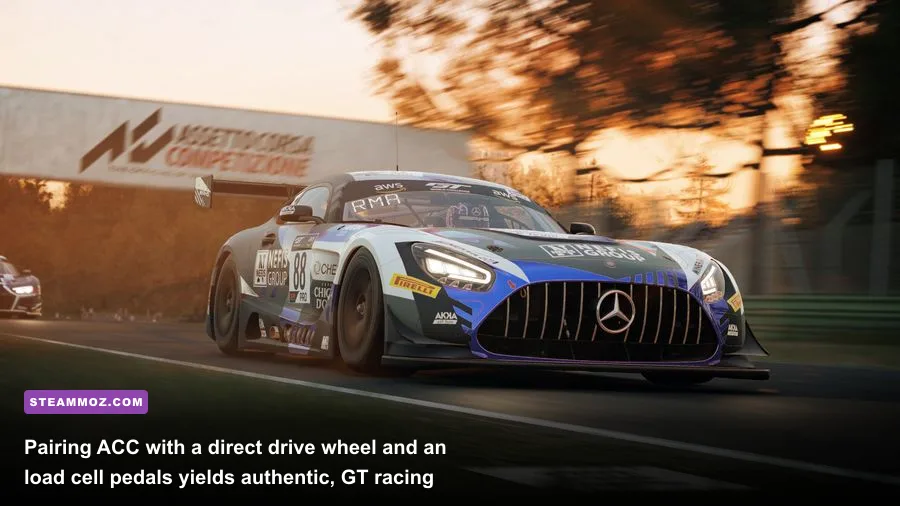
To understand why ACC still commands such respect, you have to look at the economic reality of the sim racing hobby. The sim racing market is notorious for nickel-and-diming enthusiasts. If you decide to race modern GT3s on rival platforms, you are often looking at a recurring monthly subscription fee plus a $12 to $15 fee for every single track and car on your schedule.
In contrast, you can routinely pick up the base game of Assetto Corsa Competizione on Steam for under $15 during seasonal sales, with complete DLC bundles (including GT4 packs, British GT, Intercontinental GT, and the 24h Nürburgring) running less than the cost of three individual tracks in competing platforms. You own the content forever, you can race offline or online whenever you please, and you enjoy full access to the best dedicated GT car physics ever coded.
Furthermore, if your rig encounters unexpected stutters or system-level crashes during heavy endurance sessions, taking the time to implement proven fixes that stop crashes and rescue your FPS will ensure your PC stays rock-solid when your team is 18 hours into a 24-hour race at Spa.
While Kunos is expanding the franchise's horizons, ACC remains the golden standard for focused, competitive sports car racing. It doesn't attempt to be a jack-of-all-trades sim featuring lawnmowers, vintage open-wheelers, and drift trucks. It set out to be an unapologetic, hyper-realistic, laser-accurate recreation of FIA GT3 competition—and years later, it still executes that mission better than anything else on the PC market.