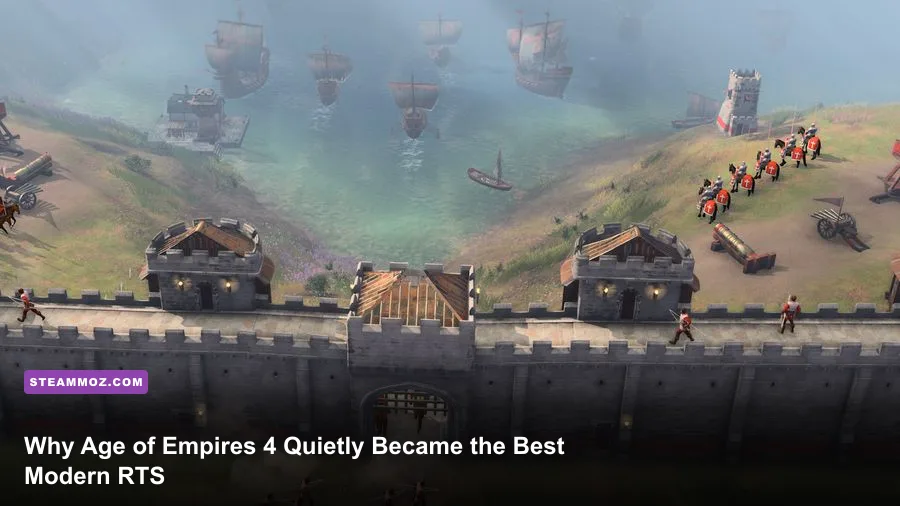
If you walked away from Age of Empires 4 back during its 2021 launch window, the game you remember simply does not exist anymore. Yes, it is absolutely worth playing today, but not because it magically recaptured the nostalgic 1999 aura of its legendary predecessor. Through relentless structural updates, total overhauls to fundamental combat math, and the release of the massive The Sultans Ascend expansion, Relic Entertainment and World's Edge turned a clunky, siege-dominated experiment into the crispest, most balanced modern real-time strategy experience on PC. It eliminates the soul-crushing finger gymnastics required by competitive StarCraft II while discarding the archaic engine quirks that hold back Age of Empires II: Definitive Edition, staking out a golden middle ground that respects your strategic intellect without demanding an RSI wrist brace.
From Siege Bloat to Tactical Precision: Re-Engineering the Core Meta
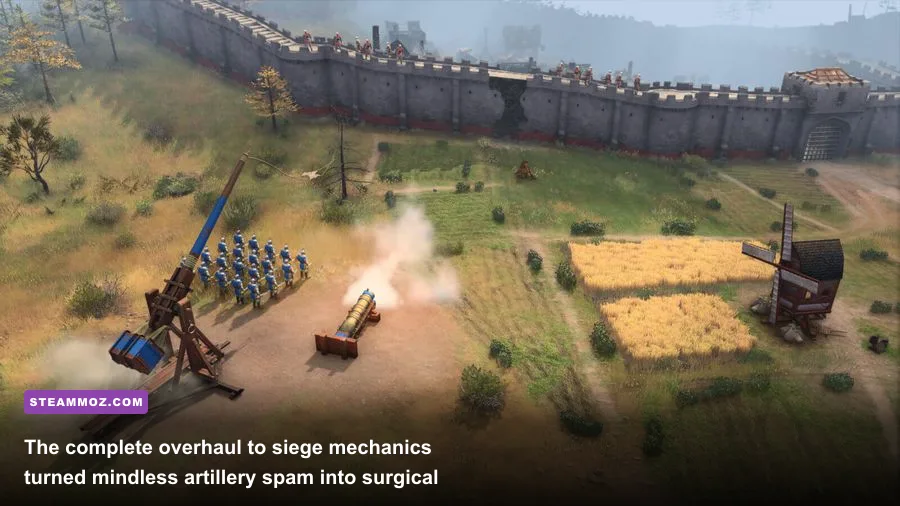
To understand why the game feels so exceptionally good right now, you have to look back at the mechanical disaster of launch. In late 2021, Age of Empires 4 was essentially "Springald Wars: The Game." Players would race to Castle Age, construct ten to fifteen Springalds—which then functioned as laser-accurate sniper cannons that shredded infantry, cavalry, and buildings alike with zero setup time—and turn every clash into an unwatchable firing squad. Heavy cavalry pathfinding was notoriously gummy, Spearmen struggled to reliably execute their Phalanx brace animations against charging knights, and defensive Keep rushing rendered wide-map resource control completely obsolete.
Today, the combat triangle functions with ruthless clarity. Relic reworked siege weapons from the ground up: Springalds are now dedicated, highly specialized anti-siege snipers with distinct bonus damage against mechanical platforms, while Mangonels fire arcing, physical projectile spreads that can actually be dodged by micro-managing infantry formations into spread spreads. Trebuchets hit hard from outside defensive keep range but require deliberate tear-down times that leave them vulnerable to flanking light cavalry. Units possess distinct physics weight. When French Royal Knights charge down an open field, their initial impact stuns squishy targets, but if an opponent plants a defensive line of hardened Donso or English Spearmen, that charge gets abruptly stopped cold, dishing out massive recoil damage to the horsemen.
The counter-system rewards proactive scouting rather than blind unit massing. If you notice an opponent leaning heavily into armored Men-at-Arms during early Castle Age, pumping out standard archers will lead to absolute ruin due to flat armor deductions. You need Crossbowmen, who carry heavy armor-piercing bolts that melt iron plate, supported by Horsemen to intercept enemy backline ranged units. Managing these real-time interactions feels intuitive thanks to clean visual readability and lightning-fast command inputs. Much like analyzing gear efficiency in an action title—as seen in our breakdown of the top high-impact weaponry upgrades—investing in military upgrades at the Blacksmith (like Veteran tier unlocks, Bloomery, and Iron Undersheets) represents a non-negotiable threshold that instantly swings large-scale skirmishes.
Asymmetrical Civilization Design: How Expansions Raised the Bar
At release, the original roster of eight civilizations drew understandable criticism for leaning too heavily on familiar historical templates. The English relied on the predictable Longbowman-and-farm-enclosure loop, the French pushed early Feudal Knight pressure, and the Holy Roman Empire funneled everything into an aggressive Fast-Castle rush to snatch up three Map Relics for their Regnitz Cathedral. They were distinct, but they didn't radically challenge how an RTS could be played.
The current state of civilization design is an entirely different beast. With sixteen fully realized civilizations—including variants and major DLC additions—the strategic diversity mirrors the asymmetry of competitive fighting games while preserving macroeconomic balance. Take the Byzantines, introduced in the landmark expansion: they do not gather gold from stone or farm standard plots like a basic faction. Instead, they construct intricate Aqueduct networks connecting to Cisterns, which provide tiered gathering speed buffs (from 5% up to an absurd 25% production and research acceleration across surrounding buildings). Furthermore, harvesting olive groves yields Olive Oil, a unique fifth resource used exclusively to hire foreign mercenary bands—such as Steppe Keshiks, French Royal Knights, or English Longbows—directly from neutral trade posts. This turns the Byzantines into a dynamic tactical chameleon capable of adapting their army composition to exploit any enemy vulnerability.
Contrast that with the Japanese, whose macro revolves around the Daimyo Manor system. By investing stone directly into their Town Center, Japanese players upgrade their civic hub into a fortified Shogunate Castle, unlocking field-commanding Bannermen. These battlefield officers project localized damage auras: the Samurai Bannerman provides +15% melee damage, while the Uma Bannerman supercharges cavalry charges. Even returning variants like the Ayyubids (a branch of the Abbasid Dynasty) shake up the formula by abandoning linear Age-up landmarks entirely in favor of an interactive "House of Wisdom" tech tree, where you pick specialized wings (Economic, Trade, Military, Culture) that award immediate rewards like instant camel squads or exponential passive Golden Age multipliers.
Much like ranking combat tiers in shooters—detailed in our guide on ranking competitive weapon effectiveness—understanding each civilization's optimal timings is what separates casual skirmishers from ranked conquerors.
The Competitive Meta: Ranked Tiers and Strategic Archetypes
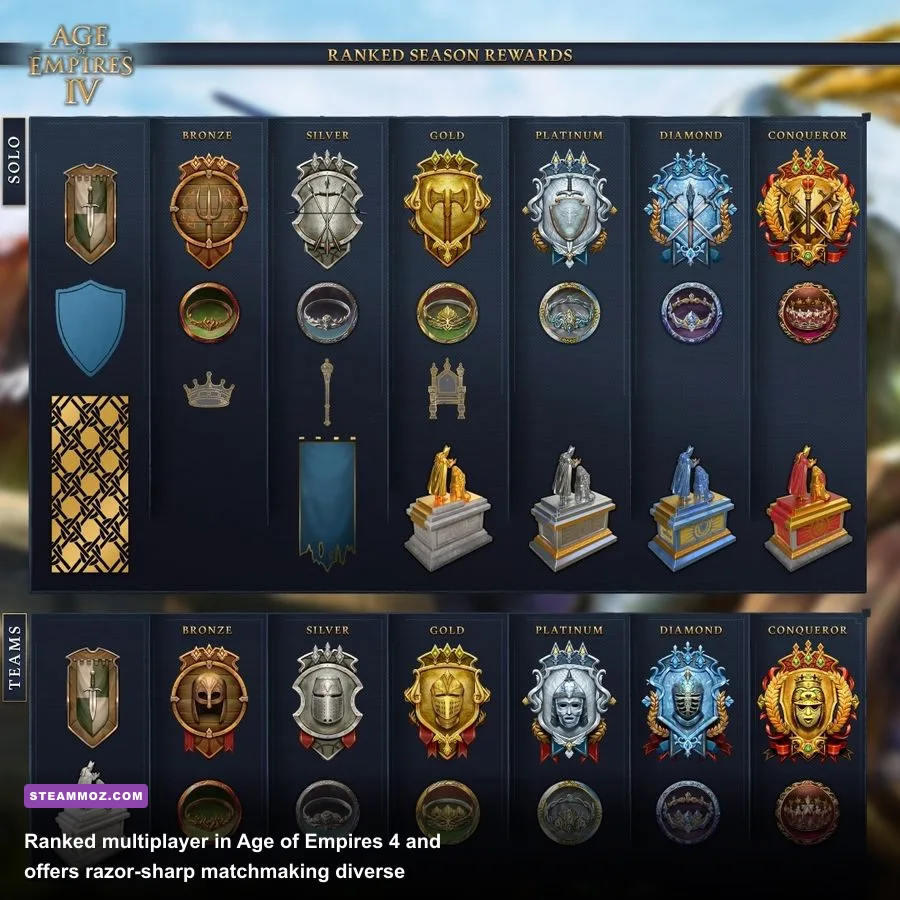
Competitive multiplayer is the true engine keeping the game vibrant. Ranked 1v1 and team ladders are bustling, queue times rarely exceed ninety seconds during peak hours across Europe and the Americas, and balance patches hit the live servers on a predictable seasonal cadence overseen by Relic Entertainment in tandem with competitive pro feedback via platforms like the AoE4 World community database.
The meta is no longer defined by single-strategy dominance. You cannot simply queue into a match, execute a rigid ten-minute build order, and expect to steamroll an opponent who understands tempo control. Fast-Castle timings, two-Town-Center economic booms, Feudal Age ram rushes, and hybrid naval control on contested rivers all have clear counters and distinct operational windows. Economy management requires continuous micro-decisions—a pacing dynamic familiar to fans of resource-heavy strategies, as explored in our guide to streamlined economy management and fast progression.
To show you where the competitive hierarchy currently settles across both standard map pools and ranked ladders, here is an exhaustive breakdown of the modern faction landscape:
| Civilization | Playstyle Archetype | Unique Economic Engine | Peak Power Window | Competitive Tier |
|---|---|---|---|---|
| Byzantines | Asymmetrical / Mercenary Flex | Aqueducts, Cisterns & Olive Oil gathering | Early Imperial (Age IV) | S-Tier |
| Ottomans | Passive Unit Generation / Timing | Military Schools & Vizier Points | Late Castle (Age III) | S-Tier |
| Rus | Map Control / Bounding Aggression | Bounty Hunting (Gold/Food) & Golden Gate | Feudal to Castle Transition | S-Tier |
| Japanese | Heavy Infantry / Aura Buffs | Daimyo Town Center upgrades & Bannermen | Early Castle (Age III) | A-Tier |
| English | Defensive Turtle into Deathball | Network of Citadels & Farm Enclosures | Feudal Rush or Late Imperial | A-Tier |
| Malians | Stealth & Passive Resource Bleed | Pit Mines, Cattle Ranches & Farimba | Castle Age Power Spike | A-Tier |
| Mongols | Nomadic / Map Harassment | Owoo Stone mining & Double Production | Feudal Age Outpost Pressure | B-Tier |
| Holy Roman Empire | Fast-Castle Religious Hoarder | Prelate Inspiration (40% Eco Boost) | Early Castle Relic Capture | B-Tier |
What makes this tiered balance healthy is that "B-Tier" civilizations are far from unplayable; they are simply more map-dependent or susceptible to specific aggressive timings. A Holy Roman Empire player who secures three relics in their Cathedral can still produce gold at an absurd pace of +240 gold per minute without allocating a single villager to mining veins, fueling endless waves of elite, heavy-hitting Landsknechte. Meanwhile, the Ottomans completely ignore early recruitment costs by churning out continuous waves of Janissaries, Sipahis, and Grand Bombards directly through their automated Military Schools.
Engine Performance, Optimization, and Visual Fidelity

When Age of Empires 4 dropped, its visuals sparked widespread debate. Some accused its visual style of leaning too far toward a clean, almost painterly aesthetic compared to the gritty, photorealistic mud and gore seen in Relic's own Company of Heroes series. However, that stylized clarity was a deliberate design choice that pays massive dividends in competitive play. When four hundred units collide under the shadow of a stone fortress, you can instantly distinguish a heavy spearman from a light man-at-arms, spot which siege units are packing up, and immediately recognize where a mangonel shot is about to land.
Under the hood, Relic’s Essence Engine 5.0 has undergone massive optimization sweeps. Memory leak bugs that previously caused framerate stuttering during prolonged team matches have been eradicated. Frame delivery remains exceptionally smooth even on modest hardware configurations. If you are fine-tuning an older rig or hunting down performance thresholds similar to analyzing hardware targets in our review of competitive system specs and engine latency, you will find AoE4 remarkably forgiving. Much like squeezing higher frame rates out of sprawling sandbox titles—as broken down in our deep dive on fine-tuning graphics settings for max FPS—dialing in the right settings can yield an incredible competitive boost.
To guarantee maximum visual clarity and rock-solid 144+ FPS performance during high-population skirmishes, apply the following engine profiles:
| Graphics Setting | Competitive Esports Preset | High-Fidelity Cinematic Preset | FPS Impact (%) | Strategic Recommendation |
|---|---|---|---|---|
| Image Quality | 100% Native Resolution | 100% Native / DSR 4K | High (15-20%) | Never drop below 100%; sub-sampling ruins unit silhouette outlines. |
| Geometry Detail | High | Maximum | Moderate (6-8%) | High preserves precise model borders and defensive wall snap markers. |
| Lighting Quality | Low | High | Moderate (8-10%) | Low strips dynamic shadowing distractions during chaotic team fights. |
| Shadow Quality | Low / Off | High | High (12-15%) | Shadows eat substantial GPU budget during 200/200 pop army clashes. |
| Physics Effects | Low | High | High (CPU Bound) | Keeps frame pacing rock solid when stone walls and keeps shatter. |
| Animation Quality | Medium | High | Low (3-5%) | Medium maintains fluid unit turn-rates without dropping draw calls. |
The sound design also deserves special recognition. The audio work in Age of Empires 4 is easily the best in the entire RTS genre. Each civilization's spoken language organically evolves across the Ages—an English villager in the Dark Age speaks authentic, guttural Old English, transitioning progressively into Middle English, and finally recognizable Early Modern English by the Imperial Age. Weapons echo dynamically based on camera altitude: zoom out to command the macro front, and you'll hear the distant, muffled thuds of trebuchets slamming stone; zoom in tight, and the deafening clatter of steel, charging horse hooves, and war horns rattles your headphones.
Single-Player Reality Check: Campaigns, Historical Flavor, and AI
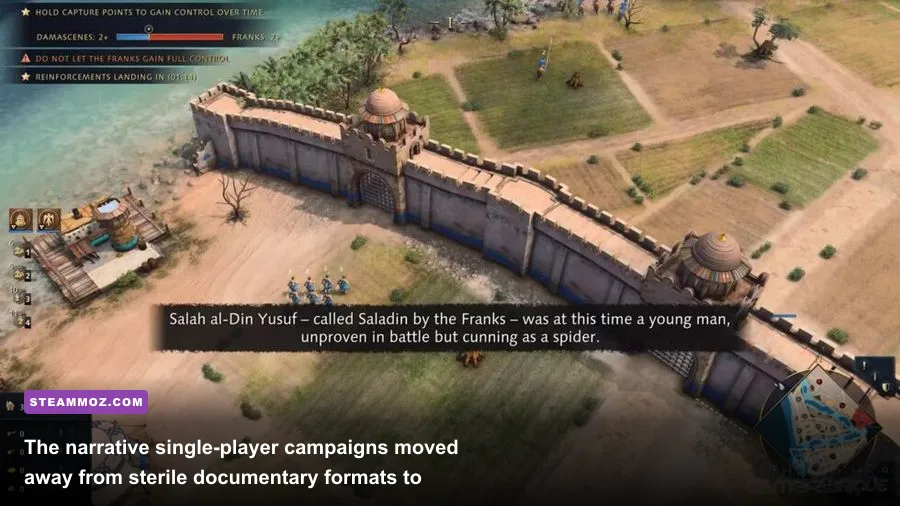
If you have zero interest in competitive multiplayer, is the single-player suite robust enough to justify buying the game? The answer depends on what you want from an RTS campaign. The launch campaigns—covering the Norman conquest, the Hundred Years War, the Mongol Empire, and the Rise of Moscow—take an unapologetically educational, documentary-style approach. You watch gorgeous 4K drone footage overlaying modern landscapes with golden, glowing historical armies before transitioning directly into the mission map.
For history buffs, this format is delightful. You learn how trebuchet counterweights were balanced using period-accurate physics or how crossbow bolts pierced chainmail. However, players seeking character-driven emotional stakes like the classic narratives of StarCraft, Warcraft III, or even Age of Empires II's localized hero campaigns (such as Joan of Arc or Barbarossa) found the launch presentation somewhat cold and detached.
World's Edge addressed this critique head-on with The Sultans Ascend campaign. Centered on the Muslim resistance during the European Crusades, this narrative shifts the focus toward recognizable historic figures like Saladin, Nur ad-Din, and Baybars. The missions ditch the repetitive "build base, build walls, withstand three waves" structure in favor of varied tactical objectives: running ambushes along desert supply lines, managing limited-force infiltrations, navigating naval raids across the Mediterranean, and defending holy cities against overwhelmingly superior Crusader siege engines. Grabbing the game solely for its modern single-player content makes picking up its comprehensive editions just as viable as evaluating other expanded game editions, as we observed in our evaluation of value-packed complete PC editions.
Furthermore, the skirmish AI has received substantial neural network training. Unlike older RTS games where the AI simply cheated by granting itself double resource income, the modern AoE4 skirmish bot scouts your early landmarks, detects whether you are stockpiling gold for a fast tech-up, and actively builds appropriate counter-units. If you attempt an early tower rush, the AI rapidly relocates its exposed villagers, pulls militia from nearby outposts, and rallies Horsemen to pick off your forward builders. It serves as a fantastic, stress-free training dojo before you test your skills in ranked matchmaking.
The Definitive Verdict: Who Should Play Age of Empires 4 Today?
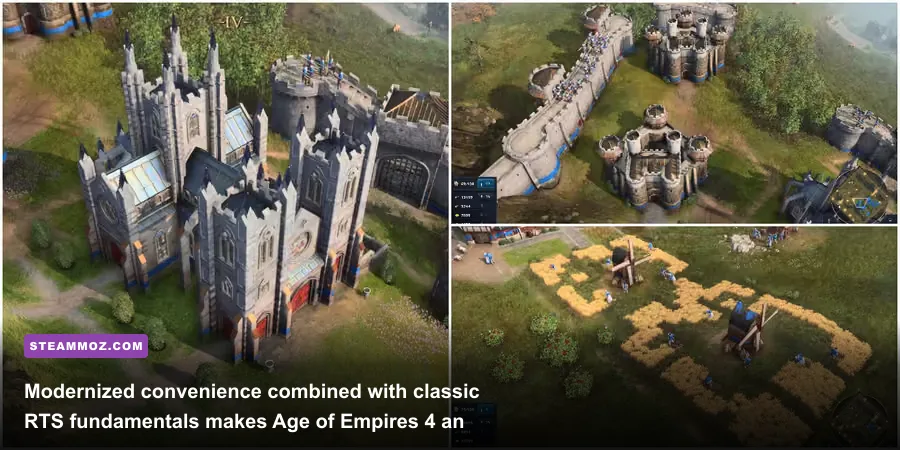
Age of Empires 4 has outlived the skepticism of its launch to secure its rightful place at the pinnacle of modern RTS gaming. It doesn't attempt to dethrone Age of Empires IV on Steam as a replacement for Age II, nor does it aim to convert StarCraft purists who crave pure twitch-reflex micro. Instead, it carved out its own distinct identity—an elegant, modern PC RTS that strips away legacy mechanical frustration without sacrificing deep tactical execution.
The quality-of-life improvements are staggering: villagers automatically construct the correct drop-off buildings if set to auto-gather, formations automatically match movement speeds so your slow spearmen aren't left behind by galloping cavalry, and siege engines no longer require infuriating geometric babysitting just to turn around in a narrow alleyway. The game respects your time by prioritizing strategic decisions—like scouting, resource allocation, landmark selection, and timing pushes—over punishing mechanical bloat.
If you were turned off years ago by sluggish pacing, uninspired launch civs, or game-breaking siege meta loops, it is time to reinstall. With deep faction mechanics, a flourishing competitive community, gorgeous visual optimization, and some of the best acoustic feedback in gaming history, Age of Empires 4 isn't just surviving—it has quietly claimed the RTS throne.